Introduction
Transactional Email APIs help businesses send automated, one-to-one emails triggered by user actions. These emails include password resets, OTPs, order confirmations, invoices, shipping updates, account alerts, product notifications, payment receipts, and security messages.
Unlike marketing emails, transactional emails are usually expected by the user and must arrive quickly. If a password reset email is delayed, the user may leave. If an invoice email fails, support tickets increase. If an OTP email lands in spam, login and signup flows break.
Transactional Email APIs matter because modern products depend on fast, reliable, secure, and trackable email communication. Developers need clean APIs, webhooks, logs, templates, bounce handling, and deliverability controls. Business teams need reporting, reliability, compliance confidence, and easy troubleshooting.
Common use cases include:
- Password reset and login verification emails
- Order confirmations and receipts
- SaaS onboarding emails
- Billing and invoice notifications
- Security alerts and account activity emails
- Product usage and system alert emails
Buyers should evaluate:
- API reliability
- Deliverability performance
- Template management
- Webhooks and event tracking
- Bounce and suppression handling
- Developer documentation
- Security controls
- Pricing flexibility
- Support quality
- Scalability for high-volume sending
Best for: SaaS companies, ecommerce platforms, fintech products, marketplaces, developer teams, product teams, and businesses that send automated customer emails at scale.
Not ideal for: teams that only send newsletters, small businesses sending manual emails, or companies that need full marketing automation instead of API-based transactional sending.
Key Trends in Transactional Email APIs
- API-first communication is growing, as SaaS products need email, SMS, push, and in-app messages working together.
- Deliverability is becoming a product reliability issue, not just a marketing concern.
- AI-assisted templates and content checks are helping teams reduce spam risk and improve clarity.
- Webhook-based event tracking is now expected, especially for product, support, and engineering teams.
- Security expectations are higher, including MFA, SSO, role-based access, audit logs, and domain authentication.
- DMARC, SPF, DKIM, and BIMI are becoming standard requirements for serious senders.
- Multi-region sending and uptime expectations are increasing, especially for global SaaS and ecommerce brands.
- Developer experience is a major buying factor, including SDKs, clear logs, test modes, and fast debugging.
- Suppression management is more important, helping teams avoid repeated sends to invalid or risky addresses.
- Pricing is becoming usage-based, with teams comparing cost per email, dedicated IP pricing, and support tiers.
How We Selected These Tools
- Selected widely recognized transactional email API providers.
- Balanced developer-first platforms, enterprise-grade providers, and SMB-friendly tools.
- Prioritized API reliability, documentation, webhooks, and deliverability features.
- Considered support for authentication, bounce handling, templates, and event tracking.
- Included tools used across SaaS, ecommerce, fintech, and product-led businesses.
- Compared integration options with applications, CRMs, backend systems, and analytics tools.
- Avoided tools that are only basic newsletter platforms.
- Focused on practical buyer fit across startups, SMBs, mid-market, and enterprise teams.
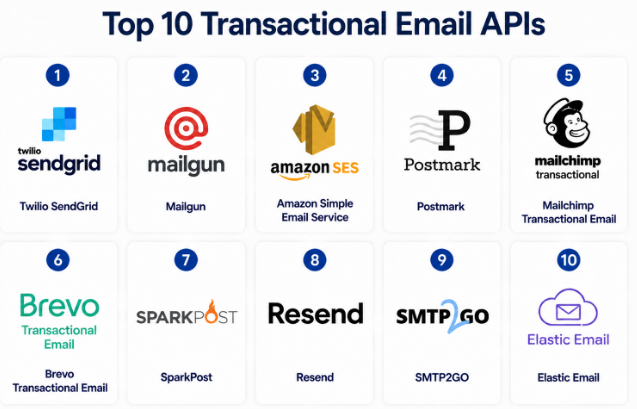
Top 10 Transactional Email APIs
#1 — Twilio SendGrid
Short description :
Twilio SendGrid is one of the most widely used transactional email API platforms for developers and businesses. It supports sending emails through API and SMTP, making it useful for SaaS products, ecommerce stores, marketplaces, and enterprise applications. Teams use it for password resets, receipts, alerts, onboarding messages, and high-volume system emails. It also includes deliverability tools, analytics, templates, and suppression management. SendGrid is a strong choice for teams that need scale and a mature ecosystem.
Key Features
- Email API and SMTP relay
- Dynamic templates
- Webhooks and event tracking
- Bounce and suppression management
- Dedicated IP options
- Deliverability analytics
- Scalable sending infrastructure
Pros
- Strong API ecosystem for developers.
- Scales well for high-volume transactional emails.
- Good fit for startups, SMBs, and enterprises.
Cons
- Advanced deliverability may need expert setup.
- Pricing can increase with volume and premium features.
- Interface may feel complex for beginners.
Platforms / Deployment
Web / API / Cloud
Security & Compliance
MFA and account security features are available. SSO and advanced controls may vary by plan. Public compliance details: Not publicly stated.
Integrations & Ecosystem
Twilio SendGrid works well with backend applications, SaaS products, ecommerce systems, and analytics workflows.
- REST APIs
- SMTP relay
- Webhooks
- CRM workflows
- Ecommerce platforms
- Application backends
Support & Community
Documentation is strong and developer-focused. Support depends on plan level. Community adoption is high because SendGrid is widely used in software and ecommerce environments.
#2 — Mailgun
Short description :
Mailgun is a developer-first transactional email API platform designed for application email sending. It is popular among SaaS companies, product teams, and engineering teams that need reliable email infrastructure. Mailgun supports APIs, SMTP, webhooks, validation, analytics, and deliverability tools. It is useful for sending account emails, billing notifications, onboarding messages, and system alerts. The platform is especially suitable for teams that want technical control and flexible integration options.
Key Features
- Email API and SMTP support
- Email validation options
- Webhook-based event tracking
- Routing and parsing features
- Deliverability monitoring
- Suppression and bounce handling
- Logs and analytics
Pros
- Strong developer experience.
- Good for SaaS and application-based email.
- Flexible API and webhook workflows.
Cons
- Non-technical users may need developer help.
- Some advanced features may require higher plans.
- Deliverability setup still needs careful configuration.
Platforms / Deployment
Web / API / Cloud
Security & Compliance
Security features vary by plan. Public compliance details: Not publicly stated.
Integrations & Ecosystem
Mailgun fits into developer and product workflows where email is part of the application stack.
- REST APIs
- SMTP
- Webhooks
- Email validation workflows
- Backend applications
- Monitoring tools
Support & Community
Mailgun has strong technical documentation. Support quality depends on plan. Community presence is strong among developers and SaaS builders.
#3 — Amazon Simple Email Service
Short description :
Amazon Simple Email Service is a cloud-based email sending service used by developers and businesses running applications on cloud infrastructure. It supports transactional and bulk email sending through API and SMTP. It is often selected by teams that need scalable, low-cost email infrastructure and are comfortable with technical setup. Amazon Simple Email Service is especially useful for engineering teams already using cloud services. It provides flexibility but usually requires more configuration than beginner-friendly tools.
Key Features
- API and SMTP email sending
- High-volume sending support
- Domain authentication
- Bounce and complaint handling
- Event publishing options
- Dedicated IP options
- Cloud-native scalability
Pros
- Strong scalability for technical teams.
- Cost-effective for high-volume sending.
- Good fit for cloud-based applications.
Cons
- Requires more technical setup.
- Less beginner-friendly than some alternatives.
- Deliverability management may require extra effort.
Platforms / Deployment
Web / API / Cloud
Security & Compliance
Security controls depend on cloud account configuration. Compliance details vary by service, region, and account setup.
Integrations & Ecosystem
Amazon Simple Email Service works best inside cloud-native architecture and developer workflows.
- Cloud applications
- APIs
- SMTP
- Event pipelines
- Monitoring services
- Serverless applications
Support & Community
Documentation is extensive but technical. Support depends on cloud support plan. Community knowledge is strong among cloud engineers and developers.
#4 — Postmark
Short description :
Postmark is a transactional email API platform focused on fast and reliable application emails. It is commonly used by SaaS companies, software products, and businesses where customer-facing emails must arrive quickly. Postmark is known for clean APIs, clear message streams, good logs, and simple troubleshooting. It is not designed as a full marketing automation tool. Instead, it focuses strongly on product and transactional email reliability.
Key Features
- Transactional email API
- SMTP sending
- Message streams
- Templates
- Delivery logs
- Bounce and spam complaint handling
- Webhooks and tracking
Pros
- Strong focus on transactional email.
- Simple and clean developer experience.
- Good visibility into message activity.
Cons
- Not ideal for full marketing automation.
- Advanced marketing campaign tools are limited.
- May need another tool for newsletters.
Platforms / Deployment
Web / API / Cloud
Security & Compliance
Security and compliance details vary by plan. Public certification details: Not publicly stated.
Integrations & Ecosystem
Postmark fits well into SaaS products, application backends, and product notification workflows.
- REST API
- SMTP
- Webhooks
- Application frameworks
- Product notification systems
- Template workflows
Support & Community
Documentation is clear and practical. Support is generally product-focused. Community strength is good among developers and SaaS founders.
#5 — Mailchimp Transactional Email
Short description :
Mailchimp Transactional Email, formerly known as Mandrill, is designed for businesses that need API-based transactional sending. It is often used by teams already connected to the Mailchimp ecosystem. The platform supports automated one-to-one emails such as receipts, password resets, and account notifications. It is useful for businesses that want transactional email features connected with broader customer communication workflows. It is best suited for teams that already understand Mailchimp’s environment.
Key Features
- Transactional email API
- SMTP sending
- Templates
- Delivery tracking
- Webhooks
- Tagging and reporting
- Bounce and rejection handling
Pros
- Useful for Mailchimp ecosystem users.
- Good for transactional customer messages.
- Supports API and SMTP workflows.
Cons
- Best fit often depends on Mailchimp usage.
- May not be the simplest option for non-Mailchimp users.
- Advanced developer flexibility may vary.
Platforms / Deployment
Web / API / Cloud
Security & Compliance
Security features vary by account and plan. Public compliance details for transactional features: Not publicly stated.
Integrations & Ecosystem
Mailchimp Transactional Email works best when transactional messages are part of broader customer communication workflows.
- Mailchimp ecosystem
- APIs
- SMTP
- Webhooks
- Ecommerce workflows
- Customer communication systems
Support & Community
Documentation is available for API and SMTP use. Support varies by account type and plan. Community awareness is strong due to Mailchimp’s broader market presence.
#6 — Brevo Transactional Email
Short description :
Brevo Transactional Email supports API and SMTP-based sending for automated business messages. It is useful for ecommerce stores, SaaS companies, and small to mid-sized businesses that want transactional email along with broader marketing and CRM features. Teams can use it for order confirmations, account emails, receipts, and product notifications. Brevo is especially useful for companies that want multiple communication tools under one platform. It can be a practical choice for teams looking for value and simplicity.
Key Features
- Transactional email API
- SMTP relay
- Email templates
- Delivery reporting
- Webhooks
- Contact and campaign ecosystem
- Automation support
Pros
- Good fit for SMBs and ecommerce teams.
- Combines transactional and marketing workflows.
- Easier for business users than many developer-only tools.
Cons
- Developer depth may be lower than API-first platforms.
- Advanced enterprise controls may vary.
- Some teams may outgrow simpler workflows.
Platforms / Deployment
Web / API / Cloud
Security & Compliance
Security features vary by plan. Public compliance details: Not publicly stated.
Integrations & Ecosystem
Brevo works well for businesses that need transactional email, marketing campaigns, CRM-style workflows, and automation in one environment.
- API
- SMTP
- Ecommerce platforms
- CRM workflows
- Marketing automation
- Webhooks
Support & Community
Documentation is accessible for both technical and business users. Support depends on plan. Community strength is moderate to strong among SMB users.
#7 — SparkPost
Short description :
SparkPost is a transactional and commercial email delivery platform used by businesses that need strong deliverability, analytics, and scalable sending. It is suitable for SaaS, media, ecommerce, and enterprise teams with serious email requirements. SparkPost provides API-based sending, performance insights, and deliverability-focused features. It is often considered by teams that need more control and deeper email intelligence. The platform is best for organizations with mature email operations.
Key Features
- Email API
- SMTP sending
- Deliverability analytics
- Event webhooks
- Templates
- Bounce and complaint management
- High-volume sending support
Pros
- Strong fit for high-volume senders.
- Good analytics and deliverability visibility.
- Suitable for mature email programs.
Cons
- May be more than small teams need.
- Setup can require technical knowledge.
- Pricing and support may vary by plan.
Platforms / Deployment
Web / API / Cloud
Security & Compliance
Security and compliance details vary by plan. Public certification details: Not publicly stated.
Integrations & Ecosystem
SparkPost integrates with applications, data systems, and email operations workflows.
- APIs
- SMTP
- Webhooks
- Data pipelines
- Analytics workflows
- Backend applications
Support & Community
Documentation is useful for technical teams. Support options vary. Community recognition is stronger among email professionals and high-volume senders.
#8 — Resend
Short description :
Resend is a modern transactional email API built with developer experience in mind. It is popular with startups, modern web applications, and product teams that want simple email sending with clean APIs. Resend focuses on making email integration easier for developers using modern frameworks. It is especially useful for teams that value speed of setup, clean documentation, and simple workflows. It is a good fit for early-stage SaaS products and modern application teams.
Key Features
- Developer-friendly email API
- SMTP support
- React email support
- Domain authentication
- Logs and delivery visibility
- Webhooks
- Modern documentation
Pros
- Very developer-friendly.
- Simple setup for modern applications.
- Good fit for startups and product teams.
Cons
- May have fewer enterprise features than older platforms.
- Advanced deliverability tooling may be limited.
- Not ideal for complex legacy environments.
Platforms / Deployment
Web / API / Cloud
Security & Compliance
Security and compliance details: Not publicly stated.
Integrations & Ecosystem
Resend fits well with modern web development stacks and frontend/backend frameworks.
- APIs
- SMTP
- React email workflows
- Modern web frameworks
- Serverless applications
- Product notification systems
Support & Community
Documentation is clean and developer-focused. Community interest is growing among modern SaaS builders and developers. Support depth may vary by plan.
#9 — SMTP2GO
Short description :
SMTP2GO is an email delivery service focused on SMTP and API-based sending. It is useful for businesses that need reliable transactional email without heavy complexity. Teams use it for application emails, system alerts, invoices, notifications, and business email delivery. SMTP2GO is practical for SMBs, IT teams, and organizations that want simple setup with clear reporting. It is also useful when teams need an SMTP relay that works across many systems.
Key Features
- SMTP relay
- Email API
- Delivery tracking
- Bounce management
- Reporting dashboards
- Domain authentication
- Email testing tools
Pros
- Easy to set up for SMTP use cases.
- Good for SMB and IT teams.
- Practical reporting and troubleshooting.
Cons
- May not offer the deepest enterprise analytics.
- Developer ecosystem may be smaller than larger API providers.
- Advanced automation may require other tools.
Platforms / Deployment
Web / API / Cloud
Security & Compliance
Security controls vary by plan. Public compliance certifications: Not publicly stated.
Integrations & Ecosystem
SMTP2GO works well with applications, servers, websites, devices, and business systems that need reliable SMTP or API email delivery.
- SMTP
- API
- WordPress workflows
- Business applications
- Server alerts
- Reporting dashboards
Support & Community
Support is generally practical and business-focused. Documentation is easy to follow. Community size is moderate, but usability is strong for SMBs.
#10 — Elastic Email
Short description :
Elastic Email provides email API, SMTP relay, and campaign-related email capabilities. It is used by startups, SMBs, developers, and businesses that need affordable email sending. The platform supports transactional emails, marketing emails, templates, analytics, and contact management features. It is useful for teams looking for a budget-friendly option with both API and campaign functions. It may be a good choice when cost and flexibility are important.
Key Features
- Email API
- SMTP relay
- Templates
- Campaign tools
- Analytics and reporting
- Contact management
- Bounce handling
Pros
- Budget-friendly for many teams.
- Supports both transactional and campaign use cases.
- Flexible for small and growing businesses.
Cons
- Enterprise depth may be limited.
- Advanced deliverability consulting may vary.
- Interface and workflows may not suit every technical team.
Platforms / Deployment
Web / API / Cloud
Security & Compliance
Security and compliance details vary. Public certification details: Not publicly stated.
Integrations & Ecosystem
Elastic Email supports common sending and marketing workflows for small and growing businesses.
- API
- SMTP
- Marketing workflows
- Contact systems
- Webhooks
- Reporting dashboards
Support & Community
Documentation is available for API and SMTP use. Support options vary by plan. Community presence is moderate among budget-conscious users and SMBs.
Comparison Table
| Tool Name | Best For | Platform(s) Supported | Deployment | Standout Feature | Public Rating |
|---|---|---|---|---|---|
| Twilio SendGrid | Scalable transactional and marketing email | Web / API | Cloud | Mature email API ecosystem | N/A |
| Mailgun | Developer-first SaaS email workflows | Web / API | Cloud | Flexible API and webhook controls | N/A |
| Amazon Simple Email Service | Cloud-native high-volume senders | Web / API | Cloud | Scalable and cost-efficient infrastructure | N/A |
| Postmark | SaaS transactional email reliability | Web / API | Cloud | Fast and focused transactional delivery | N/A |
| Mailchimp Transactional Email | Mailchimp ecosystem users | Web / API | Cloud | Transactional email inside Mailchimp workflows | N/A |
| Brevo Transactional Email | SMB and ecommerce teams | Web / API | Cloud | Transactional plus marketing ecosystem | N/A |
| SparkPost | High-volume email operations | Web / API | Cloud | Deliverability analytics and scale | N/A |
| Resend | Modern developers and startups | Web / API | Cloud | Clean developer experience | N/A |
| SMTP2GO | SMBs and SMTP relay use cases | Web / API | Cloud | Simple SMTP and API delivery | N/A |
| Elastic Email | Budget-conscious growing teams | Web / API | Cloud | Affordable API and campaign flexibility | N/A |
Evaluation & Transactional Email APIs
| Tool Name | Core (25%) | Ease (15%) | Integrations (15%) | Security (10%) | Performance (10%) | Support (10%) | Value (15%) | Weighted Total (0–10) |
|---|---|---|---|---|---|---|---|---|
| Twilio SendGrid | 9 | 7 | 9 | 7 | 9 | 7 | 8 | 8.25 |
| Mailgun | 9 | 7 | 9 | 7 | 8 | 7 | 8 | 8.10 |
| Amazon Simple Email Service | 8 | 6 | 9 | 8 | 9 | 7 | 9 | 8.10 |
| Postmark | 8 | 9 | 8 | 7 | 9 | 8 | 8 | 8.15 |
| Mailchimp Transactional Email | 7 | 7 | 7 | 7 | 8 | 7 | 7 | 7.15 |
| Brevo Transactional Email | 7 | 8 | 8 | 7 | 7 | 7 | 8 | 7.45 |
| SparkPost | 9 | 7 | 8 | 7 | 9 | 7 | 7 | 8.00 |
| Resend | 7 | 9 | 8 | 6 | 8 | 7 | 8 | 7.65 |
| SMTP2GO | 7 | 8 | 7 | 6 | 8 | 8 | 8 | 7.45 |
| Elastic Email | 7 | 7 | 7 | 6 | 7 | 7 | 8 | 7.00 |
These scores are comparative and should be used for shortlisting, not as final buying proof. A developer-first startup may prefer Resend or Postmark, while a large enterprise may prefer Twilio SendGrid, Mailgun, SparkPost, or Amazon Simple Email Service. The best choice depends on volume, technical skill, deliverability needs, compliance requirements, and budget.
Which Transactional Email APIs
Solo / Freelancer
Solo developers and freelancers should choose tools that are simple, affordable, and easy to test. Resend, Postmark, SMTP2GO, and Elastic Email are practical options. If the project is a modern web app, Resend is easy to start with. If reliability for user emails is the main need, Postmark is a strong choice.
SMB
SMBs usually need a balance of cost, ease, and support. Brevo Transactional Email, SMTP2GO, Elastic Email, Postmark, and SendGrid can work well. Ecommerce teams may prefer Brevo or SendGrid. Product teams may prefer Postmark or Mailgun. Teams with limited developer resources should avoid overly complex setups.
Mid-Market
Mid-market businesses should focus on scale, reporting, webhooks, suppression management, and deliverability support. Twilio SendGrid, Mailgun, Postmark, SparkPost, and Amazon Simple Email Service are strong options. The right choice depends on whether the business values simplicity, cost control, or advanced technical flexibility.
Enterprise
Enterprise teams should look closely at security, access controls, auditability, support, uptime expectations, dedicated IP options, and integration depth. Twilio SendGrid, Mailgun, SparkPost, and Amazon Simple Email Service are strong enterprise candidates. Enterprises should also validate SSO, RBAC, audit logs, compliance documents, and support SLAs before choosing.
Budget vs Premium
Budget-focused teams may prefer Amazon Simple Email Service, Elastic Email, SMTP2GO, or Resend. Premium buyers may prefer SendGrid, Mailgun, SparkPost, or Postmark because they provide stronger ecosystem depth, support options, or reliability focus. Cost should not be judged only by email volume; failed emails can create support costs and lost revenue.
Feature Depth vs Ease of Use
Amazon Simple Email Service and Mailgun offer strong flexibility, but they may require more technical setup. Postmark and Resend are easier for many developers. Brevo and SMTP2GO are easier for business-friendly workflows. Enterprise teams may prefer deeper platforms even if setup takes longer.
Integrations & Scalability-
For heavy API usage, SendGrid, Mailgun, Amazon Simple Email Service, Postmark, SparkPost, and Resend are strong choices. For SMTP relay and general business systems, SMTP2GO and Elastic Email are practical. For teams needing marketing plus transactional workflows, Brevo and Mailchimp Transactional Email may be better fits.
Security & Compliance Needs
Security-focused buyers should review authentication, MFA, SSO, RBAC, audit logs, encryption, data handling, and compliance documents. Do not assume every tool has the same controls. If the detail is not clearly confirmed, mark it as “Not publicly stated” during vendor evaluation and ask directly before purchase.
Frequently Asked Questions
1. What is a Transactional Email API?
A Transactional Email API lets applications send automated emails based on user actions. Examples include password resets, receipts, invoices, account alerts, OTPs, and product notifications.
2. How is transactional email different from marketing email?
Transactional email is triggered by a user action and usually contains important service information. Marketing email is promotional and usually sent to a list or segment for campaigns, newsletters, or offers.
3. Which Transactional Email API is best for startups?
Startups often prefer Resend, Postmark, Mailgun, or SendGrid because they are developer-friendly and scalable. The best choice depends on budget, framework, sending volume, and reporting needs.
4. What pricing model do these tools use?
Most providers use volume-based pricing, monthly plans, or pay-as-you-go pricing. Some features like dedicated IPs, advanced support, or validation may cost extra. Pricing should be verified directly before purchase.
5. How long does implementation usually take?
A basic setup can take a few hours for technical teams. A production-ready setup with SPF, DKIM, DMARC, templates, webhooks, suppression rules, and monitoring may take longer depending on complexity.
6. What are common mistakes when using Transactional Email APIs?
Common mistakes include skipping domain authentication, ignoring bounce handling, sending from poor-quality domains, not monitoring logs, and mixing marketing emails with critical transactional emails.
7. Do Transactional Email APIs improve deliverability automatically?
They provide infrastructure and tools, but deliverability also depends on domain setup, sender reputation, content quality, bounce rates, complaint rates, and recipient engagement.
8. Are Transactional Email APIs secure?
Most serious providers offer security controls, but features vary by plan. Buyers should check MFA, SSO, RBAC, audit logs, encryption, API key controls, and compliance documentation.
9. Can I switch from one Transactional Email API to another?
Yes, but switching should be planned carefully. Teams must migrate templates, API calls, DNS records, suppression lists, webhooks, logs, and monitoring workflows to avoid delivery failures.
10. What are alternatives to Transactional Email APIs?
Alternatives include SMTP servers, built-in email features in CRM platforms, marketing automation tools, or cloud email services. However, dedicated APIs are usually better for scalable product emails.
Conclusion
Transactional Email APIs are important for any business that depends on automated customer communication. The right platform helps users receive password resets, receipts, invoices, alerts, and product notifications quickly and reliably. However, the best tool depends on the team’s needs. Developers may prefer Mailgun, Postmark, Resend, or Amazon Simple Email Service. Larger teams may prefer Twilio SendGrid, SparkPost, or Mailgun for scale and ecosystem depth. SMBs may find Brevo, SMTP2GO, or Elastic Email more practical because they balance cost and usability.
