Introduction
Freelance management systems help companies manage external workers, freelancers, contractors, consultants, agencies, and flexible talent from one organized platform. These systems usually support freelancer onboarding, compliance checks, contracts, project assignments, time tracking, invoices, payments, approvals, reporting, and workforce visibility.
Freelance management matters because many businesses now use a blended workforce. A company may have full-time employees, part-time contractors, freelance designers, independent developers, consultants, writers, marketers, and project-based specialists working together. Without a proper system, teams may struggle with scattered contracts, unclear payment status, missed approvals, compliance risks, duplicate freelancer records, and poor visibility into external workforce cost.
Common use cases include:
- Managing freelancer onboarding and profiles
- Creating and tracking contracts
- Assigning freelance projects
- Approving timesheets and invoices
- Managing freelancer payments
- Tracking external workforce spend
- Handling compliance and worker classification
- Managing agencies and independent contractors
- Creating a private talent pool
- Reporting on freelance usage across teams
Buyers should evaluate:
- Freelancer onboarding workflow
- Contract and compliance management
- Time tracking and invoice approval
- Payment automation
- Talent pool management
- Project and assignment tracking
- Reporting and spend visibility
- Integrations with HR, finance, and procurement systems
- Security and access controls
- Global contractor support
Best for: HR teams, procurement teams, finance teams, legal teams, talent operations teams, agencies, enterprises, SMBs, staffing teams, and companies that work with freelancers or contractors regularly.
Not ideal for: Very small teams hiring one or two freelancers occasionally. In that case, a simple contract, project management tool, and accounting workflow may be enough.
Key Trends in Freelance Management Systems
- Blended workforce management: Companies want one system to manage employees, freelancers, contractors, agencies, and consultants more clearly.
- Compliance-first contractor hiring: Worker classification, tax forms, local labor rules, and contract controls are becoming more important.
- Private talent clouds: Companies are building approved pools of trusted freelancers instead of searching from scratch every time.
- Global contractor payments: Businesses need support for cross-border payments, currencies, local rules, and payment documentation.
- Procurement and HR alignment: Freelance management is no longer only a hiring issue. Procurement, finance, HR, and legal teams all need visibility.
- AI-assisted talent matching: Some systems are improving freelancer matching based on skills, availability, past work, cost, and project needs.
- Spend analytics: Companies want to understand freelance cost by department, project, manager, region, and vendor.
- Vendor and agency management: Freelance management systems increasingly support both independent workers and staffing suppliers.
- Security and access governance: External workers need limited access, proper permissions, and clean offboarding.
- Integrated approval workflows: Timesheets, invoices, contracts, and project approvals are becoming more automated and auditable.
How We Selected These Tools
The freelance management systems below were selected based on recognition, workforce management depth, contractor support, enterprise readiness, payment workflows, compliance features, and suitability for different business sizes.
The evaluation considered:
- Freelancer and contractor onboarding features
- Contract and compliance workflows
- Payment and invoice management
- Talent pool and assignment management
- Reporting and spend analytics
- Global workforce support
- Integrations with HR, finance, procurement, and project systems
- Ease of use for managers and freelancers
- Security, permissions, and governance
- Fit for SMBs, mid-market teams, enterprises, agencies, and talent operations teams
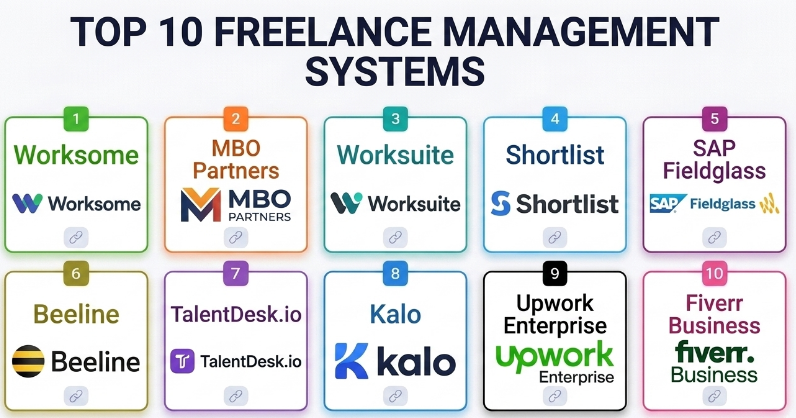
Top 10 Freelance Management Systems
#1 — Worksome
Short description :
Worksome is a freelance management system designed to help companies manage external workers, contractors, consultants, and freelance talent. It supports onboarding, compliance, contracts, payments, and workforce visibility. The platform is useful for businesses that want to reduce manual contractor administration and create a cleaner process for hiring and managing flexible talent. It is especially relevant for companies working with many independent professionals across teams or regions.
Key Features
- Contractor onboarding
- Compliance and worker classification workflows
- Contract management
- Freelancer payment support
- Talent pool management
- Reporting and workforce visibility
- Manager approval workflows
Pros
- Strong focus on freelance workforce operations
- Useful for compliance-heavy contractor management
- Good fit for companies managing many external workers
Cons
- May be more than very small teams need
- Implementation may require HR, legal, and finance alignment
- Global requirements should be validated by region
Platforms / Deployment
- Web
- Cloud
Security & Compliance
Security and compliance features depend on plan, region, configuration, and business requirements. Buyers should validate worker classification support, data privacy, access controls, and payment compliance before adoption.
Integrations & Ecosystem
Worksome fits contractor workforce operations and flexible talent workflows.
- HR systems
- Finance workflows
- Procurement processes
- Contractor onboarding
- Payment approvals
- Talent pool management
Support & Community
Worksome provides customer support and implementation resources. It is most relevant for companies treating freelance management as a structured business process.
#2 — MBO Partners
Short description :
MBO Partners is a contractor and independent workforce management platform focused on helping enterprises manage independent professionals, compliance, payments, engagement workflows, and talent communities. It is useful for companies that work with consultants, contractors, and freelance professionals at scale. MBO Partners is especially relevant for enterprises needing risk management, contractor engagement support, and independent talent program structure.
Key Features
- Independent contractor engagement management
- Compliance support
- Contractor payment workflows
- Talent community support
- Workforce program management
- Enterprise reporting
- Engagement documentation
Pros
- Strong enterprise contractor management focus
- Useful for independent talent programs
- Good compliance and workforce visibility orientation
Cons
- May be too enterprise-focused for small businesses
- Setup can require cross-functional planning
- Pricing and services should be reviewed carefully
Platforms / Deployment
- Web
- Cloud / Managed services depending on setup
Security & Compliance
Compliance support depends on engagement model, region, worker type, contract setup, and enterprise configuration. Buyers should validate legal, tax, data, and workforce classification requirements.
Integrations & Ecosystem
MBO Partners fits enterprise independent workforce programs.
- Contractor engagement
- Talent communities
- Payment workflows
- Compliance processes
- Enterprise workforce reporting
- Procurement and HR alignment
Support & Community
MBO Partners provides enterprise-focused support and workforce program guidance. It is suitable for companies building mature independent talent programs.
#3 — Worksuite
Short description :
Worksuite is a freelance management system designed for businesses managing freelancers, contractors, vendors, and external talent networks. It helps with onboarding, contracts, compliance, assignments, payments, and reporting. Worksuite is useful for media companies, creative teams, agencies, marketplaces, and businesses with recurring freelance talent needs. It is especially strong when companies want to build and manage a private network of approved freelancers.
Key Features
- Freelancer onboarding
- Talent database and private network management
- Contract and compliance workflows
- Assignment management
- Payment and invoice workflows
- Reporting dashboards
- Vendor and freelancer management
Pros
- Strong private talent pool management
- Useful for creative, media, and project-based teams
- Supports end-to-end freelance operations
Cons
- May require process setup before rollout
- Best value appears with recurring freelance usage
- Feature complexity may be high for very small teams
Platforms / Deployment
- Web
- Cloud
Security & Compliance
Compliance and security depend on configuration, worker regions, payment rules, access controls, and contract setup. Buyers should review privacy, permissions, and audit needs.
Integrations & Ecosystem
Worksuite supports flexible workforce and freelancer network workflows.
- Freelancer databases
- Contract workflows
- Payment approvals
- Project assignments
- Reporting
- Vendor management processes
Support & Community
Worksuite provides support and implementation resources. It is useful for organizations that manage a regular freelance workforce.
#4 — Shortlist
Short description :
Shortlist is a freelancer and vendor management platform that helps teams manage external talent, suppliers, onboarding, compliance, and payments. It is useful for organizations that work with freelancers, agencies, consultants, and service providers. Shortlist helps bring structure to external workforce records and engagement workflows. It is especially helpful when teams need visibility across many external contributors and vendors.
Key Features
- Freelancer and vendor database
- Onboarding workflows
- Compliance documentation
- Assignment tracking
- Payment and invoice workflows
- Vendor relationship management
- Reporting and visibility
Pros
- Good for managing freelancers and vendors together
- Useful for external workforce visibility
- Helps reduce scattered records and manual tracking
Cons
- May need customization for complex workflows
- Not always necessary for occasional freelancer hiring
- Integration needs should be reviewed before adoption
Platforms / Deployment
- Web
- Cloud
Security & Compliance
Not publicly stated for every compliance scenario. Buyers should review vendor data handling, contractor documents, permissions, payment workflows, and regional requirements.
Integrations & Ecosystem
Shortlist fits external talent and vendor management workflows.
- Freelancer onboarding
- Vendor records
- Payment approvals
- Compliance tracking
- Project assignments
- Reporting dashboards
Support & Community
Shortlist provides support resources for teams managing external workers and service providers. It is relevant for companies that need better vendor and freelancer oversight.
#5 — SAP Fieldglass
Short description :
SAP Fieldglass is a vendor management and external workforce management platform used by enterprises to manage contingent workers, services procurement, suppliers, and external labor programs. It is more enterprise-focused than simple freelance tools. SAP Fieldglass is useful for large organizations that need governance, compliance, supplier management, workforce visibility, and procurement control. It is especially relevant for companies with complex external workforce and vendor networks.
Key Features
- Contingent workforce management
- Vendor and supplier management
- Services procurement support
- Worker onboarding and offboarding
- Compliance and policy workflows
- Spend visibility
- Enterprise reporting and analytics
Pros
- Strong enterprise external workforce management
- Good for procurement-led programs
- Useful for large-scale supplier and contractor governance
Cons
- Too complex for small teams
- Implementation can be significant
- Best value appears in large enterprise environments
Platforms / Deployment
- Web
- Cloud
Security & Compliance
Enterprise security and compliance depend on configuration, access controls, procurement policies, worker data handling, regional requirements, and SAP environment setup.
Integrations & Ecosystem
SAP Fieldglass fits enterprise procurement and workforce ecosystems.
- SAP ecosystem
- Procurement workflows
- Supplier management
- External workforce programs
- Compliance reporting
- Enterprise analytics
Support & Community
SAP provides enterprise support, implementation partners, and documentation. SAP Fieldglass is suited for mature enterprise workforce programs.
#6 — Beeline
Short description :
Beeline is an extended workforce platform focused on managing contingent labor, services procurement, suppliers, contractors, and external workforce programs. It is designed for enterprise organizations that need strong visibility, governance, compliance, and reporting across non-employee labor. Beeline is useful for companies that manage staffing suppliers, contractors, consultants, and project-based external talent at scale.
Key Features
- Contingent workforce management
- Supplier and vendor management
- Services procurement
- Workforce analytics
- Compliance workflows
- Worker lifecycle management
- Enterprise program controls
Pros
- Strong for enterprise extended workforce management
- Good reporting and governance focus
- Useful for supplier-heavy environments
Cons
- Too advanced for small companies
- Requires structured implementation
- Best fit is enterprise workforce and procurement teams
Platforms / Deployment
- Web
- Cloud
Security & Compliance
Security and compliance depend on enterprise configuration, data governance, access controls, supplier rules, worker classification needs, and regional labor requirements.
Integrations & Ecosystem
Beeline supports enterprise external workforce programs.
- Vendor management
- Staffing supplier workflows
- Procurement systems
- Workforce analytics
- Compliance processes
- Contractor lifecycle management
Support & Community
Beeline provides enterprise-focused support and workforce program resources. It is most useful for large organizations managing extended workforce complexity.
#7 — TalentDesk.io
Short description :
TalentDesk.io is a freelance management platform built to help businesses manage onboarding, projects, payments, timesheets, invoices, and freelancer relationships. It is useful for companies that work with a distributed freelance workforce and need a simpler operational system than an enterprise vendor management platform. TalentDesk.io is especially relevant for agencies, content teams, professional services teams, and businesses that manage recurring freelance projects.
Key Features
- Freelancer onboarding
- Project and task assignment
- Time tracking
- Invoice management
- Payment workflows
- Freelancer database
- Reporting and approval workflows
Pros
- Practical for freelancer operations
- Useful for agencies and project-based teams
- Helps centralize timesheets, invoices, and payments
Cons
- May not provide deep enterprise procurement features
- Global compliance needs should be reviewed
- Best value appears with recurring freelancer usage
Platforms / Deployment
- Web
- Cloud
Security & Compliance
Not publicly stated for every compliance need. Buyers should review payment security, worker data handling, invoice records, access permissions, and regional requirements.
Integrations & Ecosystem
TalentDesk.io fits freelance project and payment workflows.
- Freelancer profiles
- Timesheets
- Project assignments
- Invoice approvals
- Payment workflows
- Reporting
Support & Community
TalentDesk.io provides support resources for teams managing freelancers and external contributors. It is especially useful for operational freelance management.
#8 — Kalo
Short description :
Kalo is a freelance management platform historically known for helping companies manage freelancer onboarding, assignments, payments, and external talent networks. It is useful as a reference point for businesses looking at freelancer management workflows, especially for creative and project-based teams. Buyers should verify current product availability, ownership, and service model before making a decision. The platform concept remains relevant for managing freelance contributors more systematically.
Key Features
- Freelancer onboarding
- Assignment management
- Freelancer database
- Payment workflows
- Compliance documentation
- Project tracking
- External talent visibility
Pros
- Strong freelance operations concept
- Useful for creative and content workflows
- Helps centralize freelancer records and assignments
Cons
- Current availability and product status should be verified
- May not fit new buyers without updated confirmation
- Enterprise needs may require alternative platforms
Platforms / Deployment
- Web
- Cloud / Availability may vary
Security & Compliance
Not publicly stated. Buyers should verify current security, compliance, data handling, and support status before considering adoption.
Integrations & Ecosystem
Kalo-style workflows fit freelancer operations.
- Freelancer management
- Assignment workflows
- Payment processing
- Contractor records
- Creative talent networks
- Project-based work management
Support & Community
Support availability should be verified based on current product status. Buyers should confirm whether the platform is actively supported before evaluation.
#9 — Upwork Enterprise
Short description :
Upwork Enterprise is designed for companies that want to access freelance talent while adding more structure around compliance, talent sourcing, reporting, and program management. It expands beyond the regular marketplace experience by supporting larger organizations with managed workflows, talent pools, and workforce controls. It is useful for enterprises that want freelance hiring access with more governance than individual marketplace usage.
Key Features
- Enterprise freelance hiring workflows
- Access to broad freelancer marketplace
- Talent pool support
- Compliance-oriented processes depending on setup
- Reporting and workforce visibility
- Program management support
- Payment and contract workflows
Pros
- Combines marketplace reach with enterprise controls
- Useful for scaling freelance hiring
- Good for broad skill categories
Cons
- More expensive and structured than regular marketplace use
- May not replace full vendor management systems
- Requires internal process alignment
Platforms / Deployment
- Web / iOS / Android access features may vary
- Cloud
Security & Compliance
Enterprise compliance depends on contract setup, worker classification support, access controls, data handling, payment terms, and internal governance processes.
Integrations & Ecosystem
Upwork Enterprise fits enterprise freelance hiring workflows.
- Freelancer marketplace access
- Talent pools
- Enterprise reporting
- Contract management
- Payment workflows
- Managed program support
Support & Community
Upwork Enterprise provides enterprise customer support and program resources. It is relevant for organizations scaling freelance hiring through a large marketplace.
#10 — Fiverr Business
Short description :
Fiverr Business is a team-oriented version of Fiverr’s freelance marketplace experience, designed to help businesses manage freelance service buying with more collaboration and account control. It is useful for teams that regularly purchase packaged freelance services such as design, writing, video, marketing, and digital tasks. Fiverr Business is not a full enterprise vendor management system, but it can help small and growing teams manage freelance service buying more cleanly.
Key Features
- Team-based freelance buying
- Packaged service marketplace access
- Freelancer discovery
- Project collaboration
- Business account management
- Payment workflows
- Service package comparison
Pros
- Easy for teams buying defined services
- Strong for creative and digital tasks
- Simpler than enterprise workforce systems
Cons
- Not ideal for complex contractor compliance
- Less suitable for deep workforce governance
- Best for packaged services rather than long-term workforce management
Platforms / Deployment
- Web / iOS / Android
- Cloud
Security & Compliance
Security depends on business account setup, payment controls, file sharing, freelancer access, and internal approval rules. Compliance support should be reviewed for sensitive or regulated work.
Integrations & Ecosystem
Fiverr Business fits team-based freelance service buying.
- Service marketplace
- Team collaboration
- Packaged freelance tasks
- Creative services
- Digital marketing support
- Payment workflows
Support & Community
Fiverr provides business and marketplace support resources. It is suitable for teams that need frequent small or clearly scoped freelance services.
Comparison Table
| Tool Name | Best For | Platform(s) Supported | Deployment | Standout Feature | Public Rating |
|---|---|---|---|---|---|
| Worksome | Contractor compliance and freelance workforce management | Web | Cloud | Freelancer onboarding, compliance, and payments | N/A |
| MBO Partners | Enterprise independent workforce programs | Web | Cloud / Managed services | Independent contractor engagement management | N/A |
| Worksuite | Private freelancer networks | Web | Cloud | End-to-end freelancer operations | N/A |
| Shortlist | Freelancer and vendor management | Web | Cloud | External talent and vendor database | N/A |
| SAP Fieldglass | Enterprise external workforce management | Web | Cloud | Contingent workforce and services procurement | N/A |
| Beeline | Enterprise extended workforce programs | Web | Cloud | Supplier and contingent workforce governance | N/A |
| TalentDesk.io | Freelance projects, invoices, and payments | Web | Cloud | Timesheets, invoices, and freelancer operations | N/A |
| Kalo | Freelance assignment workflows | Web | Cloud / Availability may vary | Freelancer records and assignment management | N/A |
| Upwork Enterprise | Enterprise freelance marketplace access | Web, mobile access varies | Cloud | Marketplace reach with enterprise controls | N/A |
| Fiverr Business | Team-based freelance service buying | Web, iOS, Android | Cloud | Packaged freelance services for teams | N/A |
Evaluation & Freelance Management Systems
| Tool Name | Core (25%) | Ease (15%) | Integrations (15%) | Security (10%) | Performance (10%) | Support (10%) | Value (15%) | Weighted Total (0–10) |
|---|---|---|---|---|---|---|---|---|
| Worksome | 9 | 8 | 8 | 8 | 8 | 8 | 8 | 8.25 |
| MBO Partners | 9 | 7 | 8 | 9 | 8 | 9 | 7 | 8.20 |
| Worksuite | 9 | 8 | 8 | 8 | 8 | 8 | 8 | 8.25 |
| Shortlist | 8 | 8 | 7 | 8 | 8 | 7 | 8 | 7.80 |
| SAP Fieldglass | 10 | 6 | 10 | 9 | 9 | 9 | 7 | 8.65 |
| Beeline | 10 | 6 | 9 | 9 | 9 | 9 | 7 | 8.50 |
| TalentDesk.io | 8 | 8 | 7 | 8 | 8 | 8 | 8 | 7.95 |
| Kalo | 7 | 7 | 6 | 6 | 7 | 6 | 6 | 6.50 |
| Upwork Enterprise | 8 | 8 | 8 | 8 | 8 | 8 | 8 | 8.00 |
| Fiverr Business | 7 | 9 | 7 | 8 | 8 | 8 | 8 | 7.75 |
The scoring is comparative and should be used as a shortlist guide, not as a universal ranking. SAP Fieldglass and Beeline are stronger for enterprise contingent workforce programs. Worksome and Worksuite are strong for freelance workforce management. TalentDesk.io is practical for project, invoice, and payment workflows. Upwork Enterprise and Fiverr Business are useful when teams want marketplace access with more business controls.
Which Freelance Management System Is Right for You?
Solo / Freelancer
Solo operators usually do not need a full freelance management system unless they manage many subcontractors. A freelancer who hires other freelancers occasionally can start with a project management tool, simple contracts, invoice software, and clear payment records.
If a solo consultant runs a small agency with recurring subcontractors, TalentDesk.io, Worksuite, or a lightweight external workforce system may help centralize onboarding, assignments, and payments.
SMB
Small businesses should first decide whether they need a freelancer marketplace or a freelancer management system. If the goal is to find talent, Upwork or Fiverr-style platforms may help. If the goal is to manage existing freelancers, Worksome, Worksuite, TalentDesk.io, or Shortlist may be more useful.
SMBs should prioritize simple onboarding, contracts, invoice approvals, payment tracking, and freelancer records. Too much enterprise complexity can slow down small teams.
Mid-Market
Mid-market companies often need better control over freelancer spend, compliance, contracts, project assignments, and approvals. Worksome, Worksuite, TalentDesk.io, Shortlist, and Upwork Enterprise can be relevant depending on the freelance model.
If the company works with both freelancers and agencies, vendor management features become more important. If the company hires independent contractors globally, compliance and payment workflows become critical.
Enterprise
Enterprises should evaluate freelance management as part of broader external workforce governance. SAP Fieldglass, Beeline, MBO Partners, Worksome, Worksuite, and Upwork Enterprise can be relevant depending on the program structure.
Enterprise buyers should involve HR, procurement, finance, legal, IT, and security teams. Contractor management affects classification risk, payments, access control, intellectual property, confidentiality, and workforce reporting.
Budget vs Premium
Budget-focused teams should start with basic freelancer records, standard contracts, invoice approval workflows, and a small set of approved freelancers before buying complex software.
Premium systems are worth considering when freelance usage becomes frequent, global, expensive, compliance-heavy, or difficult to track manually.
Feature Depth vs Ease of Use
For ease of use, TalentDesk.io, Fiverr Business, Upwork Enterprise, Worksome, and Worksuite can be approachable depending on workflow needs.
For feature depth, SAP Fieldglass, Beeline, and MBO Partners are stronger for enterprise workforce governance, supplier management, and compliance-heavy programs.
Integrations & Scalability
Freelance management systems often need to connect with HR systems, finance tools, procurement platforms, identity systems, accounting software, payment systems, and project management tools.
Scalability depends on freelancer volume, contract types, global payment needs, department usage, approval layers, reporting needs, and compliance requirements.
Security & Compliance Needs
Freelancers often need access to company systems, files, tools, customer data, or confidential projects. This creates security and legal risk if onboarding and offboarding are weak.
Companies should manage NDAs, contracts, identity verification, access permissions, payment records, worker classification, tax documentation, and project ownership clearly.
Frequently Asked Questions
1. What is a freelance management system?
A freelance management system is software that helps companies manage freelancers, contractors, consultants, and external workers. It usually supports onboarding, contracts, compliance, assignments, timesheets, invoices, payments, and reporting.
2. How is freelance management software different from a freelance marketplace?
A freelance marketplace helps you find freelancers. A freelance management system helps you manage freelancers after you already work with them. Some platforms offer both marketplace access and management features.
3. Which freelance management system is best for enterprises?
SAP Fieldglass, Beeline, MBO Partners, Worksome, and Worksuite are strong options for enterprise-style external workforce management. The best choice depends on procurement model, compliance needs, and workforce scale.
4. Which platform is best for small businesses?
Small businesses may prefer Worksome, Worksuite, TalentDesk.io, Shortlist, Upwork Enterprise, or Fiverr Business depending on whether they need management, marketplace access, or simple team-based freelance service buying.
5. Why do companies need freelance management systems?
Companies need freelance management systems to reduce manual work, improve compliance, track payments, manage contracts, centralize freelancer records, control access, and understand external workforce spend.
6. Can freelance management systems handle payments?
Yes. Many systems support invoice approval, payment workflows, freelancer payment tracking, and sometimes global payment support. Exact payment features vary by platform and region.
7. What is contractor compliance?
Contractor compliance means ensuring freelancers and contractors are engaged legally and correctly. This may include contracts, tax documentation, worker classification, payment records, data privacy, and local labor rules.
8. What is a private talent pool?
A private talent pool is a company’s approved network of freelancers and contractors. It helps teams rehire trusted talent faster instead of searching for new freelancers every time.
9. What is the biggest mistake companies make with freelancers?
The biggest mistake is hiring freelancers informally without proper contracts, scope, payment terms, access controls, and offboarding. This can create legal, security, and payment problems later.
10. Do freelance management systems replace project management tools?
No. Freelance management systems manage freelancer lifecycle, compliance, contracts, payments, and records. Project management tools manage tasks, timelines, files, and collaboration. Many companies use both.
11. Are freelance management systems useful for agencies?
Yes. Agencies that regularly work with freelance writers, designers, developers, editors, marketers, or consultants can use these systems to manage assignments, invoices, payments, and freelancer records.
12. How should I choose a freelance management system?
Start by identifying your main need. Choose enterprise platforms like SAP Fieldglass or Beeline for large contingent workforce programs, Worksome or Worksuite for freelance workforce management, TalentDesk.io for project and payment workflows, and Upwork Enterprise or Fiverr Business if marketplace access is also important.
Conclusion
Freelance management systems help companies bring structure, visibility, and control to external workforce operations. The best system depends on company size, freelancer volume, compliance needs, payment complexity, and whether the organization needs marketplace access or internal freelancer management. Worksome and Worksuite are strong for managing freelance workers and private talent pools, while MBO Partners supports enterprise independent workforce programs. SAP Fieldglass and Beeline are better for large contingent workforce and supplier management needs. TalentDesk.io is practical for agencies and project-based teams managing assignments, invoices, and payments. Upwork Enterprise and Fiverr Business are useful when companies want marketplace access with more business controls.
