Introduction
A fake review is feedback that does not honestly represent a real customer’s experience. These reviews do not come from someone who actually bought the product, visited the hotel, or used the service. Instead, they are created to mislead people who are trying to make a buying choice. It is important to remember that a suspicious sign does not always mean a review is fake. A reader should look for several warning signs before reaching a final conclusion. A review can be short, emotional, or poorly written and still describe a genuine customer experience.
Why Do People Create Fake Reviews?
People and businesses create fake reviews for various reasons related to marketing, reputation, and competition. Understanding these motivations helps buyers recognize why misleading feedback appears online.
To Increase Ratings
Businesses often want to maintain high average ratings to attract attention. Positive fake reviews can quickly lift a low rating or push a new product to the top of search results. When a score looks high, buyers feel more confident choosing that option over others.
To Improve Product Sales
Strong ratings directly influence buying decisions. Sellers know that higher visibility and glowing recommendations lead to more clicks and purchases. Some sellers use fake feedback to create an artificial sense of demand, making a new or unknown item look popular.
To Damage Competitors
Competition on the internet is fierce. Unethical individuals or businesses may use fake negative reviews against rivals. By flooding a competitor’s page with complaints, they hope to drive potential customers away and steer them toward their own business instead.
To Create a False Reputation
Building a solid reputation through genuine service takes time and effort. Some operators try to shortcut this process by purchasing bulk reviews. Repeated fake feedback can quickly build an inaccurate online image that hides poor service or inferior product quality.
To Manipulate Customer Trust
Volume and ratings heavily affect customer confidence. People naturally trust groups of positive opinions. When bad actors artificially inflate these numbers, they exploit natural human trust to secure sales or influence public opinion.
Why Fake Reviews Can Be A Problem
Fake reviews create serious challenges for everyday consumers and honest businesses alike. When feedback is misleading, it distorts reality and harms the integrity of online marketplaces.
The primary issues caused by fake feedback include:
- Wrong buying decisions: Buyers spend money on items that fail to meet their needs.
- Loss of money: Families and individuals waste hard-earned cash on poor products.
- Poor service choices: Travelers end up in uncomfortable hotels or diners with low standards.
- Reduced trust: People begin to doubt whether any online feedback is real.
- Unfair competition: Honest businesses lose customers to rivals who use deceptive marketing tactics.
- Damage to genuine businesses: Unfair negative reviews can ruin an honest company’s livelihood.
- Confusion for customers: Sifting through mixed and fabricated messages makes research stressful.
- Difficulty finding reliable information: True customer experiences get buried under artificial noise.
One suspicious review does not always change the full picture. Readers should look at the overall review pattern rather than panicking over a single unusual comment.
Common Signs of Fake Reviews
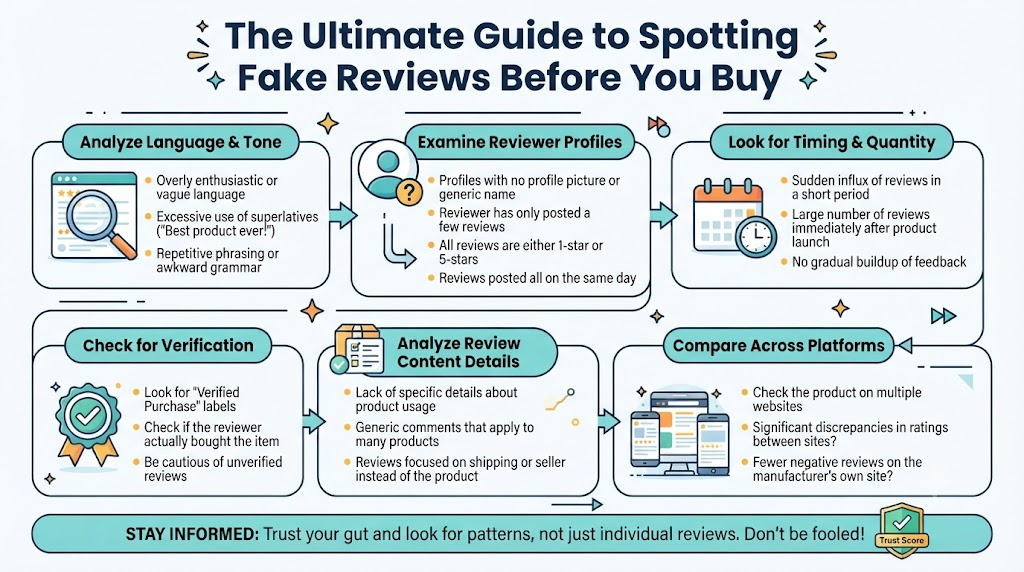
Learning to spot patterns is the best defense against misleading feedback. While no single clue proves a review is fake, seeing several warning signs together often indicates coordinated manipulation.
Too Many Reviews in a Short Time
A sudden burst of similar reviews is often worth checking. If a business has received two reviews a month for three years and suddenly gets fifty glowing reviews over a single weekend, something unusual may have happened. Real customer interest usually grows at a steady pace rather than appearing in sudden, massive waves.
Very Similar Wording
Repeated phrases can indicate copied or coordinated reviews. When multiple accounts use the exact same sentence structure, punctuation habits, or unique phrasing, the text may have been written by one person or generated automatically.
Generic Praise
Vague comments give little useful detail. Examples include:
- “Amazing product!”
- “Best service ever!”
- “Highly recommended!”
While a real customer might leave a short note, a page filled exclusively with generic praise lacks the substance of actual everyday use. Do not assume short reviews are always fake, but watch out when every positive post says the exact same thing without any context.
Extreme Language
Repeated dramatic praise or harsh criticism can be a warning sign. Fake positive reviews often use overly emotional words like “life-changing” or “absolute perfection” for ordinary household items. Similarly, fake negative reviews often use extreme language to attack a business’s character rather than describing a specific service failure.
No Specific Experience
Genuine reviews often include useful details about the product or service, such as how long shipping took, how a staff member helped solve a problem, or how a specific feature worked. If a review sounds like a commercial rather than a personal story, look closer.
Repeated Spelling or Writing Patterns
When many accounts share similar writing styles, grammar habits, or unique typos, they may belong to a paid review network. Real customer bases usually feature a wide variety of writing styles, education levels, and vocabulary choices.
Suspicious Reviewer Profiles
Checking who wrote the review can provide valuable context. Readers can look at available reviewer histories to see if an account posts frequently or appears suddenly out of nowhere.
Many Reviews Across Unrelated Products
An account that leaves glowing five-star reviews for industrial machinery, baby formula, luxury watches, and pet shampoo all on the same day is displaying unusual activity. Real consumers usually review items within their own lifestyle and shopping habits.
Reviews That Sound Like Advertising
Promotional wording is a common clue. If a review sounds like a radio commercial or uses corporate marketing slogans, it may have been written by someone trying to sell the item rather than use it.
Reviews That Contradict the Product or Service
Sometimes a review praises a feature the product does not even have, or complains about a service that the business does not offer. Comparing review claims with actual product descriptions helps reveal these mismatches.
How to Check a Reviewer Profile
Looking beyond a single comment helps readers understand the source of the feedback. Most major platforms allow users to click on a reviewer’s name to view past activity.
Factors to review include:
- Account age: Check how long the profile has existed where visible.
- Number of reviews: See if the account has left dozens of reviews or just one.
- Review history: Look at what else the person has reviewed in the past.
- Review frequency: Notice if all reviews were posted within a single hour or spread out over years.
- Similar wording: Check if the account uses phrasing found in other suspicious posts.
- Locations: Verify if the reviewer’s listed location makes sense for a local business.
- Helpful votes: See if other users found the account’s previous posts useful.
Platforms show different profile information, and features change over time. An old account is not always genuine, just as a new account is not always fake. Use these details as clues to guide your judgment, not as absolute proof.
Check the Review Timeline
Timing plays a major role in spotting coordinated review campaigns. Real customer feedback tends to flow naturally over weeks, months, and years.
Watch for timeline patterns such as:
- Dozens of reviews posted on the exact same calendar day.
- Several similar reviews appearing within a narrow time window.
- Sudden spikes in ratings right after a public controversy or bad news cycle.
- Repeated review activity clustered around specific promotional events.
Unusual timing alone does not prove fraud. A business might run a legitimate discount campaign that brings in a wave of new feedback. However, odd timeline spikes give readers a clear reason to investigate further.
Look for Specific Details
Real experiences usually include specific details about how a product or service performed in the real world. Genuine feedback often mentions concrete elements that prove the person interacted with the business.
Helpful details might include:
- Specific product quality or material observations.
- The exact delivery experience or shipping time.
- Staff interaction or customer support communication.
- Room condition, cleanliness, or noise levels at a hotel.
- Food quality, portion size, or menu details at a restaurant.
- Specific features used or technical problems faced.
- How the business handled a return or resolved an issue.
Useful details make reviews much more informative. At the same time, remember that genuine reviews can still be short. Not every real customer writes a detailed essay about their purchase.
Compare Positive and Negative Reviews
Relying solely on five-star ratings can lead to poor choices. A balanced view requires looking at the full spectrum of opinions.
Encourage yourself to compare:
- Glowing positive reviews that praise every single feature.
- Negative reviews that explain where things went wrong.
- Neutral three-star reviews, which often provide the most objective analysis.
- Recent feedback compared against older reviews from previous years.
Comparing different perspectives gives a complete picture of how a product performs over time. Do not assume negative reviews are always honest, as competitors can abuse them just as easily as sellers abuse positive ones.
Check Reviews on More Than One Platform
No single website holds every review on the internet. Cross-checking feedback across multiple sources helps verify whether a company’s reputation is consistent.
Readers can compare feedback from:
- Official business websites and online stores.
- Dedicated review platforms and consumer forums.
- Major e-commerce marketplaces.
- Travel and hospitality platforms.
- Social media pages and community groups.
Different platforms attract different types of users. Comparing across sources helps you see if complaints on one site appear elsewhere, or if glowing praise on a brand’s website matches independent customer experiences.
Check for Copied or Repeated Reviews
Lazy bad actors often copy and paste the same review across multiple products or competing listings. Spotting duplicated text is a quick way to catch fake content.
Key signs of copied feedback include:
- Identical sentences appearing on completely different items.
- Similar phrases used by unrelated accounts.
- Exact descriptions with the same spelling mistakes or unusual grammar.
If a review sounds unusually formal or strangely phrased, copy a sentence and search for it online. If the exact same text appears on twenty different store pages, the review is likely fraudulent.
Fake Positive Reviews vs Fake Negative Reviews
| Feature | Fake Positive Review | Fake Negative Review |
| Main purpose | To artificially boost sales, ratings, and visibility | To harm a competitor’s reputation and drive away buyers |
| Common language | Overly enthusiastic, exaggerated praise, marketing slogans | Harsh attacks, emotional anger, vague complaints about service |
| Typical target | New products, struggling businesses, or newly launched services | Market leaders, growing competitors, or local rivals |
| Possible warning signs | Generic wording, brand-new profiles, sudden posting spikes | Lack of order details, extreme hostility, absence of receipts |
| Reader response | Look for specific product details and reviewer history | Check if complaints match known product flaws or competitor wars |
Genuine Reviews vs Suspicious Reviews
| Review Feature | Often Seen in Genuine Reviews | May Be A Warning Sign |
| Specific experience | Mentions real usage, flaws, and specific features | Vague statements that apply to any product |
| Product details | Concrete examples of how the item performed | Generic praise like “best ever” or “amazing” |
| Writing style | Natural tone, varied vocabulary, occasional minor typos | Polished marketing speak, copied phrases, robotic structure |
| Review timing | Spread out naturally over weeks and months | Massive clusters of reviews on a single day |
| Reviewer history | Diverse reviews across different categories | Single-use accounts or sudden bursts of unrelated praise |
| Emotional tone | Balanced, calm, realistic, slightly critical or pleased | Overly dramatic, aggressive, or unnaturally ecstatic |
| Repeated wording | Unique phrasing based on personal experience | Identical sentences found across multiple accounts |
| Balanced feedback | Mentions both good points and minor drawbacks | Pure perfection or total destruction without nuance |
These traits are clues, not absolute proof. Always evaluate reviews in context rather than judging them on a single characteristic.
How Review Ratings Can Mislead Buyers
Looking only at an average star rating can be misleading. A 4.8-star rating sounds impressive, but the number hides important context that every buyer should examine.
Important rating factors include:
- Total number of reviews: A 5-star rating based on two reviews provides far less confidence than a 4.2-star rating based on two thousand reviews.
- Recent activity: A business might have built a great reputation five years ago, but recent reviews could show a steep decline in quality.
- Rating distribution: Check if ratings cluster at the absolute top and bottom while leaving the middle empty. This U-shaped pattern often signals manipulated feedback.
- Review dates: Look at when the ratings were submitted to ensure the product is still performing well today.
Avoid relying on universal rules about how many reviews make an item safe. Instead, look at the depth, variety, and consistency of the feedback set.
How to Spot AI-Generated or Automated Review Patterns
Modern technology makes it easy to generate large amounts of text in seconds. Automated tools can write hundreds of unique reviews that look convincing at first glance.
Potential clues of automated text include:
- Repeated sentence structures across multiple different reviewer accounts.
- Very polished, textbook descriptions that lack human personality.
- Unnatural repetition of keywords and promotional phrases.
- Overly formal phrasing for casual consumer products.
AI-written text is not automatically fake. A real customer might use an AI writing assistant to help organize their thoughts into a clean review. The core question is always whether the review honestly represents a real personal experience.
Tools and Methods for Checking Reviews
Readers do not need complex software to evaluate online feedback. Practical manual methods are often the most reliable way to spot suspicious activity.
Effective verification methods include:
- Manual Review Checking: Read several reviews instead of forming an opinion from the top recommendation.
- Reviewer Profile Checking: Review available past history to see if the user is active across multiple topics.
- Search for Repeated Phrases: Run a quick search on unusual wording to check for copied content.
- Cross-Platform Comparison: Compare what people say on independent forums versus the brand’s store page.
- Rating Pattern Review: Look at the spread of ratings rather than trusting one headline number.
- Platform Reporting Tools: Use built-in reporting buttons on review sites to flag clear policy violations.
No tool can catch every fake review. Combining manual habits with healthy skepticism is the best way to protect yourself online.
How Businesses Can Identify Fake Reviews
Business owners also face challenges when fake reviews target their listings. Monitoring feedback helps companies protect their hard-earned reputation.
Recommended business monitoring practices:
- Monitor new customer feedback regularly.
- Track unusual review spikes or sudden drops in ratings.
- Check for repeated wording and suspicious reviewer profiles.
- Compare reviewer patterns with actual customer purchase records.
- Keep detailed records of customer service interactions.
- Respond calmly and professionally to public feedback.
- Report policy violations to platform moderators using proper evidence.
- Encourage genuine customers to share honest feedback.
Businesses should avoid accusing customers publicly without clear evidence. Professional, polite communication preserves brand trust even when dealing with difficult situations.
How to Respond to a Suspicious Review
If a business owner encounters a suspicious review, handling it correctly prevents escalation and protects brand integrity.
A practical response process includes:
- Read the review carefully to understand the specific complaint.
- Check available customer records to see if a real transaction took place.
- Look for factual details that confirm or deny the user’s claims.
- Avoid emotional replies that sound defensive or angry.
- Respond politely to show future customers that you care about service.
- Report the review to the platform if it violates terms of service.
- Keep evidence such as screenshots and communication logs.
- Continue collecting genuine feedback from real buyers to dilute the impact of fake posts.
Never harass, threaten, or attempt to expose reviewers online. Keep all communication professional and follow official platform dispute channels.
What Customers Should Do Before Trusting a Review
Smart shoppers follow a reliable checklist before making a final buying decision based on online feedback.
- Read several reviews instead of just the featured top comment.
- Check both positive and negative feedback for balance.
- Look at recent reviews to ensure current quality.
- Check for specific details about product performance.
- Review reviewer profiles where available.
- Watch out for repeated wording and copied text.
- Compare feedback across more than one platform.
- Check the actual product or service specifications.
- Avoid making major decisions from a single comment.
- Report suspicious reviews when appropriate.
Why Genuine Customer Reviews Matter
Real customer feedback plays an essential role in modern commerce. When reviews are honest and transparent, they benefit both buyers and sellers.
Genuine feedback helps by:
- Guiding buyers toward informed, confident purchasing decisions.
- Giving businesses actionable feedback to improve their products.
- Highlighting real strengths that matter to everyday users.
- Pointing out real problems so companies can fix them.
- Building long-term transparency and trust in online marketplaces.
- Supporting fair competition where good products win on merit.
Platforms like Truereviewnow.com focus on helping consumers understand how to navigate customer feedback safely, ensuring that real voices always stand out above artificial noise.
Role of Review Platforms in Fighting Fake Reviews
Review websites invest heavily in keeping their platforms trustworthy, but moderation systems face immense challenges.
Platforms use various defense mechanisms:
- Establishing clear community guidelines and review policies.
- Automated detection algorithms that flag unusual posting spikes.
- Human moderation teams that review reported content.
- User reporting tools that rely on community vigilance.
- Verification systems that confirm whether a purchase actually happened.
- Account monitoring tools to catch coordinated bot networks.
- Review removal processes for proven policy breakers.
No review platform catches every single fake review. Understanding the limits of these systems helps readers stay alert and make independent judgments.
Common Mistakes People Make When Reading Reviews
Even experienced shoppers sometimes fall for misleading feedback traps. Avoiding common errors makes online research much more reliable.
- Trusting the average rating alone without looking at the underlying review distribution.
- Reading only five-star reviews and ignoring valid warning signs.
- Reading only negative reviews and assuming every product is terrible.
- Ignoring review dates and relying on outdated praise from years ago.
- Ignoring reviewer history when making high-stakes purchases.
- Assuming perfect grammar means fake, or assuming poor grammar means genuine.
- Believing every detailed review without checking if the claims make sense.
- Making a decision from one comment rather than looking at the broader pattern.
- Ignoring differences between platforms where customer demographics vary.
Frequently Asked Questions
1. What is a fake review?
A fake review is feedback that does not honestly represent a real customer experience. It is often created to artificially boost ratings, damage a competitor, or mislead buyers.
2. How can I spot a fake review online?
Look for warning signs such as sudden posting spikes, overly generic praise, repeated wording across multiple accounts, extreme emotional language, and lack of specific product details.
3. Are short reviews always fake?
No. Real customers often leave brief comments like “great product” when they are busy. Short reviews become suspicious mainly when they appear in large numbers with identical wording.
4. Can a verified review still be misleading?
Yes. Even when a platform confirms a purchase took place, a reviewer might be biased, overly emotional, or incentivized in subtle ways to leave positive feedback.
5. How can I check a reviewer’s profile?
Click on the reviewer’s username on supported platforms to view their past activity, review frequency, account age, and other items they have rated.
6. Why do businesses get fake negative reviews?
Unethical competitors sometimes use fake negative reviews to drive potential customers away from rival businesses and toward their own products or services.
7. How do fake positive reviews affect buyers?
Fake positive reviews create a false sense of quality and popularity, leading buyers to spend money on inferior products or poor services.
8. Can AI-generated reviews be fake?
Yes. Automated tools can quickly generate large volumes of convincing text, making it important to watch for unnatural repetition and robotic phrasing.
9. Should I trust a five-star rating with many reviews?
Usually, a large volume of reviews is a good sign, but you should still check the review dates, distribution spread, and specific details to ensure the rating is genuine.
10. What should I do if I find a suspicious review?
Review the broader feedback pattern, check the reviewer’s profile, compare opinions across multiple platforms, and use platform reporting tools if the content violates terms of service.
Conclusion
Online reviews play a vital role in everyday purchasing decisions, whether you are buying a household product, booking a hotel room, or hiring a local service. However, the presence of misleading feedback means that consumers must look beyond surface-level ratings. Fake reviews and artificial ratings can distort reality, but you can protect yourself by learning how to spot warning signs and examining the full picture rather than trusting a single comment.
