Introduction
When people think about military affairs, they often picture battlefield clashes or advanced hardware. However, the real foundation of national defense rests on careful planning and strategy. For anyone exploring defense studies through resources like WarOpsX.com, looking past the surface reveals a complex mix of politics, logistics, and organization.
Understanding Military Strategy
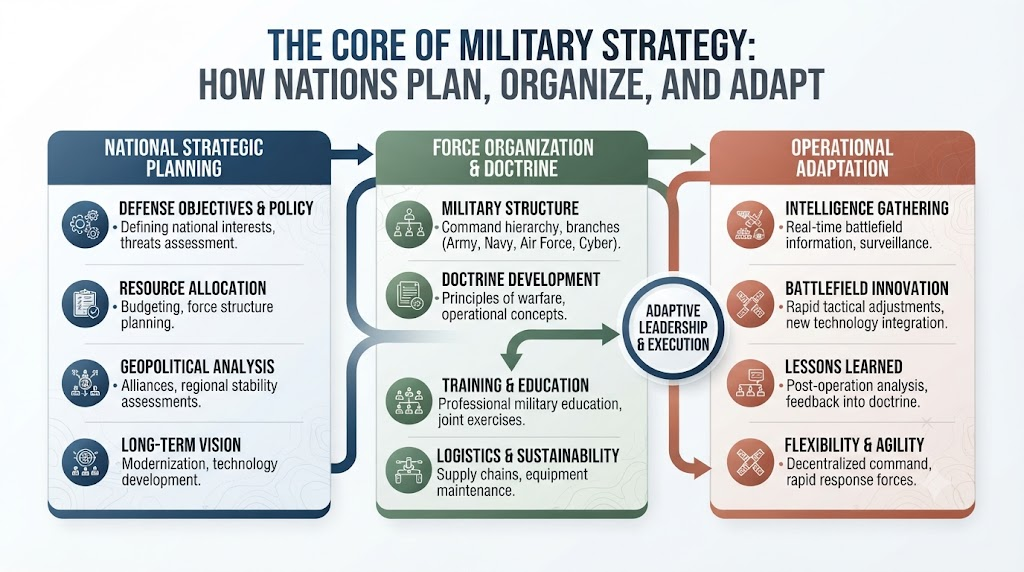
Military strategy is simply the plan a nation uses to apply its armed forces to meet national security goals. While tactics handle what happens during a single engagement, strategy looks at the big picture. It connects political leadership with military action. Think of strategy as the bridge between what a government wants to achieve and what its military forces can actually do. Planners have to weigh risks, understand potential adversaries, and figure out how to use available resources without overextending. Studying this helps analysts understand why certain campaigns succeed and how military doctrines adapt over time.
The Historical Roots of Strategic Thought
Strategic thinking has evolved dramatically over the centuries. Ancient writers focused heavily on terrain, troop discipline, and the psychological side of conflict. Leaders looked at trickery, indirect approaches, and the political dynamics of alliances.
As the Industrial Revolution took hold, war changed completely. Mass production, railways, and telegraphs meant armies could grow much larger. Suddenly, strategists had to account for national industrial capacity, massive supply chains, and total mobilization.
In the twentieth century, the arrival of nuclear weapons introduced the idea of deterrence. Instead of just focusing on winning a protracted war, superpowers shifted their focus toward preventing major conflicts altogether through the threat of overwhelming retaliation.
Main Elements of Strategic Planning
A solid military strategy pulls together several key pieces:
Objectives and Ends
Every plan starts with clear political goals. These goals dictate how large a military effort needs to be and how long it might last.
Ways and Concepts
The “ways” describe the operational methods chosen to bridge the gap between goals and power. Planners decide whether to use a strategy of direct confrontation, maneuver, or exhaustion.
Means and Resources
The “means” are the actual tools available, including personnel, equipment, industrial power, and funding. Planners must stay realistic about what a nation can sustain.
Risk Assessment
Planners must constantly evaluate what could go wrong, from unexpected enemy moves to supply chain bottlenecks.
Conducting Military Operations
Operations turn theory into practice. An operation is a coordinated military action designed to reach a specific goal within a broader campaign.
Operational art ties individual battles to larger political goals. While armies used to fight in tight, concentrated groups, modern operations often span vast areas and require coordination across multiple services. Understanding these frameworks helps observers see how forces move and sustain themselves safely.
The Vital Role of Logistics
History shows that conflicts are often decided by logistics rather than battlefield heroics. Military logistics covers everything from buying and maintaining equipment to transporting troops and providing medical care.
Good supply lines ensure that units get fuel, food, and ammunition right when they need them. Modern militaries rely heavily on complex supply networks and advanced tracking to stay ready around the globe. Without solid logistics, even the best plans fall apart.
Command and Control Systems
Command and Control systems give leaders the framework they need to give orders, coordinate units, and keep track of what is happening.
In the past, commanders relied on messengers and simple maps. Today, these systems use secure communication networks and data tools to gather information from scattered units and help leaders make fast decisions. Keeping these communication channels secure is a top priority for defense organizations.
Intelligence, Surveillance, and Reconnaissance (ISR)
Good decisions require good information. Intelligence, Surveillance, and Reconnaissance (ISR) is the process of collecting and analyzing data about terrain, enemy capabilities, and intentions.
- Surveillance means keeping a systematic watch over an area.
- Reconnaissance involves sending out specific missions to find out about a target.
- Intelligence is the analysis of that raw data to give planners a clear picture.
Modern ISR ranges from aerial sensors to advanced data tools, helping leaders understand situations before challenges arise.
Defense Technology and Modern Systems
Technology continually changes how militaries train and operate. From early ironclad ships to modern digital networks, technology shapes defense capabilities.
Today’s defense technology includes secure radios, advanced sensors, simulation tools, and data software. While tech offers clear advantages, it also brings high costs and deep dependencies. Analysts study these tools to see how they impact global stability.
Military Organizational Structure
An organization’s structure dictates how authority flows and how different branches work together. Most militaries are split into land, naval, and air forces, backed by administrative and technical support.
Clear hierarchies ensure that large groups can function under high-pressure conditions. Over time, these structures shift to handle new technologies and changing threats.
Multidomain Operations
Modern defense studies emphasize Multidomain Operations, which look at how militaries coordinate across land, sea, air, space, and cyberspace.
Conflicts rarely stay in one domain. A naval mission, for instance, might rely on communication satellites in space, cyber defenses to protect networks, and land-based supply chains. Understanding this coordination is essential for modern analysis.
Comparing Traditional and Modern Approaches
| Factor | Traditional Approach | Modern Approach |
| Primary Focus | Mass mobilization and direct control | Multi-domain integration and deterrence |
| Communication | Linear hierarchies and physical messengers | Decentralized, encrypted, and networked |
| Information Gathering | Manual scout reports and basic maps | Multi-source ISR and sensor networks |
| Logistics | Heavy stockpiles and regional supply depots | Just-in-time provisioning and global chains |
| Organizational Structure | Rigid service hierarchies | Joint-force task forces |
| Decision Support | Centralized human estimation | Data-driven modeling and simulation |
Common Challenges in Defense Studies
Researchers looking into military strategy often run into a few common hurdles:
- Dense Terminology: Defense literature is full of acronyms and technical terms that require patience to decode.
- Separating Fact from Speculation: Public information often mixes verified data with unverified rumors or political rhetoric.
- Understanding Context: Applying old historical lessons to modern scenarios means recognizing how technology and culture have changed.
- Information Overload: The sheer volume of digital sources makes finding reliable analysis difficult.
Best Practices for Defense Research
Conducting responsible research in military strategy means sticking to solid standards:
- Use Credible Sources: Rely on government publications, peer-reviewed journals, and established research institutes.
- Verify Historical Claims: Cross-reference dates and outcomes across multiple reliable references.
- Keep Context in Mind: Evaluate strategies based on the political and economic realities of their time.
- Separate Fact from Opinion: Distinguish between actual historical events and analytical commentary.
- Check Dates: Ensure technology research reflects current, verified capabilities rather than old projections.
Frequently Asked Questions
What is the main purpose of military strategy?
Military strategy connects national political goals with the effective use of armed forces, making sure military power supports broader security needs.
How do strategy and tactics differ?
Strategy covers the long-term plan and overall goals of a campaign, while tactics focus on the specific actions taken during individual engagements.
Why is logistics so important?
Logistics ensures that forces receive fuel, food, and ammunition. Without reliable supply lines, even the best strategies fail in the field.
What does Command and Control mean?
It includes the structures, communication tools, and decision aids that allow leaders to exercise authority and direct units.
What is the role of ISR?
ISR involves gathering and analyzing data about adversary capabilities and terrain to give leaders a clear picture of the situation.
What are Multidomain Operations?
They refer to coordinating military actions across land, sea, air, space, and cyberspace to achieve goals in complex settings.
How does technology impact defense studies?
Technology changes operational capabilities, shifts logistical needs, and requires constant updates to strategic doctrine.
What makes a research source reliable?
Official government papers, peer-reviewed academic journals, and reputable defense institutes make the best sources.
Conclusion
Military strategy remains a vital field for understanding international security and defense management. By studying the history of strategic thought, the role of logistics and command systems, and the complexities of modern operations, analysts gain a clearer picture of how nations handle security challenges. Approaching these topics with intellectual rigor and solid sources ensures a balanced, well-informed perspective.
