Introduction
Imagine a work day with zero emergency server tickets. Production runs smoothly without manual intervention. Servers provision, scale, and heal themselves automatically. This is the promise of modern infrastructure automation. Many tech teams are now asking what is NoOps and how it changes daily workflows. This guide breaks down everything you need to know about this exciting shift.
Understanding the Core Idea of NoOps
NoOps stands for No Operations. It sounds extreme at first glance. Does it mean IT operations people lose their jobs? Absolutely not. It means that routine operational tasks run through complete automation.
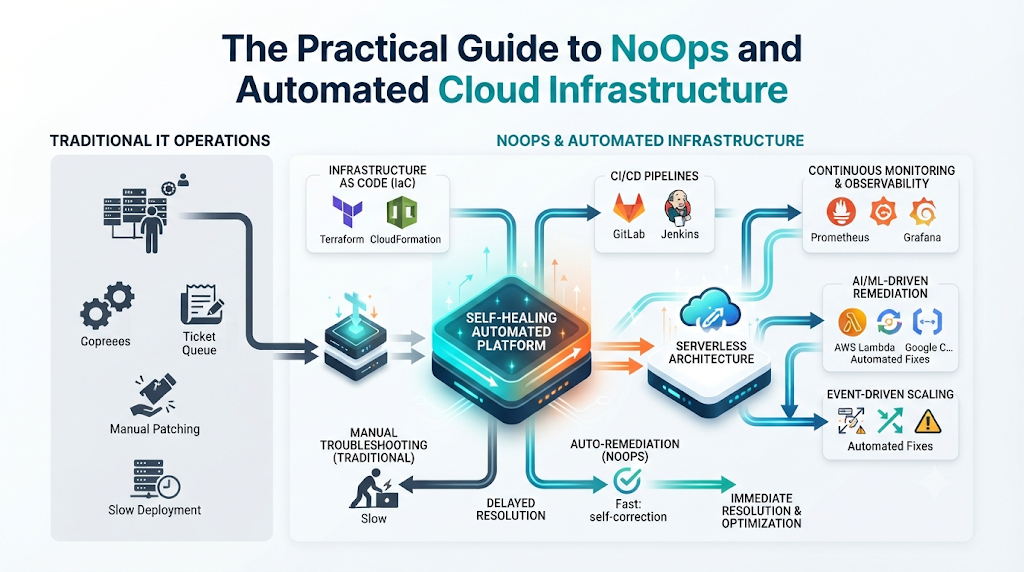
Developers write code and push it to a repository. Automated pipelines take over from there. The system builds, tests, deploys, and monitors itself. Engineers can focus entirely on building great software products instead of managing physical or virtual servers.
NoOps vs DevOps: Understanding the Shift
Many teams wonder how this model compares to older methods. When comparing NoOps vs DevOps, you see a clear evolution in IT culture. DevOps brought developers and operations teams together. It broke down silos and introduced automated deployment pipelines.
NoOps takes that collaboration and automates the operational layer itself. In a DevOps setup, developers still file tickets or work with operators to resolve complex deployment issues. In a true NoOps environment, the underlying infrastructure abstracts away entirely. Cloud services and intelligent platforms handle resource scaling and error recovery without human touch.
The Power of NoOps Automation Tools
Achieving this level of freedom requires the right software stack. Modern NoOps automation tools make self-managing infrastructure possible. These tools handle provisioning, configuration, and security checks automatically.
Infrastructure as Code allows teams to define servers using text files. When a developer pushes a code update, the system reads these files and updates the cloud environment instantly. This keeps staging and production environments identical. It also eliminates human configuration errors entirely.
| Automation Layer | Primary Purpose | Common Technologies |
|---|---|---|
| Provisioning | Setting up cloud infrastructure | Terraform, CloudFormation |
| Orchestration | Managing container lifecycles | Kubernetes, Docker |
| Delivery | Automating code deployment | GitHub Actions, ArgoCD |
| Observability | Monitoring system health | Prometheus, Grafana |
Building Reliable Self-Healing Systems
Automation is only useful if systems stay healthy. Modern cloud architectures rely on containerization to achieve high uptime. Tools like Docker package applications cleanly. Kubernetes manages those containers across distributed cloud clusters.
If a container crashes, Kubernetes restarts it on a healthy node instantly. This self-healing design prevents minor bugs from turning into major outages. Engineers sleep better because the system fixes its own minor failures.
Monitoring and Observability Without Manual Checks
Removing manual operations means trusting your monitoring systems. Teams must rely on advanced observability platforms to track system health. These tools collect logs and metrics in real time.
Artificial intelligence and machine learning models analyze this telemetry data. When an anomaly occurs, the system triggers automated rollbacks or scaling actions. This proactive approach keeps applications running smoothly without human alerts at midnight.
Advancing Your Career With a NoOps Training Course
As automation reshapes the industry, professionals need new skills. Learning modern cloud practices opens up exciting career opportunities. Enrolling in a structured NoOps training course helps engineers master container orchestration and pipeline automation.
These learning programs cover cloud fundamentals, infrastructure management, and security automation. Students learn by building real projects in simulated cloud environments. Platforms like NoOpsSchool offer practical resources for learners at every stage.
Earning Professional Recognition and Certification
Validating your technical skills helps you stand out in the job market. Employers look for proof that engineers understand advanced cloud automation. Earning a recognized NoOps certification demonstrates your commitment to modern IT practices.
Specialized paths help professionals focus on their exact career goals. For example, an advanced NoOps engineer certification proves your ability to build and maintain automated delivery pipelines. These credentials give hiring managers confidence in your technical background.
Designing Advanced Systems With NoOps Architect Training
Designing large-scale automated systems requires deep technical vision. Senior engineers must understand how to tie multiple cloud services together securely. Specialized NoOps architect training prepares leaders to design resilient, self-sustaining cloud environments.
Architects learn how to plan multi-region deployments, implement strict security guardrails, and optimize cloud spending. They ensure that automation scales smoothly as company user bases grow. Training programs from NoOpsSchool provide deep insights into these advanced architectural patterns.
Enterprise Leadership and NoOps Manager Certification
Transitioning an entire organization toward automated operations requires strong leadership. Engineering managers must guide their teams through cultural and technical changes. Leaders need to track deployment speed, system reliability, and delivery efficiency.
Pursuing a focused NoOps manager certification helps IT leaders align their tech stack with business goals. Managers learn how to foster a culture of continuous learning and operational excellence. Good leadership ensures that automation benefits both engineers and business stakeholders.
Accelerating Projects With NoOps Consulting Services
Many companies want to adopt automation but lack internal experience. Building secure pipelines and self-healing systems takes time and specialized knowledge. Using expert NoOps consulting services helps businesses modernize their infrastructure quickly.
Consultants review existing workflows and identify operational bottlenecks. They design custom migration plans and implement robust CI/CD pipelines. This expert guidance prevents costly architectural mistakes during cloud transformation projects.
Scaling Teams and When to Hire NoOps Freelancers
Growing tech companies often face sudden surges in project demand. Internal teams may not have spare bandwidth to build new automation pipelines. In these moments, organizations choose to hire NoOps freelancers to bridge the talent gap.
Freelance specialists bring fresh perspective and deep technical skill. They can set up infrastructure monitoring, write provisioning scripts, or optimize container clusters. Working with flexible experts helps companies meet tight project deadlines easily.
| Professional Role | Core Focus Area | Ideal Certification Path |
|---|---|---|
| Cloud Engineer | Building deployment pipelines | NoOps Engineer Certification |
| System Architect | Designing resilient cloud systems | NoOps Architect Training |
| IT Manager | Leading operational transformation | NoOps Manager Certification |
| External Expert | Implementing rapid cloud automation | Specialized Consulting Services |
Frequently Asked Questions
What does NoOps mean in simple terms? NoOps means running IT operations without manual intervention. Systems provision, scale, and heal themselves through advanced automation tools.
Does NoOps replace traditional DevOps? No, NoOps builds upon DevOps principles. It automates routine operational tasks so teams can focus entirely on writing software features.
What skills do I need to learn NoOps? You need a solid understanding of cloud computing, Infrastructure as Code, container orchestration, and automated monitoring platforms.
How does Infrastructure as Code help automation? Infrastructure as Code lets you define servers using configuration files. This allows automated systems to build and update environments consistently.
Can small startups use NoOps practices? Yes, startups benefit greatly by using managed cloud services and serverless tools that require minimal operational management.
What is the difference between NoOps and Site Reliability Engineering? Site Reliability Engineering applies software engineering to IT operations. NoOps aims to automate operational tasks entirely to remove manual work.
How do self-healing systems handle crashes? Self-healing systems use automated monitors to detect failures. When a service stops working, the platform restarts or replaces it automatically.
Why do companies hire external automation consultants? Companies hire consultants to assess their infrastructure maturity, design secure pipelines, and accelerate cloud migration projects.
How can I start my learning journey? You can start by studying cloud basics, learning configuration tools, and exploring structured educational platforms like NoOpsSchool.
Does NoOps mean humans do no work in IT? No, humans are still vital. People design system architecture, write application logic, set security policies, and govern automation rules.
Conclusion
NoOps represents the future of cloud infrastructure automation. By removing manual tasks through Infrastructure as Code and self-healing systems, organizations deliver software faster and more reliably. Whether you are an engineer upgrading your skills, a manager guiding a cloud transition, or a business seeking expert help, embracing automation is essential. Platforms like NoOpsSchool provide the guidance needed to succeed in this modern landscape. Start exploring automation today and build resilient systems for tomorrow.
