Introduction
Long-Term Care Management Systems are software platforms that help nursing homes, skilled nursing facilities, assisted living centers, senior living communities, rehabilitation centers, and long-term care providers manage resident care, clinical documentation, medication workflows, billing, compliance, staffing, reporting, and daily operations.
In simple words, these systems help care teams move from paper files, manual notes, disconnected billing tools, and scattered spreadsheets to one organized digital platform. They support both clinical and administrative teams so residents receive safer, better-coordinated care.
Long-term care providers use these systems for:
- Resident admission and care planning
- Nursing documentation and assessments
- Medication administration tracking
- Billing, claims, and financial workflows
- Staff scheduling and task management
- Compliance reporting and audit preparation
- Family communication and resident engagement
Buyers should evaluate:
- Clinical documentation depth
- Ease of use for nursing staff
- Billing and reimbursement support
- Medication management features
- Compliance and audit tools
- Interoperability with hospitals and pharmacies
- Reporting and analytics
- Mobile access
- Training and implementation support
- Security and access controls
Best for: Skilled nursing facilities, assisted living providers, senior living communities, rehabilitation centers, continuing care retirement communities, multi-location care operators, clinical directors, administrators, billing teams, and compliance managers.
Not ideal for: Very small care homes that only need basic resident records, independent caregivers, or organizations already using a full healthcare EHR that covers long-term care workflows properly
Key Trends in Long-Term Care Management Systems
- AI-supported documentation: More systems are moving toward smarter notes, alerts, risk flags, and workflow suggestions.
- Resident-centered care planning: Providers want care plans that are easier to update, track, and share across teams.
- Medication safety tools: eMAR, pharmacy integrations, alerts, and administration tracking are becoming essential.
- Interoperability: Long-term care providers need better data exchange with hospitals, labs, pharmacies, payers, and referral partners.
- Cloud-based platforms: Cloud deployment is becoming the preferred model for easier access, updates, and multi-location control.
- Mobile access for staff: Nurses and caregivers need quick access to tasks, notes, alerts, and resident information from tablets or mobile devices.
- Compliance automation: Audit logs, assessment tracking, incident reporting, and regulatory documentation are key buying priorities.
- Better analytics: Operators want dashboards for census, occupancy, staffing, readmissions, quality measures, billing, and resident outcomes.
- Family engagement: More platforms include communication tools, portals, updates, and engagement workflows.
- Integrated financial operations: Billing, claims, accounts receivable, and reimbursement tracking are increasingly connected to clinical workflows.
How We Selected These Tools
The tools below were selected based on practical buyer-focused criteria:
- Market recognition in long-term care, senior living, skilled nursing, and post-acute care
- Strength of clinical documentation and resident management workflows
- Support for billing, claims, compliance, and reimbursement needs
- Medication management and pharmacy ecosystem support
- Fit across small, mid-sized, and enterprise care organizations
- Reporting, analytics, and operational visibility
- Interoperability and integration potential
- Security and role-based access expectations
- Implementation support and training resources
- Long-term usability for administrators, nurses, caregivers, and billing teams
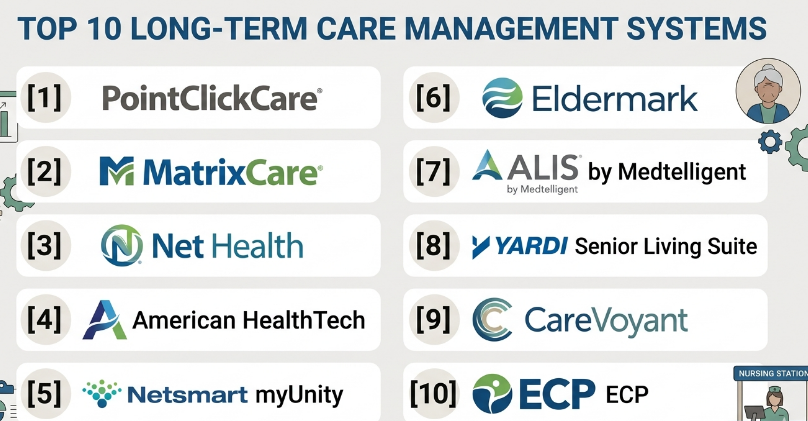
Top 10 Long-Term Care Management Systems
#1 — PointClickCare
Short description :
PointClickCare is one of the most recognized cloud-based platforms for long-term care, skilled nursing, senior living, and post-acute care providers. It helps organizations manage clinical documentation, billing, resident records, medication workflows, care coordination, and operational reporting. The system is especially useful for providers that need a mature platform with broad industry adoption. It supports both single-location and multi-location organizations. PointClickCare is often considered by facilities that need strong clinical and financial workflow alignment.
Key Features
- Resident clinical records
- Care planning and documentation
- Billing and financial management
- eMAR and medication workflows
- Analytics and reporting
- Interoperability support
- Multi-facility management
Pros
- Strong market presence in long-term and post-acute care
- Broad clinical and financial feature set
- Good fit for growing and enterprise providers
Cons
- May require structured training for full adoption
- Can feel complex for smaller facilities
- Pricing details are usually customized
Platforms / Deployment
Web / Mobile access may vary
Cloud
Security & Compliance
Healthcare-focused security controls are expected. Specific certifications such as SOC 2 or ISO 27001: Not publicly stated.
Integrations & Ecosystem
PointClickCare has a broad ecosystem for long-term and post-acute care workflows.
- Pharmacy integrations
- Lab and diagnostic workflows
- Billing and claims systems
- Hospital and referral networks
- Analytics and reporting tools
Support & Community
PointClickCare provides onboarding, training, documentation, and customer support resources. Support level may vary based on contract, facility size, and selected modules.
#2 — MatrixCare
Short description :
MatrixCare is a long-term care and post-acute care platform designed for skilled nursing, senior living, home health, hospice, and related care settings. It helps organizations manage resident care, clinical documentation, billing, compliance, analytics, and care coordination. MatrixCare is useful for providers operating across different care environments. It offers strong workflow depth for organizations that need more than basic resident management. It is especially relevant for providers looking for connected clinical and operational visibility.
Key Features
- Resident records and care planning
- Clinical documentation
- Billing and reimbursement workflows
- Medication management support
- Analytics and reporting
- Compliance workflows
- Multi-care setting support
Pros
- Strong fit for post-acute and senior care organizations
- Useful for multi-service care providers
- Good clinical and operational workflow depth
Cons
- May need careful implementation planning
- Smaller facilities may not need all modules
- Some advanced capabilities may vary by package
Platforms / Deployment
Web / Mobile access may vary
Cloud
Security & Compliance
Healthcare security and compliance controls are expected. Specific public certifications: Not publicly stated.
Integrations & Ecosystem
MatrixCare supports connected workflows across senior care and post-acute care.
- Pharmacy workflows
- Billing systems
- Clinical documentation
- Analytics tools
- Care coordination systems
Support & Community
MatrixCare offers onboarding and support resources for healthcare organizations. Support depth may vary by selected modules and customer size.
#3 — Net Health
Short description :
Net Health provides healthcare software for specialty care, rehabilitation, wound care, occupational health, and post-acute environments. For long-term care organizations, it can support therapy, rehabilitation, documentation, analytics, and care management workflows. It is useful for facilities that need stronger therapy and specialty clinical support. Net Health is often considered by providers looking to improve clinical documentation, outcomes tracking, and operational efficiency. It is best suited for care organizations with specialized service lines.
Key Features
- Therapy and rehabilitation workflows
- Clinical documentation
- Wound care support
- Analytics and outcomes reporting
- Compliance-focused workflows
- Care coordination tools
- Specialty care documentation
Pros
- Strong fit for rehabilitation and specialty care settings
- Useful analytics and documentation support
- Good option for facilities with therapy-heavy workflows
Cons
- May not be a full replacement for every long-term care operational need
- Product fit depends on selected modules
- Pricing and implementation vary by use case
Platforms / Deployment
Web / Mobile access may vary
Cloud
Security & Compliance
Healthcare security controls are expected. Specific certifications: Not publicly stated.
Integrations & Ecosystem
Net Health supports specialty clinical workflows and care documentation.
- Therapy systems
- Rehabilitation workflows
- Reporting and analytics
- Clinical documentation
- Care coordination tools
Support & Community
Net Health provides customer support, implementation resources, and training. Support details may vary by product line and contract.
#4 — American HealthTech
Short description :
American HealthTech is a long-term care EHR and management system focused on skilled nursing and post-acute care providers. It helps facilities manage clinical documentation, billing, resident records, reporting, and regulatory workflows. The platform is suitable for providers that need a dedicated long-term care system rather than a general healthcare tool. It supports both care delivery and administrative processes. American HealthTech can be useful for facilities seeking practical long-term care workflow coverage.
Key Features
- Skilled nursing documentation
- Resident management
- Billing and accounts receivable workflows
- Care planning support
- Reporting and analytics
- Compliance workflows
- Administrative management tools
Pros
- Built specifically for long-term and post-acute care
- Covers both clinical and billing workflows
- Useful for skilled nursing providers
Cons
- Interface and workflow experience should be tested during demo
- Integration needs should be reviewed carefully
- Some capabilities may vary by deployment or package
Platforms / Deployment
Web / Windows access may vary
Cloud / Hybrid may vary
Security & Compliance
Healthcare compliance support is expected. Specific certifications: Not publicly stated.
Integrations & Ecosystem
American HealthTech supports common long-term care administrative and clinical workflows.
- Billing systems
- Resident records
- Clinical documentation
- Reporting
- Compliance workflows
Support & Community
Support and training resources are available for long-term care customers. Exact support model: Varies / Not publicly stated.
#5 — Netsmart myUnity
Short description :
Netsmart myUnity is a healthcare platform used across post-acute, senior living, home health, hospice, and long-term care environments. It is designed for organizations that need connected clinical documentation, care coordination, billing, and operational workflows. The system is well suited for larger providers managing multiple care settings. It supports interoperability and enterprise-level healthcare operations. myUnity is especially useful for organizations that want one platform across several care programs.
Key Features
- Multi-setting care management
- Clinical documentation
- Care coordination workflows
- Billing and administrative support
- Interoperability capabilities
- Reporting and analytics
- Enterprise workflow support
Pros
- Strong fit for enterprise care organizations
- Useful for multi-care-setting providers
- Good interoperability focus
Cons
- May be too advanced for small facilities
- Implementation can require significant planning
- Pricing is typically customized
Platforms / Deployment
Web / Mobile access may vary
Cloud / Hybrid may vary
Security & Compliance
Healthcare-grade security and compliance controls are expected. Specific certifications: Not publicly stated.
Integrations & Ecosystem
Netsmart myUnity fits into larger healthcare technology ecosystems.
- EHR workflows
- Billing and claims systems
- Analytics tools
- Interoperability workflows
- Care coordination platforms
Support & Community
Netsmart provides enterprise-oriented implementation, onboarding, and support services. Support may vary by contract and organization size.
#6 — Eldermark
Short description :
Eldermark is a senior living software platform designed for assisted living, memory care, and senior care communities. It helps providers manage resident records, assessments, care plans, medication workflows, billing, occupancy, and staff communication. Eldermark is especially useful for senior living operators that want a system focused on resident-centered care and community operations. It supports both clinical and business workflows. It is a practical option for providers that do not need a full skilled nursing enterprise EHR.
Key Features
- Resident assessments
- Care planning
- eMAR and medication tracking
- Billing and occupancy management
- Staff communication tools
- Reporting and dashboards
- Senior living workflow support
Pros
- Strong fit for assisted living and memory care
- Practical resident management features
- Good focus on senior living operations
Cons
- May not fit complex skilled nursing requirements
- Enterprise integrations should be validated
- Some features may vary by package
Platforms / Deployment
Web / Mobile access may vary
Cloud
Security & Compliance
Healthcare and senior living security controls are expected. Specific certifications: Not publicly stated.
Integrations & Ecosystem
Eldermark supports senior living operations and care workflows.
- eMAR workflows
- Billing tools
- Resident assessments
- Care planning
- Reporting
- Community management workflows
Support & Community
Eldermark provides onboarding and support for senior living communities. Support depth may vary by customer size and product selection.
#7 — ALIS by Medtelligent
Short description :
ALIS by Medtelligent is a senior living management platform focused on assisted living, memory care, and residential care communities. It helps providers manage resident care, assessments, service plans, medication administration, billing, and family communication. ALIS is useful for operators that want a clean, senior-living-focused platform. It can support both small communities and multi-site providers. The platform is especially relevant for care teams that need simple access to resident information and daily tasks.
Key Features
- Resident records
- Assessments and service plans
- eMAR support
- Billing workflows
- Family communication tools
- Reporting and dashboards
- Multi-community management
Pros
- Good fit for assisted living and memory care providers
- User-friendly senior living workflow focus
- Supports resident care and business operations
Cons
- Not designed as a full skilled nursing enterprise EHR
- Advanced integrations should be reviewed
- Some features may depend on selected modules
Platforms / Deployment
Web / Mobile access may vary
Cloud
Security & Compliance
Healthcare-related access controls and compliance workflows are expected. Specific certifications: Not publicly stated.
Integrations & Ecosystem
ALIS supports senior living care and administrative workflows.
- eMAR
- Billing
- Resident assessments
- Family communication
- Reporting
- Multi-site management
Support & Community
ALIS provides support and onboarding resources. Support details may vary based on community size and selected services.
#8 — Yardi Senior Living Suite
Short description :
Yardi Senior Living Suite is built for senior living operators that need property management, resident care, billing, financials, and operational workflows. It is especially useful for organizations that combine real estate, community operations, and care services. Yardi is commonly considered by larger senior living operators that need strong financial and property management capabilities. The platform supports resident lifecycle management from prospect to move-in to ongoing care. It is a good choice for operators that need both business and care visibility.
Key Features
- Resident and prospect management
- Care management workflows
- Billing and financial management
- Property and community operations
- Reporting and analytics
- Occupancy management
- Multi-location support
Pros
- Strong financial and property management foundation
- Good fit for senior living operators
- Useful for multi-community organizations
Cons
- May be more business-operations focused than clinical-EHR focused
- Implementation can require planning
- Smaller communities may find it more than needed
Platforms / Deployment
Web / Mobile access may vary
Cloud
Security & Compliance
Enterprise software security controls are expected. Specific healthcare certifications: Not publicly stated.
Integrations & Ecosystem
Yardi supports business, property, and senior living operations.
- Accounting and financial tools
- Resident management
- CRM workflows
- Care management
- Reporting and analytics
- Property operations
Support & Community
Yardi provides customer support, training, and implementation resources. Support level may vary by product suite and customer size.
#9 — CareVoyant
Short description :
CareVoyant is a healthcare management platform used by home care, home health, outpatient therapy, and long-term care-related providers. It supports clinical documentation, scheduling, billing, payroll, and care coordination workflows. It is useful for organizations that need connected administrative and care delivery operations. CareVoyant can fit providers that operate across more than one care model. The platform is practical for teams that need flexible workflow coverage across care services.
Key Features
- Clinical documentation
- Scheduling and staff management
- Billing and payroll support
- Care coordination workflows
- Reporting and analytics
- Multi-service care support
- Administrative workflow management
Pros
- Flexible fit across different care services
- Combines clinical and back-office workflows
- Useful for organizations with mixed care models
Cons
- Long-term care depth should be validated for each use case
- Interface and workflow fit should be tested
- Some details may vary by implementation
Platforms / Deployment
Web / Mobile access may vary
Cloud / Hybrid may vary
Security & Compliance
Healthcare compliance controls are expected. Specific certifications: Not publicly stated.
Integrations & Ecosystem
CareVoyant supports care operations that need clinical and administrative alignment.
- Billing systems
- Payroll workflows
- Scheduling
- Clinical documentation
- Reporting
- Care coordination tools
Support & Community
CareVoyant provides support and implementation assistance. Support details: Varies / Not publicly stated.
#10 — ECP
Short description :
ECP is a senior living software platform focused on medication management, resident care, compliance, and operational workflows. It is commonly used by assisted living, memory care, and senior living communities. ECP is especially known for eMAR and medication administration support. It helps care teams improve documentation, reduce manual paperwork, and manage resident care more consistently. It is a practical option for communities that need strong medication and care workflow support.
Key Features
- eMAR and medication tracking
- Resident care documentation
- Service plans
- Compliance reporting
- Staff task management
- Pharmacy-related workflows
- Reporting and dashboards
Pros
- Strong medication management focus
- Good fit for assisted living and senior living communities
- Practical for care teams needing simpler daily workflows
Cons
- May not replace a full enterprise long-term care EHR
- Advanced financial workflows should be validated
- Best fit depends on care setting and module needs
Platforms / Deployment
Web / Mobile access may vary
Cloud
Security & Compliance
Healthcare-related controls are expected. Specific certifications: Not publicly stated.
Integrations & Ecosystem
ECP supports senior living care and medication workflows.
- Pharmacy workflows
- eMAR
- Resident care documentation
- Compliance reporting
- Staff task management
- Operational dashboards
Support & Community
ECP provides customer support and onboarding resources. Support details may vary by plan and community size.
Comparison Table
| Tool Name | Best For | Platform(s) Supported | Deployment | Standout Feature | Public Rating |
|---|---|---|---|---|---|
| PointClickCare | Skilled nursing and post-acute care | Web, mobile access may vary | Cloud | Broad long-term care ecosystem | N/A |
| MatrixCare | Multi-service senior and post-acute providers | Web, mobile access may vary | Cloud | Cross-care setting workflows | N/A |
| Net Health | Therapy and specialty care providers | Web, mobile access may vary | Cloud | Rehabilitation and specialty documentation | N/A |
| American HealthTech | Skilled nursing providers | Web, Windows access may vary | Cloud / Hybrid may vary | Long-term care EHR workflows | N/A |
| Netsmart myUnity | Enterprise post-acute organizations | Web, mobile access may vary | Cloud / Hybrid may vary | Multi-setting healthcare platform | N/A |
| Eldermark | Assisted living and memory care | Web, mobile access may vary | Cloud | Senior living care operations | N/A |
| ALIS by Medtelligent | Assisted living communities | Web, mobile access may vary | Cloud | Resident care and family communication | N/A |
| Yardi Senior Living Suite | Senior living operators | Web, mobile access may vary | Cloud | Property, financial, and care operations | N/A |
| CareVoyant | Mixed care service providers | Web, mobile access may vary | Cloud / Hybrid may vary | Clinical and back-office workflows | N/A |
| ECP | Assisted living medication workflows | Web, mobile access may vary | Cloud | eMAR and medication management | N/A |
Evaluation & Long-Term Care Management Systems
| Tool Name | Core (25%) | Ease (15%) | Integrations (15%) | Security (10%) | Performance (10%) | Support (10%) | Value (15%) | Weighted Total (0–10) |
|---|---|---|---|---|---|---|---|---|
| PointClickCare | 9 | 8 | 9 | 8 | 8 | 8 | 8 | 8.40 |
| MatrixCare | 9 | 7 | 8 | 8 | 8 | 8 | 7 | 7.95 |
| Net Health | 8 | 7 | 8 | 8 | 8 | 8 | 7 | 7.70 |
| American HealthTech | 8 | 7 | 7 | 7 | 8 | 7 | 8 | 7.50 |
| Netsmart myUnity | 9 | 7 | 9 | 8 | 8 | 8 | 7 | 8.10 |
| Eldermark | 8 | 8 | 7 | 7 | 8 | 7 | 8 | 7.65 |
| ALIS by Medtelligent | 8 | 8 | 7 | 7 | 8 | 7 | 8 | 7.65 |
| Yardi Senior Living Suite | 8 | 7 | 8 | 8 | 8 | 8 | 7 | 7.70 |
| CareVoyant | 7 | 7 | 7 | 7 | 7 | 7 | 8 | 7.15 |
| ECP | 8 | 8 | 7 | 7 | 8 | 7 | 8 | 7.65 |
These scores are comparative and should be used as a starting point, not a final buying decision. A tool with a higher score may be better for larger or more complex providers, while a slightly lower-scoring tool may be easier and more affordable for smaller communities. Always validate workflows, security, integrations, support, and pricing before purchase.
Which Long-Term Care Management System Should You Choose?
Solo / Freelancer
Solo caregivers or very small care homes may not need a complete long-term care system. Basic scheduling, documentation, and billing tools may be enough if there are no complex clinical, medication, or compliance needs.
If a dedicated senior care tool is required, lightweight platforms such as ECP, ALIS, or Eldermark may be easier to evaluate first.
SMB
Small and mid-sized facilities should prioritize ease of use, fast onboarding, care documentation, eMAR, billing, and reporting. The system should reduce daily admin work, not make staff feel overloaded.
Good options to compare include Eldermark, ALIS, ECP, American HealthTech, and MatrixCare, depending on care setting and clinical depth.
Mid-Market
Mid-market providers need better reporting, workflow consistency, medication safety, compliance support, and billing visibility. They may also need multi-location control and integration with pharmacies, labs, accounting systems, and referral partners.
PointClickCare, MatrixCare, Net Health, Yardi Senior Living Suite, and Netsmart myUnity are strong options to evaluate at this level.
Enterprise
Enterprise long-term care providers need scalability, strong implementation support, data governance, interoperability, advanced reporting, access controls, and multi-site standardization.
PointClickCare, Netsmart myUnity, MatrixCare, and Yardi Senior Living Suite are strong candidates for larger organizations. Enterprise buyers should involve clinical, IT, finance, compliance, and operations teams in the selection process.
Budget vs Premium
Budget-focused buyers should avoid paying for advanced modules they will not use. A simpler system may be better if the facility mainly needs resident records, care plans, medication tracking, and basic billing.
Premium platforms are better for organizations with complex reimbursement, multiple locations, high resident volume, pharmacy integrations, quality reporting, and enterprise compliance needs.
Feature Depth vs Ease of Use
Feature depth is useful only when staff can actually use the system correctly. Nurses, caregivers, administrators, and billing teams should all be included in demos.
A platform with fewer features but better adoption may deliver better results than a complex platform that staff avoid using.
Integrations & Scalability-
Long-term care providers should review integrations early. Important connections may include pharmacy systems, labs, hospitals, billing tools, accounting software, payroll, HR systems, and analytics platforms.
Scalability should include resident volume, user roles, facilities, reports, permissions, and workflow complexity.
Security & Compliance Needs
Long-term care systems handle sensitive resident and healthcare data. Buyers should check MFA, RBAC, audit logs, encryption, backup policies, user permissions, and data access controls.
Do not assume certifications such as SOC 2, ISO 27001, or HIPAA readiness unless the vendor clearly provides proof. Always validate security documents before signing.
Frequently Asked Questions
1. What is a Long-Term Care Management System?
A Long-Term Care Management System helps care facilities manage resident records, care plans, medication workflows, documentation, billing, staffing, reporting, and compliance. It is designed for long-term and senior care environments.
2. Who uses Long-Term Care Management Systems?
These systems are used by skilled nursing facilities, assisted living communities, memory care centers, rehabilitation facilities, senior living operators, administrators, nurses, billing teams, and compliance managers.
3. How much does Long-Term Care Management Software cost?
Pricing varies based on facility size, number of users, selected modules, implementation needs, and contract terms. If pricing is not clearly available, it should be treated as Varies / N/A.
4. What features matter most in long-term care software?
Important features include resident records, care planning, clinical documentation, eMAR, billing, compliance reporting, staff workflows, analytics, and integrations with pharmacy or healthcare systems.
5. Is cloud-based long-term care software better?
Cloud-based systems are popular because they support easier access, updates, scalability, and multi-location management. However, buyers should still review security, uptime, data backup, and support policies.
6. What is eMAR in long-term care software?
eMAR means electronic medication administration record. It helps staff document, track, and manage medication administration more accurately and consistently.
7. Can long-term care systems integrate with pharmacy systems?
Many long-term care platforms support pharmacy-related workflows or integrations, but exact capabilities vary. Facilities should confirm pharmacy compatibility before purchase.
8. What are common mistakes when choosing long-term care software?
Common mistakes include ignoring staff usability, skipping workflow testing, choosing based only on price, not checking integrations, and assuming compliance features without vendor proof.
9. How long does implementation take?
Implementation depends on facility size, data migration, training needs, workflow complexity, and selected modules. A small facility may implement faster, while enterprise rollouts often need phased planning.
10. What are alternatives to Long-Term Care Management Systems?
Alternatives include general EHR software, spreadsheets, basic scheduling tools, billing software, or custom internal systems. However, these may lack eMAR, care planning, compliance, and long-term care-specific workflows.
Conclusion
Long-Term Care Management Systems are becoming essential for providers that want better resident care, stronger documentation, safer medication workflows, smoother billing, and clearer compliance visibility. The best system is not the same for every facility. A skilled nursing provider may need a deep clinical and reimbursement platform, while an assisted living community may value eMAR, resident engagement, and easy daily workflows more.
