Introduction
Pharmacy Management Systems are software platforms that help pharmacies manage daily operations such as prescription processing, inventory control, billing, insurance claims, patient records, refill reminders, reporting, and compliance workflows. In simple terms, they help pharmacies reduce manual work, improve accuracy, and serve patients faster.
This category matters more now because pharmacies are no longer only medicine-dispensing counters. They are becoming patient-care hubs, with services like medication synchronization, adherence programs, immunization tracking, e-prescribing, digital payments, delivery coordination, and clinical documentation.
Common use cases include retail pharmacy billing, prescription workflow management, medication inventory tracking, third-party insurance claims, patient communication, and pharmacy analytics.
Buyers should evaluate:
- Prescription workflow depth
- Inventory and purchase management
- Billing and claims support
- Ease of use for pharmacy staff
- Patient communication tools
- Security and compliance controls
- Reporting and analytics
- Integration with POS, EHR, labs, delivery, and payment systems
- Vendor support and onboarding
- Total cost of ownership
Best for: Independent pharmacies, retail pharmacy chains, hospital pharmacies, long-term care pharmacies, specialty pharmacies, and healthcare groups that need accurate prescription, billing, inventory, and patient workflow management.
Not ideal for: Very small medical shops with only basic billing needs, businesses that do not handle prescriptions, or teams that only need a simple POS system without pharmacy-specific compliance, claims, and medication workflow features.
Key Trends in Pharmacy Management Systems
- AI-assisted workflow automation is helping pharmacies reduce manual prescription checks, identify refill opportunities, and improve patient follow-up.
- Medication adherence tools are becoming more important as pharmacies focus on long-term patient outcomes, not only transactions.
- Cloud-first deployment is growing because pharmacy owners want remote access, faster updates, and easier multi-location management.
- Integrated POS and payment workflows are now expected, especially for retail pharmacies selling OTC products and healthcare items.
- E-prescribing and digital prescription intake are becoming standard expectations in many markets.
- Inventory intelligence is improving with reorder alerts, dead-stock tracking, expiry management, and demand forecasting.
- Patient engagement tools such as SMS reminders, mobile apps, refill requests, and delivery updates are becoming key differentiators.
- Compliance and audit readiness are more important due to stricter healthcare data and controlled-substance requirements.
- Interoperability with healthcare systems is increasing, including EHR, claims, lab, delivery, and payment integrations.
- Flexible pricing models are becoming more common, including subscription pricing, module-based pricing, and custom enterprise plans.
How We Selected These Tools
The Top 10 Pharmacy Management Systems were selected using practical buyer-focused criteria:
- Market recognition and adoption among pharmacies
- Pharmacy-specific workflow depth
- Prescription processing and claims support
- Inventory and purchasing capabilities
- Support for independent, retail, long-term care, or enterprise pharmacy needs
- Integration ecosystem and partner network
- Usability for pharmacists, technicians, and pharmacy owners
- Reporting, analytics, and operational visibility
- Security and compliance posture signals
- Vendor support, onboarding, and long-term product maturity
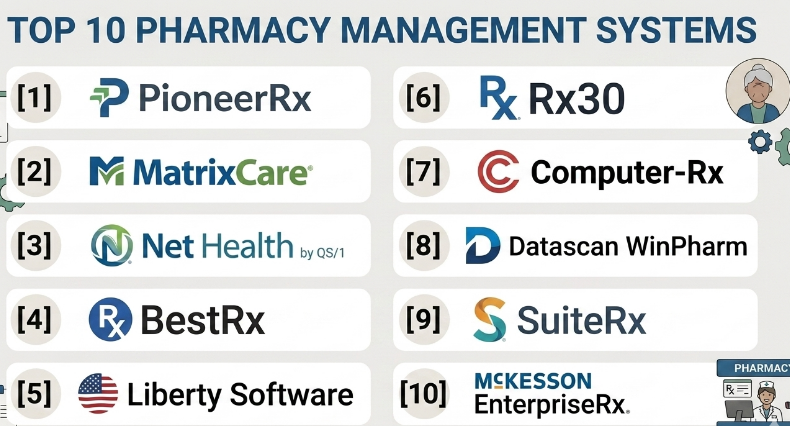
Top 10 Pharmacy Management Systems
#1 — PioneerRx
Short description :
PioneerRx is a pharmacy management system focused mainly on independent and community pharmacies. It supports prescription processing, patient care programs, inventory control, claims workflows, reporting, and pharmacy operations. The system is known for strong retail pharmacy workflow coverage and practical tools for improving patient engagement. It is suitable for pharmacies that want a modern system with automation, reporting, and medication adherence support. It works well for teams that need both operational control and patient-focused services.
Key Features
- Prescription processing and pharmacy workflow management
- Medication synchronization and adherence support
- Patient communication and refill management
- Inventory control and purchasing tools
- Reporting and pharmacy performance dashboards
- Integrations with pharmacy service partners
- Support for independent pharmacy growth workflows
Pros
- Strong fit for independent and community pharmacies.
- Good balance of operational tools and patient engagement.
- Broad ecosystem for pharmacy-specific workflows.
Cons
- May be more detailed than needed for very small stores.
- Pricing and implementation details may require direct vendor discussion.
- Best suited for pharmacies ready to modernize workflows.
Platforms / Deployment
Web / Windows / iOS / Android
Cloud / Hybrid
Security & Compliance
RBAC, audit-related workflow support, and healthcare workflow controls may be available depending on configuration.
SOC 2, ISO 27001, and HIPAA details: Not publicly stated.
Integrations & Ecosystem
PioneerRx supports pharmacy workflow integrations across claims, patient communication, delivery, inventory, and clinical services.
- Claims and pharmacy switching partners
- Patient messaging and refill tools
- Delivery and logistics workflows
- Payment and POS-related tools
- Reporting and operational dashboards
Support & Community
Support is generally positioned around pharmacy onboarding, implementation, training, and ongoing customer assistance. Community strength is relatively strong among independent pharmacy users. Exact support tiers: Varies / Not publicly stated.
#2 — PrimeRx
Short description :
PrimeRx is a pharmacy management system built for retail, specialty, and independent pharmacies. It helps manage prescription processing, workflow automation, claims, patient records, inventory, and reporting. It is suitable for pharmacies that need a complete operational platform with strong prescription and billing support. PrimeRx is often considered by pharmacies looking for a mature system with multiple pharmacy workflow modules. It can support growing pharmacies that need better visibility and automation.
Key Features
- Prescription processing and refill management
- Claims processing and billing workflows
- Inventory and purchasing support
- Patient profile and medication history management
- Reporting and analytics
- Workflow automation
- Multi-module pharmacy operations support
Pros
- Strong pharmacy-specific workflow coverage.
- Suitable for independent and specialty pharmacy needs.
- Good option for pharmacies needing billing and claims depth.
Cons
- Implementation may require planning and staff training.
- Advanced modules may increase total cost.
- Some details may vary by pharmacy type and configuration.
Platforms / Deployment
Web / Windows
Cloud / Hybrid
Security & Compliance
Healthcare data security controls are expected in pharmacy environments.
Specific SOC 2, ISO 27001, SSO/SAML, and HIPAA details: Not publicly stated.
Integrations & Ecosystem
PrimeRx connects with pharmacy operations, billing, claims, inventory, and patient engagement workflows.
- Claims and payer-related integrations
- E-prescribing workflows
- Inventory and wholesaler-related tools
- Patient communication features
- Reporting and analytics modules
Support & Community
Support is typically vendor-led with onboarding, training, and customer service. Documentation and implementation support may vary by package. Community visibility is moderate to strong in pharmacy software discussions.
#3 — NRx by QS/1
Short description :
NRx by QS/1 is a long-standing pharmacy management system used by pharmacies that need structured prescription processing, claims handling, workflow control, and reporting. It is designed for pharmacy operations where accuracy, repeatability, and transaction control matter. It is suitable for independent, retail, and community pharmacies that prefer an established platform. The system focuses on prescription workflow, claims accuracy, patient data, and operational reliability. It is a good fit for pharmacies that value stability and mature pharmacy functionality.
Key Features
- Prescription processing and workflow management
- Claims submission and adjudication support
- Patient record management
- Inventory-related pharmacy operations
- Reporting and operational visibility
- Pharmacy workflow automation
- Support for established pharmacy processes
Pros
- Mature pharmacy software background.
- Strong fit for pharmacies needing structured workflows.
- Useful for teams that value reliability and process control.
Cons
- User experience may feel traditional compared with newer tools.
- Customization and setup may require vendor support.
- Public technical details are limited.
Platforms / Deployment
Windows / Web
Cloud / Hybrid
Security & Compliance
Healthcare workflow controls and audit-related features may be supported.
Specific SSO/SAML, SOC 2, ISO 27001, and HIPAA details: Not publicly stated.
Integrations & Ecosystem
NRx connects with pharmacy claims, operational, and reporting workflows.
- Claims processing ecosystem
- Pharmacy reporting tools
- Inventory and purchase workflows
- Patient and prescription records
- Pharmacy service integrations
Support & Community
Support is generally vendor-provided through onboarding, service teams, and pharmacy-specific assistance. Community strength is stronger among long-term pharmacy users. Details vary by customer agreement.
#4 — BestRx
Short description :
BestRx is a pharmacy management system designed mainly for independent pharmacies. It helps manage prescription filling, claims, patient records, refill workflows, inventory, and pharmacy reporting. The platform focuses on simplifying day-to-day pharmacy operations while giving owners better control over performance. It is suitable for pharmacies that need practical software without unnecessary complexity. BestRx can be a strong option for pharmacies that want core functionality, automation, and operational visibility.
Key Features
- Prescription filling and refill management
- Claims and billing workflow support
- Patient profile management
- Inventory and purchasing tools
- Reporting and business insights
- Workflow automation
- Pharmacy communication support
Pros
- Practical fit for independent pharmacies.
- Easier to approach than some enterprise-heavy platforms.
- Supports core pharmacy operations well.
Cons
- May not be ideal for very complex enterprise pharmacy networks.
- Advanced integrations may depend on configuration.
- Public security certification details are limited.
Platforms / Deployment
Web / Windows
Cloud / Hybrid
Security & Compliance
Role-based access and pharmacy workflow security may be available depending on setup.
SOC 2, ISO 27001, and full compliance documentation: Not publicly stated.
Integrations & Ecosystem
BestRx supports pharmacy operations through claims, inventory, reporting, and patient workflow integrations.
- Claims and billing workflows
- Refill and patient communication tools
- Inventory and purchasing support
- Reporting and analytics
- Pharmacy operations integrations
Support & Community
Support is generally available through vendor onboarding and customer service channels. Documentation and support levels may vary by plan or deployment model.
#5 — Liberty Software
Short description :
Liberty Software provides pharmacy management tools for independent pharmacies, retail pharmacies, and pharmacy teams that need prescription processing, inventory control, patient care, and reporting. It is designed to help pharmacies manage both front-end and prescription operations. The system can support workflow efficiency, medication synchronization, refill management, and business reporting. It is useful for pharmacies that want a balance of usability, pharmacy depth, and operational control. It is especially relevant for pharmacies focused on patient service and retail workflow improvement.
Key Features
- Prescription workflow management
- Medication synchronization support
- Inventory and purchasing tools
- Patient communication and refill support
- Reporting and business intelligence
- POS and retail workflow support
- Pharmacy operations automation
Pros
- Good fit for independent retail pharmacies.
- Strong practical pharmacy workflow coverage.
- Useful for improving patient follow-up and refill processes.
Cons
- Some advanced capabilities may require specific modules.
- Pricing may vary based on pharmacy size and needs.
- Enterprise-level details may not be fully public.
Platforms / Deployment
Windows / Web
Cloud / Hybrid
Security & Compliance
Security controls may include access permissions and audit-related workflows.
SOC 2, ISO 27001, SSO/SAML, and HIPAA details: Not publicly stated.
Integrations & Ecosystem
Liberty Software supports pharmacy workflow connectivity across prescription, retail, claims, and communication operations.
- Claims and payer workflows
- POS and retail management tools
- Patient engagement features
- Inventory management
- Reporting tools
Support & Community
Support is generally vendor-led with onboarding, training, and service assistance. Community presence is meaningful among independent pharmacy operators.
#6 — Rx30
Short description :
Rx30 is a pharmacy management system used for prescription processing, patient records, claims, inventory, and workflow automation. It is designed to support retail pharmacy operations and help staff manage daily prescription volume. The platform is suitable for pharmacies that need a complete operational system with billing, refill, reporting, and inventory capabilities. Rx30 can be useful for teams that want a mature pharmacy software platform. It is often considered by pharmacies looking for established workflow tools.
Key Features
- Prescription processing and workflow management
- Patient record management
- Claims and billing workflows
- Inventory control
- Reporting and analytics
- Refill and medication workflow support
- Pharmacy operations automation
Pros
- Mature pharmacy management functionality.
- Strong fit for prescription-heavy operations.
- Supports key workflows from intake to billing.
Cons
- May require structured implementation and training.
- Interface experience may vary by configuration.
- Public detail on security certifications is limited.
Platforms / Deployment
Windows / Web
Cloud / Hybrid
Security & Compliance
Pharmacy workflow controls and access management may be available.
SOC 2, ISO 27001, and SSO/SAML details: Not publicly stated.
Integrations & Ecosystem
Rx30 supports pharmacy operations through prescription, claims, inventory, and reporting connections.
- Claims and insurance workflows
- Inventory management tools
- Patient and prescription records
- Reporting modules
- POS and pharmacy operations integrations
Support & Community
Support is typically vendor-led with implementation and operational assistance. Support depth may depend on contract, deployment, and pharmacy size.
#7 — Computer-Rx
Short description :
Computer-Rx is a pharmacy management system focused on retail and independent pharmacy operations. It helps manage prescriptions, claims, inventory, patient profiles, workflow, and pharmacy reporting. The system is suitable for pharmacies that want an established platform with core pharmacy management features. It can support prescription accuracy, staff productivity, and day-to-day operational control. Computer-Rx may appeal to pharmacies that prefer a mature pharmacy software environment.
Key Features
- Prescription processing
- Claims and billing support
- Patient profile management
- Inventory and purchasing workflows
- Reporting and business insights
- Pharmacy workflow tools
- Support for retail pharmacy operations
Pros
- Covers essential pharmacy management needs.
- Useful for independent and retail pharmacies.
- Mature system with pharmacy-focused workflows.
Cons
- Public product details may be limited.
- May not feel as modern as newer cloud-first systems.
- Implementation experience may vary.
Platforms / Deployment
Windows / Web
Cloud / Hybrid
Security & Compliance
Access control and pharmacy workflow security may be available.
Specific SOC 2, ISO 27001, HIPAA, and SSO/SAML details: Not publicly stated.
Integrations & Ecosystem
Computer-Rx supports pharmacy workflows through prescription, claims, inventory, and reporting integrations.
- Claims and billing workflows
- Inventory tools
- Patient profile data
- Retail pharmacy workflows
- Reporting capabilities
Support & Community
Support is generally available through vendor channels. Documentation, onboarding, and training depth may vary by customer agreement.
#8 — Datascan WinPharm
Short description :
Datascan WinPharm is a pharmacy management system built for independent pharmacy operations. It supports prescription processing, patient profiles, inventory, claims workflows, reporting, and pharmacy business management. The system is suitable for pharmacies that want operational control and practical day-to-day workflow support. It can help reduce manual work, improve prescription handling, and support better pharmacy visibility. It may be useful for pharmacies that prefer a focused pharmacy software vendor.
Key Features
- Prescription processing
- Patient profile and medication history support
- Claims and billing workflow tools
- Inventory management
- Reporting and business insights
- Refill workflow support
- Pharmacy operations management
Pros
- Pharmacy-focused functionality.
- Useful for independent pharmacy workflows.
- Can support practical operational reporting.
Cons
- Public integration and security details are limited.
- May require vendor guidance during setup.
- Not ideal for teams wanting a broad healthcare enterprise suite.
Platforms / Deployment
Windows / Web
Cloud / Hybrid
Security & Compliance
Security and compliance details are not fully public.
SOC 2, ISO 27001, SSO/SAML, and HIPAA details: Not publicly stated.
Integrations & Ecosystem
Datascan WinPharm supports pharmacy operational integrations based on pharmacy needs.
- Claims workflows
- Inventory tools
- Prescription records
- Reporting tools
- Patient communication options
Support & Community
Support is generally vendor-provided. Onboarding, training, and support tiers may vary. Public community information is limited.
#9 — SuiteRx
Short description :
SuiteRx is a pharmacy management platform used by pharmacies that need workflow, dispensing, inventory, billing, and reporting capabilities. It supports pharmacy operations across prescription intake, processing, claims, patient management, and business tracking. The platform can be useful for pharmacies that want a flexible system with different workflow modules. It is suitable for independent pharmacies and pharmacy organizations that need structured operations. SuiteRx may also fit teams looking for automation and pharmacy workflow improvement.
Key Features
- Prescription workflow management
- Claims and billing support
- Inventory control
- Patient record management
- Reporting and analytics
- Workflow automation
- Pharmacy operations tools
Pros
- Covers important pharmacy management workflows.
- Can support pharmacies needing operational flexibility.
- Useful for workflow automation and reporting.
Cons
- Public details on all modules may be limited.
- May require careful implementation planning.
- Best fit depends on pharmacy type and required modules.
Platforms / Deployment
Web / Windows
Cloud / Hybrid
Security & Compliance
Security controls may vary by deployment and configuration.
SOC 2, ISO 27001, SSO/SAML, and HIPAA details: Not publicly stated.
Integrations & Ecosystem
SuiteRx supports pharmacy workflow integrations across prescription, claims, inventory, and operational tools.
- Claims and payer workflows
- Inventory management
- Patient record workflows
- Reporting tools
- Pharmacy automation modules
Support & Community
Support and onboarding are generally vendor-led. Documentation and support depth may vary by customer package.
#10 — McKesson EnterpriseRx
Short description :
McKesson EnterpriseRx is a pharmacy management system designed for larger pharmacy operations, chain pharmacies, and enterprise healthcare environments. It supports prescription workflow, centralized operations, patient services, and pharmacy productivity. The system is suitable for organizations that need scalability, operational consistency, and enterprise-grade pharmacy workflows. It can help standardize processes across multiple locations. EnterpriseRx is best suited for larger teams with structured implementation resources.
Key Features
- Enterprise pharmacy workflow management
- Prescription processing support
- Centralized operational controls
- Multi-location pharmacy support
- Patient and prescription data management
- Reporting and business visibility
- Scalable pharmacy operations support
Pros
- Strong fit for enterprise and multi-location pharmacies.
- Designed for scale and operational standardization.
- Suitable for complex pharmacy environments.
Cons
- May be too complex for small independent pharmacies.
- Implementation may require significant planning.
- Pricing and deployment details are usually custom.
Platforms / Deployment
Web / Windows
Cloud / Hybrid
Security & Compliance
Enterprise healthcare environments usually require strong security controls.
Specific SOC 2, ISO 27001, SSO/SAML, MFA, and HIPAA details: Not publicly stated.
Integrations & Ecosystem
EnterpriseRx supports large pharmacy operations and may connect with broader healthcare, claims, and enterprise systems.
- Claims and payer workflows
- Enterprise healthcare systems
- Patient data workflows
- Reporting and analytics
- Multi-location operations tools
Support & Community
Support is likely enterprise-oriented, including implementation, onboarding, account support, and service management. Exact support tiers: Varies / Not publicly stated.
Comparison Table
| Tool Name | Best For | Platform(s) Supported | Deployment | Standout Feature | Public Rating |
|---|---|---|---|---|---|
| PioneerRx | Independent and community pharmacies | Web / Windows / iOS / Android | Cloud / Hybrid | Patient engagement and pharmacy workflow depth | N/A |
| PrimeRx | Retail and specialty pharmacies | Web / Windows | Cloud / Hybrid | Broad prescription and claims workflow support | N/A |
| NRx by QS/1 | Established pharmacy operations | Windows / Web | Cloud / Hybrid | Mature prescription and claims workflows | N/A |
| BestRx | Independent pharmacies | Web / Windows | Cloud / Hybrid | Practical pharmacy operations and automation | N/A |
| Liberty Software | Retail independent pharmacies | Windows / Web | Cloud / Hybrid | Pharmacy workflow plus retail support | N/A |
| Rx30 | Prescription-heavy pharmacy operations | Windows / Web | Cloud / Hybrid | End-to-end prescription and billing workflows | N/A |
| Computer-Rx | Independent and retail pharmacies | Windows / Web | Cloud / Hybrid | Core pharmacy management workflows | N/A |
| Datascan WinPharm | Independent pharmacies | Windows / Web | Cloud / Hybrid | Focused pharmacy operations management | N/A |
| SuiteRx | Pharmacies needing flexible workflow modules | Web / Windows | Cloud / Hybrid | Workflow automation and operational control | N/A |
| McKesson EnterpriseRx | Enterprise and chain pharmacies | Web / Windows | Cloud / Hybrid | Multi-location enterprise pharmacy scale | N/A |
Evaluation & Pharmacy Management Systems
| Tool Name | Core (25%) | Ease (15%) | Integrations (15%) | Security (10%) | Performance (10%) | Support (10%) | Value (15%) | Weighted Total (0–10) |
|---|---|---|---|---|---|---|---|---|
| PioneerRx | 9 | 8 | 8 | 7 | 8 | 8 | 8 | 8.20 |
| PrimeRx | 9 | 8 | 8 | 7 | 8 | 8 | 8 | 8.20 |
| NRx by QS/1 | 8 | 7 | 7 | 7 | 8 | 8 | 7 | 7.45 |
| BestRx | 8 | 8 | 7 | 7 | 8 | 8 | 8 | 7.75 |
| Liberty Software | 8 | 8 | 7 | 7 | 8 | 8 | 8 | 7.75 |
| Rx30 | 8 | 7 | 7 | 7 | 8 | 7 | 7 | 7.40 |
| Computer-Rx | 7 | 7 | 7 | 7 | 7 | 7 | 7 | 7.00 |
| Datascan WinPharm | 7 | 7 | 6 | 6 | 7 | 7 | 7 | 6.75 |
| SuiteRx | 7 | 7 | 7 | 6 | 7 | 7 | 7 | 6.90 |
| McKesson EnterpriseRx | 9 | 7 | 8 | 8 | 9 | 8 | 7 | 8.05 |
These scores are comparative, not absolute. A higher score does not automatically mean the tool is best for every pharmacy. For example, EnterpriseRx may score high for scale, but it may not be the best fit for a small independent pharmacy. Buyers should use the scoring table as a shortlist guide, then validate pricing, support, integrations, compliance, and workflow fit through demos and pilots.
Which Pharmacy Management Systems
Solo / Freelancer
A solo pharmacy consultant or very small pharmacy operation should avoid overbuying. The best choice is usually a simple, easy-to-use pharmacy system with strong prescription, inventory, and billing basics.
Recommended direction:
- BestRx
- Liberty Software
- Datascan WinPharm
These tools may be easier to manage than enterprise-heavy platforms.
SMB
Small and mid-sized independent pharmacies need a stronger balance of prescription workflow, claims, inventory, refill reminders, reporting, and patient communication.
Recommended direction:
- PioneerRx
- PrimeRx
- BestRx
- Liberty Software
These systems offer strong practical value for pharmacies that want to improve efficiency without moving into overly complex enterprise software.
Mid-Market
Mid-market pharmacies often need better integrations, reporting, workflow automation, and multi-location visibility. They may also need stronger support, data migration help, and module flexibility.
Recommended direction:
- PrimeRx
- PioneerRx
- Rx30
- NRx by QS/1
- SuiteRx
The right choice depends on the pharmacy’s prescription volume, claims complexity, inventory needs, and patient service model.
Enterprise
Enterprise pharmacy groups need scalability, reliability, standardization, reporting, and integration with broader healthcare systems.
Recommended direction:
- McKesson EnterpriseRx
- PrimeRx
- NRx by QS/1
- PioneerRx
Enterprise buyers should focus heavily on security controls, implementation support, integration architecture, service-level expectations, and long-term vendor roadmap.
Budget vs Premium
Budget-focused pharmacies should prioritize core prescription processing, inventory, billing, and refill management. Premium buyers should look for automation, advanced reporting, patient engagement, delivery workflows, and multi-location controls.
Budget-friendly direction:
- BestRx
- Datascan WinPharm
- Computer-Rx
Premium or advanced direction:
- PioneerRx
- PrimeRx
- McKesson EnterpriseRx
Feature Depth vs Ease of Use
A feature-rich system is valuable only when staff can use it properly. Pharmacies with limited technical support should prefer platforms with simpler workflows, clear onboarding, and strong vendor training.
Ease-first direction:
- BestRx
- Liberty Software
- Datascan WinPharm
Depth-first direction:
- PioneerRx
- PrimeRx
- EnterpriseRx
Integrations & Scalability-
Pharmacies planning to connect with EHR systems, payment tools, delivery platforms, wholesalers, claims processors, and analytics systems should evaluate API availability, partner ecosystem, and data export options.
Best fit for integration-heavy needs:
- PrimeRx
- PioneerRx
- EnterpriseRx
- NRx by QS/1
Security & Compliance Needs
Pharmacies handle sensitive patient and medication data, so security should not be treated as a small feature. Buyers should validate MFA, audit logs, role-based access, encryption, backup policies, user permissions, and compliance documentation.
Best approach:
- Ask vendors for security documentation.
- Review access control options.
- Confirm data backup and recovery policies.
- Validate audit logs and user activity tracking.
- Check whether compliance requirements match your region.
Frequently Asked Questions
1. What is a Pharmacy Management System?
A Pharmacy Management System is software that helps pharmacies manage prescriptions, billing, claims, inventory, patient records, refills, reporting, and daily operations. It reduces manual work and helps improve accuracy, speed, and compliance.
2. How much does Pharmacy Management System software cost?
Pricing varies by vendor, pharmacy size, number of users, modules, deployment type, and support needs. Some vendors use subscription pricing, while others provide custom quotes. If pricing is not public, buyers should request a detailed cost breakdown.
3. What features should a pharmacy look for first?
The most important features are prescription processing, claims handling, inventory control, patient records, refill management, reporting, user permissions, and support. Advanced buyers should also check integrations, automation, and analytics.
4. Is cloud-based pharmacy software better than on-premise software?
Cloud-based systems can be easier to update, access, and scale. On-premise or hybrid systems may suit pharmacies with specific infrastructure or control requirements. The best option depends on security needs, budget, internet reliability, and business size.
5. How long does implementation usually take?
Implementation time varies based on pharmacy size, data migration, integrations, staff training, and workflow complexity. A small pharmacy may move faster, while multi-location or enterprise pharmacy projects need more planning and testing.
6. What are common mistakes when buying pharmacy software?
Common mistakes include choosing only by price, ignoring staff usability, skipping integration checks, not reviewing security controls, and failing to plan data migration. A demo alone is not enough; teams should run real workflow testing.
7. Are Pharmacy Management Systems secure?
Many pharmacy systems include security controls such as user permissions, audit trails, and access management. However, buyers should not assume every vendor has the same security posture. Always ask for details on MFA, encryption, audit logs, backups, and compliance documentation.
8. Can these systems integrate with POS and payment tools?
Many pharmacy systems support POS, payment, claims, inventory, wholesaler, and patient communication integrations. The depth of integration varies by vendor, so buyers should confirm exact integration availability before signing.
9. Can a pharmacy switch from one system to another easily?
Switching is possible but requires planning. Data migration, prescription records, patient profiles, inventory data, staff training, and claims workflows must be handled carefully. A pilot and migration checklist can reduce disruption.
10. What are alternatives to Pharmacy Management Systems?
Alternatives include basic POS software, healthcare ERP systems, inventory tools, or custom-built pharmacy applications. However, these may not support pharmacy-specific workflows like prescription processing, claims, medication history, and compliance needs.
Conclusion
Pharmacy Management Systems are now essential for pharmacies that want better accuracy, faster workflows, stronger inventory control, improved patient service, and better business visibility. The right system can help reduce manual tasks, improve prescription handling, support claims workflows, and make day-to-day pharmacy operations more organized. However, there is no single best platform for every pharmacy. A small independent pharmacy may need ease of use and practical billing tools, while a large pharmacy group may need multi-location control, advanced integrations, and enterprise support. The best next step is to shortlist two or three systems, run demos using real pharmacy workflows, validate integrations and security requirements, and compare total cost before making a final decision.
