Introduction
Passkey and FIDO2 authentication platforms help organizations move away from passwords and reduce account takeover risk. In simple words, they allow users to sign in with secure methods like biometrics, device-based credentials, security keys, or platform authenticators instead of typing passwords. These systems are built around stronger authentication standards such as FIDO2 and WebAuthn.
This category matters because phishing, credential theft, password reuse, and MFA fatigue attacks are still major business risks. Passkeys offer a safer and smoother login experience because the private credential stays protected on the user’s device or security key. For businesses, this means stronger identity security and fewer password reset problems.
Common use cases include:
- Passwordless employee login
- Customer authentication for apps
- Phishing-resistant MFA
- Secure admin access
- Compliance-driven identity protection
Buyers should evaluate:
- FIDO2/WebAuthn support
- Passkey lifecycle management
- Identity provider integrations
- Device and browser compatibility
- User recovery flows
- Admin controls and audit logs
- Enterprise policy management
- Developer APIs and SDKs
- Security certifications
- Pricing flexibility
Best for: enterprises, SaaS companies, banks, healthcare firms, e-commerce platforms, IT teams, security teams, developers, and organizations moving toward passwordless authentication.
Not ideal for: very small teams that only need basic MFA, businesses without identity management maturity, or apps where users cannot reliably access supported devices or browsers.
Key Trends in Passkey & FIDO2 Authentication Platforms
- Passwordless login is becoming a security priority as companies reduce dependency on passwords.
- Passkeys are moving into consumer apps for banking, shopping, healthcare, and SaaS platforms.
- Phishing-resistant MFA is gaining importance because SMS OTP and push approvals are easier to attack.
- Device-bound and synced passkeys are both growing, depending on security and usability needs.
- Identity platforms are adding native passkey support instead of treating it as a separate add-on.
- Developers want easy APIs and SDKs to add WebAuthn and passkeys without building everything from scratch.
- Enterprises need recovery and lifecycle controls for lost devices, employee exits, and high-risk users.
- Compliance teams want stronger audit trails around authentication events and privileged access.
- Customer identity platforms are improving UX to reduce login friction while increasing security.
- Hardware security keys remain important for admins, executives, developers, and high-risk roles.
How We Selected These Tools
The platforms below were selected using practical evaluation criteria:
- Recognition in passwordless, FIDO2, WebAuthn, or identity security markets
- Support for enterprise or developer passkey use cases
- Strength of authentication features
- Ease of integration with modern apps and identity providers
- Fit for workforce, customer identity, or privileged access
- Support for phishing-resistant MFA
- Platform maturity and ecosystem presence
- Admin controls, reporting, and policy flexibility
- Developer experience, APIs, and documentation quality
- Suitability across SMB, mid-market, and enterprise needs
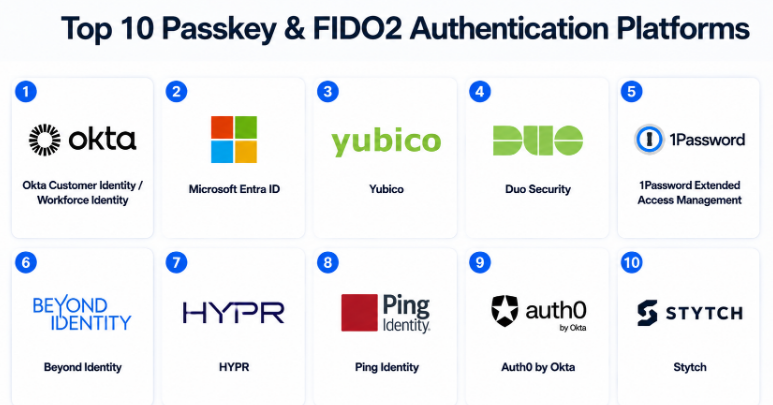
Top 10 Passkey & FIDO2 Authentication Platforms
#1 — Okta Customer Identity / Workforce Identity
Short description :
Okta is a leading identity platform used by businesses to manage workforce and customer authentication. It supports modern authentication methods, including passwordless and phishing-resistant login patterns. Okta is best suited for organizations that need centralized identity, SSO, MFA, lifecycle management, and strong integration with enterprise apps. It is a strong fit for mid-market and enterprise teams that want passkeys as part of a broader identity strategy.
Key Features
- Workforce and customer identity support
- Passwordless authentication options
- FIDO2/WebAuthn support
- SSO and MFA capabilities
- Identity lifecycle management
- Risk-based authentication controls
- Large application integration ecosystem
Pros
- Strong enterprise identity ecosystem
- Good fit for complex workforce authentication
- Broad app and directory integrations
Cons
- Can be expensive for smaller teams
- Setup may require identity expertise
- Advanced features may depend on plan level
Platforms / Deployment
Web / Cloud / Hybrid identity integrations
Security & Compliance
SSO/SAML, MFA, RBAC, audit logs, encryption, and enterprise policy controls are available. SOC 2 and ISO 27001 are commonly associated with enterprise identity platforms, but specific compliance scope should be verified. HIPAA support is Not publicly stated unless confirmed by contract.
Integrations & Ecosystem
Okta has a broad ecosystem for enterprise applications, identity providers, HR systems, directories, and security tools.
- SAML and OIDC apps
- HR systems
- Directory services
- SIEM tools
- Endpoint and device management
- API-based identity workflows
Support & Community
Okta provides documentation, onboarding resources, enterprise support tiers, partner services, and a strong identity community. Support level depends on the selected plan.
#2 — Microsoft Entra ID
Short description :
Microsoft Entra ID is Microsoft’s cloud identity platform for workforce authentication, access management, and security controls. It supports passwordless authentication methods, including FIDO2 security keys and passkey-related experiences within the Microsoft ecosystem. It is especially useful for organizations already using Microsoft 365, Windows, Azure, and Microsoft security tools.
Key Features
- Passwordless authentication support
- FIDO2 security key support
- Conditional Access policies
- MFA and SSO
- Identity governance features
- Integration with Microsoft 365 and Azure
- Security reporting and audit logs
Pros
- Strong fit for Microsoft-based organizations
- Deep integration with Windows and Microsoft 365
- Mature enterprise identity controls
Cons
- Best value comes inside Microsoft ecosystem
- Licensing can be complex
- Non-Microsoft environments may need extra planning
Platforms / Deployment
Web / Windows / macOS / iOS / Android
Cloud / Hybrid
Security & Compliance
SSO/SAML, MFA, RBAC, audit logs, encryption, Conditional Access, and identity governance are available. Compliance coverage varies by Microsoft cloud services and subscription.
Integrations & Ecosystem
Microsoft Entra ID works deeply with Microsoft apps, cloud services, endpoint tools, and enterprise security workflows.
- Microsoft 365
- Azure services
- Windows devices
- SAML and OIDC apps
- SIEM and security tools
- Endpoint management platforms
Support & Community
Microsoft offers extensive documentation, enterprise support plans, partner services, and a large admin community. Support depth depends on licensing and support contract.
#3 — Yubico
Short description :
Yubico is widely known for YubiKey hardware security keys that support FIDO2, WebAuthn, U2F, smart card, and other strong authentication methods. It is a strong choice for phishing-resistant MFA, privileged access, developers, admins, executives, and high-risk users. Yubico is not a full identity provider by itself, but it works with many identity and security platforms.
Key Features
- FIDO2 and WebAuthn support
- Hardware security keys
- Phishing-resistant MFA
- Support for multiple authentication protocols
- Enterprise key management options
- Broad identity platform compatibility
- Strong fit for privileged users
Pros
- Highly trusted hardware-based authentication
- Strong phishing resistance
- Works with many identity providers
Cons
- Requires physical key distribution and management
- Lost key recovery must be planned carefully
- Not a full identity platform by itself
Platforms / Deployment
Windows / macOS / Linux / iOS / Android support varies by key and device
Hardware / Hybrid
Security & Compliance
FIDO2, WebAuthn, and hardware-backed authentication are supported. Compliance details depend on deployment and customer environment. SOC 2, ISO 27001, and HIPAA are Not publicly stated for every use case.
Integrations & Ecosystem
Yubico integrates with major identity providers, operating systems, browsers, developer tools, and enterprise access systems.
- Okta
- Microsoft Entra ID
- Google Workspace
- Duo
- SSO platforms
- Privileged access tools
Support & Community
Yubico has strong documentation, enterprise programs, partner support, and a large security community. Hardware deployment planning is important for success.
#4 — Duo Security
Short description :
Duo Security, part of Cisco, is an access security platform focused on MFA, device trust, and secure access. It supports phishing-resistant authentication methods and works well for workforce security. Duo is suitable for businesses that want strong MFA, user-friendly access controls, device visibility, and policy enforcement without replacing their full identity provider.
Key Features
- MFA and passwordless authentication support
- FIDO2 security key support
- Device trust and posture checks
- Adaptive access policies
- SSO support
- Admin dashboard and reporting
- Broad application coverage
Pros
- Strong MFA and access security focus
- User-friendly authentication experience
- Good fit for workforce protection
Cons
- Not a full CIAM platform
- Advanced controls may require higher plans
- Best results need careful policy design
Platforms / Deployment
Web / Windows / macOS / Linux / iOS / Android
Cloud / Hybrid
Security & Compliance
MFA, SSO, audit logs, device trust controls, and policy management are available. Compliance details vary by plan and Cisco offering.
Integrations & Ecosystem
Duo integrates with identity providers, VPNs, cloud apps, internal apps, and endpoint-related workflows.
- SSO platforms
- VPNs
- Cloud applications
- Device trust tools
- Directory services
- Security reporting workflows
Support & Community
Duo provides strong documentation, onboarding resources, business support, and Cisco-backed enterprise support options.
#5 — 1Password Extended Access Management
Short description :
1Password is best known as a password manager, but it has expanded into access management and passkey support. It helps individuals and businesses manage credentials, passkeys, secrets, and secure access workflows. It is useful for teams that want password management today while gradually moving toward passkeys and stronger access controls.
Key Features
- Passkey storage and management
- Password management
- Secure sharing
- Business admin controls
- Device and browser support
- Developer secrets workflows
- Access management capabilities
Pros
- Strong usability for employees
- Good bridge from passwords to passkeys
- Useful for teams managing many credentials
Cons
- Not a complete replacement for an enterprise identity provider
- Some advanced access features may require specific plans
- Passkey strategy still depends on supported apps
Platforms / Deployment
Web / Windows / macOS / Linux / iOS / Android
Cloud
Security & Compliance
MFA, encryption, admin controls, audit logs, and business security controls are available. SOC 2 details are commonly associated with business security posture, but exact scope should be verified. HIPAA and ISO 27001 details are Not publicly stated unless contractually confirmed.
Integrations & Ecosystem
1Password integrates with browsers, developer tools, business workflows, identity systems, and security processes.
- Browser extensions
- Developer tools
- SSO workflows
- SCIM provisioning
- Secrets management
- Business admin console
Support & Community
1Password has strong documentation, business support, user guides, and a large customer community. Enterprise support depends on plan.
#6 — Beyond Identity
Short description :
Beyond Identity is a passwordless authentication platform focused on phishing-resistant access, device identity, and security policy enforcement. It is designed for organizations that want to remove passwords and reduce credential-based attacks. The platform is suitable for workforce security, developer access, and high-assurance login use cases.
Key Features
- Passwordless authentication
- Phishing-resistant access
- Device-based trust signals
- Policy-based authentication
- Enterprise access controls
- Identity provider integrations
- Risk-aware authentication workflows
Pros
- Strong passwordless-first approach
- Good fit for phishing-resistant authentication
- Useful for device-aware access decisions
Cons
- May require process change for users and admins
- Best fit for teams ready for passwordless maturity
- Pricing and packaging may need vendor confirmation
Platforms / Deployment
Web / Windows / macOS / Linux / iOS / Android
Cloud / Hybrid
Security & Compliance
SSO integrations, policy controls, device trust, and audit capabilities are available. Specific SOC 2, ISO 27001, GDPR, or HIPAA details should be verified. If unknown, treat as Not publicly stated.
Integrations & Ecosystem
Beyond Identity connects with existing identity providers and enterprise security workflows.
- Identity providers
- SSO platforms
- Device security tools
- Conditional access workflows
- Developer access systems
- Security operations tools
Support & Community
Documentation and business support are available. Community size is smaller than older identity vendors, but the platform is focused on modern passwordless security.
#7 — HYPR
Short description :
HYPR is a passwordless authentication platform designed for enterprise and regulated environments. It focuses on phishing-resistant authentication, decentralized credential security, and workforce login experiences. HYPR is useful for companies that want to modernize authentication while improving security and reducing password dependency.
Key Features
- Passwordless authentication
- FIDO-based authentication support
- Phishing-resistant MFA
- Enterprise policy controls
- Workforce authentication workflows
- Identity provider integrations
- Admin reporting and visibility
Pros
- Strong focus on enterprise passwordless access
- Good fit for regulated and security-sensitive teams
- Supports modern authentication standards
Cons
- May be more than small businesses need
- Implementation planning is important
- Public pricing details are often limited
Platforms / Deployment
Web / Windows / macOS / iOS / Android
Cloud / Hybrid
Security & Compliance
FIDO-based authentication, enterprise policy controls, and audit features are available. SOC 2, ISO 27001, HIPAA, and GDPR specifics should be verified directly. If uncertain, use Not publicly stated.
Integrations & Ecosystem
HYPR works with identity providers, enterprise access systems, and workforce authentication environments.
- SSO providers
- Directory services
- Enterprise applications
- Device-based authentication flows
- Security dashboards
- Access management systems
Support & Community
HYPR provides enterprise-focused support and implementation guidance. Public community size is smaller than broader IAM platforms.
#8 — Ping Identity
Short description :
Ping Identity is an enterprise identity platform used for workforce and customer identity use cases. It supports modern authentication, MFA, SSO, adaptive policies, and passwordless strategies. Ping is a strong option for large organizations that need flexible identity architecture, hybrid deployment options, and advanced access control.
Key Features
- Workforce and customer identity support
- MFA and passwordless capabilities
- SSO and federation
- Adaptive authentication
- Hybrid identity architecture
- API and developer support
- Enterprise policy controls
Pros
- Strong for complex enterprise identity needs
- Good hybrid and large-scale architecture support
- Useful for customer and workforce use cases
Cons
- Can be complex for smaller teams
- Implementation may require expert support
- Licensing and packaging may need careful review
Platforms / Deployment
Web / Cloud / Self-hosted / Hybrid
Security & Compliance
SSO/SAML, MFA, RBAC, audit logs, encryption, and policy controls are available. Compliance details vary by product and deployment model.
Integrations & Ecosystem
Ping Identity integrates with enterprise apps, APIs, directories, cloud systems, and legacy identity environments.
- SAML and OIDC applications
- API gateways
- Directory services
- Cloud apps
- Legacy systems
- Security analytics tools
Support & Community
Ping provides enterprise documentation, implementation partners, support plans, and professional services. It is best suited for teams with identity architecture needs.
#9 — Auth0 by Okta
Short description :
Auth0 is a customer identity and access management platform used by developers to add authentication to applications. It supports modern login methods, passwordless flows, social login, enterprise federation, and passkey-related authentication patterns. Auth0 is especially useful for SaaS products, consumer apps, and developer teams that need flexible authentication APIs.
Key Features
- Customer identity management
- Passwordless authentication options
- WebAuthn/passkey support
- Social login and enterprise federation
- Developer APIs and SDKs
- Rules/actions for customization
- Tenant-based admin controls
Pros
- Strong developer experience
- Good for SaaS and customer-facing apps
- Flexible authentication customization
Cons
- Costs can increase with scale
- Advanced customization needs developer skill
- Enterprise features may require higher plans
Platforms / Deployment
Web / Cloud
Security & Compliance
SSO/SAML, MFA, audit logs, encryption, and admin controls are available. Compliance details vary by plan and product scope. HIPAA and some regulated use cases should be verified contractually.
Integrations & Ecosystem
Auth0 has a strong developer and application ecosystem.
- Web and mobile apps
- APIs and SDKs
- Social identity providers
- Enterprise identity providers
- SAML and OIDC
- Application security workflows
Support & Community
Auth0 has strong documentation, developer guides, community support, and enterprise support options. It is popular with developer teams.
#10 — Stytch
Short description :
Stytch is a developer-first authentication platform for building modern login experiences, including passkeys, passwordless login, email magic links, OTP, and fraud-aware authentication flows. It is best suited for SaaS teams, consumer apps, and product teams that want flexible authentication without building everything in-house.
Key Features
- Passkey authentication support
- Passwordless login flows
- Developer APIs and SDKs
- User management
- Fraud and risk signals
- B2B and consumer authentication options
- Flexible login orchestration
Pros
- Strong developer-first approach
- Good for modern customer login experiences
- Flexible passwordless options
Cons
- Not mainly a workforce IAM platform
- Enterprise depth may vary by use case
- Requires developer implementation work
Platforms / Deployment
Web / Cloud / Mobile app integrations
Security & Compliance
MFA, passkeys, encryption, admin controls, and security-focused authentication workflows are available. SOC 2, ISO 27001, HIPAA, and GDPR details should be verified. If uncertain, write Not publicly stated.
Integrations & Ecosystem
Stytch integrates through APIs, SDKs, application frameworks, and customer identity workflows.
- Web applications
- Mobile applications
- Backend systems
- API-based auth flows
- Fraud signals
- Product analytics workflows
Support & Community
Stytch offers developer documentation and support resources. Enterprise support availability depends on plan and contract.
Comparison Table
| Tool Name | Best For | Platform(s) Supported | Deployment | Standout Feature | Public Rating |
|---|---|---|---|---|---|
| Okta Customer Identity / Workforce Identity | Enterprise identity and access management | Web, cloud apps, workforce systems | Cloud / Hybrid | Broad identity ecosystem | N/A |
| Microsoft Entra ID | Microsoft-based organizations | Web, Windows, macOS, iOS, Android | Cloud / Hybrid | Deep Microsoft integration | N/A |
| Yubico | Hardware-backed phishing-resistant MFA | Windows, macOS, Linux, iOS, Android | Hardware / Hybrid | FIDO2 security keys | N/A |
| Duo Security | Workforce MFA and device trust | Web, Windows, macOS, Linux, iOS, Android | Cloud / Hybrid | Easy MFA and access security | N/A |
| 1Password Extended Access Management | Password and passkey management | Web, Windows, macOS, Linux, iOS, Android | Cloud | Passkeys plus credential management | N/A |
| Beyond Identity | Passwordless workforce security | Web, Windows, macOS, Linux, iOS, Android | Cloud / Hybrid | Device-based passwordless access | N/A |
| HYPR | Enterprise passwordless authentication | Web, Windows, macOS, iOS, Android | Cloud / Hybrid | Phishing-resistant passwordless login | N/A |
| Ping Identity | Large enterprise identity architecture | Web, enterprise apps, APIs | Cloud / Self-hosted / Hybrid | Flexible enterprise identity architecture | N/A |
| Auth0 by Okta | Developer-first customer authentication | Web, mobile apps, APIs | Cloud | Flexible CIAM APIs | N/A |
| Stytch | Modern app passkey authentication | Web, mobile apps, APIs | Cloud | Developer-friendly passkey implementation | N/A |
Evaluation & Passkey & FIDO2 Authentication Platforms
| Tool Name | Core (25%) | Ease (15%) | Integrations (15%) | Security (10%) | Performance (10%) | Support (10%) | Value (15%) | Weighted Total (0–10) |
|---|---|---|---|---|---|---|---|---|
| Okta Customer Identity / Workforce Identity | 9 | 8 | 10 | 9 | 9 | 9 | 7 | 8.75 |
| Microsoft Entra ID | 9 | 8 | 10 | 9 | 9 | 9 | 8 | 8.90 |
| Yubico | 9 | 7 | 9 | 10 | 9 | 8 | 8 | 8.55 |
| Duo Security | 8 | 9 | 8 | 9 | 8 | 8 | 8 | 8.30 |
| 1Password Extended Access Management | 8 | 9 | 8 | 8 | 8 | 8 | 8 | 8.15 |
| Beyond Identity | 8 | 7 | 8 | 9 | 8 | 7 | 7 | 7.75 |
| HYPR | 8 | 7 | 8 | 9 | 8 | 7 | 7 | 7.75 |
| Ping Identity | 9 | 7 | 9 | 9 | 8 | 8 | 7 | 8.20 |
| Auth0 by Okta | 8 | 8 | 9 | 8 | 8 | 8 | 7 | 8.05 |
| Stytch | 8 | 8 | 8 | 8 | 8 | 7 | 8 | 7.95 |
The scores are comparative and based on general product fit, not a fixed universal ranking. A high enterprise score does not always mean the tool is best for a small team. A developer-first platform may score lower in enterprise governance but still be the best choice for a SaaS product. Buyers should validate each score against their own use case, budget, compliance needs, user base, and integration requirements.
Which Passkey & FIDO2 Authentication Platform Should You Choose?
Solo / Freelancer
Solo users usually need simple protection, secure login, and easy credential management. 1Password and Yubico are strong choices because they help reduce password risk without requiring complex identity architecture.
For developers building apps, Stytch or Auth0 can be useful because they provide APIs and ready-made authentication flows.
SMB
SMBs should look for ease of rollout, strong MFA, passkey support, admin visibility, and simple pricing. Duo Security, 1Password, Microsoft Entra ID, and Okta can work well depending on the current tech stack.
If the SMB already uses Microsoft 365, Microsoft Entra ID is usually a practical starting point. If the company wants stronger access protection without a large IAM project, Duo is also a good option.
Mid-Market
Mid-market companies need stronger policy controls, identity integrations, audit logs, and scalable administration. Okta, Microsoft Entra ID, Duo, Yubico, Beyond Identity, and HYPR are suitable options.
The right platform depends on whether the goal is workforce access, customer login, privileged access, or full passwordless transformation.
Enterprise
Enterprises should prioritize phishing-resistant MFA, identity governance, policy control, auditability, recovery processes, SSO, directory integration, and compliance readiness. Okta, Microsoft Entra ID, Ping Identity, Yubico, HYPR, and Beyond Identity are stronger enterprise candidates.
For high-risk users such as admins, executives, and developers, hardware-backed FIDO2 authentication through Yubico can add strong protection.
Budget vs Premium
For budget-conscious teams, Microsoft Entra ID may be practical if already included in existing Microsoft licensing. 1Password and Duo can also be cost-effective depending on needs.
Premium choices such as Okta, Ping Identity, HYPR, and Beyond Identity may offer deeper identity controls, but they require larger planning and budget.
Feature Depth vs Ease of Use
1Password and Duo are easier for many teams to adopt. Okta, Microsoft Entra ID, and Ping Identity offer deeper identity features but may require more administration.
Developer-first platforms like Auth0 and Stytch are easier for product teams building customer login flows, but they still require engineering effort.
Integrations & Scalability-
Okta, Microsoft Entra ID, Ping Identity, and Auth0 are strong for integration-heavy environments. Yubico integrates broadly as a hardware authentication layer. Duo fits well where organizations need MFA and device trust across many apps.
Before choosing, check support for SAML, OIDC, SCIM, HR systems, directories, endpoint tools, SIEM, and application frameworks.
Security & Compliance Needs
For high-security environments, prioritize FIDO2, WebAuthn, phishing-resistant MFA, audit logs, RBAC, SSO, device trust, and recovery controls. Compliance-sensitive organizations should verify SOC 2, ISO 27001, GDPR, HIPAA, data residency, and audit support directly with the vendor.
Do not select only based on passkey support. Also evaluate lifecycle management, user recovery, lost device handling, admin access, and emergency access processes.
Frequently Asked Questions
1. What is a passkey?
A passkey is a modern login credential that lets users sign in without typing a password. It usually uses biometrics, device security, or a hardware security key to confirm the user safely.
2. What is FIDO2 authentication?
FIDO2 is an authentication standard that supports passwordless and phishing-resistant login. It uses public key cryptography so the user’s private credential is not shared with the website or app.
3. Are passkeys safer than passwords?
Yes, passkeys are generally safer because they reduce phishing, password reuse, and credential theft risk. However, organizations still need strong recovery, device management, and policy controls.
4. Do passkeys replace MFA?
In many cases, passkeys can act as strong MFA or passwordless authentication. For high-risk users, companies may still combine passkeys with device trust, conditional access, or hardware security keys.
5. What is the common pricing model?
Pricing varies by vendor. Some platforms charge per user, per monthly active user, per employee, per app, or by enterprise contract. If pricing is not clear, treat it as Varies / N/A.
6. How long does implementation take?
Implementation depends on the environment. A small team can start quickly, but enterprise rollout may require identity planning, app testing, user training, recovery workflows, and staged migration.
7. What is the biggest mistake during rollout?
The biggest mistake is enabling passwordless login without a clear recovery process. Lost devices, employee exits, shared devices, and admin lockouts must be planned before full rollout.
8. Do all browsers and devices support passkeys?
Most modern browsers and major operating systems support passkeys, but behavior can vary by device, browser, platform, and enterprise policy. Always test with your real user base.
9. Can passkeys work for customer-facing apps?
Yes. Platforms like Auth0 and Stytch are strong for customer authentication use cases. Product teams should focus on user experience, account recovery, device compatibility, and fraud controls.
10. What alternatives should we consider?
Alternatives include traditional MFA, password managers, hardware security keys, SSO, conditional access, privileged access management, and full identity governance tools. In many cases, passkeys work best as part of a broader identity strategy.
Conclusion
Passkey and FIDO2 authentication platforms are becoming important because passwords are no longer enough for modern security. They help reduce phishing, credential theft, MFA fatigue, and password reset problems while improving the login experience for users. Still, the best platform depends on the business context. Microsoft Entra ID is strong for Microsoft-based organizations. Okta and Ping Identity are strong for large identity programs. Yubico is excellent for hardware-backed phishing-resistant MFA. Duo is practical for workforce MFA and device trust. Auth0 and Stytch are strong for developers building customer login flows. 1Password is useful for teams moving from password management toward passkeys. Beyond Identity and HYPR fit organizations serious about passwordless transformation.
