Introduction
Investing Portfolio Trackers are tools that help investors monitor all their investments in one place. They can track stocks, mutual funds, ETFs, bonds, crypto, retirement accounts, cash positions, dividends, fees, and performance over time. In simple words, these tools help users understand where their money is invested, how it is performing, and whether the portfolio is aligned with their goals.
These platforms matter more now because investors often use multiple brokers, apps, banks, and asset classes. Without a clear tracker, it becomes difficult to see real returns, risk exposure, taxes, asset allocation, and long-term progress.
Common use cases include personal wealth tracking, retirement planning, dividend monitoring, multi-broker portfolio analysis, crypto and stock tracking, family investment reporting, and advisor-client portfolio review.
Buyers should evaluate:
- Asset class coverage
- Broker and bank integrations
- Reporting quality
- Tax and dividend tracking
- Privacy and security controls
- Mobile app experience
- Pricing transparency
- Ease of use
- Data refresh reliability
- Export and analysis features
Best for: Individual investors, freelancers, wealth-conscious families, financial advisors, small investment teams, and professionals managing multiple accounts across stocks, ETFs, mutual funds, crypto, and retirement portfolios.
Not ideal for: Users with only one simple brokerage account who already get enough reporting from their broker. It may also not be ideal for large institutional asset managers who need full portfolio accounting, compliance, trade order management, and enterprise-grade investment operations platforms.
Key Trends in Investing Portfolio Trackers
- AI-based portfolio insights are becoming more common, helping users detect concentration risk, hidden fees, underperforming assets, and rebalancing opportunities.
- Multi-asset tracking is now expected, including stocks, ETFs, mutual funds, bonds, crypto, real estate, cash, and retirement accounts.
- Automatic broker syncing is improving, but data reliability still depends on supported financial institutions and API quality.
- Privacy-first portfolio tracking is gaining attention as users become more careful about linking financial accounts.
- Tax-aware reporting is becoming more valuable, especially for capital gains, dividends, tax-loss harvesting, and annual reports.
- Goal-based dashboards are replacing basic performance charts, helping users track retirement, wealth growth, passive income, and savings targets.
- Mobile-first investing behavior is driving demand for clean dashboards, alerts, and simple portfolio summaries.
- Crypto and alternative asset support is now a key differentiator for users with diversified digital and non-traditional assets.
- Subscription pricing models are common, with premium features often locked behind paid plans.
- Advisor-friendly reporting is growing, especially for tools that support family offices, wealth advisors, and client-ready reports.
How We Selected These Tools
- Selected tools with strong market recognition and active investor usage.
- Included a balanced mix of personal finance platforms, portfolio analytics tools, dividend trackers, crypto-aware trackers, and advisor-friendly solutions.
- Evaluated feature depth across portfolio tracking, performance analysis, allocation reporting, and account aggregation.
- Considered usability for solo investors, families, advisors, and advanced portfolio users.
- Reviewed ecosystem strength such as broker syncing, manual entry, CSV import, exports, and reporting.
- Considered security signals such as MFA, encryption, account-linking controls, and privacy posture where publicly known.
- Included tools that serve different investment styles such as long-term investing, dividend income, retirement planning, and active tracking.
- Avoided tools that are too narrow, inactive, or not clearly focused on portfolio tracking.
- Used “N/A” where public ratings or specific compliance details are not confidently known.
- Scoring is comparative and practical, not a formal financial recommendation.
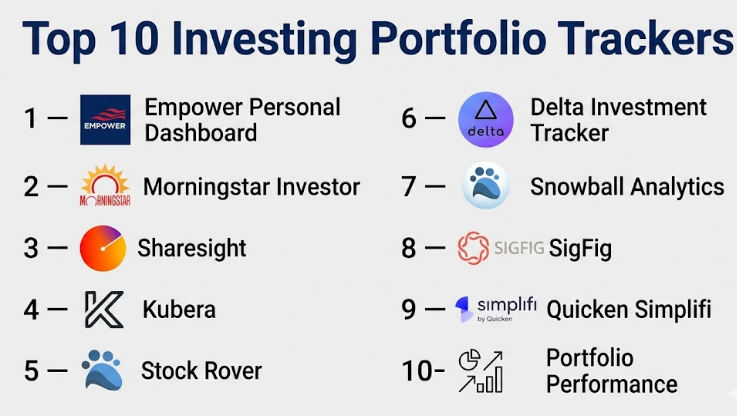
Top 10 Investing Portfolio Trackers
#1 — Empower Personal Dashboard
Short description :
Empower Personal Dashboard is a personal finance and investment tracking platform designed for individuals who want a full view of their net worth, investment accounts, cash flow, and retirement planning. It is useful for users who want portfolio tracking combined with broader financial planning. The tool can help investors monitor asset allocation, fees, account balances, and long-term financial progress. It is especially helpful for people managing multiple accounts across banks, brokers, and retirement platforms. It is not just an investment tracker; it also works as a broader wealth dashboard.
Key Features
- Net worth tracking across linked accounts
- Investment allocation analysis
- Retirement planning tools
- Fee analyzer for investment accounts
- Cash flow and spending visibility
- Mobile and web dashboards
- Multi-account aggregation
Pros
- Strong for full financial picture, not only investments.
- Useful retirement and fee analysis features.
- Good fit for long-term investors with multiple accounts.
Cons
- Some users may find it more financial-planning focused than portfolio-analysis focused.
- Account syncing quality may vary by institution.
- Advanced trading-focused analytics are limited.
Platforms / Deployment
Web / iOS / Android
Cloud
Security & Compliance
MFA and encryption are commonly expected for financial account aggregation. Specific certifications such as SOC 2 or ISO 27001 are Not publicly stated.
Integrations & Ecosystem
Empower supports account aggregation across many financial institutions, making it useful for users who want a single dashboard for investments and personal finance.
- Bank account connections
- Brokerage account connections
- Retirement account tracking
- Credit and cash account visibility
- Mobile app ecosystem
Support & Community
Documentation and user support are available through standard help resources. Support depth may vary by account type and service level.
#2 — Morningstar Investor
Short description :
Morningstar Investor is designed for investors who want research-driven portfolio tracking and investment analysis. It is especially useful for mutual fund, ETF, and stock investors who value ratings, portfolio X-ray style analysis, asset allocation views, and research-backed insights. The platform is suitable for long-term investors who want to understand risk, diversification, and fund quality. It is more analytical than many basic portfolio trackers. It works well for users who prefer research and portfolio intelligence over simple balance tracking.
Key Features
- Portfolio analysis and asset allocation views
- Fund, ETF, and stock research
- Investment ratings and analyst insights where available
- Portfolio X-ray style exposure analysis
- Watchlists and investment monitoring
- Risk and diversification review
- Research-focused investment tools
Pros
- Strong research depth for funds, ETFs, and stocks.
- Useful for long-term portfolio review.
- Good for investors who want more than simple tracking.
Cons
- May feel complex for beginners.
- Premium research features may require paid access.
- Less focused on budgeting or daily personal finance.
Platforms / Deployment
Web / iOS / Android
Cloud
Security & Compliance
Standard account security controls are expected. Specific compliance certifications are Not publicly stated.
Integrations & Ecosystem
Morningstar Investor is strongest as a research and portfolio analysis environment rather than a broad automation hub.
- Portfolio import options
- Watchlists
- Fund and ETF research database
- Stock research tools
- Portfolio exposure analysis
Support & Community
Morningstar has a strong brand presence and educational content ecosystem. Support options vary by subscription and region.
#3 — Sharesight
Short description :
Sharesight is an investment portfolio tracker built for investors who need detailed performance, dividend, and tax reporting. It is popular among users who invest across multiple markets and want accurate return calculations. The platform is especially useful for investors who care about income tracking, capital gains reporting, and multi-currency portfolios. It supports both casual and serious investors, including accountants and advisors in some use cases. Sharesight is strong when reporting accuracy matters.
Key Features
- Portfolio performance tracking
- Dividend and income reporting
- Capital gains tax reporting
- Multi-currency support
- Broker import and trade confirmation support
- Taxable income reports
- Portfolio sharing options
Pros
- Strong tax and dividend reporting.
- Good for investors across multiple markets.
- Useful for long-term investors and accountants.
Cons
- May require careful setup for accurate reporting.
- Some advanced features may require paid plans.
- Interface may feel detailed for very casual investors.
Platforms / Deployment
Web / iOS / Android
Cloud
Security & Compliance
Encryption and secure account handling are expected. Specific certifications such as SOC 2 or ISO 27001 are Not publicly stated.
Integrations & Ecosystem
Sharesight has a practical ecosystem for brokers, trade imports, and reporting workflows.
- Broker import support
- CSV import
- Trade confirmation forwarding
- Tax report exports
- Accountant and advisor sharing options
Support & Community
Sharesight provides documentation, help resources, and plan-based support. Community visibility is moderate but the platform is well known among portfolio tracking users.
#4 — Kubera
Short description :
Kubera is a modern net worth and portfolio tracker designed for users who want to track traditional and alternative assets in one place. It can be useful for high-net-worth individuals, families, founders, and investors with assets beyond public stocks. Users can track brokerage accounts, crypto, real estate, private investments, domains, precious metals, and cash assets. Kubera focuses on clean wealth tracking rather than heavy financial planning. It is a strong choice for users with complex personal balance sheets.
Key Features
- Net worth tracking across many asset types
- Traditional and alternative asset support
- Crypto and digital asset tracking
- Real estate and private asset entries
- Beneficiary and legacy planning features
- Clean dashboard experience
- Manual and automated account tracking
Pros
- Strong for total wealth tracking.
- Good for alternative and private assets.
- Clean interface for complex portfolios.
Cons
- May be more expensive than basic trackers.
- Not designed for deep stock research.
- Some data connections may vary by region.
Platforms / Deployment
Web
Cloud
Security & Compliance
Security features are expected for account aggregation and sensitive financial data. Specific certifications are Not publicly stated.
Integrations & Ecosystem
Kubera supports a wide range of asset connections and manual tracking options.
- Financial account connections
- Crypto wallet and exchange tracking
- Real estate tracking
- Manual asset entries
- Net worth reporting
Support & Community
Support is available through product help and customer channels. Community strength is smaller than mass-market personal finance tools.
#5 — Stock Rover
Short description :
Stock Rover is a research and portfolio analysis platform built for stock, ETF, and income-focused investors. It is especially helpful for users who want screening, portfolio analytics, comparison tools, and deeper fundamental data. Investors can use it to analyze holdings, compare securities, track dividends, and review portfolio health. It fits advanced individual investors who want more control and analysis depth. It is less of a simple net worth tracker and more of an investment research workstation.
Key Features
- Stock and ETF screening
- Portfolio analytics
- Dividend tracking
- Fundamental research data
- Watchlists and alerts
- Portfolio comparison tools
- Investment research reports
Pros
- Strong analysis depth for serious investors.
- Useful screening and comparison tools.
- Good for dividend and stock research workflows.
Cons
- Learning curve may be higher for beginners.
- Less focused on broad personal finance.
- Full feature access may require paid plans.
Platforms / Deployment
Web
Cloud
Security & Compliance
Standard account security controls are expected. Specific certifications are Not publicly stated.
Integrations & Ecosystem
Stock Rover works well for investors who want screening, research, and portfolio analytics in one place.
- Brokerage portfolio import options
- Watchlists
- Research data tools
- Alerts
- Portfolio reports
Support & Community
Documentation and learning resources are available. It has a strong following among self-directed investors, especially those focused on stock research.
#6 — Delta Investment Tracker
Short description :
Delta Investment Tracker is a mobile-first portfolio tracker designed for users who want to monitor stocks, crypto, ETFs, and other investments in a simple interface. It is useful for investors who want quick performance visibility, alerts, and multi-asset tracking. The platform is especially attractive for users with both traditional and crypto assets. Delta focuses on ease of use and daily portfolio visibility. It is best for investors who prefer a modern app experience over complex reporting.
Key Features
- Stocks, ETFs, crypto, and asset tracking
- Mobile-first portfolio dashboard
- Price alerts and watchlists
- Performance overview
- Multi-asset support
- Manual and connected tracking options
- News and market updates
Pros
- Clean mobile experience.
- Good for mixed stock and crypto portfolios.
- Easy for beginners to start tracking.
Cons
- Advanced tax reporting may be limited.
- Serious research features are not as deep as specialist platforms.
- Some integrations and features may vary by plan.
Platforms / Deployment
iOS / Android / Web
Cloud
Security & Compliance
Security details are Not publicly stated beyond standard app security expectations.
Integrations & Ecosystem
Delta supports a mix of asset tracking options and integrations useful for modern investors.
- Crypto exchange connections
- Wallet tracking support
- Stock and ETF tracking
- Alerts and watchlists
- Mobile notifications
Support & Community
Support resources are available through help channels. Community presence is stronger among mobile and crypto-focused investors.
#7 — Snowball Analytics
Short description :
Snowball Analytics is a portfolio tracking and dividend-focused analytics platform for investors who want to track performance, income, allocation, and investment progress. It is especially useful for long-term investors who care about dividend growth and portfolio quality. The tool supports tracking across different assets and provides visual dashboards for portfolio review. It is suitable for individuals who want practical analysis without enterprise complexity. Snowball Analytics is a good fit for investors focused on clarity and income visibility.
Key Features
- Portfolio tracking dashboard
- Dividend income tracking
- Asset allocation views
- Performance analytics
- Watchlists
- Multi-currency support where available
- Visual reporting
Pros
- Strong fit for dividend-focused investors.
- Clean dashboard and practical insights.
- Useful for long-term wealth tracking.
Cons
- May not have the same research depth as larger platforms.
- Some broker integrations may vary by region.
- Advanced tax features may be limited.
Platforms / Deployment
Web
Cloud
Security & Compliance
Not publicly stated.
Integrations & Ecosystem
Snowball Analytics supports portfolio tracking workflows with a focus on performance and income visibility.
- Portfolio imports
- Manual transaction entry
- Dividend tracking
- Watchlists
- Reporting dashboards
Support & Community
Support and documentation are available. Community strength is growing but may be smaller than older investment platforms.
#8 — SigFig
Short description :
SigFig is known for portfolio tracking and investment advisory-related tools. It can help users monitor investment accounts, analyze portfolio allocation, and identify areas that may need improvement. The platform has historically focused on portfolio management, investment advice, and account aggregation. It is useful for investors who want portfolio visibility with guidance-oriented features. It may be more suitable for users looking for managed or advisory-style experiences rather than deep DIY research.
Key Features
- Portfolio tracking
- Account aggregation
- Allocation analysis
- Investment guidance features
- Risk review
- Performance monitoring
- Advisory-oriented workflows
Pros
- Useful for users who want guided portfolio review.
- Good for account aggregation and allocation visibility.
- Suitable for investors who prefer simplified insights.
Cons
- Less suited for advanced stock research.
- Features may depend on service availability.
- Not as flexible for alternative assets.
Platforms / Deployment
Web / iOS / Android
Cloud
Security & Compliance
Standard financial platform security is expected. Specific certifications are Not publicly stated.
Integrations & Ecosystem
SigFig works around account aggregation and advisory-style portfolio review.
- Brokerage account connections
- Portfolio analysis
- Allocation review
- Advisory workflows
- Mobile access
Support & Community
Support availability varies by product and service model. Public community depth is moderate.
#9 — Quicken Simplifi
Short description :
Quicken Simplifi is a personal finance app that includes investment tracking along with budgeting, spending, savings, and cash flow management. It is useful for users who want money management and investment visibility in one platform. While it may not be the deepest investment analytics tool, it is practical for people who want a simple view of finances and portfolio balances. It fits households, individuals, and freelancers who want to connect daily money habits with long-term investing. It is more finance dashboard than investment research platform.
Key Features
- Investment balance tracking
- Budgeting and spending management
- Net worth dashboard
- Cash flow planning
- Account aggregation
- Savings goal tracking
- Mobile and web access
Pros
- Good all-in-one personal finance experience.
- Easy to use for everyday money management.
- Helpful for users who want investments and budget together.
Cons
- Investment analytics are not as deep as specialist tools.
- May not be enough for advanced investors.
- Account syncing can vary by institution.
Platforms / Deployment
Web / iOS / Android
Cloud
Security & Compliance
MFA and encryption are expected for financial account apps. Specific certifications are Not publicly stated.
Integrations & Ecosystem
Quicken Simplifi connects with financial accounts to give users a broader financial dashboard.
- Bank account aggregation
- Credit card tracking
- Brokerage balance tracking
- Spending categories
- Financial reports
Support & Community
Quicken has a long-standing personal finance software presence. Support resources and documentation are available.
#10 — Portfolio Performance
Short description :
Portfolio Performance is an open-source desktop portfolio tracking tool for users who prefer local control and detailed investment reporting. It is suitable for privacy-conscious investors who do not want a cloud-only tracker. The tool supports performance measurement, transaction tracking, charts, and portfolio analysis. It is useful for technically comfortable users who are willing to manage their own data. It may not be the easiest option for beginners, but it is powerful for self-directed investors who value control.
Key Features
- Open-source portfolio tracking
- Local desktop data storage
- Performance calculations
- Transaction tracking
- Charts and reports
- Multi-currency support
- Manual data management
Pros
- Strong privacy and local control.
- No need to rely fully on cloud aggregation.
- Good for detailed self-managed tracking.
Cons
- Setup may feel technical for beginners.
- Limited automated broker syncing compared with cloud tools.
- Desktop-first experience may not suit mobile-first users.
Platforms / Deployment
Windows / macOS / Linux
Self-hosted / Local desktop
Security & Compliance
Local data control is a key advantage. Formal compliance certifications are Not publicly stated.
Integrations & Ecosystem
Portfolio Performance is strongest for users who are comfortable importing and managing investment data themselves.
- CSV imports
- Manual transaction entry
- Price data configuration
- Local reports
- Community-supported workflows
Support & Community
Community support and documentation are available. As an open-source tool, support depends heavily on community resources rather than formal enterprise support tiers.
Comparison Table
| Tool Name | Best For | Platform(s) Supported | Deployment | Standout Feature | Public Rating |
|---|---|---|---|---|---|
| Empower Personal Dashboard | Net worth and retirement-focused investors | Web, iOS, Android | Cloud | Full financial dashboard with investment tracking | N/A |
| Morningstar Investor | Research-focused fund, ETF, and stock investors | Web, iOS, Android | Cloud | Research-backed portfolio analysis | N/A |
| Sharesight | Dividend, tax, and multi-market investors | Web, iOS, Android | Cloud | Tax and performance reporting | N/A |
| Kubera | High-net-worth and alternative asset tracking | Web | Cloud | Broad net worth and alternative asset tracking | N/A |
| Stock Rover | Advanced stock and ETF research investors | Web | Cloud | Deep screening and portfolio analytics | N/A |
| Delta Investment Tracker | Mobile-first stock and crypto investors | Web, iOS, Android | Cloud | Multi-asset mobile tracking | N/A |
| Snowball Analytics | Dividend and long-term portfolio investors | Web | Cloud | Dividend and income visibility | N/A |
| SigFig | Guided portfolio review and advisory-style users | Web, iOS, Android | Cloud | Allocation and guidance-oriented tracking | N/A |
| Quicken Simplifi | Personal finance users with basic investment tracking | Web, iOS, Android | Cloud | Budgeting plus investment visibility | N/A |
| Portfolio Performance | Privacy-focused self-directed investors | Windows, macOS, Linux | Local desktop / Self-hosted | Open-source local portfolio tracking | N/A |
Evaluation & Investing Portfolio Trackers
| Tool Name | Core (25%) | Ease (15%) | Integrations (15%) | Security (10%) | Performance (10%) | Support (10%) | Value (15%) | Weighted Total |
|---|---|---|---|---|---|---|---|---|
| Empower Personal Dashboard | 8.5 | 8.5 | 8.5 | 8.0 | 8.0 | 8.0 | 8.5 | 8.33 |
| Morningstar Investor | 8.5 | 7.5 | 7.5 | 7.5 | 8.5 | 8.0 | 7.5 | 7.98 |
| Sharesight | 9.0 | 7.5 | 8.0 | 7.5 | 8.5 | 8.0 | 8.0 | 8.23 |
| Kubera | 8.0 | 8.5 | 8.0 | 7.5 | 8.0 | 7.5 | 7.5 | 7.93 |
| Stock Rover | 9.0 | 7.0 | 7.5 | 7.5 | 8.5 | 8.0 | 8.0 | 8.05 |
| Delta Investment Tracker | 7.5 | 9.0 | 8.0 | 7.0 | 8.0 | 7.5 | 8.0 | 7.93 |
| Snowball Analytics | 8.0 | 8.0 | 7.5 | 7.0 | 8.0 | 7.0 | 8.0 | 7.73 |
| SigFig | 7.5 | 8.0 | 7.5 | 7.5 | 8.0 | 7.5 | 7.5 | 7.63 |
| Quicken Simplifi | 7.0 | 8.5 | 8.0 | 7.5 | 8.0 | 8.0 | 8.0 | 7.78 |
| Portfolio Performance | 8.0 | 6.5 | 6.5 | 8.0 | 8.0 | 7.0 | 9.0 | 7.55 |
These scores are comparative, not absolute. A higher score does not always mean the tool is best for every investor. For example, Portfolio Performance may score lower on ease of use but can be excellent for privacy-focused users. Sharesight may be stronger for tax reporting, while Stock Rover is stronger for research. Buyers should use the scores as a shortlist guide, then validate features, integrations, pricing, and security requirements before choosing.
Which Investing Portfolio Trackers
Solo / Freelancer
Solo investors and freelancers usually need a simple dashboard that shows net worth, portfolio growth, income, and risk exposure. They should avoid tools that require heavy setup unless they enjoy detailed analysis.
Good options:
- Empower Personal Dashboard for full financial visibility
- Quicken Simplifi for budgeting plus investments
- Delta Investment Tracker for mobile-first tracking
- Portfolio Performance for privacy-focused manual tracking
SMB
Small businesses, small advisory teams, and family offices may need more structured reporting and better portfolio views. They should focus on export options, tax reports, sharing features, and multi-account support.
Good options:
- Sharesight for tax and dividend reporting
- Kubera for complex asset tracking
- Morningstar Investor for research-backed portfolio review
- Stock Rover for investment analysis
Mid-Market
Mid-market users often need a mix of usability, integrations, and reporting depth. They may have multiple users, complex account structures, and reporting needs across different stakeholders.
Good options:
- Sharesight for reporting-heavy workflows
- Kubera for broad wealth visibility
- Morningstar Investor for research-led decisions
- Stock Rover for advanced analysis
Enterprise
Large enterprises, institutional investors, and wealth management firms may need more than a simple portfolio tracker. They may require compliance workflows, advanced reporting, client management, permissions, audit logs, and portfolio accounting.
Good options from this list may support only part of the need:
- Morningstar Investor for research support
- Sharesight for reporting use cases
- Kubera for executive or private wealth visibility
For full enterprise investment operations, dedicated portfolio management, accounting, and wealth management platforms may be better.
Budget vs Premium
Budget-conscious users should start with tools that provide enough basic tracking without unnecessary advanced features. Portfolio Performance can be attractive for users who prefer open-source and local control. Quicken Simplifi and Delta may be practical for users who want simple dashboards.
Premium users should look at Sharesight, Morningstar Investor, Kubera, or Stock Rover depending on whether they value tax reporting, research, alternative assets, or advanced analytics.
Feature Depth vs Ease of Use
If ease of use is the priority, Delta, Quicken Simplifi, and Empower Personal Dashboard are easier starting points. If feature depth matters more, Sharesight, Stock Rover, and Morningstar Investor provide stronger analytical value.
For users who want both simplicity and depth, the best approach is to start with a clean dashboard and then add a more advanced analytics tool only when needed.
Integrations & Scalability-
Investors with many accounts should prioritize tools with strong account aggregation, CSV imports, broker integrations, and export options. Sharesight, Empower Personal Dashboard, Kubera, and Quicken Simplifi are practical choices for multi-account visibility.
Users who invest globally should also check currency handling, market coverage, tax reports, and transaction import quality before committing.
Security & Compliance Needs
Security-sensitive users should review MFA, encryption, account linking methods, data storage practices, and export controls. Users who do not want cloud account aggregation may prefer Portfolio Performance because it gives more local control.
Financial advisors and teams should also check role-based access, audit logs, client sharing, and compliance documentation. If these details are not publicly stated, buyers should ask vendors directly before purchase.
Frequently Asked Questions
1. What is an Investing Portfolio Tracker?
An Investing Portfolio Tracker is a tool that helps users monitor investments across different accounts and asset classes. It usually shows holdings, balances, gains, losses, allocation, dividends, and overall performance in one dashboard.
2. How much do Investing Portfolio Trackers usually cost?
Pricing varies widely. Some tools offer free or basic plans, while others use monthly or annual subscriptions. Advanced features such as tax reporting, research data, account syncing, and premium analytics are often paid.
3. Are portfolio trackers safe to use?
Many portfolio trackers use encryption, secure account linking, and MFA, but security varies by vendor. Users should review privacy policies, account connection methods, and whether the tool can only read data or also perform transactions.
4. Can I track stocks, ETFs, mutual funds, and crypto in one tool?
Yes, some tools support multiple asset classes, including stocks, ETFs, mutual funds, crypto, cash, and alternative assets. However, coverage differs by platform, so users should confirm supported exchanges, brokers, and markets.
5. What is the biggest mistake when choosing a portfolio tracker?
The biggest mistake is choosing only based on design or popularity. Investors should first check whether the tool supports their broker, asset classes, tax needs, currency, reports, and privacy expectations.
6. Do portfolio trackers help with tax reporting?
Some tools provide tax-related reports such as capital gains, dividends, income summaries, and transaction records. However, not every tracker is built for tax reporting, and users should still verify results with a tax professional where needed.
7. Can I switch from one portfolio tracker to another?
Yes, but switching can take effort. Users should export transactions, holdings, reports, and cost basis data where possible. Before switching, check whether the new tool supports CSV import or broker syncing.
8. Which portfolio tracker is best for dividend investors?
Sharesight, Snowball Analytics, and Stock Rover are strong options for dividend-focused users. The right choice depends on whether the investor needs tax reports, income projections, research tools, or simple dividend dashboards.
9. Which tool is best for privacy-focused investors?
Portfolio Performance is a strong option for users who prefer local desktop tracking and open-source software. It may require more manual setup, but it gives users more control over their data.
10. Do I need a portfolio tracker if my broker already shows performance?
Not always. If all investments are in one brokerage account, broker reporting may be enough. A separate tracker becomes more useful when users have multiple brokers, retirement accounts, crypto holdings, cash accounts, or alternative assets.
.
Conclusion
Investing Portfolio Trackers help investors move from scattered account views to clearer financial decision-making. The best tool depends on the type of investor, asset mix, reporting needs, privacy expectations, and budget. A beginner may prefer a simple mobile or personal finance dashboard, while a dividend investor may need income reporting, and an advanced investor may prefer research-heavy analytics. There is no single universal winner because each platform solves a different problem.
