Introduction
AI Content Authenticity & Provenance Tools help businesses, creators, publishers, platforms, and security teams prove where digital content came from, how it was created, whether AI was used, and whether the content has been edited. In simple English, these tools help answer: Is this content real, AI-generated, edited, or trustworthy?
This category matters more now because AI-generated images, videos, audio, and text are becoming harder to identify with the human eye. Brands, newsrooms, governments, legal teams, education platforms, social networks, and enterprises need stronger ways to verify media before publishing, sharing, approving, or using it in business decisions.
Real-world use cases include:
- Verifying whether an image or video is AI-generated
- Adding Content Credentials to creative files
- Detecting deepfakes and synthetic media
- Protecting brand reputation from fake content
- Tracking media history across creation, editing, and publishing
- Supporting compliance and responsible AI governance
Buyers should evaluate:
- C2PA / Content Credentials support
- AI-generated content detection accuracy
- Image, video, audio, and text coverage
- Watermarking and metadata support
- API and workflow integration
- Enterprise dashboard and reporting
- Chain-of-custody tracking
- Ease of verification
- Scalability for large media libraries
- Security, privacy, and compliance posture
Best for: media companies, marketing teams, AI product teams, legal teams, publishers, social platforms, government agencies, education institutions, creative teams, and enterprises using or reviewing AI-generated content.
Not ideal for: individuals who only need occasional manual checks, teams with very low media risk, or businesses that do not publish, moderate, verify, or manage digital content at scale.
Key Trends in AI Content Authenticity & Provenance Tools
- C2PA and Content Credentials are becoming more important as organizations want standardized content history and origin tracking.
- AI detection alone is not enough, so teams are combining detection, watermarking, metadata, and provenance.
- Invisible watermarking is growing because visible labels can be removed, cropped, or ignored.
- Enterprise AI governance teams need audit trails for content created by generative AI tools.
- Social platforms and publishers are under pressure to label synthetic content clearly.
- Creative tools are adding provenance at the point of creation, not only after publishing.
- Deepfake detection is expanding beyond images into audio, video, voice, and multimodal content.
- APIs are becoming essential for platforms that need automated verification at scale.
- Regulated industries want evidence-based workflows, especially for legal, financial, healthcare, and public-sector communication.
- Human review is still needed, because detection confidence scores are not the same as legal proof.
How We Selected These Tools
The tools below were selected using practical market and product evaluation logic:
- Recognition in AI content authenticity, provenance, deepfake detection, or media verification
- Relevance to C2PA, Content Credentials, watermarking, or synthetic media detection
- Fit for business, creative, platform, and enterprise workflows
- Support for image, video, audio, or multimodal content
- API availability and workflow integration potential
- Practical use in publishing, moderation, compliance, and security review
- Developer and enterprise adoption signals
- Strength of documentation, ecosystem, and support
- Ability to support modern AI governance needs
- Balance between open standards, commercial platforms, and developer-first tools
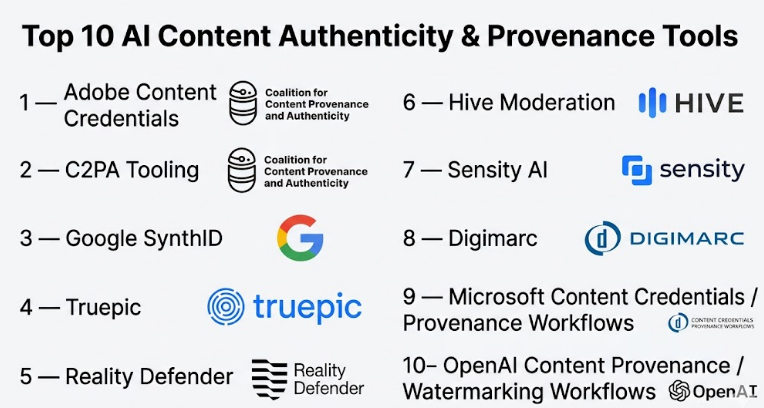
Top 10 AI Content Authenticity & Provenance Tools
#1 — Adobe Content Credentials
Short description :
Adobe Content Credentials helps creators, publishers, and organizations attach provenance information to digital content.It is strongly connected with the C2PA standard and the broader Content Authenticity Initiative.The tool helps show how content was created, edited, and attributed.
It is useful for creative teams that want transparency around AI usage and content ownership.
It is especially relevant for design, photography, media, and enterprise creative workflows.
Key Features
- Content Credentials support
- Provenance metadata for creative files
- Creator attribution support
- AI transparency signals
- Integration with creative workflows
- Verification and inspection capabilities
- Useful for media trust and publishing workflows
Pros
- Strong fit for creative professionals
- Good alignment with content transparency standards
- Useful for attribution and AI disclosure
Cons
- Best value is stronger within creative workflows
- Metadata may not always survive unsupported platforms
- Not a full deepfake detection platform by itself
Platforms / Deployment
Web / Windows / macOS
Cloud / Hybrid
Security & Compliance
Supports provenance and content transparency workflows.
SOC 2, ISO 27001, HIPAA, GDPR details: Not publicly stated for this category context.
Integrations & Ecosystem
Adobe Content Credentials fits well into creative, publishing, and media workflows.
- Creative design tools
- Image editing workflows
- Publishing workflows
- Content verification tools
- C2PA-style provenance ecosystem
- Brand and creator attribution workflows
Support & Community
Adobe has strong product documentation, a large creative user base, and enterprise support options depending on plan. Community awareness is strong among creators and publishers.
#2 — C2PA Tooling
Short description :
C2PA tooling supports the open technical standard behind Content Credentials.
It helps organizations create, inspect, and verify provenance records for digital media.
This is useful for teams that want standards-based authenticity instead of relying on one vendor.
It is especially relevant for publishers, platforms, camera makers, and AI companies.
C2PA is best understood as a standard and ecosystem, not one simple end-user product.
Key Features
- Open standard for content provenance
- Cryptographic signing support
- Content history and edit tracking model
- Works across supported media workflows
- Supports interoperability goals
- Useful for verification and transparency
- Strong relevance for AI-generated content labeling
Pros
- Vendor-neutral standard approach
- Strong long-term ecosystem value
- Useful for enterprise and platform adoption
Cons
- Requires technical implementation
- Not a plug-and-play business product by itself
- Adoption depends on platform and workflow support
Platforms / Deployment
Varies / N/A
Cloud / Self-hosted / Hybrid
Security & Compliance
Supports cryptographic provenance concepts.
SOC 2, ISO 27001, HIPAA, GDPR details: Not publicly stated.
Integrations & Ecosystem
C2PA tooling is relevant across content creation, publishing, verification, and platform workflows.
- Media creation tools
- Camera and capture systems
- Publishing platforms
- Verification applications
- AI content systems
- Enterprise content workflows
Support & Community
Community support depends on the specific implementation. Documentation and ecosystem resources are available, but technical teams may be needed for adoption.
#3 — Google SynthID
Short description :
Google SynthID is a watermarking technology designed to identify AI-generated content.
It is used to embed signals into AI-generated images and other media types depending on product support.
SynthID is useful where invisible watermarking is preferred over visible labels.
It is especially relevant for organizations using Google AI tools and generative media workflows.
It supports the larger goal of making AI-generated content easier to identify.
Key Features
- Invisible watermarking for AI-generated media
- AI content identification support
- Designed to survive some common edits
- Useful for generative AI workflows
- Supports responsible AI disclosure
- Relevant for images and expanding media types
- Strong fit within Google AI ecosystem
Pros
- Invisible watermarking is harder to remove than visible labels
- Strong fit for AI-generated media workflows
- Useful for platform-scale content authenticity
Cons
- Best suited to supported Google ecosystems
- Not a complete provenance platform by itself
- Public enterprise deployment details may vary
Platforms / Deployment
Web / Cloud
Cloud
Security & Compliance
AI watermarking technology for content identification.
SOC 2, ISO 27001, HIPAA, GDPR details: Not publicly stated for this category context.
Integrations & Ecosystem
SynthID is strongest in Google’s AI and media generation ecosystem.
- Google AI tools
- Image generation workflows
- Media verification workflows
- AI governance processes
- Content labeling systems
- Platform-level authenticity workflows
Support & Community
Support depends on Google product usage and enterprise agreements. Public documentation and awareness are growing.
#4 — Truepic
Short description :
Truepic focuses on authentic media capture, verification, and digital content trust.
It is useful for organizations that need proof that photos or videos were captured in a real-world context.
The platform is relevant for insurance, legal, marketplace, journalism, compliance, and field verification use cases.Truepic helps create stronger chain-of-custody records for visual content.
It is a strong fit for companies where media authenticity affects decisions or claims.
Key Features
- Secure image and video capture workflows
- Provenance and authenticity support
- Chain-of-custody style verification
- Enterprise media verification use cases
- Useful for field documentation
- Supports trust in visual evidence
- Strong fit for regulated workflows
Pros
- Strong real-world media verification use case
- Useful for evidence and documentation workflows
- Enterprise-friendly authenticity focus
Cons
- May be more than casual creators need
- Best value is in structured business workflows
- Pricing and deployment details may vary
Platforms / Deployment
Web / iOS / Android
Cloud / Hybrid
Security & Compliance
Media authenticity and verification platform.
Specific compliance details: Not publicly stated.
Integrations & Ecosystem
Truepic fits workflows where trusted media capture and verification are important.
- Enterprise applications
- Mobile capture workflows
- Claims and inspection systems
- Legal documentation workflows
- Media verification processes
- API-based business workflows
Support & Community
Support is business-focused and varies by plan. Documentation and onboarding may depend on enterprise implementation needs.
#5 — Reality Defender
Short description :
Reality Defender is an AI detection platform focused on identifying deepfakes and synthetic media.
It is useful for enterprises, platforms, security teams, and media organizations reviewing suspicious content.
The platform can support detection workflows across different media types depending on plan and capability.It is especially valuable where fake images, videos, audio, or identity attacks create business risk.
It fits teams that need automated review plus investigation workflows.
Key Features
- Deepfake detection capabilities
- AI-generated media detection
- Enterprise review workflows
- Multimodal detection focus
- API and dashboard-oriented usage
- Useful for fraud and trust teams
- Content risk analysis support
Pros
- Strong focus on synthetic media threats
- Useful for enterprise fraud and platform review
- Can support automated detection workflows
Cons
- Detection tools can produce uncertainty
- Best results require human review process
- Pricing and compliance details may vary
Platforms / Deployment
Web / API
Cloud / Hybrid
Security & Compliance
Synthetic media detection and risk review platform.
SOC 2, ISO 27001, HIPAA, GDPR details: Not publicly stated.
Integrations & Ecosystem
Reality Defender fits business workflows that need automated synthetic media review.
- APIs
- Fraud review systems
- Trust and safety workflows
- Media moderation platforms
- Security operations workflows
- Enterprise dashboards
Support & Community
Support is enterprise-oriented and varies by contract or plan. Documentation and onboarding are likely strongest for business customers.
#6 — Hive Moderation
Short description :
Hive Moderation provides AI-based content moderation and media analysis capabilities.
It is relevant for detecting AI-generated content, unsafe media, and platform policy violations.
The tool is useful for marketplaces, social apps, dating platforms, media platforms, and online communities.
For AI authenticity workflows, Hive is often useful as a detection and moderation layer.
It is best for teams that need automated content review at scale.
Key Features
- AI-generated content detection support
- Image and video moderation
- Content classification workflows
- API-based integration
- Scalable review automation
- Trust and safety use cases
- Platform moderation support
Pros
- Strong fit for high-volume content platforms
- Practical API-first moderation workflows
- Useful beyond only AI authenticity
Cons
- Not a full provenance metadata platform
- Detection confidence still needs review
- Best value is for content-heavy platforms
Platforms / Deployment
Web / API
Cloud
Security & Compliance
Content moderation and detection platform.
Specific compliance details: Not publicly stated.
Integrations & Ecosystem
Hive Moderation works well with platform moderation and automated review systems.
- APIs
- Social platforms
- Marketplace platforms
- Trust and safety queues
- Content management systems
- Moderation dashboards
Support & Community
Support varies by customer tier. Documentation and onboarding are generally focused on API users and platform teams.
#7 — Sensity AI
Short description :
Sensity AI focuses on deepfake detection, synthetic identity protection, and visual threat intelligence.
It is useful for organizations concerned about identity fraud, fake videos, impersonation, and synthetic media abuse.The tool is relevant for finance, media, government, cybersecurity, and trust and safety teams.
Sensity helps detect manipulated or AI-generated visual content in risk workflows.
It is strongest where synthetic media is a security or fraud concern.
Key Features
- Deepfake detection workflows
- Synthetic media risk analysis
- Visual threat intelligence
- Identity fraud support
- Enterprise monitoring use cases
- Media verification support
- Security-focused detection approach
Pros
- Strong focus on deepfake risk
- Useful for fraud and security teams
- Good fit for high-risk industries
Cons
- May not be needed for basic creator workflows
- Not mainly a C2PA provenance tool
- Commercial details may vary
Platforms / Deployment
Web / API
Cloud / Hybrid
Security & Compliance
Deepfake detection and visual threat intelligence platform.
Compliance details: Not publicly stated.
Integrations & Ecosystem
Sensity AI supports security, fraud, and media verification workflows.
- APIs
- Fraud detection systems
- Security operations workflows
- Media review platforms
- Identity verification processes
- Trust and safety systems
Support & Community
Support is business and enterprise-focused. Public community details are limited compared with open-source tools.
#8 — Digimarc
Short description :
Digimarc provides digital watermarking and content identification technologies.
It is useful for brands, publishers, packaging teams, media owners, and enterprises that need persistent content identification.For AI content authenticity, watermarking can help mark content in ways that are less visible than normal labels.Digimarc is relevant where content ownership, traceability, and verification matter.
It is best for organizations that need durable content identification across channels.
Key Features
- Digital watermarking technology
- Content identification workflows
- Brand protection support
- Media traceability use cases
- Enterprise-scale content marking
- Verification and detection capabilities
- Useful for physical and digital asset workflows
Pros
- Strong watermarking expertise
- Useful for brand and media protection
- Works across broader identification use cases
Cons
- Not only focused on AI-generated content
- May require workflow planning
- Pricing and deployment may vary
Platforms / Deployment
Web / API / Varies
Cloud / Hybrid
Security & Compliance
Digital watermarking and identification platform.
Compliance details: Not publicly stated.
Integrations & Ecosystem
Digimarc can support content, brand, packaging, and media workflows.
- Digital asset workflows
- Brand protection systems
- Publishing workflows
- Product packaging ecosystems
- Verification tools
- Enterprise APIs
Support & Community
Support is enterprise-focused and varies by engagement. Documentation and onboarding depend on the use case.
#9 — Microsoft Content Credentials / Provenance Workflows
Short description :
Microsoft supports content authenticity and provenance through Content Credentials-related efforts and responsible AI workflows.It is relevant for enterprises using Microsoft productivity, cloud, and AI platforms.
The focus is on helping users and organizations better understand the origin and transformation of digital content.It fits businesses that want AI transparency connected to enterprise governance.
Microsoft’s value is strongest where authenticity workflows connect with broader enterprise identity and productivity systems.
Key Features
- Content Credentials ecosystem support
- AI transparency workflows
- Enterprise governance alignment
- Cloud and productivity ecosystem relevance
- Identity and access ecosystem fit
- Useful for responsible AI adoption
- Supports provenance direction in enterprise workflows
Pros
- Strong enterprise ecosystem fit
- Useful for companies already using Microsoft platforms
- Supports broader AI governance direction
Cons
- Tooling may vary by product
- Not a single standalone authenticity product for every use case
- Implementation details may depend on Microsoft environment
Platforms / Deployment
Web / Windows / Cloud
Cloud / Hybrid
Security & Compliance
Enterprise platform security depends on Microsoft product and plan.
Specific compliance details for this category context: Not publicly stated.
Integrations & Ecosystem
Microsoft provenance workflows fit enterprise AI, content, and productivity environments.
- Microsoft cloud ecosystem
- Enterprise identity systems
- Productivity workflows
- AI governance workflows
- Content management workflows
- Security and compliance processes
Support & Community
Support depends on Microsoft product plan and enterprise agreement. Documentation and enterprise support channels are generally strong.
#10 — OpenAI Content Provenance / Watermarking Workflows
Short description :
OpenAI content provenance and watermarking-related workflows are relevant for identifying and labeling AI-generated content created through OpenAI systems.
This is important for publishers, developers, platforms, and enterprises using generative AI at scale.
The goal is to help improve transparency around synthetic media and AI-generated outputs.
It is especially relevant for AI product teams that need responsible disclosure and authenticity handling.
Implementation details may vary depending on media type, model, and platform support.
Key Features
- AI-generated content transparency support
- Provenance-related workflows
- Watermarking and metadata direction where supported
- Useful for AI governance
- Relevant for synthetic media disclosure
- Fits developer and platform workflows
- Supports responsible AI usage patterns
Pros
- Strong relevance for generative AI workflows
- Useful for AI product and platform teams
- Helps support transparency expectations
Cons
- Capabilities may vary by content type and product
- Not a complete standalone verification suite
- Public enterprise details may vary
Platforms / Deployment
Web / API
Cloud
Security & Compliance
AI platform security and compliance depend on product and plan.
Specific details for this category context: Not publicly stated.
Integrations & Ecosystem
OpenAI provenance-related workflows are most relevant where AI-generated outputs are created or distributed.
- AI applications
- Developer APIs
- Content generation workflows
- Publishing systems
- Governance processes
- Platform moderation workflows
Support & Community
Support depends on product tier and enterprise agreement. Developer documentation and ecosystem awareness are strong.
Comparison Table
| Tool Name | Best For | Platform(s) Supported | Deployment | Standout Feature | Public Rating |
|---|---|---|---|---|---|
| Adobe Content Credentials | Creators, publishers, media teams | Web, Windows, macOS | Cloud / Hybrid | Creative provenance and attribution | N/A |
| C2PA Tooling | Standards-based provenance adoption | Varies / N/A | Cloud / Self-hosted / Hybrid | Open provenance standard | N/A |
| Google SynthID | AI watermarking in supported workflows | Web / Cloud | Cloud | Invisible AI watermarking | N/A |
| Truepic | Trusted media capture and verification | Web, iOS, Android | Cloud / Hybrid | Secure capture and chain of custody | N/A |
| Reality Defender | Deepfake and synthetic media detection | Web / API | Cloud / Hybrid | Enterprise synthetic media detection | N/A |
| Hive Moderation | Platform-scale AI content detection | Web / API | Cloud | Moderation plus AI detection | N/A |
| Sensity AI | Deepfake risk and synthetic identity threats | Web / API | Cloud / Hybrid | Visual threat intelligence | N/A |
| Digimarc | Digital watermarking and content ID | Web / API / Varies | Cloud / Hybrid | Durable watermarking | N/A |
| Microsoft Content Credentials / Provenance Workflows | Enterprise AI transparency | Web, Windows, Cloud | Cloud / Hybrid | Enterprise ecosystem alignment | N/A |
| OpenAI Content Provenance / Watermarking Workflows | AI-generated content transparency | Web / API | Cloud | AI output provenance direction | N/A |
Evaluation & AI Content Authenticity & Provenance Tools
| Tool Name | Core (25%) | Ease (15%) | Integrations (15%) | Security (10%) | Performance (10%) | Support (10%) | Value (15%) | Weighted Total (0–10) |
|---|---|---|---|---|---|---|---|---|
| Adobe Content Credentials | 9 | 8 | 9 | 8 | 8 | 9 | 8 | 8.45 |
| C2PA Tooling | 9 | 6 | 8 | 8 | 8 | 7 | 9 | 8.00 |
| Google SynthID | 8 | 8 | 8 | 8 | 8 | 8 | 8 | 8.00 |
| Truepic | 8 | 8 | 8 | 8 | 8 | 8 | 7 | 7.85 |
| Reality Defender | 8 | 8 | 8 | 8 | 8 | 8 | 7 | 7.85 |
| Hive Moderation | 7 | 9 | 8 | 7 | 8 | 8 | 8 | 7.85 |
| Sensity AI | 8 | 7 | 8 | 8 | 8 | 7 | 7 | 7.60 |
| Digimarc | 8 | 7 | 8 | 8 | 8 | 8 | 7 | 7.75 |
| Microsoft Content Credentials / Provenance Workflows | 8 | 8 | 9 | 8 | 8 | 9 | 7 | 8.15 |
| OpenAI Content Provenance / Watermarking Workflows | 7 | 8 | 8 | 8 | 8 | 8 | 8 | 7.75 |
These scores are comparative, not public ratings.
A higher score means stronger overall fit across authenticity, provenance, integrations, security, usability, and business value.
Provenance tools score better for content history and attribution, while detection tools score better for identifying suspicious or synthetic media.
The best choice depends on whether your priority is creation transparency, deepfake detection, watermarking, moderation, or enterprise governance.
Which AI Content Authenticity & Provenance Tools
Solo / Freelancer
Solo creators and freelancers should focus on simple tools that help protect attribution and show transparency. Adobe Content Credentials is a strong option for creators who work with images and creative files. If the work involves AI-generated content, basic provenance and labeling workflows are more useful than complex enterprise detection platforms.
Recommended options:
- Adobe Content Credentials
- Google SynthID
- C2PA-based verification tools
SMB
Small and mid-sized businesses should choose tools based on their content risk. A marketing agency may need Content Credentials and watermarking. A marketplace or social platform may need AI detection and moderation. A legal or claims-based business may need secure capture.
Recommended options:
- Adobe Content Credentials
- Truepic
- Hive Moderation
- Digimarc
Mid-Market
Mid-market companies usually need APIs, dashboards, scalable review workflows, and integration with content systems. They should combine provenance with detection because metadata can be removed and detection confidence can vary.
Recommended options:
- Reality Defender
- Hive Moderation
- Truepic
- Digimarc
- Sensity AI
Enterprise
Enterprises need governance, policy, auditability, security review, brand protection, and cross-team adoption. They should evaluate whether they need media provenance, deepfake detection, watermarking, or all three.
Recommended options:
- Adobe Content Credentials
- Microsoft Content Credentials / Provenance Workflows
- Reality Defender
- Sensity AI
- Digimarc
- C2PA Tooling
Budget vs Premium
Budget-focused teams should start with built-in provenance features in their existing creative or AI platforms. Premium buyers should evaluate enterprise tools that offer APIs, dashboards, detection workflows, support, and large-scale media processing.
Feature Depth vs Ease of Use
If ease of use matters most, choose tools already built into your content creation or AI workflow. If feature depth matters more, combine C2PA-based provenance, watermarking, and AI detection into one review process.
Integrations & Scalability-
For scalable workflows, APIs are critical. Platforms handling user-generated content should prioritize moderation APIs and automated verification. Enterprises should check whether tools integrate with DAM systems, CMS platforms, AI tools, legal review workflows, and security dashboards.
Security & Compliance Needs
For high-risk industries, content authenticity should be part of AI governance. Teams should define who can create AI content, how it is labeled, where provenance is stored, and how suspicious media is reviewed before publication or business use.
Frequently Asked Questions
1. What are AI content authenticity tools?
AI content authenticity tools help verify whether digital content is real, edited, AI-generated, or connected to a trusted source. They may use metadata, watermarking, detection models, or chain-of-custody records.
2. What is content provenance?
Content provenance means the history of a digital asset. It can show who created it, what tool was used, whether AI was involved, and what edits happened before publication.
3. Are AI detection tools always accurate?
No. AI detection tools can provide useful signals, but they are not perfect. Teams should treat results as part of a review process, not as final legal proof.
4. What is the difference between watermarking and provenance?
Watermarking adds a visible or invisible signal to content. Provenance records the content’s origin and history. Many organizations use both for stronger trust.
5. What is C2PA?
C2PA is a technical standard for digital content provenance. It supports Content Credentials, which help show how content was created, edited, and verified.
6. Can metadata be removed from content?
Yes, metadata can sometimes be stripped when files are uploaded, compressed, copied, or shared through unsupported platforms. That is why many teams combine metadata with watermarking and detection.
7. Which tool is best for creators?
Adobe Content Credentials is a strong choice for creators who want attribution and transparency. Creators using AI generation tools should also check whether their platform supports watermarking or provenance.
8. Which tool is best for enterprises?
Enterprises should evaluate Adobe, Microsoft, Reality Defender, Sensity AI, Truepic, Digimarc, and C2PA-based tooling. The best choice depends on whether the main need is provenance, detection, watermarking, or governance.
9. How should a company start implementation?
Start with your highest-risk content workflows. Identify where AI content is created, where media is approved, who verifies content, and which systems need authenticity checks.
10. What are common mistakes buyers make?
Common mistakes include relying only on AI detection, ignoring metadata loss, skipping human review, failing to define ownership, and not integrating verification into publishing workflows.
Conclusion
AI Content Authenticity & Provenance Tools are becoming important because digital trust is no longer automatic. Images, videos, audio, documents, and social media posts can now be created or changed with powerful AI systems. This creates new risks for brands, publishers, legal teams, platforms, governments, and everyday users. Tools like Adobe Content Credentials, C2PA tooling, Google SynthID, Truepic, Reality Defender, Hive Moderation, Sensity AI, Digimarc, Microsoft provenance workflows, and OpenAI provenance-related workflows each solve a different part of the trust problem.
