Introduction
Service Discovery Tools help applications find and communicate with other services without hardcoding IP addresses, ports, or server locations. In simple terms, they act like a smart directory for microservices, containers, virtual machines, APIs, and distributed workloads. When one service moves, scales, restarts, or fails, service discovery helps other services find the correct healthy endpoint automatically.
In modern cloud-native environments, this matters more than ever because applications are no longer hosted on one fixed server. They run across Kubernetes clusters, hybrid clouds, edge locations, service meshes, and dynamic infrastructure. Service discovery supports reliability, automation, zero-trust networking, and faster application delivery.
Common use cases include:
- Microservices communication
- Kubernetes service routing
- Multi-cloud application networking
- Service mesh discovery
- Dynamic infrastructure automation
Buyers should evaluate:
- Registry and discovery model
- Kubernetes and cloud support
- Health checks
- Security controls
- Service mesh compatibility
- API and automation support
- Performance at scale
- Documentation and community
- Operational complexity
- Cost and enterprise support
Best for: Platform engineers, DevOps teams, SRE teams, cloud architects, backend developers, and enterprises running microservices, Kubernetes, hybrid cloud, or distributed applications.
Not ideal for: Small static applications, simple websites, or teams using only one server where DNS records or basic load balancing are enough.
Key Trends in Service Discovery Tools
- Kubernetes-native discovery is becoming the default as more teams use containers and dynamic workloads.
- Service discovery and service mesh are merging through tools that combine registry, routing, encryption, and traffic control.
- Zero-trust networking is now expected, especially with mTLS, identity-based access, and service-level authorization.
- Multi-cloud and hybrid discovery are growing because many companies run workloads across cloud and on-prem environments.
- DNS-based discovery remains important because it is simple, widely supported, and easy to integrate.
- Automation-first operations are increasing through APIs, GitOps, Terraform, Helm, and Kubernetes operators.
- Observability integration is becoming critical for troubleshooting service health, latency, and routing failures.
- AI-assisted operations are emerging, mostly around anomaly detection, configuration analysis, and incident response.
- Developer experience matters more, especially for teams that want simple onboarding and fewer manual networking tasks.
- Open-source adoption remains strong, but enterprise support is often needed for production-grade scale and compliance.
How We Selected These Tools
- Selected tools with strong market adoption and proven use in distributed systems.
- Included a mix of Kubernetes-native, service mesh, DNS-based, enterprise, and open-source options.
- Considered feature depth around registry, health checks, routing, and automation.
- Reviewed practical fit for SMB, mid-market, and enterprise teams.
- Prioritized tools with strong documentation, community, or enterprise ecosystem.
- Considered integration with Kubernetes, cloud platforms, CI/CD, APIs, and observability tools.
- Included tools that support modern service discovery patterns rather than only legacy registry models.
- Avoided tools that are too narrow, outdated, or not commonly used for production service discovery.
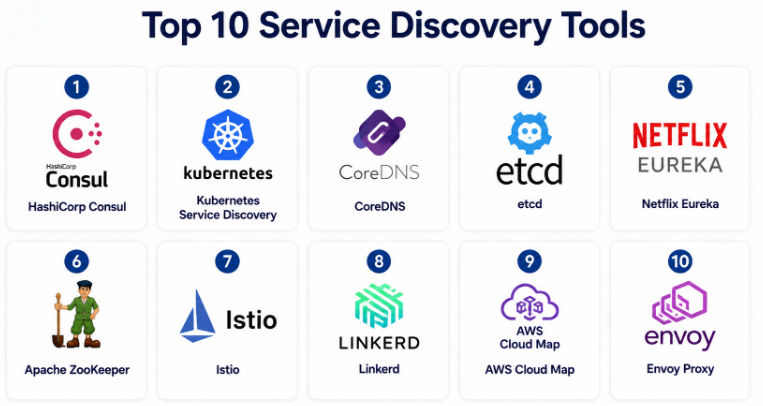
Top 10 Service Discovery Tools
#1 — HashiCorp Consul
Short description :
HashiCorp Consul is one of the most recognized tools for service discovery, service mesh, and network automation. It helps services register themselves, discover other services, check health status, and communicate securely across environments. Consul is useful for Kubernetes, virtual machines, hybrid cloud, and multi-cloud setups. It is often used by platform teams that need more control than basic DNS discovery. It fits organizations that want service discovery plus secure service-to-service communication.
Key Features
- Service registry and health checking
- DNS and HTTP API-based discovery
- Multi-datacenter support
- Kubernetes integration
- Service mesh with mTLS
- Traffic management features
- Policy-based service access
Pros
- Strong fit for hybrid and multi-cloud environments.
- Combines service discovery with service mesh security.
- Good ecosystem for DevOps and platform engineering teams.
Cons
- Can be complex for small teams.
- Enterprise features may require paid plans.
- Requires careful operational planning at scale.
Platforms / Deployment
Cloud / Self-hosted / Hybrid
Security & Compliance
Supports mTLS, service identity, ACLs, encryption, audit logging, and role-based access controls depending on deployment and edition. SOC 2, ISO 27001, GDPR, HIPAA: Not publicly stated.
Integrations & Ecosystem
Consul integrates well with cloud-native and infrastructure automation ecosystems.
- Kubernetes
- Terraform
- Envoy
- Prometheus
- Nomad
- Cloud platforms
Support & Community
Strong documentation, active ecosystem, commercial support options, and broad DevOps community adoption.
#2 — Kubernetes Service Discovery
Short description :
Kubernetes Service Discovery is the built-in discovery model used inside Kubernetes clusters. It allows workloads to find services by stable DNS names instead of changing pod IP addresses. It is best for teams already running containerized applications on Kubernetes. It works naturally with Kubernetes Services, Pods, labels, and internal DNS. For many cloud-native teams, this is the default starting point before adding advanced tools like service mesh or external discovery.
Key Features
- Native Kubernetes service discovery
- DNS-based service lookup
- ClusterIP, NodePort, and LoadBalancer service models
- Label-based service selection
- Works with CoreDNS
- Supports internal service communication
- Integrates with Kubernetes networking
Pros
- Built directly into Kubernetes.
- Simple for teams already using Kubernetes.
- No separate discovery platform needed for many use cases.
Cons
- Mostly focused on Kubernetes environments.
- Limited for complex multi-cloud or VM-based workloads.
- Advanced traffic control needs service mesh or ingress tools.
Platforms / Deployment
Cloud / Self-hosted / Hybrid
Security & Compliance
Security depends on Kubernetes configuration, RBAC, network policies, secrets management, and cluster controls. SOC 2, ISO 27001, GDPR, HIPAA: Not publicly stated.
Integrations & Ecosystem
Kubernetes service discovery is deeply connected to the Kubernetes ecosystem.
- CoreDNS
- Ingress controllers
- Service mesh tools
- Cloud load balancers
- Helm
- GitOps tools
Support & Community
Very strong community, broad documentation, and large ecosystem support across cloud providers and enterprise platforms.
#3 — CoreDNS
Short description :
CoreDNS is a flexible DNS server commonly used for service discovery in Kubernetes and cloud-native environments. It uses a plugin-based architecture, making it highly extensible for different DNS and discovery needs. CoreDNS is often used as the cluster DNS in Kubernetes. It is best for teams that need reliable DNS-based discovery with strong cloud-native compatibility. It is lightweight, flexible, and widely adopted in container platforms.
Key Features
- DNS-based service discovery
- Plugin-based architecture
- Kubernetes plugin support
- Cloud DNS integrations
- Forwarding and caching
- Lightweight deployment
- Extensible configuration
Pros
- Simple and efficient DNS-based discovery.
- Strong Kubernetes ecosystem fit.
- Flexible plugin model.
Cons
- Not a full service mesh.
- Advanced policy and traffic control need other tools.
- Misconfiguration can affect cluster-wide DNS resolution.
Platforms / Deployment
Linux / Cloud / Self-hosted / Hybrid
Security & Compliance
Security depends on DNS configuration, cluster security, access controls, and deployment model. SOC 2, ISO 27001, GDPR, HIPAA: Not publicly stated.
Integrations & Ecosystem
CoreDNS works well with DNS-driven infrastructure and Kubernetes environments.
- Kubernetes
- etcd
- AWS Route 53
- Google Cloud DNS
- Azure DNS
- Prometheus
Support & Community
Strong open-source community, mature documentation, and wide use in Kubernetes environments.
#4 — etcd
Short description :
etcd is a distributed key-value store used to store critical configuration and state data for distributed systems. While it is not only a service discovery tool, it is often used as a foundation for discovery, coordination, and configuration. Kubernetes uses etcd as its backing store for cluster data. It is best for engineering teams that need strong consistency and reliable coordination in cloud-native systems.
Key Features
- Distributed key-value storage
- Strong consistency model
- Leader election support
- Watch API for changes
- Reliable cluster coordination
- TLS support
- Kubernetes ecosystem importance
Pros
- Highly reliable for critical distributed system data.
- Strong consistency and coordination capabilities.
- Important foundation for Kubernetes infrastructure.
Cons
- Requires operational expertise.
- Not a complete user-facing service discovery platform by itself.
- Backup, restore, and cluster health need careful handling.
Platforms / Deployment
Linux / Self-hosted / Hybrid
Security & Compliance
Supports TLS and client certificate authentication depending on configuration. SOC 2, ISO 27001, GDPR, HIPAA: Not publicly stated.
Integrations & Ecosystem
etcd is often used behind platforms and systems that need reliable state storage.
- Kubernetes
- CoreDNS
- Cloud-native infrastructure
- Custom distributed systems
- Automation scripts
- Monitoring tools
Support & Community
Strong open-source community, mature technical documentation, and important role in Kubernetes operations.
#5 — Netflix Eureka
Short description :
Netflix Eureka is a service registry used for service discovery in microservice architectures, especially Java and Spring-based environments. It allows services to register themselves and discover other services dynamically. Eureka became popular through Netflix OSS and Spring Cloud Netflix. It is best suited for teams maintaining Spring microservices or legacy service discovery models. It remains relevant where Java-based registry discovery is already established.
Key Features
- Service registration and discovery
- Client-side discovery model
- Health status awareness
- High availability setup
- Spring Cloud integration
- REST-based registry
- Useful for Java microservices
Pros
- Familiar to many Spring and Java teams.
- Simple model for service registration.
- Useful for existing Spring Cloud environments.
Cons
- Less modern than Kubernetes-native discovery.
- Not ideal for new cloud-native service mesh strategies.
- Ecosystem momentum is lower than Kubernetes-first tools.
Platforms / Deployment
Linux / Windows / macOS / Self-hosted / Hybrid
Security & Compliance
Security depends on application setup, network controls, and Spring security configuration. SOC 2, ISO 27001, GDPR, HIPAA: Not publicly stated.
Integrations & Ecosystem
Eureka is mainly used in Java and Spring ecosystems.
- Spring Cloud
- Java microservices
- REST APIs
- Load balancing clients
- Monitoring tools
- CI/CD pipelines
Support & Community
Good historical community knowledge, many tutorials, and strong relevance for existing Spring Cloud systems. Enterprise support varies by implementation.
#6 — Apache ZooKeeper
Short description :
Apache ZooKeeper is a coordination service for distributed applications. It is used for naming, configuration, synchronization, and cluster coordination. Some systems use ZooKeeper for service discovery patterns, especially older distributed platforms. It is best for teams running systems that already depend on ZooKeeper, such as certain data platforms or legacy distributed applications. It is powerful but requires careful operations.
Key Features
- Distributed coordination
- Naming service support
- Configuration management
- Leader election
- Watch mechanisms
- High availability cluster design
- Mature open-source ecosystem
Pros
- Proven in large distributed systems.
- Strong coordination capabilities.
- Useful for legacy and data infrastructure ecosystems.
Cons
- Operationally complex.
- Not purpose-built only for modern service discovery.
- Newer systems often prefer etcd, Kubernetes, or Consul.
Platforms / Deployment
Linux / Windows / macOS / Self-hosted / Hybrid
Security & Compliance
Supports authentication and access controls depending on configuration. SOC 2, ISO 27001, GDPR, HIPAA: Not publicly stated.
Integrations & Ecosystem
ZooKeeper is commonly found in distributed data and messaging ecosystems.
- Apache Kafka legacy deployments
- Hadoop ecosystem
- Distributed applications
- Monitoring tools
- Java applications
- Internal platform tools
Support & Community
Mature open-source project with long history, broad technical references, and strong usage in legacy distributed platforms.
#7 — Istio
Short description :
Istio is a service mesh platform that provides traffic management, security, observability, and service-to-service communication controls. While it is not only a service discovery tool, it works closely with Kubernetes service discovery and service mesh routing. Istio is best for teams that need advanced control over microservices communication. It fits enterprise and platform teams that require mTLS, traffic splitting, policy enforcement, and observability.
Key Features
- Service mesh traffic management
- mTLS service-to-service encryption
- Service identity
- Traffic splitting and routing
- Observability support
- Kubernetes-native operation
- Policy and authorization controls
Pros
- Strong security and traffic control capabilities.
- Good fit for complex Kubernetes microservices.
- Useful for enterprise-grade platform engineering.
Cons
- Can be complex to deploy and operate.
- May be too heavy for small teams.
- Requires service mesh knowledge.
Platforms / Deployment
Cloud / Self-hosted / Hybrid
Security & Compliance
Supports mTLS, authorization policies, service identity, and observability integrations. SOC 2, ISO 27001, GDPR, HIPAA: Not publicly stated.
Integrations & Ecosystem
Istio fits deeply into Kubernetes and observability ecosystems.
- Kubernetes
- Envoy
- Prometheus
- Grafana
- Jaeger
- OpenTelemetry
Support & Community
Strong open-source community, broad documentation, and enterprise ecosystem through cloud and platform providers.
#8 — Linkerd
Short description :
Linkerd is a lightweight service mesh focused on simplicity, security, and reliability for Kubernetes workloads. It uses Kubernetes service discovery and adds secure communication, telemetry, and traffic control features. Linkerd is best for teams that want service mesh benefits without the heavier operational complexity of some alternatives. It is popular among teams that value ease of use and fast onboarding.
Key Features
- Lightweight service mesh
- Kubernetes-native discovery support
- Automatic mTLS
- Service-level telemetry
- Traffic policies
- Reliability features
- Simple operational model
Pros
- Easier to operate than many service mesh tools.
- Strong security defaults for Kubernetes services.
- Good fit for small to mid-sized platform teams.
Cons
- Feature depth may be lower than heavier service mesh platforms.
- Mainly focused on Kubernetes.
- Enterprise support depends on provider choice.
Platforms / Deployment
Cloud / Self-hosted / Hybrid
Security & Compliance
Supports automatic mTLS and service identity features. SOC 2, ISO 27001, GDPR, HIPAA: Not publicly stated.
Integrations & Ecosystem
Linkerd works well with Kubernetes and observability stacks.
- Kubernetes
- Prometheus
- Grafana
- Helm
- GitOps tools
- CI/CD pipelines
Support & Community
Good open-source community, clear documentation, and practical onboarding experience.
#9 — AWS Cloud Map
Short description :
AWS Cloud Map is a cloud service discovery tool for applications running on AWS. It allows services to register resources and discover them through APIs or DNS. It works well with AWS container, serverless, and application workloads. AWS Cloud Map is best for teams already committed to AWS and looking for managed service discovery. It reduces the need to run a separate registry system for AWS-native applications.
Key Features
- Managed service discovery
- API and DNS-based discovery
- AWS-native integration
- Health checking support
- Works with container workloads
- Supports dynamic resource registration
- Useful for cloud-native AWS applications
Pros
- Managed service reduces operational overhead.
- Strong fit for AWS-centric teams.
- Works with modern cloud application patterns.
Cons
- Less suitable for non-AWS environments.
- Vendor lock-in may be a concern.
- Cross-cloud discovery needs additional design.
Platforms / Deployment
Cloud
Security & Compliance
Uses AWS identity, access management, encryption, and logging capabilities depending on configuration. SOC 2, ISO 27001, GDPR, HIPAA: Not publicly stated here.
Integrations & Ecosystem
AWS Cloud Map fits naturally into AWS infrastructure.
- Amazon ECS
- Amazon EKS
- AWS Lambda
- Route 53
- CloudWatch
- IAM
Support & Community
AWS documentation and enterprise support options are available. Community guidance is strong among AWS users.
#10 — Envoy Proxy
Short description :
Envoy Proxy is a high-performance proxy widely used in service mesh, traffic management, and cloud-native networking. It is not a traditional standalone service registry, but it plays a major role in service discovery through dynamic configuration APIs and integration with control planes. Envoy is best for advanced platform teams building modern networking layers. It is commonly used underneath service mesh platforms and API traffic systems.
Key Features
- Dynamic service discovery support
- Layer 7 proxy capabilities
- Load balancing
- Health checking
- Observability features
- xDS APIs
- Service mesh foundation
Pros
- Powerful and flexible for advanced networking.
- Strong fit for service mesh architectures.
- High-performance proxy model.
Cons
- Requires strong networking knowledge.
- Usually needs a control plane.
- Not ideal as a simple plug-and-play discovery tool.
Platforms / Deployment
Linux / Cloud / Self-hosted / Hybrid
Security & Compliance
Supports TLS, mTLS patterns, access logging, and policy-based architectures depending on control plane configuration. SOC 2, ISO 27001, GDPR, HIPAA: Not publicly stated.
Integrations & Ecosystem
Envoy is widely used in cloud-native networking platforms.
- Istio
- Consul
- Kubernetes
- OpenTelemetry
- Prometheus
- API gateways
Support & Community
Strong open-source community, broad cloud-native adoption, and deep technical documentation.
Comparison Table
| Tool Name | Best For | Platform(s) Supported | Deployment | Standout Feature | Public Rating |
|---|---|---|---|---|---|
| HashiCorp Consul | Hybrid and multi-cloud service discovery | Cloud / Self-hosted / Hybrid | Cloud / Self-hosted / Hybrid | Service discovery plus service mesh | N/A |
| Kubernetes Service Discovery | Kubernetes-native workloads | Cloud / Self-hosted / Hybrid | Cloud / Self-hosted / Hybrid | Built-in Kubernetes DNS discovery | N/A |
| CoreDNS | DNS-based Kubernetes discovery | Linux / Cloud / Self-hosted | Self-hosted / Hybrid | Plugin-based DNS discovery | N/A |
| etcd | Distributed state and coordination | Linux / Self-hosted | Self-hosted / Hybrid | Strongly consistent key-value store | N/A |
| Netflix Eureka | Spring and Java microservices | Linux / Windows / macOS | Self-hosted / Hybrid | Simple service registry for Java apps | N/A |
| Apache ZooKeeper | Distributed coordination systems | Linux / Windows / macOS | Self-hosted / Hybrid | Mature coordination service | N/A |
| Istio | Enterprise Kubernetes service mesh | Cloud / Self-hosted / Hybrid | Cloud / Self-hosted / Hybrid | Advanced traffic and security control | N/A |
| Linkerd | Lightweight Kubernetes service mesh | Cloud / Self-hosted / Hybrid | Cloud / Self-hosted / Hybrid | Simple service mesh with mTLS | N/A |
| AWS Cloud Map | AWS-native service discovery | Cloud | Cloud | Managed AWS service discovery | N/A |
| Envoy Proxy | Advanced traffic and service mesh architectures | Linux / Cloud / Self-hosted | Self-hosted / Hybrid | Dynamic discovery through xDS APIs | N/A |
Evaluation & Service Discovery Tools
| Tool Name | Core (25%) | Ease (15%) | Integrations (15%) | Security (10%) | Performance (10%) | Support (10%) | Value (15%) | Weighted Total (0–10) |
|---|---|---|---|---|---|---|---|---|
| HashiCorp Consul | 9 | 7 | 9 | 9 | 8 | 8 | 8 | 8.25 |
| Kubernetes Service Discovery | 8 | 8 | 9 | 7 | 8 | 9 | 9 | 8.25 |
| CoreDNS | 8 | 8 | 8 | 6 | 8 | 8 | 9 | 7.85 |
| etcd | 8 | 6 | 8 | 7 | 9 | 8 | 8 | 7.65 |
| Netflix Eureka | 7 | 8 | 7 | 5 | 7 | 7 | 8 | 7.10 |
| Apache ZooKeeper | 7 | 5 | 7 | 6 | 8 | 7 | 7 | 6.80 |
| Istio | 9 | 5 | 9 | 9 | 8 | 8 | 7 | 7.95 |
| Linkerd | 8 | 8 | 8 | 8 | 8 | 7 | 8 | 7.90 |
| AWS Cloud Map | 8 | 8 | 8 | 8 | 8 | 8 | 7 | 7.85 |
| Envoy Proxy | 8 | 5 | 9 | 8 | 9 | 8 | 7 | 7.75 |
These scores are comparative, not absolute. A higher score does not mean the tool is the best for every company. For example, Istio is powerful but may be too complex for small teams. Kubernetes Service Discovery scores well because it is simple and native for Kubernetes users. Consul scores high for hybrid environments where discovery, security, and multi-cloud support matter together.
Which Service Discovery Tools
Solo / Freelancer
Solo developers usually do not need a heavy service discovery platform. If you are building a small app, basic DNS, Docker Compose networking, or managed cloud services may be enough. For Kubernetes projects, Kubernetes Service Discovery with CoreDNS is usually the simplest choice.
Recommended options:
- Kubernetes Service Discovery
- CoreDNS
- AWS Cloud Map for AWS-only projects
SMB
SMBs need service discovery that is reliable but not too hard to manage. A small DevOps team should avoid tools that require deep service mesh expertise unless there is a clear need. Kubernetes Service Discovery, Linkerd, and AWS Cloud Map are practical choices.
Recommended options:
- Kubernetes Service Discovery
- Linkerd
- AWS Cloud Map
- CoreDNS
Mid-Market
Mid-market teams usually run multiple services, environments, and deployment pipelines. They may need health checks, secure service-to-service communication, and better observability. Consul, Linkerd, Istio, and Kubernetes-native discovery are strong options depending on architecture.
Recommended options:
- HashiCorp Consul
- Kubernetes Service Discovery
- Linkerd
- Istio
Enterprise
Enterprises often need multi-cloud, hybrid deployment, compliance controls, service identity, auditability, and strong support. Consul and Istio are strong enterprise choices. AWS Cloud Map is useful for AWS-heavy organizations. Envoy is valuable for advanced platform teams building custom traffic control systems.
Recommended options:
- HashiCorp Consul
- Istio
- AWS Cloud Map
- Envoy Proxy
Budget vs Premium
For budget-conscious teams, open-source options like Kubernetes Service Discovery, CoreDNS, etcd, Linkerd, and ZooKeeper can work well. However, the real cost is not only licensing. Operational complexity, team skills, monitoring, and downtime risk also matter.
Premium options may make sense when you need:
- Enterprise support
- Stronger security controls
- Managed operations
- Compliance reporting
- Multi-team governance
Feature Depth vs Ease of Use
If ease of use matters most, Kubernetes Service Discovery, CoreDNS, AWS Cloud Map, and Linkerd are easier starting points. If feature depth matters more, Consul, Istio, and Envoy provide stronger control but need more planning and expertise.
Choose based on team maturity, not only feature lists.
Integrations & Scalability-
For Kubernetes-first teams, Kubernetes Service Discovery, CoreDNS, Linkerd, Istio, and Envoy fit naturally. For hybrid environments, Consul is often stronger. For AWS-native workloads, AWS Cloud Map is a practical managed option.
Before choosing, validate:
- Kubernetes support
- Cloud provider support
- CI/CD integration
- Observability integration
- API access
- Infrastructure-as-code support
Security & Compliance Needs
Security-focused teams should evaluate mTLS, service identity, RBAC, audit logs, encryption, and policy enforcement. Consul, Istio, Linkerd, and AWS Cloud Map are strong candidates depending on the environment. For regulated industries, do not assume compliance claims. Ask vendors for current compliance documents and security architecture details.
Frequently Asked Questions
1. What is a service discovery tool?
A service discovery tool helps applications find other services automatically. Instead of hardcoding IP addresses, services register themselves and clients discover them through DNS, APIs, or a service registry.
2. Why do modern applications need service discovery?
Modern applications run across containers, clouds, and changing infrastructure. Service discovery helps services communicate even when instances move, scale, restart, or fail.
3. Is Kubernetes service discovery enough?
For many Kubernetes-only environments, yes. But if you need multi-cloud discovery, service mesh security, advanced routing, or VM support, tools like Consul, Istio, or AWS Cloud Map may be better.
4. What is the difference between DNS discovery and registry discovery?
DNS discovery uses names to resolve services, while registry discovery stores service information in a dedicated registry. DNS is simple, while registry-based models often provide richer health and metadata features.
5. Are service discovery tools expensive?
Pricing varies. Some tools are open source, some are managed cloud services, and some have enterprise editions. Always consider operational cost, support cost, and team skill requirements.
6. What are common mistakes when implementing service discovery?
Common mistakes include poor health check design, weak security controls, no backup plan, unclear ownership, and choosing a tool that is too complex for the team.
7. How important are health checks?
Health checks are very important. They help prevent traffic from going to unhealthy services and improve reliability during failures, restarts, and deployments.
8. Can service discovery improve security?
Yes, when combined with service identity, mTLS, access policies, and audit logs. However, service discovery alone is not a full security solution.
9. How long does implementation usually take?
It depends on complexity. A Kubernetes-native setup may be quick, while hybrid service discovery with service mesh, policies, and observability can take more planning and testing.
10. What are alternatives to service discovery tools?
Alternatives include static DNS records, load balancers, API gateways, ingress controllers, service mesh platforms, or managed cloud networking services. The right choice depends on architecture size and complexity.
Conclusion
Service Discovery Tools are now a core part of modern application infrastructure. As applications move across Kubernetes, cloud platforms, hybrid environments, and distributed systems, teams need a reliable way for services to find and communicate with each other. The best tool depends on where your workloads run, how much control you need, how skilled your team is, and what security expectations your organization must meet. Kubernetes Service Discovery and CoreDNS are strong starting points for container teams. Consul is powerful for hybrid and multi-cloud environments. Istio and Linkerd are useful when service mesh security and traffic control matter.
