Introduction
Actuarial Modeling Software helps insurance companies, pension funds, and financial institutions calculate risk, forecast future events, and make data-driven decisions. In simple terms, it allows actuaries to simulate real-world financial scenarios—like mortality rates, claims patterns, and economic shifts—to estimate future outcomes and manage uncertainty.
In today’s environment, these tools are more important than ever. Regulatory pressures, climate risks, AI-driven underwriting, and dynamic pricing models demand faster, more accurate modeling. Organizations now need scalable, cloud-ready actuarial systems that integrate with enterprise data platforms and analytics ecosystems.
Real-world use cases include:
- Insurance pricing and underwriting models
- Solvency and regulatory capital calculations
- Pension liability forecasting
- Risk and scenario analysis for financial planning
- Reinsurance optimization and portfolio modeling
What buyers should evaluate:
- Model flexibility and customization
- Performance at scale (large datasets, simulations)
- Integration with data pipelines and BI tools
- Regulatory reporting capabilities
- Cloud vs on-prem deployment options
- Security and access control
- Ease of use for actuarial and non-actuarial teams
- Vendor support and roadmap
Best for: Actuaries, risk analysts, insurance companies, pension administrators, and financial institutions managing large-scale risk and compliance models.
Not ideal for: Small businesses with simple financial calculations or teams that can rely on spreadsheets or basic analytics tools.
Key Trends in Actuarial Modeling Software
- AI-assisted modeling: Machine learning is increasingly used for predictive analytics and scenario optimization.
- Cloud-first platforms: Vendors are shifting toward SaaS and hybrid cloud deployments for scalability.
- Automation of regulatory reporting: Tools now include built-in compliance frameworks for faster reporting.
- Real-time data integration: Integration with streaming data and APIs for dynamic modeling.
- Low-code modeling environments: Easier model building without deep programming expertise.
- Enhanced visualization: Dashboards and reporting tools for non-technical stakeholders.
- Open ecosystem integrations: APIs for connecting with BI tools, data lakes, and enterprise systems.
- Focus on performance: High-speed simulations using distributed computing.
- Security-first design: Increased focus on RBAC, encryption, and audit trails.
- Flexible pricing models: Subscription-based pricing replacing traditional licensing.
How We Selected These Tools (Methodology)
- Evaluated market adoption and industry usage across insurance and finance sectors
- Assessed feature completeness for modeling, simulation, and reporting
- Considered performance and scalability for large actuarial datasets
- Reviewed security and compliance readiness signals
- Analyzed integration capabilities with modern data stacks
- Looked at customer fit across SMB to enterprise segments
- Considered vendor reputation and long-term viability
- Reviewed ease of use and learning curve
- Evaluated support quality and documentation
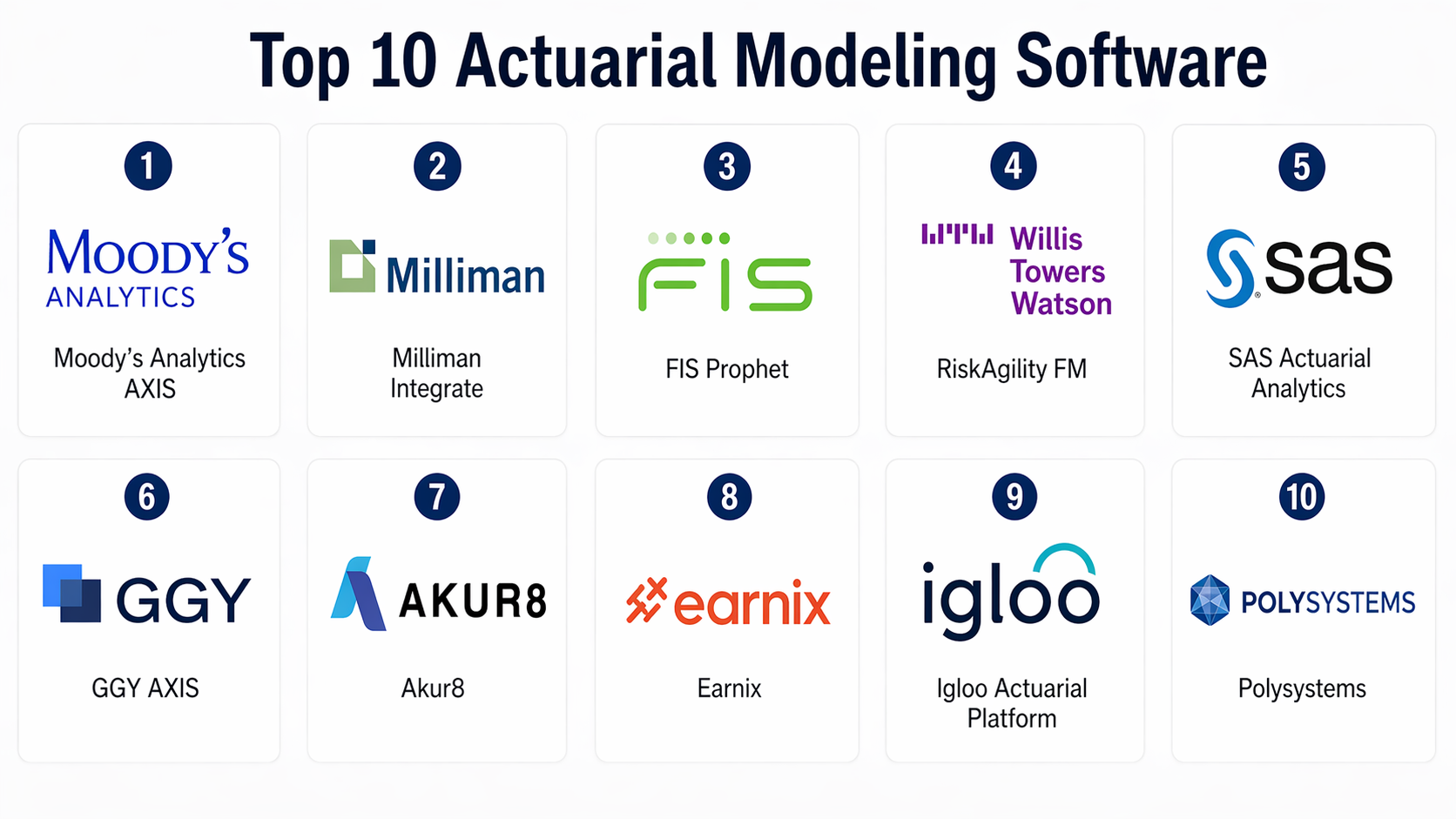
Top 10 Actuarial Modeling Software
#1 — Moody’s Analytics AXIS
Short description:
A widely used actuarial modeling platform for life insurance and financial risk modeling. It supports complex stochastic simulations and regulatory compliance reporting. Ideal for large insurers and financial institutions needing enterprise-grade modeling capabilities.
Key Features
- Advanced stochastic modeling
- Regulatory reporting support
- High-performance simulation engine
- Scenario testing and forecasting
- Integration with financial systems
Pros
- Strong industry adoption
- Highly scalable for enterprise use
Cons
- Steep learning curve
- Premium pricing
Platforms / Deployment
Windows / Cloud / Hybrid
Security & Compliance
Not publicly stated
Integrations & Ecosystem
Integrates with enterprise financial systems and data warehouses.
- APIs for data exchange
- Supports external analytics tools
- Enterprise integration support
Support & Community
Strong enterprise support with training programs; limited public community.
#2 — Milliman Integrate
Short description:
A modeling platform designed for actuarial workflows, focusing on automation and collaboration. It allows actuaries to manage and deploy models efficiently across teams.
Key Features
- Model governance and versioning
- Workflow automation
- Cloud deployment support
- Data integration tools
- Collaboration features
Pros
- Strong automation capabilities
- Good for team collaboration
Cons
- Limited flexibility for custom models
- Requires setup effort
Platforms / Deployment
Web / Cloud
Security & Compliance
Not publicly stated
Integrations & Ecosystem
Supports integration with enterprise data systems.
- API-based integrations
- Data connectors
- Reporting tools
Support & Community
Enterprise-level support; documentation available.
#3 — FIS Prophet
Short description:
A leading actuarial modeling solution for life insurance, offering strong regulatory compliance and financial modeling capabilities.
Key Features
- Financial projections
- Regulatory compliance modules
- Risk modeling
- Scenario analysis
- Reporting dashboards
Pros
- Strong compliance features
- Trusted by global insurers
Cons
- Complex implementation
- Costly for smaller firms
Platforms / Deployment
Windows / Cloud
Security & Compliance
Not publicly stated
Integrations & Ecosystem
- Integrates with finance systems
- Supports APIs
- Data warehouse connectivity
Support & Community
Well-documented with enterprise support.
#4 — Willis Towers Watson RiskAgility FM
Short description:
A powerful modeling tool designed for financial modeling and risk analysis with a focus on flexibility and performance.
Key Features
- Flexible modeling framework
- Distributed computing support
- Scenario simulation
- Risk analytics
- Data integration
Pros
- Highly flexible
- Strong performance
Cons
- Requires technical expertise
- Limited beginner friendliness
Platforms / Deployment
Windows / Cloud
Security & Compliance
Not publicly stated
Integrations & Ecosystem
- API support
- Integration with enterprise tools
- Data pipeline connectivity
Support & Community
Enterprise support with structured onboarding.
#5 — SAS Actuarial Analytics
Short description:
A comprehensive analytics platform with actuarial modeling capabilities integrated into broader data analytics tools.
Key Features
- Advanced analytics and modeling
- Data visualization
- AI/ML integration
- Risk analytics
- Reporting tools
Pros
- Strong analytics capabilities
- AI integration
Cons
- Expensive
- Requires SAS expertise
Platforms / Deployment
Web / Cloud / Hybrid
Security & Compliance
Not publicly stated
Integrations & Ecosystem
- Integration with SAS ecosystem
- APIs available
- BI tool compatibility
Support & Community
Strong enterprise support and large user base.
#6 — GGY AXIS (Moody’s)
Short description:
An extension of AXIS tailored for actuarial modeling and regulatory reporting with strong performance capabilities.
Key Features
- High-speed calculations
- Regulatory compliance
- Scenario modeling
- Data management
- Risk analytics
Pros
- Reliable and scalable
- Widely used
Cons
- Expensive
- Complex setup
Platforms / Deployment
Windows / Cloud
Security & Compliance
Not publicly stated
Integrations & Ecosystem
- Enterprise integrations
- API support
- Data connectors
Support & Community
Enterprise-grade support.
#7 — Akur8
Short description:
A modern actuarial modeling platform focused on AI-driven pricing and automation for insurance companies.
Key Features
- AI-powered pricing models
- Automation workflows
- Data ingestion tools
- Visualization dashboards
- Model explainability
Pros
- Modern AI capabilities
- User-friendly interface
Cons
- Newer in market
- Limited enterprise features
Platforms / Deployment
Web / Cloud
Security & Compliance
Not publicly stated
Integrations & Ecosystem
- API integrations
- Data platform compatibility
- Cloud ecosystem support
Support & Community
Growing support ecosystem.
#8 — Earnix
Short description:
A predictive analytics platform used for pricing and risk modeling in insurance and banking.
Key Features
- Predictive modeling
- Pricing optimization
- Real-time analytics
- Data integration
- Decision automation
Pros
- Strong predictive analytics
- Real-time capabilities
Cons
- Complex configuration
- Higher cost
Platforms / Deployment
Web / Cloud
Security & Compliance
Not publicly stated
Integrations & Ecosystem
- API integrations
- CRM and BI integration
- Data pipelines
Support & Community
Enterprise support with documentation.
#9 — Igloo Actuarial Platform
Short description:
A collaborative actuarial platform focused on improving workflow and communication among actuarial teams.
Key Features
- Workflow automation
- Collaboration tools
- Model management
- Data integration
- Reporting tools
Pros
- Strong collaboration features
- Easy to use
Cons
- Limited advanced modeling
- Smaller ecosystem
Platforms / Deployment
Web / Cloud
Security & Compliance
Not publicly stated
Integrations & Ecosystem
- API-based integration
- Data connectors
- Reporting tools
Support & Community
Moderate support availability.
#10 — Polysystems (PSL)
Short description:
A legacy actuarial modeling tool widely used for life insurance modeling and projections.
Key Features
- Financial modeling
- Life insurance calculations
- Scenario analysis
- Data processing
- Reporting tools
Pros
- Proven reliability
- Trusted by insurers
Cons
- Outdated interface
- Limited modern integrations
Platforms / Deployment
Windows / On-prem
Security & Compliance
Not publicly stated
Integrations & Ecosystem
- Limited integration support
- Legacy system compatibility
Support & Community
Basic support; smaller community.
Comparison Table (Top 10)
| Tool Name | Best For | Platform(s) Supported | Deployment | Standout Feature | Public Rating |
|---|---|---|---|---|---|
| Moody’s AXIS | Enterprise insurers | Windows | Hybrid | High-performance simulations | N/A |
| Milliman Integrate | Workflow automation | Web | Cloud | Model governance | N/A |
| FIS Prophet | Compliance modeling | Windows | Cloud | Regulatory reporting | N/A |
| RiskAgility FM | Flexible modeling | Windows | Cloud | Distributed computing | N/A |
| SAS Actuarial Analytics | Analytics-driven modeling | Web | Hybrid | AI integration | N/A |
| GGY AXIS | Enterprise modeling | Windows | Cloud | Scalability | N/A |
| Akur8 | AI pricing models | Web | Cloud | AI automation | N/A |
| Earnix | Predictive analytics | Web | Cloud | Real-time modeling | N/A |
| Igloo Platform | Team collaboration | Web | Cloud | Workflow tools | N/A |
| Polysystems | Legacy modeling | Windows | On-prem | Proven reliability | N/A |
Evaluation & Actuarial Modeling Software
| Tool Name | Core (25%) | Ease (15%) | Integrations (15%) | Security (10%) | Performance (10%) | Support (10%) | Value (15%) | Weighted Total |
|---|---|---|---|---|---|---|---|---|
| Moody’s AXIS | 9 | 6 | 8 | 7 | 9 | 8 | 6 | 7.9 |
| Milliman Integrate | 8 | 8 | 7 | 7 | 7 | 8 | 7 | 7.6 |
| FIS Prophet | 9 | 6 | 7 | 7 | 8 | 8 | 6 | 7.7 |
| RiskAgility FM | 9 | 5 | 8 | 7 | 9 | 7 | 6 | 7.8 |
| SAS Analytics | 9 | 6 | 9 | 8 | 8 | 8 | 6 | 8.0 |
| GGY AXIS | 9 | 6 | 8 | 7 | 9 | 8 | 6 | 7.9 |
| Akur8 | 8 | 9 | 7 | 7 | 7 | 7 | 8 | 7.8 |
| Earnix | 8 | 7 | 8 | 7 | 8 | 7 | 7 | 7.7 |
| Igloo | 7 | 8 | 6 | 6 | 6 | 6 | 7 | 6.8 |
| Polysystems | 7 | 5 | 5 | 6 | 7 | 6 | 6 | 6.3 |
How to interpret scores:
These scores are relative comparisons, not absolute truths. Higher scores indicate stronger overall capabilities based on weighted criteria. Enterprise tools often score high on core features but lower on ease and cost. SMB-friendly tools may score higher in usability and value.
Which Actuarial Modeling Software
Solo / Freelancer
Tools like Akur8 or SAS (limited use) work best due to ease of use and modern interfaces.
SMB
Milliman Integrate and Igloo offer good balance between cost and functionality.
Mid-Market
Earnix and SAS provide scalability and analytics depth.
Enterprise
Moody’s AXIS, FIS Prophet, and RiskAgility FM are top choices.
Budget vs Premium
- Budget: Igloo, Akur8
- Premium: AXIS, Prophet, SAS
Feature Depth vs Ease of Use
- Deep features: AXIS, Prophet
- Ease of use: Akur8, Igloo
Integrations & Scalability
- Best: SAS, RiskAgility
- Moderate: Earnix, Milliman
Security & Compliance Needs
- Enterprise tools preferred for strict compliance requirements.
Frequently Asked Questions (FAQs)
1. What is actuarial modeling software used for?
It is used to simulate financial risks and predict outcomes in insurance and finance. It helps organizations make informed decisions.
2. Is actuarial software only for insurance companies?
No, it is also used in pensions, banking, and risk management sectors.
3. How much does actuarial software cost?
Pricing varies widely depending on features and scale. Enterprise tools are usually premium priced.
4. Is cloud-based actuarial software better?
Cloud tools offer scalability and flexibility, but some organizations prefer on-prem for compliance reasons.
5. Can non-actuaries use these tools?
Some modern tools offer user-friendly interfaces, but most require actuarial knowledge.
6. How long does implementation take?
Implementation can take weeks to months depending on complexity.
7. What integrations are important?
Integration with data warehouses, BI tools, and financial systems is critical.
8. Are these tools secure?
Most enterprise tools follow strong security practices, though specifics vary.
9. Can I switch tools easily?
Switching is complex due to data migration and model rebuilding.
10. What are alternatives to actuarial software?
For simple cases, spreadsheets or BI tools may suffice.
Conclusion
Actuarial modeling software plays a critical role in modern financial and insurance ecosystems. From regulatory compliance to predictive risk analysis, these tools help organizations navigate uncertainty with data-driven precision. However, there is no single “best” solution—each tool is designed for different levels of complexity, scale, and user expertise. Enterprise platforms offer depth and performance, while newer cloud-based tools focus on usability and automation. The right choice depends on your team size, technical capability, and long-term modeling needs. A practical next step is to shortlist two or three tools, run a pilot with real data, and validate performance, integrations, and usability before making a final decision.
