Introduction
Demand Planning Tools are software solutions that help businesses predict future customer demand using historical data, statistical models, and AI-driven forecasting. In simple terms, these tools answer a critical question: “How much should we produce, stock, or procure to meet customer demand without overstocking or running out?”
In modern supply chains, demand is no longer stable. Market fluctuations, seasonality, promotions, and global disruptions make forecasting difficult. That’s why demand planning tools have evolved into AI-powered, real-time decision platforms that support smarter inventory, production, and distribution planning.
Real-world use cases include:
- Retail demand forecasting for seasonal products
- Manufacturing production planning
- Inventory optimization across warehouses
- Promotion and sales forecasting
- Supply-demand balancing in global supply chains
What buyers should evaluate:
- Forecasting accuracy and AI capabilities
- Data integration (ERP, CRM, POS systems)
- Scenario planning and simulation features
- Ease of use and visualization dashboards
- Scalability for growing demand complexity
- Collaboration and workflow management
- Real-time vs batch forecasting
- Cost vs ROI
- Data quality handling
- Vendor support and onboarding
Best for: Retailers, manufacturers, FMCG companies, e-commerce businesses, and supply chain planners who need accurate forecasting and inventory optimization.
Not ideal for: Very small businesses with predictable demand, companies with minimal inventory complexity, or those relying on simple spreadsheets.
Key Trends in Demand Planning Tools
- AI/ML-based forecasting models replacing traditional statistical methods
- Demand sensing using real-time data (POS, IoT, market signals)
- Scenario planning and digital twins for better decision-making
- Cloud-native demand planning platforms replacing legacy tools
- Automation of planning workflows reducing manual intervention
- Integration with supply chain control towers
- Collaborative planning across departments and partners
- Sustainability-driven demand planning (waste reduction)
- API-first ecosystems for seamless integrations
- Subscription-based pricing models
How We Selected These Tools (Methodology)
- Analyzed market adoption across industries
- Evaluated forecasting accuracy and AI capabilities
- Assessed integration with ERP, CRM, and SCM systems
- Reviewed scalability and performance signals
- Considered ease of use and user interface design
- Checked security and compliance readiness
- Compared vendor ecosystem and support quality
- Balanced enterprise and mid-market solutions
- Focused on real-world usability and ROI potential
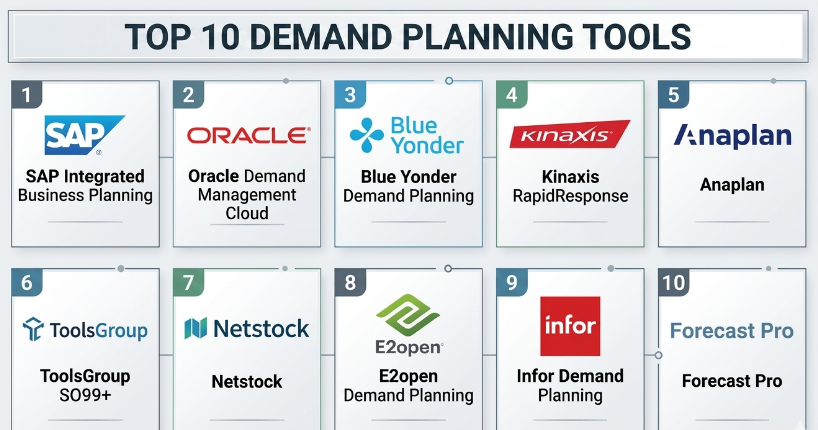
Top 10 Demand Planning Tools
#1 — SAP Integrated Business Planning (IBP)
Short description:
SAP IBP is a powerful enterprise demand planning platform designed for large organizations. It combines forecasting, inventory optimization, and supply planning into a unified system. It is widely used in manufacturing, retail, and global enterprises for advanced demand planning.
Key Features
- AI-based demand forecasting
- Inventory and supply optimization
- Scenario planning and simulations
- Real-time analytics dashboards
- Integration with SAP ERP
- Collaboration tools
Pros
- Highly scalable for global operations
- Deep integration with SAP ecosystem
Cons
- Complex implementation
- High cost
Platforms / Deployment
Cloud / Hybrid
Security & Compliance
SSO, RBAC, encryption; other details not publicly stated
Integrations & Ecosystem
Strong integration within SAP ecosystem and external systems.
- SAP ERP
- Data lakes
- APIs
Support & Community
Extensive enterprise support with a large global user base
#2 — Oracle Demand Management Cloud
Short description:
Oracle’s demand planning tool offers AI-driven forecasting and predictive insights. It focuses on improving forecast accuracy and aligning demand with supply.
Key Features
- Machine learning forecasting
- Demand sensing
- Scenario planning
- KPI dashboards
- Supply-demand balancing
Pros
- Strong analytics capabilities
- Scalable cloud architecture
Cons
- Requires Oracle ecosystem
- Learning curve
Platforms / Deployment
Cloud
Security & Compliance
Encryption, RBAC; others not publicly stated
Integrations & Ecosystem
- Oracle ERP
- Supply chain systems
- APIs
Support & Community
Enterprise-grade support with structured documentation
#3 — Blue Yonder Demand Planning
Short description:
Blue Yonder provides AI-powered demand forecasting and supply chain planning, especially strong in retail and logistics.
Key Features
- AI-driven demand forecasting
- Real-time demand sensing
- Promotion planning
- Inventory optimization
- Exception management
Pros
- Advanced AI capabilities
- Strong retail focus
Cons
- Complex setup
- Premium pricing
Platforms / Deployment
Cloud
Security & Compliance
Not publicly stated
Integrations & Ecosystem
- ERP systems
- POS systems
- APIs
Support & Community
Good enterprise support
#4 — Kinaxis RapidResponse
Short description:
Kinaxis is known for real-time concurrent planning and fast scenario analysis, making it ideal for dynamic industries.
Key Features
- Real-time planning
- Scenario simulation
- Demand-supply alignment
- Analytics dashboards
- Collaboration tools
Pros
- Fast decision-making
- User-friendly interface
Cons
- Limited customization
- Higher pricing
Platforms / Deployment
Cloud
Security & Compliance
SSO, encryption; others not publicly stated
Integrations & Ecosystem
- ERP systems
- APIs
Support & Community
Strong onboarding and enterprise support
#5 — Anaplan
Short description:
Anaplan is a flexible planning platform that supports demand planning, financial planning, and business forecasting.
Key Features
- Connected planning
- Scenario modeling
- Collaboration tools
- Real-time analytics
- Forecasting models
Pros
- Highly flexible platform
- Strong collaboration features
Cons
- Requires configuration
- Can be costly
Platforms / Deployment
Cloud
Security & Compliance
SSO, encryption; others not publicly stated
Integrations & Ecosystem
- ERP
- CRM
- APIs
Support & Community
Strong community and documentation
#6 — ToolsGroup SO99+
Short description:
ToolsGroup focuses on inventory optimization and demand forecasting using probabilistic models.
Key Features
- Probabilistic forecasting
- Inventory optimization
- Demand sensing
- Automation
- Service level optimization
Pros
- High forecast accuracy
- Strong inventory optimization
Cons
- Niche focus
- Limited UI flexibility
Platforms / Deployment
Cloud
Security & Compliance
Not publicly stated
Integrations & Ecosystem
- ERP systems
- APIs
Support & Community
Enterprise-focused support
#7 — Netstock
Short description:
Netstock is designed for SMBs, offering demand forecasting and inventory optimization tools that are easy to use.
Key Features
- Demand forecasting
- Inventory optimization
- KPI dashboards
- Supplier performance tracking
- Alerts and recommendations
Pros
- Easy to use
- Affordable for SMBs
Cons
- Limited advanced features
- Not ideal for large enterprises
Platforms / Deployment
Cloud
Security & Compliance
Not publicly stated
Integrations & Ecosystem
- ERP integrations
- APIs
Support & Community
Good SMB-focused support
#8 — E2open Demand Planning
Short description:
E2open provides end-to-end demand planning with strong collaboration and visibility features.
Key Features
- Demand sensing
- Forecasting
- Collaboration tools
- Risk monitoring
- Analytics dashboards
Pros
- Comprehensive platform
- Strong partner network
Cons
- Complexity
- Pricing transparency
Platforms / Deployment
Cloud
Security & Compliance
Not publicly stated
Integrations & Ecosystem
- ERP
- Supply chain systems
Support & Community
Enterprise support
#9 — Infor Demand Planning
Short description:
Infor offers industry-specific demand planning tools with strong analytics and forecasting capabilities.
Key Features
- Statistical forecasting
- Demand modeling
- Scenario planning
- KPI dashboards
- Industry-specific features
Pros
- Industry customization
- Good analytics
Cons
- UI complexity
- Limited flexibility
Platforms / Deployment
Cloud
Security & Compliance
Not publicly stated
Integrations & Ecosystem
- ERP
- APIs
Support & Community
Moderate support
#10 — Forecast Pro
Short description:
Forecast Pro is a specialized forecasting tool focused on statistical demand planning and ease of use.
Key Features
- Statistical forecasting
- Data visualization
- Forecast automation
- Reporting tools
- Easy integration
Pros
- Simple and effective
- Fast deployment
Cons
- Limited AI features
- Not enterprise-grade
Platforms / Deployment
Windows / Cloud
Security & Compliance
Not publicly stated
Integrations & Ecosystem
- ERP
- Data tools
Support & Community
Basic support and documentation
Comparison Table (Top 10)
| Tool Name | Best For | Platform(s) Supported | Deployment | Standout Feature | Public Rating |
|---|---|---|---|---|---|
| SAP IBP | Enterprises | Web | Cloud/Hybrid | Advanced forecasting | N/A |
| Oracle Demand Cloud | Enterprises | Web | Cloud | AI forecasting | N/A |
| Blue Yonder | Retail/logistics | Web | Cloud | Demand sensing | N/A |
| Kinaxis | Mid-large companies | Web | Cloud | Real-time planning | N/A |
| Anaplan | Cross-functional planning | Web | Cloud | Connected planning | N/A |
| ToolsGroup | Inventory optimization | Web | Cloud | Probabilistic forecasting | N/A |
| Netstock | SMB | Web | Cloud | Ease of use | N/A |
| E2open | End-to-end SCM | Web | Cloud | Collaboration | N/A |
| Infor | Industry-specific | Web | Cloud | Customization | N/A |
| Forecast Pro | Small-mid | Windows/Web | Cloud | Simplicity | N/A |
Evaluation & Scoring of Demand Planning Tools
| Tool Name | Core (25%) | Ease (15%) | Integrations (15%) | Security (10%) | Performance (10%) | Support (10%) | Value (15%) | Weighted Total |
|---|---|---|---|---|---|---|---|---|
| SAP IBP | 9 | 6 | 9 | 8 | 9 | 9 | 6 | 8.1 |
| Oracle | 8 | 6 | 8 | 8 | 8 | 8 | 7 | 7.8 |
| Blue Yonder | 9 | 7 | 8 | 7 | 8 | 7 | 7 | 7.9 |
| Kinaxis | 8 | 8 | 7 | 7 | 8 | 8 | 7 | 7.8 |
| Anaplan | 8 | 7 | 8 | 7 | 8 | 8 | 7 | 7.8 |
| ToolsGroup | 8 | 6 | 7 | 6 | 7 | 7 | 7 | 7.1 |
| Netstock | 6 | 9 | 6 | 6 | 7 | 7 | 9 | 7.2 |
| E2open | 8 | 6 | 8 | 7 | 8 | 8 | 7 | 7.6 |
| Infor | 7 | 6 | 7 | 6 | 7 | 7 | 7 | 6.9 |
| Forecast Pro | 6 | 8 | 6 | 5 | 6 | 6 | 8 | 6.7 |
How to interpret scores:
- Scores compare tools within this list
- Higher score = stronger overall performance
- Enterprise tools score higher in core features
- SMB tools score higher in ease and value
- Always validate through real-world testing
Which Demand Planning Tools
Solo / Freelancer
Basic tools like spreadsheets or simple forecasting software are enough.
SMB
Netstock and Forecast Pro are ideal for affordability and simplicity.
Mid-Market
Kinaxis, Anaplan, and E2open offer a balance of features and usability.
Enterprise
SAP IBP, Oracle, and Blue Yonder are best for large-scale operations.
Budget vs Premium
- Budget: Netstock, Forecast Pro
- Premium: SAP, Oracle, Blue Yonder
Feature Depth vs Ease of Use
- Feature-rich: SAP, Oracle
- Easy to use: Netstock, Kinaxis
Integrations & Scalability
- Strong: SAP, Oracle, Anaplan
- Moderate: Netstock, Forecast Pro
Security & Compliance Needs
- High: SAP, Oracle
- Moderate: Others
Frequently Asked Questions (FAQs)
1. What is demand planning software?
It helps predict future demand using historical data and analytics.
2. How accurate are forecasts?
Accuracy depends on data quality, algorithms, and market conditions.
3. Are these tools AI-based?
Most modern tools use AI and machine learning.
4. How long does implementation take?
It can range from weeks to months depending on complexity.
5. Can SMBs use these tools?
Yes, some tools are designed specifically for SMBs.
6. Do they integrate with ERP systems?
Yes, most tools offer integrations with ERP and CRM systems.
7. What industries benefit most?
Retail, manufacturing, FMCG, and e-commerce.
8. Are they cloud-based?
Most modern tools are cloud-based.
9. What are common mistakes?
Poor data quality, underestimating complexity, and lack of training.
10. Can I switch tools later?
Yes, but migration requires planning and data preparation.
Conclusion
Demand Planning Tools have become essential for businesses aiming to improve forecasting accuracy, reduce inventory costs, and respond quickly to market changes. With AI-driven insights and real-time analytics, these platforms enable smarter, data-driven decision-making.