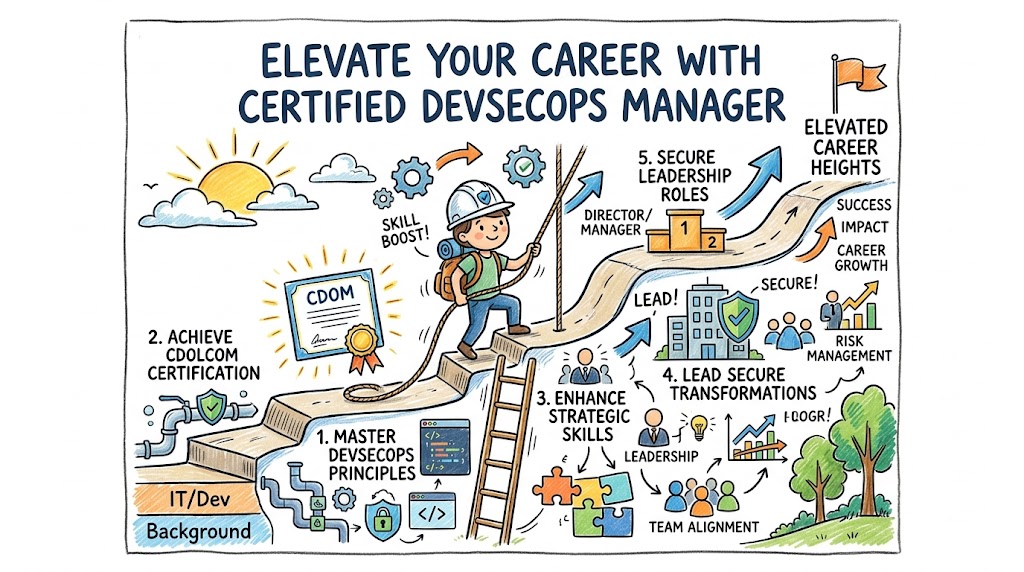
The modern software landscape demands a shift in how we approach security, moving it from a final checkpoint to a core component of the development lifecycle. This Certified DevSecOps Manager guide is designed for professionals navigating this transition, offering a clear path toward mastering secure development practices. Whether you are aiming to refine your technical leadership or broaden your influence across devsecopsschool or aiopsschool, this roadmap provides the clarity needed to make informed career decisions. By focusing on integrated security, engineers and managers can significantly improve delivery velocity without compromising system integrity.
What is the Certified DevSecOps Manager?
The Certified DevSecOps Manager represents a specialized credential focused on integrating security controls into automated pipelines. It exists to bridge the gap between traditional security silos and the rapid pace of modern software delivery environments. Instead of relying on theoretical frameworks, this certification emphasizes practical, production-focused learning that addresses real-world vulnerabilities. It aligns security objectives with enterprise engineering workflows, ensuring that team members understand how to implement guardrails without creating bottlenecks.
Who Should Pursue Certified DevSecOps Manager?
This path is designed for software engineers, site reliability engineers, and cloud architects who want to specialize in security orchestration. It is equally valuable for security professionals looking to gain hands-on experience with modern CI/CD tooling and infrastructure-as-code practices. Engineering managers and technical leaders will also find this beneficial for understanding how to lead secure development teams effectively. Both professionals in India and global markets will find the skills gained here directly applicable to current industry demands for secure, scalable software systems.
Why Certified DevSecOps Manager
The demand for professionals who can bridge the gap between development and security is currently at an all-time high. This certification provides long-term value by teaching foundational principles that remain relevant regardless of specific tool changes or vendor trends. It serves as a proof of competence that helps professionals distinguish themselves in a competitive market. Furthermore, it offers a high return on investment by enabling engineers to prevent costly security incidents before they reach production environments.
Certified DevSecOps Manager Certification Overview
The program is delivered via the official curriculum available at the course website and is hosted on the devsecopsschool platform. This certification employs a robust assessment approach that tests a candidate’s ability to apply security practices in simulated production scenarios. It provides clear ownership of learning milestones, ensuring that every participant moves through a structured curriculum. The approach is deeply practical, focusing on the tactical application of security tools within the broader software development lifecycle.
Certified DevSecOps Manager Certification Tracks & Levels
The certification structure is divided into foundation, professional, and advanced levels to suit different stages of professional growth. Foundation tracks focus on core concepts and basic pipeline security, while professional tracks dive deep into orchestration and policy management. Advanced levels are reserved for complex architecture and strategic security planning. These tracks align perfectly with individual career progression, allowing engineers to specialize in areas like cloud security, pipeline automation, or policy-driven governance.
Complete Certified DevSecOps Manager Certification Table
| Track | Level | Who it’s for | Prerequisites | Skills Covered | Recommended Order |
| Security Operations | Foundation | Junior Engineers | Basic Linux/Cloud knowledge | Security Basics, CLI tools | 1 |
| Pipeline Security | Professional | DevOps/Security Engineers | Foundation Certification | CI/CD Integration, SAST/DAST | 2 |
| Strategy & Leadership | Advanced | Managers/Architects | Professional Certification | Governance, Risk Management | 3 |
Detailed Guide for Each Certified DevSecOps Manager Certification
Certified DevSecOps Manager – Foundation Level
What it is
This certification validates an engineer’s understanding of basic security principles and their integration into CI/CD pipelines. It covers the fundamental concepts required to start building secure automated workflows.
Who should take it
This is ideal for junior developers, system administrators, and those new to the security space who want to establish a strong technical baseline.
Skills you’ll gain
- Implementing basic secret management.
- Setting up automated code scanning.
- Managing access control for cloud resources.
Real-world projects you should be able to do
- Integrate a static analysis tool into a GitHub Actions pipeline.
- Configure basic role-based access control for a development environment.
- Perform a vulnerability assessment on a simple web container.
Preparation plan
- 7–14 days: Focus on understanding core security terminology and basic tool usage through hands-on labs.
- 30 days: Build a small project that integrates one scanning tool into a working CI pipeline.
- 60 days: Review security best practices and ensure all concepts are mapped to practical implementation.
Common mistakes
Focusing too much on theoretical exam dumps instead of building actual pipelines is a major setback for candidates. Many also fail to understand the importance of security-as-code concepts in a real-world setting.
Best next certification after this
- Same-track: Professional Level Certified DevSecOps Manager.
- Cross-track: Certified SRE Practitioner.
- Leadership option: Advanced DevSecOps Leadership.
Choose Your Learning Path
DevOps Path
The DevOps path focuses on the automation of the entire software delivery lifecycle. It emphasizes the integration of security tools without slowing down the deployment process. Professionals learn to balance speed with quality through robust pipeline design. This path is essential for those aiming to become lead engineers or platform architects.
DevSecOps Path
The DevSecOps path is a deep dive into the intersection of security and development workflows. It prioritizes the creation of self-service security tools that empower developers to secure their own code. Mastery of this path allows for the architectural design of secure, resilient systems. This is the primary track for those seeking the full manager-level certification.
SRE Path
The SRE path focuses on the reliability and scalability of systems while maintaining a high security posture. It explores how observability and incident management can be used to improve system security. This path is vital for engineers who manage large-scale distributed systems in complex environments. It bridges the gap between uptime and security.
AIOps Path
The AIOps path explores how machine learning can be applied to identify security threats and operational anomalies. It covers the use of intelligent monitoring to predict and prevent security breaches before they occur. This is an emerging field that requires both data handling skills and security knowledge. It is perfect for those interested in next-generation operations.
MLOps Path
The MLOps path focuses on the secure deployment and monitoring of machine learning models. It covers the unique security challenges of the ML lifecycle, including data poisoning and model integrity. Professionals in this track ensure that AI-driven services are secure and compliant with enterprise standards. It is a critical path for data-driven organizations.
DataOps Path
The DataOps path focuses on the secure flow and processing of data across an organization. It covers data privacy, compliance, and secure data pipeline management. Professionals learn to manage data at scale while ensuring that all security controls are applied consistently. This path is essential for anyone handling sensitive enterprise data.
FinOps Path
The FinOps path explores the intersection of cloud cost management and security. It focuses on how to optimize costs without sacrificing security controls or compliance. Professionals in this track learn to manage cloud resources efficiently while maintaining strict governance. This path is increasingly important for managing cloud budgets effectively.
Role → Recommended Certified DevSecOps Manager Certifications
| Role | Recommended Certifications |
| DevOps Engineer | Professional Level Certified DevSecOps Manager |
| SRE | SRE Security Specialist |
| Platform Engineer | Infrastructure Security Professional |
| Cloud Engineer | Cloud Security Certification |
| Security Engineer | Advanced Certified DevSecOps Manager |
| Data Engineer | DataOps & Security Specialist |
| FinOps Practitioner | Secure FinOps Operations |
| Engineering Manager | Strategic DevSecOps Leadership |
Next Certifications to Take After Certified DevSecOps Manager
Same Track Progression
Once the manager certification is complete, candidates should look toward advanced architectural certifications. These focus on multi-cloud security strategy and complex disaster recovery scenarios. Deepening knowledge in specific areas like container orchestration security is also highly recommended. This ensures continued relevance in a rapidly changing technical field.
Cross-Track Expansion
Expanding into SRE or DataOps tracks allows professionals to become more versatile members of a high-performing engineering team. Understanding how security principles apply to data pipelines or system reliability provides a distinct competitive advantage. This cross-pollination of skills is what sets top-tier engineers apart. It also opens up more diverse career opportunities across different departments.
Leadership & Management Track
Transitioning to leadership requires a focus on security governance, team management, and strategic planning. Certifications in security leadership help professionals manage risk at an enterprise scale. Developing the ability to communicate security ROI to stakeholders is a critical skill for senior leaders. This path prepares engineers to lead entire security organizations.
Training & Certification Support Providers for Certified DevSecOps Manager
DevOpsSchool is a leading provider of comprehensive technical training programs that focus on hands-on learning. They have a long history of preparing engineers for complex certification exams in the DevOps and security domains.
Cotocus provides advanced workshops and specialized training tracks that are tailored for corporate teams and individual professionals looking to upskill quickly. Their focus on real-world applications makes them a trusted partner for certification prep.
Scmgalaxy offers a deep dive into configuration management and pipeline orchestration, which are critical components for any security-focused certification path. They emphasize practical lab-based training sessions.
BestDevOps specializes in providing updated materials and guided paths for various DevOps and SRE certifications. They are known for their clear explanations and focus on current industry standards.
devsecopsschool is dedicated specifically to the security aspects of the DevOps movement, offering specialized certification tracks for managers and engineers alike. Their curriculum is highly focused on modern security workflows.
sreschool provides in-depth training on site reliability engineering, ensuring that security and reliability are treated as interconnected disciplines in the modern enterprise.
aiopsschool focuses on the intersection of AI and operations, providing valuable insights into how automated systems can be secured and managed effectively.
dataopsschool offers focused training for professionals working in the data space, ensuring that data pipelines and analytics platforms are secure and compliant.
finopsschool specializes in cloud financial management and governance, providing the skills needed to manage costs and security simultaneously.
Frequently Asked Questions
- What is the difficulty level of this certification?The certification is designed to be rigorous but achievable for engineers with practical experience. It focuses on application rather than rote memorization.
- How much time is required to prepare?Most professionals dedicate between four to eight weeks, depending on their existing experience with security tools and pipelines.
- Are there any specific prerequisites?A strong foundation in Linux, basic networking, and an understanding of CI/CD pipeline concepts is highly recommended before starting.
- Is this certification globally recognized?Yes, the certification is valued by organizations worldwide as it focuses on universal security principles applied to modern DevOps practices.
- Does the program provide hands-on experience?The program emphasizes practical lab exercises that mirror real-world security challenges faced in production environments.
- What is the return on investment for this certification?Professionals often report faster career growth and an increased ability to lead security-focused initiatives within their organizations.
- How does this sequence with other certifications?It is best taken after gaining foundational knowledge in DevOps or cloud engineering and can lead to advanced architecture or management tracks.
- Can I pursue this while working full-time?Yes, the program is structured to be flexible, allowing working professionals to learn at their own pace through modular content.
- What kind of career support is provided?The providers offer guidance on professional development, resume building, and interview preparation for security-focused roles.
- How often is the content updated?The curriculum is regularly reviewed to ensure it reflects the latest industry trends, tool updates, and security best practices.
- What is the exam format?The exam consists of both theoretical assessments and practical scenario-based tasks to ensure complete competence.
- Is this suitable for someone from a non-security background?Absolutely, as it builds security expertise from the ground up, making it accessible to any experienced IT professional.
FAQs on Certified DevSecOps Manager
- What specifically does the manager certification cover?It covers security orchestration, policy-as-code, and leadership strategies for managing secure development teams in modern environments.
- Is it only for security professionals?No, it is highly recommended for DevOps engineers and SREs who want to incorporate security into their daily workflows.
- How does this help my team?It equips you with the knowledge to build automated security guardrails that reduce manual effort and increase pipeline efficiency.
- Is it worth it for a small business?Yes, implementing these practices early on prevents security debt and scales well as the organization grows.
- Does it teach specific tools?It teaches the underlying concepts and principles, which are then applied using industry-standard tools for hands-on practice.
- Will this help me get a leadership role?It provides the strategic and technical foundation required for senior roles that oversee security and engineering quality.
- How do I maintain my certification?Keeping up with the latest workshops and continuing professional development activities is the standard way to stay current.
- Is this suitable for cloud-native environments?It is specifically designed for cloud-native workflows, focusing on container security and infrastructure-as-code best practices.
Final Thoughts: Is Certified DevSecOps Manager Worth It?
If you are serious about advancing your career in the current technical landscape, this certification is a solid choice. It provides the necessary framework to move beyond basic security tasks and into the realm of strategic, automated security management. The path is not about collecting badges; it is about proving that you can build and lead secure systems in a high-pressure environment. If you approach the material with the intent to master the underlying principles, you will find it to be an invaluable asset in your professional toolkit. Focus on the hands-on labs, apply the knowledge to your current projects, and you will see immediate improvements in your engineering work.
