Introduction
In the modern technology landscape, companies race to ship new software features daily to stay competitive. Yet, rushing code directly into production frequently leaves security as an afterthought, resulting in expensive data breaches and operational downtime. When security validations happen only at the very end of a release cycle, engineering teams experience frustrating bottlenecks and costly rework. DevSecOps addresses this challenge by embedding security checks directly into every phase of software creation, from initial design to live production environments. Organizations often require external guidance to successfully bridge the gap between rapid software delivery and rigorous security standards. Through targeted consulting, maturity assessments, hands-on implementation, education, and managed operations, businesses can build hardened systems without sacrificing delivery speed. This is where comprehensive platforms like DevSecOpsNow.com assist organizations in navigating their security transformations with practical solutions.
Understanding DevSecOps Services
Traditional software engineering historically treated security as a separate hurdle positioned at the very end of the pipeline. Independent security teams would inspect the finished product, discover severe vulnerabilities, and return the code to developers, triggering massive delays. DevSecOps transforms this dynamic by turning security into a shared operational priority.
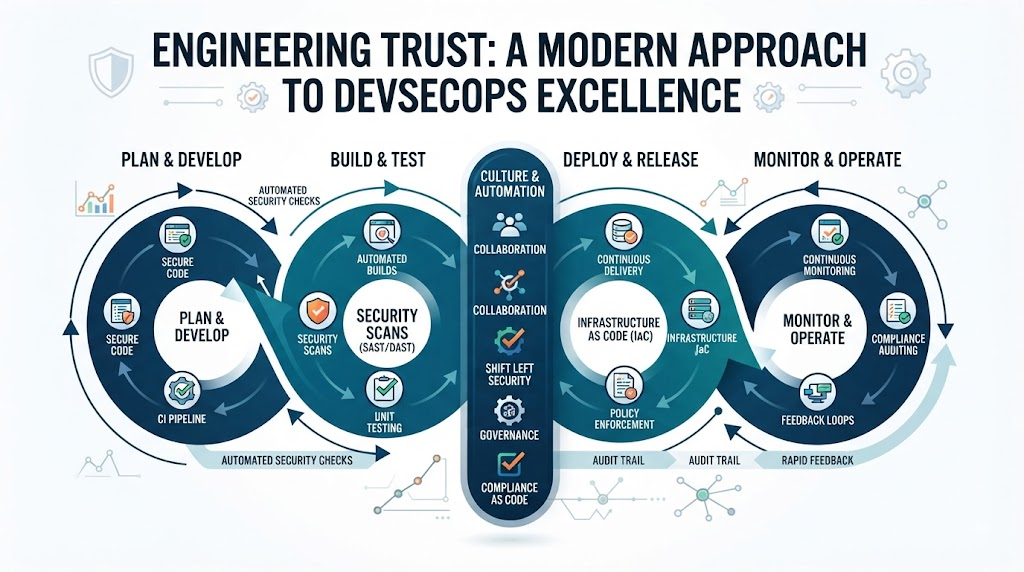
DevSecOps unites development, security, and operations from day one. Instead of halting progress for manual reviews, automated tooling runs security checks directly inside the delivery pipeline. This ensures potential risks are identified and resolved early, when remediation is fast and inexpensive. True collaboration forms the core of this methodology, bringing developers, IT operators, and security professionals together under a unified workflow.
DevSecOps Consulting Services for Better Security Strategy
Establishing a robust security posture demands a strategic blueprint tailored precisely to an organization’s technical stack and business goals. DevSecOps Consulting Services assist enterprises in evaluating their existing security landscape and mapping out a clear roadmap for progress.
Consultants review current CI/CD pipelines, recommend appropriate security tools, and help define governance policies. They guide teams in architecting secure environments that protect sensitive data without creating unnecessary friction for developers. Effective consulting also addresses compliance requirements, ensuring that systems align with recognized industry standards. This long-term guidance prevents costly missteps and fosters continuous security growth over time.
DevSecOps Assessment Services for Identifying Security Gaps
Before initiating major changes to software workflows, businesses need a transparent evaluation of their current strengths and vulnerabilities. DevSecOps Assessment Services deliver an in-depth review of existing development practices, cloud configurations, and container platforms.
Assessors examine vulnerability management routines, access privileges, automation levels, and daily developer habits. By pinpointing hidden security gaps across pipelines and underlying infrastructure, an assessment equips leadership with a prioritized action plan. This focused approach ensures that time and resources target the most critical risks first.
DevSecOps Implementation Services for Secure Software Delivery
Transitioning from traditional workflows to an automated, secure delivery model demands practical technical execution. DevSecOps Implementation Services help enterprises translate high-level security strategies into daily operational reality.
Implementation specialists configure automated security scans within CI/CD pipelines, establish cloud guardrails, and build monitoring frameworks. The primary objective is to introduce security checks that run seamlessly in the background without frustrating engineering teams. Successful implementation blends naturally into existing routines, making secure practices second nature for every developer.
DevSecOps Managed Services for Continuous Security
Security is an ongoing commitment requiring constant observation and rapid incident response rather than a one-time project. DevSecOps Managed Services provide organizations with continuous expert backing after the initial setup phase concludes.
Managed support teams oversee continuous security monitoring, track emerging vulnerabilities, check pipeline health, and generate compliance reports. This removes heavy operational burdens from internal staff, freeing developers to concentrate on core product features. Having dedicated professionals monitoring systems around the clock dramatically lowers the likelihood of surprise security incidents.
DevSecOps Training for Security-Aware Teams
Even the most advanced automation tools cannot replace human insight and technical awareness. DevSecOps Training bridges existing knowledge gaps by educating technical staff on how to write and maintain secure code from inception.
Training programs cover secure coding principles, pipeline protection, vulnerability triage, and cloud-native security concepts. When developers understand the reasoning behind security rules and recognize common vulnerabilities early, overall software quality rises significantly. Education transforms security from an obstructive checklist into an integrated part of daily engineering.
Corporate DevSecOps Training for Enterprise Teams
Larger enterprises require a unified approach to security education that spans across multiple departments and leadership tiers. Corporate DevSecOps Training ensures that developers, operations staff, security engineers, and engineering leaders share a common understanding of risk management.
Enterprise training initiatives combine practical, hands-on exercises with best practices designed for large-scale operations. Managers learn how to facilitate secure workflows, while technical teams master advanced automation and container protection. This organization-wide focus builds a resilient, lasting culture of security across the entire business.
Cloud Security Consulting Services for Modern Infrastructure
Contemporary applications depend heavily on cloud environments, which introduce unique access and configuration complexities. Cloud Security Consulting Services help organizations defend their cloud footprints against misconfigurations, unauthorized entry, and data leaks.
Consultants audit identity and access management setups, design secure networking boundaries, and enforce proper secrets management protocols. They also secure Infrastructure-as-Code scripts prior to actual resource deployment. Expert cloud guidance ensures businesses can innovate rapidly while maintaining robust asset protection.
Kubernetes Security Consulting Services for Containerized Applications
Container orchestration systems like Kubernetes provide immense flexibility, yet demand specialized expertise to secure effectively. Kubernetes Security Consulting Services help teams safeguard containerized workloads throughout their entire lifecycle.
Specialists harden cluster settings, enforce role-based access rules, and establish strict network micro-segmentation between containers. They also evaluate container images for known vulnerabilities and implement runtime monitoring to detect anomalies early. Effective Kubernetes hardening stops attackers from moving laterally across infrastructure if an individual pod is breached.
Software Supply Chain Security Services
Modern software heavily incorporates open-source libraries, third-party packages, and external container images. Software Supply Chain Security Services provide organizations with deep visibility and rigorous control over all external dependencies entering their applications.
These services detect vulnerable open-source packages, malicious components, and compromised build pipelines before production deployment. Teams learn to generate and manage software bills of materials to track every internal component accurately. Securing the supply chain blocks malicious actors from injecting unauthorized code through trusted third-party vectors.
Penetration Testing Services for Stronger Application Security
While automated security scans identify common flaws, human creativity remains essential for uncovering intricate logical weaknesses. Penetration Testing Services involve ethical hackers executing controlled simulations against applications, APIs, and cloud architecture.
Penetration testing validates whether existing defenses can withstand a persistent attacker under realistic conditions. Findings are categorized by true operational risk, giving remediation teams clear priorities. Automated DevSecOps tooling and penetration testing complement each other, with automation handling routine checks while human testers uncover deep architectural vulnerabilities.
How DevSecOps Services Work Together
A successful security program relies on a cohesive sequence of services where each phase reinforces the next.
$$\text{Assessment} \longrightarrow \text{Consulting} \longrightarrow \text{Implementation} \longrightarrow \text{Training} \longrightarrow \text{Managed Services} \longrightarrow \text{Penetration Testing} \longrightarrow \text{Improvement}$$
The lifecycle begins with an assessment to locate existing gaps, followed by consulting to outline a tailored strategy. Implementation puts those plans into practice within development pipelines, while training equips teams to sustain the changes. Managed services deliver continuous daily oversight, and periodic penetration testing validates overall defense efficacy. Each stage supports the subsequent one, establishing a continuous cycle of security enhancement.
DevSecOps Service Comparison Table
| Service | Main Focus | Business Benefit |
| DevSecOps Consulting Services | Security strategy and planning | Better security decisions |
| DevSecOps Assessment Services | Finding security and process gaps | Clear improvement roadmap |
| DevSecOps Implementation Services | Integrating security into delivery | More secure software releases |
| DevSecOps Managed Services | Ongoing security support | Reduced operational workload |
| DevSecOps Training | Building team skills | Stronger security awareness |
| Cloud Security Consulting Services | Securing cloud environments | Reduced cloud security risks |
| Kubernetes Security Consulting Services | Securing container platforms | Safer cloud-native applications |
| Software Supply Chain Security Services | Protecting software components | Reduced supply chain risk |
| Penetration Testing Services | Finding exploitable weaknesses | Stronger security validation |
Common DevSecOps Challenges Businesses Face
Organizations transitioning toward modern software delivery methods often encounter distinct operational roadblocks. Identifying these obstacles early allows teams to plan effective solutions:
- Late-Stage Security: Detecting flaws only after development concludes results in expensive rewrites and missed deadlines.
- Tool Fatigue: Deploying too many disconnected security tools generates excessive noise and confusion.
- Alarm Overload: High volumes of false positives cause teams to ignore crucial warnings.
- Expertise Shortage: A lack of internal security specialists slows down secure workflow adoption.
- Cloud Misconfigurations: Complex cloud setups frequently leave systems exposed to accidental data leaks.
- Developer Pushback: Security controls that disrupt productivity are often circumvented by frustrated staff.
Structured DevSecOps frameworks resolve these issues by automating routine checks and integrating security smoothly into existing workflows.
Benefits of Professional DevSecOps Services
Investing in specialized expertise and structured security practices delivers clear operational advantages for modern tech organizations:
- Earlier identification and resolution of vulnerabilities before code reaches production environments
- Accelerated release cycles without compromising overall software stability
- Enhanced protection for cloud infrastructure and containerized workloads
- Minimized exposure to vulnerable open-source dependencies and supply chain attacks
- Strengthened cross-functional collaboration among development, operations, and security groups
- Reduced manual intervention through intelligent security automation
- Increased trust and confidence from customers and enterprise partners
How DevSecOpsNow.com Helps Organizations
Companies aiming to fortify their software pipelines require dependable partners who understand real-world engineering environments. DevSecOpsNow.com offers comprehensive support tailored to help enterprises build, scale, and maintain secure practices. Through expert consulting, meticulous assessments, seamless integration, and ongoing managed care, the platform assists teams across all phases of security maturity.
Additionally, DevSecOpsNow.com provides targeted solutions spanning cloud defense, Kubernetes hardening, supply chain protection, and penetration testing. With tailored educational programs designed for both individual contributors and leadership teams, businesses can foster a lasting security culture. These practical capabilities empower organizations to protect applications and accelerate delivery without unnecessary friction.
How to Choose the Right DevSecOps Service Provider
Selecting an ideal partner is a critical decision influencing the long-term safety and velocity of engineering operations. Consider these practical criteria when evaluating potential vendors:
- Verify proven technical competence across both traditional development pipelines and modern security operations.
- Ensure the provider possesses hands-on experience with your specific cloud and container ecosystems.
- Look for an ability to deliver comprehensive support spanning initial assessments to ongoing managed oversight.
- Evaluate their approach to team education and internal skill development.
- Prioritize partners who emphasize transparent communication and tie security outcomes directly to business objectives.
DevSecOps Service Comparison: Consulting vs Implementation vs Managed Services
| Service Type | Best For | Main Purpose |
| Consulting | Organizations planning DevSecOps | Strategy and guidance |
| Assessment | Organizations identifying security gaps | Finding weaknesses |
| Implementation | Organizations adopting DevSecOps | Building security into workflows |
| Managed Services | Organizations needing ongoing support | Continuous security management |
| Training | Teams building security skills | Knowledge and awareness |
Future of DevSecOps
The software security landscape continues shifting rapidly alongside emerging technologies and delivery models. Upcoming advancements will likely emphasize AI-assisted security analysis to isolate complex flaws even faster. Automation will expand further into automated remediation, allowing pipelines to correct basic vulnerabilities autonomously. Cloud-native security designs, software bill of materials adoption, and policy-as-code will become industry standards. Tightly coupling security with platform engineering will ensure that building secure software remains effortless for every developer.
Frequently Asked Questions
1. What are DevSecOps Consulting Services?
Answer: DevSecOps Consulting Services help organizations analyze their current security posture and design a practical strategy for integrating security into software delivery pipelines.
2. Why are DevSecOps Assessment Services important?
Answer: These assessments review existing development workflows, tools, and cloud setups to uncover hidden security gaps and provide a prioritized roadmap for improvement.
3. How do DevSecOps Implementation Services help businesses?
Answer: Implementation services provide hands-on technical support to integrate automated security testing and guardrails directly into daily software development operations.
4. What are DevSecOps Managed Services?
Answer: Managed services offer ongoing expert oversight, continuous vulnerability monitoring, and pipeline support to reduce the operational burden on internal teams.
5. Why is DevSecOps Training important for technical teams?
Answer: Training builds essential knowledge in secure coding and pipeline security, helping developers catch and prevent risks early in the development cycle.
6. What is the value of Corporate DevSecOps Training?
Answer: Corporate training aligns entire enterprise departments—including developers, operations, and management—around shared security practices and a collaborative culture.
7. Why do businesses need Cloud Security Consulting Services?
Answer: Cloud consulting helps organizations secure cloud infrastructure, manage identity controls properly, and prevent accidental data exposure across modern environments.
8. Why are Kubernetes Security Consulting Services important?
Answer: These services harden container platforms, enforce proper access controls, and protect containerized workloads throughout their runtime lifecycle.
9. What are Software Supply Chain Security Services?
Answer: Supply chain security services inspect open-source dependencies and third-party packages to protect applications from external vulnerabilities and malicious code.
10. How do Penetration Testing Services support DevSecOps?
Answer: Penetration testing uses ethical hackers to simulate real-world attacks, validating overall system defenses and uncovering deep logical flaws that automation might miss.
Final Thoughts
Safeguarding modern software delivery is an absolute necessity for organizations striving to protect users and preserve brand trust. Integrating security throughout the entire development lifecycle prevents expensive breaches and eliminates frustrating release delays. By utilizing professional consulting, thorough assessments, expert implementation, and continuous managed support, companies can build resilient systems. Cloud, Kubernetes, and supply chain security further ensure that every tier of modern applications stays secure. Collaborating with experienced platforms like DevSecOpsNow.com enables organizations to navigate this journey smoothly and achieve lasting security success.
