Introduction
In today’s fast-paced data landscape, mastering modern data pipelines and orchestration is critical, which is why professionals look closely at credentials like CDOA – Certified DataOps Architect. This comprehensive guide is designed for software engineers, data practitioners, and technical leaders who want to evaluate whether this credential fits their career trajectory in cloud-native data ecosystems. By breaking down the core competencies, curriculum structure, and practical outcomes, this guide helps you make an informed decision without wading through marketing hype. Whether you operate within modern enterprise architectures or agile data teams, understanding this program ensures your technical skills align with industry expectations. Delivered through FinOpsSchool, this structured learning path bridges the gap between theoretical data management and scalable production operations.
What is the CDOA – Certified DataOps Architect?
The CDOA – Certified DataOps Architect represents a rigorous validation of advanced capabilities in building, automating, and scaling data pipelines and architectures. It exists to address the growing complexity of enterprise data environments where traditional data engineering falls short of continuous delivery standards. The curriculum emphasizes real-world, production-focused learning over abstract theory, ensuring practitioners can handle messy enterprise datasets. It aligns seamlessly with modern engineering workflows, version-controlled data infrastructure, and automated testing paradigms. By focusing on practical application, the program prepares engineers to lead complex data transformation initiatives with confidence and resilience.
Who Should Pursue CDOA – Certified DataOps Architect?
This certification benefits a wide range of technical professionals, including data engineers, platform architects, and infrastructure specialists seeking data specialization. Beginners with a solid foundation in software development find a clear roadmap to advanced data operations, while experienced engineers validate their architectural expertise. SREs and cloud professionals responsible for data reliability and pipeline uptime will also find the material directly applicable to their daily operational challenges. Both global enterprises and fast-growing organizations in India increasingly look for this specific architectural expertise to streamline their data delivery lifecycle. Engineering managers and technical leads pursuing this track gain the strategic oversight needed to govern modern data platforms effectively.
Why CDOA – Certified DataOps Architect
Enterprise adoption of automated, reliable data pipelines drives sustained demand for certified architects who can eliminate silos between data science, engineering, and operations. This certification provides long-term career longevity because it teaches foundational architectural principles rather than temporary software trends. Professionals who master these concepts stay relevant even as underlying tooling ecosystems and cloud platforms evolve over time. The return on investment in terms of time and career growth makes it a high-value credential for mid-to-senior engineers. Organizations actively reward professionals who can reduce pipeline failure rates, optimize data flow, and accelerate time-to-insight.
CDOA – Certified DataOps Architect Certification Overview
The program is delivered via [https://dataopsschool.com/certifications/] and hosted on https://dataopsschool.com. It features a multi-tiered assessment approach combining rigorous theoretical examinations with hands-on architectural design challenges. Ownership and governance of the certification standards ensure high industry credibility and strict technical relevance. The structure is designed to accommodate working professionals through flexible learning modules combined with intensive practical labs. Candidates must demonstrate deep understanding of automated testing, continuous integration, and monitoring frameworks specific to data workflows.
CDOA – Certified DataOps Architect Certification Tracks & Levels
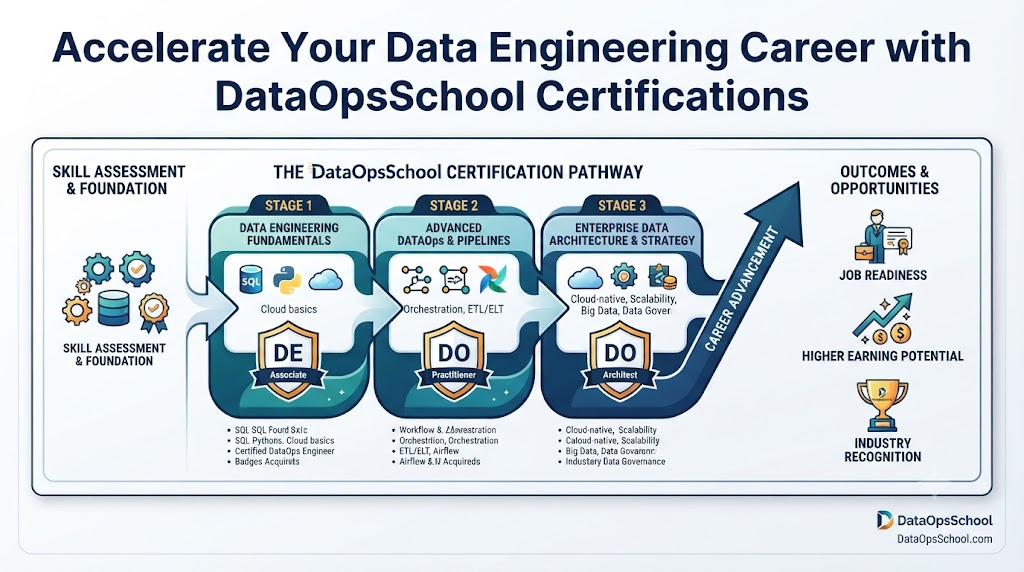
The foundation level establishes core data operations concepts, version control for data, and basic pipeline automation strategies for newcomers. The professional level dives deep into advanced pipeline orchestration, monitoring, security, and automated incident management in production. The advanced track focuses on enterprise-scale multi-cloud architectures, governance frameworks, and strategic leadership in data operations. Specialization tracks allow practitioners to tailor their learning toward specific cloud providers, streaming architectures, or large-scale analytics platforms. This tiered progression mirrors real-world career advancement from hands-on implementer to enterprise data strategist.
Complete CDOA – Certified DataOps Architect Certification Table
| Track | Level | Who it’s for | Prerequisites | Skills Covered | Recommended Order |
| DataOps Core | Foundation | Junior Data Engineers | Basic SQL and Python | Pipeline basics, Git, CI/CD | 1 |
| DataOps Architecture | Professional | Senior Engineers | 2 years data experience | Orchestration, monitoring, security | 2 |
| Enterprise DataOps | Advanced | Data Architects | Professional certification | Multi-cloud, governance, strategy | 3 |
Detailed Guide for Each CDOA – Certified DataOps Architect Certification
CDOA – Certified DataOps Architect – Professional Level
What it is
This certification validates advanced proficiency in designing, deploying, and managing automated, scalable data architectures using modern practices.
Who should take it
Senior data engineers, platform architects, and technical leads with solid experience in production data environments seeking formal architectural validation.
Skills you’ll gain
- Advanced pipeline orchestration and scheduling
- Automated data quality testing and validation
- Infrastructure-as-Code for data platforms
- Production monitoring, alerting, and observability
Real-world projects you should be able to do
- Design a fault-tolerant multi-stage streaming pipeline with automated recovery mechanisms.
- Implement end-to-end data lineage tracking and governance across cloud storage layers.
- Build a continuous deployment pipeline for data transformation models with automated testing gates.
Preparation plan
- Dedicate the first 14 days to reviewing core architecture patterns, orchestration tools, and data governance frameworks.
- Spend the next 30 days building hands-on labs, setting up monitoring stacks, and practicing pipeline failure simulations.
- Use the final days for mock examinations, reviewing complex case studies, and solidifying weak conceptual areas.
Common mistakes
- Focusing too heavily on specific proprietary tools rather than underlying architectural principles and patterns.
- Neglecting automated data quality testing in favor of simple script execution.
- Underestimating the importance of data lineage and compliance in enterprise setups.
Best next certification after this
- Same-track option: Advanced Enterprise Data Architect Specialization
- Cross-track option: Certified MLOps and Model Operations Engineer
- Leadership option: Certified Engineering Manager in Data Platforms
Choose Your Learning Path
DevOps Path
The DevOps track focuses on building a robust foundation in infrastructure automation, continuous integration, and release management. Engineers learn to treat infrastructure as code, ensuring repeatable and reliable deployments across various environments. This path emphasizes collaboration between development and operations teams to accelerate software delivery cycles. Mastery of containerization and orchestration tools forms the backbone of this technical journey. Practitioners completing this path are well-equipped to manage modern, cloud-native operational ecosystems.
DevSecOps Path
The DevSecOps track integrates security seamlessly into every phase of the software development and data operations lifecycle. Professionals learn to implement automated vulnerability scanning, compliance checks, and threat modeling within pipelines. This path emphasizes shift-left security principles to catch vulnerabilities before code reaches production environments. Engineers explore identity management, secret handling, and secure container deployment strategies. Completing this path ensures organizations maintain rigorous security standards without sacrificing delivery speed.
SRE Path
The Site Reliability Engineering track centers on system availability, performance optimization, and incident response automation. Practitioners learn to define service level objectives, error budgets, and robust monitoring strategies for complex architectures. This path emphasizes proactive capacity planning and root cause analysis to prevent recurring production failures. Engineers master chaos engineering principles to test system resilience under controlled failure conditions. Graduates of this path ensure enterprise systems remain scalable, reliable, and performant under heavy loads.
AIOps / MLOps Path
The AIOps and MLOps track bridges the gap between traditional software operations and machine learning model lifecycles. Professionals learn to automate model training, validation, packaging, and deployment in production environments. This path emphasizes experiment tracking, model registry management, and continuous monitoring for data drift. Engineers explore scalable compute provisioning and inference optimization techniques for AI workloads. Completing this path empowers teams to deliver reliable machine learning solutions at scale.
DataOps Path
The DataOps track focuses on streamlining the flow of data from ingestion to consumption through automation and cultural alignment. Practitioners learn to apply agile principles, automated testing, and CI/CD pipelines to data engineering workflows. This path emphasizes data quality, lineage tracking, and robust orchestration across distributed storage systems. Engineers master monitoring techniques specifically tailored to detect schema changes and pipeline bottlenecks. Graduates of this path drive high-reliability data platforms that power modern enterprise analytics.
FinOps Path
The FinOps track centers on financial accountability and cost optimization within cloud-native and data-heavy environments. Professionals learn to attribute cloud spend accurately, identify idle resources, and implement budgeting guardrails. This path emphasizes collaboration between engineering, finance, and product teams to maximize business value. Engineers explore cost-aware architectural design and automated resource scaling policies. Completing this path ensures organizations achieve maximum operational efficiency alongside strict cost control.
Role → Recommended CDOA – Certified DataOps Architect Certifications
| Role | Recommended Certifications |
| DevOps Engineer | DataOps Foundation, Professional Orchestration |
| SRE | Production Monitoring and Reliability in DataOps |
| Platform Engineer | Enterprise DataOps Architecture |
| Cloud Engineer | Cloud-Native Data Pipelines Specialization |
| Security Engineer | Data Security and Compliance Architect |
| Data Engineer | CDOA – Certified DataOps Architect Professional |
| FinOps Practitioner | Cost-Optimized Data Operations Track |
| Engineering Manager | Strategic DataOps Leadership Track |
Next Certifications to Take After CDOA – Certified DataOps Architect
Same Track Progression
Deepening your specialization involves pursuing advanced multi-cloud data architecture and enterprise governance credentials. These advanced programs focus on global scale, complex cross-region data replication, and advanced cost management. Engineers transition from implementers to strategic decision-makers who design overarching corporate data standards. This progression ensures your expertise remains at the cutting edge of industry requirements.
Cross-Track Expansion
Broadening your skill set allows you to integrate data operations with machine learning workflows or site reliability practices. Taking certifications in adjacent fields like MLOps or SRE creates well-rounded engineers capable of handling multidisciplinary challenges. Cross-functional knowledge makes you an invaluable asset in modern cross-functional engineering squads. This holistic approach prevents operational blind spots in complex enterprise systems.
Leadership & Management Track
Transitioning to leadership involves mastering strategic planning, team scaling, and executive stakeholder management. Management certifications help technical professionals articulate the business value of robust data operations to non-technical executives. This path prepares you for roles such as Director of Platform Engineering or Head of Data Operations. Balancing technical depth with leadership acumen accelerates your upward career trajectory.
Training & Certification Support Providers for CDOA – Certified DataOps Architect
DevOpsSchool offers comprehensive training programs tailored for professionals seeking rigorous preparation through expert-led sessions and hands-on labs.
Cotocus provides specialized enterprise coaching and practical implementation workshops designed to bridge theory with real-world scenarios.
Scmgalaxy delivers extensive resource libraries, community support, and structured learning modules for aspiring system architects.
BestDevOps focuses on career-oriented training tracks, mock assessments, and personalized mentorship for technical certifications.
devsecopsschool.com specializes in secure pipeline integration and compliance-focused training programs for modern engineering teams.
sreschool.com offers targeted courses on reliability engineering, observability, and incident management best practices.
aiopsschool.com provides advanced learning paths for integrating artificial intelligence and machine learning into operational workflows.
dataopsschool.com serves as the primary hub for authoritative curriculum design, official certifications, and architectural standards.
finopsschool.com delivers specialized education on cloud financial management, cost optimization, and resource accountability.
Frequently Asked Questions
1. What is the difficulty level of CDOA – Certified DataOps Architect?
The difficulty is intermediate to advanced, requiring a solid background in data engineering, pipeline development, and basic cloud operations. Candidates should dedicate consistent study time to master the practical lab components.
2. How long does it typically take to prepare for the certification?
Most working professionals require between four to eight weeks of dedicated study, depending on their existing familiarity with data orchestration and automation tools.
3. Are there any mandatory prerequisites before enrolling?
While formal prerequisites are flexible, having at least two years of hands-on experience with data engineering, SQL, and Python is highly recommended for success.
4. What is the return on investment for this certification?
Certified professionals often report accelerated career progression, enhanced technical credibility, and greater efficiency in managing complex production data environments.
5. How is the exam structured and administered?
The assessment combines theoretical multiple-choice questions with practical, scenario-based architectural design challenges evaluated by industry experts.
6. Can I take the exam online from home or office?
Yes, the certification examinations are conducted online with proctoring to ensure academic integrity and standard testing conditions worldwide.
7. How often do I need to renew my certification?
Certifications typically require renewal every two years through continuing education credits or passing an updated professional assessment.
8. Does the exam cover specific commercial tools or open-source frameworks?
The curriculum focuses primarily on vendor-agnostic architectural principles, open-source standards, and widely adopted industry methodologies.
9. What kind of hands-on practice is included in the preparation?
Preparation materials include guided labs covering pipeline deployment, monitoring setup, automated testing, and failure recovery scenarios.
10. How does this certification help in the job market?
It acts as a verified badge of competence, signaling to employers that you can independently design and maintain robust, scalable data operations.
11. Is prior programming experience required?
Yes, proficiency in Python or similar languages is essential for understanding data transformation scripts and automation workflows.
12. How do I choose between foundation and professional levels?
Choose foundation if you are new to data operations principles; choose professional if you already build and maintain pipelines in production.
FAQs on CDOA – Certified DataOps Architect
1. What core architectural principles are tested in CDOA?
The exam rigorously tests automated pipeline orchestration, data quality validation, infrastructure as code, and continuous monitoring paradigms.
2. How does CDOA differ from traditional data engineering certifications?
Unlike traditional credentials focused solely on ETL creation, CDOA emphasizes operational resilience, automation, and DevOps collaboration.
3. What specific cloud environments are referenced in the curriculum?
The training covers multi-cloud architectural patterns, ensuring concepts apply across AWS, Azure, and Google Cloud Platform.
4. How are data quality and testing validated within the program?
Candidates learn to implement automated testing frameworks that catch schema drift and data anomalies before downstream consumption.
5. What role does version control play in the CDOA framework?
Version control is treated as foundational, covering code, data schemas, and pipeline configurations to ensure complete reproducibility.
6. Can data security practices be integrated into the dataops workflow?
Yes, the curriculum includes robust modules on access control, lineage tracking, and compliance enforcement within automated pipelines.
7. What troubleshooting skills will I develop during preparation?
You will learn to diagnose pipeline bottlenecks, resolve orchestration deadlocks, and implement automated alerting for failures.
8. How does CDOA support enterprise scalability?
It teaches distributed processing patterns, containerized execution, and scalable resource management for massive enterprise datasets.
Final Thoughts: Is CDOA Worth It?
Investing your time in rigorous architectural certifications requires a clear-eyed look at your professional goals and current skill gaps. For engineers dedicated to mastering the operational side of data platforms, this program provides a structured, highly practical roadmap. It cuts through vendor noise and focuses on principles that remain relevant regardless of which specific tools dominate the market next year. If you want to move beyond writing ad-hoc scripts and step into designing resilient, enterprise-grade data workflows, this credential offers a dependable path forward. Success ultimately depends on your commitment to hands-on lab practice and applying these concepts to real production challenges.
