Introduction
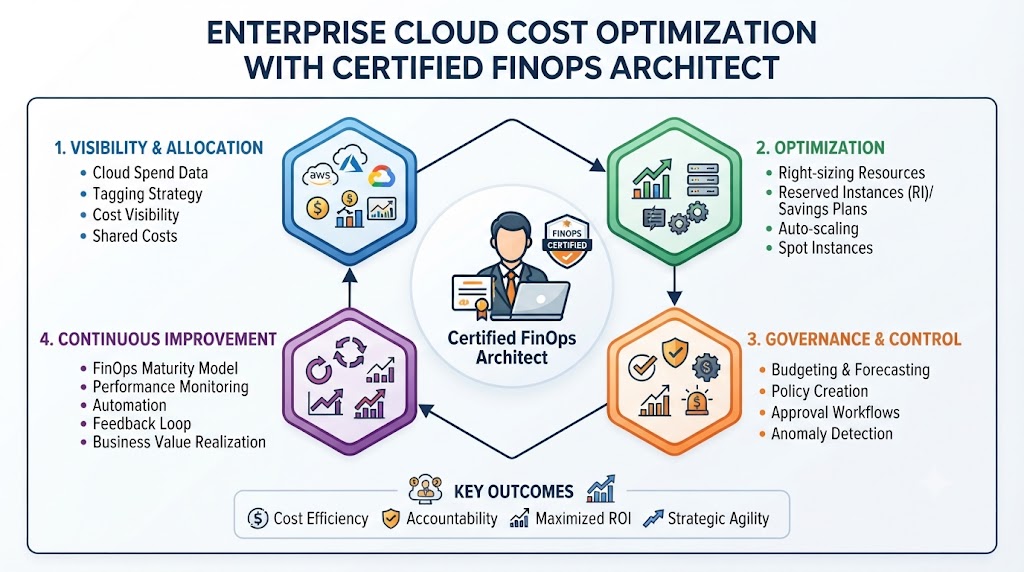
Welcome to this comprehensive guide on the Certified FinOps Architect program. This guide is crafted for working engineers, managers, and technical leaders who want to understand the true impact of cloud financial management on technical infrastructure. Provided directly by FinOpsSchool, this structured learning journey sets a high bar for industry standards in cost-aware engineering.
We will explore how cloud costs have shifted from accounting problems to core engineering challenges. As cloud-native architectures grow in complexity, integrating financial operations into platform engineering is critical for modern teams. This guide will help you make better career decisions by breaking down exactly what this certification entails and how it maps to your daily work.
What is the Certified FinOps Architect?
The Certified FinOps Architect is a highly specialized credential validating your ability to bridge the gap between engineering, finance, and business leadership. It represents a deep understanding of cloud financial management principles applied directly to technical architecture and deployment pipelines. This is not about theoretical spreadsheet accounting; it focuses heavily on real-world, production-centric infrastructure optimization.
You will learn how to design cost-efficient architectures without sacrificing system performance, reliability, or scalability. It exists largely because modern organizations are wasting millions on unoptimized cloud deployments and orphaned resources. The curriculum aligns perfectly with modern engineering workflows, enforcing accountability right at the pull request level.
Who Should Pursue Certified FinOps Architect?
This certification is highly beneficial for cloud professionals, Site Reliability Engineers, and platform developers who design large-scale infrastructure. Engineers who want to deeply understand the financial impact of their technical decisions will find immense value in this knowledge. Security and data professionals also benefit, as big data processing and continuous security logging often drive massive, hidden cloud costs.
Beginners can use this training to build a strong foundational mindset regarding resource allocation before they pick up bad habits. Experienced engineers use it to validate their architectural expertise and demonstrate business value in enterprise environments. Engineering managers should pursue it to better forecast platform budgets and establish guardrails for their development teams. With massive cloud adoption globally and a rapidly maturing tech sector in India, this specialized skill set is universally demanded.
Why Certified FinOps Architect
Enterprise adoption of scalable cloud platforms has led to a parallel rise in uncontrolled cloud spend across organizations. This creates a massive demand for professionals who can govern these resources technically rather than just reporting on them. The Certified FinOps Architect is valuable because it teaches core principles of unit economics that outlast any specific tool or platform update.
Whether your company runs on AWS, Azure, or GCP, the underlying architectural patterns for cost optimization remain entirely the same. This longevity ensures that your skills remain relevant despite rapid shifts in the technology and DevOps landscape. The return on your time and career investment is substantial, as companies are highly motivated to promote engineers who directly improve their bottom line.
Certified FinOps Architect Certification Overview
The comprehensive program is delivered via the official Certified FinOps Architect curriculum and hosted directly on the FinOpsSchool platform. The certification is meticulously structured to provide a hands-on, practical assessment rather than relying on simple multiple-choice trivia. It evaluates your actual ability to implement governance policies, tag infrastructure effectively, and analyze billing data in realistic scenarios.
Ownership of the certification journey lies heavily with the candidate, pushing you to build working solutions in sandbox environments. The overall structure is broken into logical phases, starting from foundational cost visibility all the way to advanced architectural optimization. This ensures a steady ramp-up in difficulty, keeping the material highly relevant to day-to-day enterprise operations.
Certified FinOps Architect Certification Tracks & Levels
The curriculum is logically divided into multiple tiers to accommodate professionals at entirely different stages of their careers. The foundation level focuses on shared vocabulary, basic cost allocation, and understanding the billing mechanisms of major cloud providers. Moving up, the professional level introduces complex topics like reserved instances, automated savings plans, and infrastructure rightsizing workflows.
The advanced level requires candidates to architect highly dynamic, auto-scaling systems that optimize for cost in real-time based on traffic. Specialized tracks within the program allow candidates to focus on niche areas like DevOps pipeline efficiency or data storage governance. This leveling perfectly maps to standard career progression, from junior cloud engineer to principal platform architect.
Complete Certified FinOps Architect Certification Table
| Track | Level | Who it’s for | Prerequisites | Skills Covered | Recommended Order |
| Fundamentals | Foundation | Junior Engineers, Analysts | Basic Cloud Knowledge | Cost Visibility, Tagging, Basic Billing | 1 |
| Architecture | Professional | Cloud Engineers, DevOps | Foundation Pass | Rightsizing, Spot Instances, Budgeting | 2 |
| Optimization | Advanced | SREs, Principal Engineers | Professional Pass | Auto-scaling, Unit Economics, FinOps APIs | 3 |
| Leadership | Expert | Managers, Directors | Advanced Pass | Enterprise Governance, Forecasting, Culture | 4 |
Detailed Guide for Each Certified FinOps Architect Certification
Certified FinOps Architect – Foundation Level
What it is
This introductory certification validates your core understanding of cloud economics and the shared vocabulary of financial operations. It proves you know how cloud billing works and how to track expenses basic across resources.
Who should take it
Junior cloud engineers, financial analysts transitioning to tech, and developers who are new to cloud-native environments. It is ideal for anyone wanting to build a baseline understanding of why infrastructure costs money.
Skills you’ll gain
- Understanding cloud pricing models and billing cycles.
- Establishing basic tagging and labeling strategies.
- Navigating native cloud provider billing dashboards.
- Identifying basic waste in non-production environments.
Real-world projects you should be able to do
- Map unallocated cloud spend to specific engineering teams.
- Implement a standardized resource tagging policy via scripts.
- Generate a daily cost anomaly report for management.
Preparation plan
For a 7-14 days sprint, focus entirely on the core glossary and native billing tools of one cloud provider. A 30-day plan allows time to deploy small test resources and observe how billing reacts over a few weeks. A 60-day approach is best for absolute beginners, leaving ample time to study general cloud fundamentals first.
Common mistakes
Candidates often memorize definitions without understanding how resources are actually provisioned. Another mistake is ignoring the cultural aspect of team accountability, which is heavily tested.
Best next certification after this
- Same-track option: Certified FinOps Architect – Professional Level.
- Cross-track option: A base-level DevOps or Cloud certification.
- Leadership option: Agile project management fundamentals.
Certified FinOps Architect – Professional Level
What it is
This mid-level certification validates your ability to actively optimize cloud environments and automate cost controls. It shifts the focus from merely reporting on costs to actively changing architecture to save money.
Who should take it
Mid-level DevOps engineers, cloud infrastructure engineers, and systems administrators managing active production workloads. It fits professionals who are responsible for the daily care and feeding of cloud environments.
Skills you’ll gain
- Implementing automated infrastructure rightsizing.
- Designing effective Reserved Instance and Savings Plan strategies.
- Managing spot instance lifecycle and graceful degradation.
- Integrating cost estimation directly into CI/CD pipelines.
Real-world projects you should be able to do
- Automate the shutdown of development servers during off-hours.
- Migrate static legacy workloads to containerized spot instances.
- Build a dashboard tracking cost-per-customer in real-time.
Preparation plan
In 7-14 days, experienced cloud engineers can review the specific optimization frameworks and take practice exams. A 30-day plan should involve hands-on automation scripting using Terraform or Python to enforce budgets. For a 60-day plan, candidates should focus on mastering multiple cloud provider pricing models in depth.
Common mistakes
Focusing too much on manual cost-cutting rather than automated, scalable governance. Many also fail to understand the performance trade-offs when downgrading compute resource families.
Best next certification after this
- Same-track option: Certified FinOps Architect – Advanced Level.
- Cross-track option: Certified Kubernetes Administrator (CKA).
- Leadership option: Cloud capacity planning and forecasting credentials.
Certified FinOps Architect – Advanced Level
What it is
This elite certification proves you can design highly resilient, large-scale distributed systems with complex cost optimizations baked in. It validates mastery over dynamic unit economics and cross-cloud financial strategies.
Who should take it
Principal engineers, senior SREs, and platform architects who design systems serving millions of users. It is meant for technical leaders who hold ultimate responsibility for platform stability and budget.
Skills you’ll gain
- Architecting multi-cloud cost arbitrage systems.
- Establishing mature FinOps culture across large engineering orgs.
- Building custom billing metric exporters for observability platforms.
- Advanced capacity forecasting using statistical models.
Real-world projects you should be able to do
- Architect a globally distributed system that dynamically scales across different cloud regions based on spot pricing.
- Implement custom Kubernetes admission controllers that reject overly expensive deployments.
- Lead a multi-million dollar cloud contract negotiation based on technical usage metrics.
Preparation plan
A 7-14 day plan is only for seasoned principal engineers needing a quick syntax and framework review. A 30-day strategy involves deep-diving into case studies of enterprise cost optimization at scale. A 60-day plan allows time to build a fully automated, mock enterprise environment with active scaling and billing APIs.
Common mistakes
Over-engineering solutions that save pennies but cost thousands in engineering hours to maintain. Ignoring the business context and pushing for optimizations that negatively impact end-user latency.
Best next certification after this
- Same-track option: Certified FinOps Architect – Leadership Track.
- Cross-track option: Advanced Cloud Security Architecture.
- Leadership option: Executive tech management or enterprise architecture credentials.
Choose Your Learning Path
DevOps Path
The DevOps path focuses on embedding financial discipline directly into software delivery lifecycles. You will learn to treat infrastructure bills as code metrics that require monitoring and tuning. This path teaches automation techniques to stop manual cloud waste before code hits production. It is built for engineers who manage the pipelines and infrastructure layers.
DevSecOps Path
The DevSecOps path addresses the steep financial overhead associated with constant security monitoring and log auditing. Professionals learn how to optimize log aggregation pipelines without compromising security posture or compliance rules. The focus centers on preventing runaway data transfer charges caused by excessive security telemetry. This path is vital for teams where security tools inflate cloud invoices.
SRE Path
The SRE path balances service level objectives with strict economic boundaries. Practitioners learn to leverage spot instances and elastic scaling without risking system stability. You will master architectural patterns that handle traffic surges safely while keeping resource expenditure low. It emphasizes the delicate balance between high availability and prudent financial design.
AIOps Path
The AIOps path incorporates machine learning algorithms to predict and govern cloud spending patterns automatically. Engineers learn to deploy models that ingest billing telemetry to flag resource anomalies instantly. It covers event-driven remediation workflows that fix over-provisioned infrastructure without human intervention. This modern route minimizes manual operational overhead in financial management.
MLOps Path
The MLOps path tackles the heavy computational expenses involved in training and running machine learning models. You will learn to orchestrate GPU clusters efficiently and streamline data pipelines to minimize processing hours. It highlights model optimization and edge strategies that dramatically lower cloud inference expenditures. This path is essential for teams managing expensive AI workloads.
DataOps Path
The DataOps path focuses on financial governance across large-scale data warehouses and streaming pipelines. This track teaches query tuning to shorten runtime costs and optimize big data execution. You will master tiered storage management to transition cold records to affordable storage classes automatically. It ensures massive data operations deliver measurable business value.
FinOps Path
The dedicated FinOps path targets professionals transitioning into full-time cloud financial management roles. You will concentrate heavily on unit economics, cross-functional cultural changes, and chargeback models. This path develops your ability to translate technical infrastructure realities into clear financial metrics for business stakeholders. It serves as the ultimate route for technical leaders moving into specialized fiscal governance.
Role → Recommended Certified FinOps Architect Certifications
| Role | Recommended Certifications |
| DevOps Engineer | Professional Level, Fundamentals Level |
| SRE | Advanced Level, Professional Level |
| Platform Engineer | Advanced Level, Professional Level |
| Cloud Engineer | Professional Level, Fundamentals Level |
| Security Engineer | Professional Level |
| Data Engineer | Advanced Level, Professional Level |
| FinOps Practitioner | Expert Leadership, Advanced Level |
| Engineering Manager | Expert Leadership, Fundamentals Level |
Next Certifications to Take After Certified FinOps Architect
Same Track Progression
Continuing down this specialized path involves mastering advanced leadership or cross-cloud billing integrations. Deep specialization means understanding the billing architectures of multiple providers simultaneously. You can also pursue niche cost-governance accreditations to complement your core architecture skills. This trajectory cements your status as a recognized authority in enterprise cost optimization.
Cross-Track Expansion
Diversifying your skill set can involve exploring container orchestration platforms or advanced cloud networking. Learning container management deeply helps you apply financial controls directly to microservices architectures. Branching into security engineering is also beneficial, as security and cost form the dual pillars of modern enterprise governance. This broad approach turns you into a highly capable platform generalist.
Leadership & Management Track
Moving into organizational leadership requires shifting your focus toward enterprise governance frameworks and team structures. Management certifications help you scale financial accountability initiatives across large engineering departments. You evolve from tuning individual servers to defining the cost culture for an entire business entity. This track prepares you for executive platform roles and cloud center leadership positions.
Training & Certification Support Providers for Certified FinOps Architect
DevOpsSchool
DevOpsSchool delivers industry-recognized training with a heavy emphasis on real-world engineering practices. Their approach to this certification focuses on integrating financial metrics directly into existing DevOps toolchains. They provide intensive bootcamps led by seasoned practitioners who bring authentic production challenges into the curriculum. Students gain practical experience that translates immediately to operational environments. This provider excels at connecting traditional infrastructure tasks with modern financial awareness, making it ideal for engineers seeking hands-on mastery.
Cotocus
Cotocus offers strategic consulting and tailored enterprise training designed to align technical delivery with financial targets. Their programs frame the certification journey around overarching business goals, making them suitable for teams driving corporate cost initiatives. Training modules frequently incorporate case studies based on actual enterprise infrastructure obstacles. They emphasize the organizational changes needed to unite engineering and finance teams effectively. Cotocus instructors provide deep insights into large-scale multi-cloud optimization while keeping strict adherence to enterprise governance policies.
Scmgalaxy
Scmgalaxy utilizes a collaborative, community-driven teaching model that combines structured study with open-source tool exploration. Their preparation framework highlights how version control systems and configuration management tie directly into resource auditing. Students benefit from active peer discussions and shared operational troubleshooting scripts. This provider is particularly effective for engineers who thrive in interactive learning environments. Scmgalaxy ensures candidates gain the practical coding skills required to automate cost policies within live repositories.
BestDevOps
BestDevOps provides fast-paced, high-impact training built for busy technology environments. Their courses cut through unnecessary theory to deliver actionable knowledge that engineers can apply immediately. They specialize in teaching automation workflows using modern continuous delivery tools to enforce budgets. This provider suits experienced professionals looking to upskill rapidly without lengthy detours. Their rigorous labs simulate sudden billing spikes and architectural failures, preparing candidates for real-world operational pressure.
devsecopsschool.com
This provider merges cloud financial management directly with security and compliance operations. Their curriculum highlights how security tooling, log retention, and monitoring impact monthly cloud invoices. They teach engineers how to maintain a strong security posture without generating unexpected data transfer or storage charges. Instructors specialize in balancing risk mitigation with economic efficiency. This platform is ideal for security professionals and platform architects who manage sensitive, high-cost environments.
sreschool.com
Focused entirely on site reliability, this provider approaches cloud financial operations through the lens of system stability. They teach students how to balance strict uptime targets with financial constraints. The training covers advanced resilience patterns, such as using spot instances safely without degrading performance. Their labs test your ability to maintain service level objectives while driving down compute expenses. It is an excellent option for reliability engineers viewing cost control as a core aspect of system design.
aiopsschool.com
This provider integrates artificial intelligence and machine learning into the financial governance learning journey. They train candidates to utilize predictive analytics and automated anomaly detection for cloud billing data. The curriculum demonstrates how AI tools can spot waste and trigger automated remediation scripts. This approach suits data-focused professionals looking to eliminate manual toil through modern automation toolsets.
dataopsschool.com
Data operations represent some of the highest cloud expenses, and this provider tackles that challenge head-on. Their training focuses on optimizing big data pipelines, storage lifecycle rules, and analytical query performance. Students learn to prevent runaway processing costs during heavy data workloads. This instruction is invaluable for data engineers aiming to prove their analytics platforms deliver positive financial returns.
finopsschool.com
As the official source of the curriculum, this provider offers the most authoritative preparation path available. Their platform houses the primary learning materials, official practice exams, and verified lab environments. Studying here guarantees complete alignment with the official certification standards and testing formats. They provide a balanced view of financial operations, blending technical tactics with enterprise strategy.
Frequently Asked Questions
1. What is the primary objective of this certification?
It verifies your capability to design, monitor, and optimize cloud architectures for maximum financial efficiency without losing system performance.
2. Is a finance or accounting background required?
No, the curriculum is built specifically for technical professionals, focusing on cloud unit economics rather than corporate finance.
3. How long does the preparation process usually take?
Most working engineers dedicate between 4 to 8 weeks to prepare, depending on their existing cloud experience.
4. Are there any strict prerequisites?
While open to anyone, having foundational experience with at least one major public cloud provider ensures a smoother learning curve.
5. Which cloud platform is emphasized in the exams?
The concepts are multi-cloud and vendor-neutral, though examples regularly apply to major environments like AWS, Azure, and Google Cloud.
6. Does the test require programming skills?
While heavy software development isn’t tested, familiarity with infrastructure-as-code and automation scripting is expected.
7. How does this credential affect career progression?
It boosts your value to employers by proving you can directly reduce overhead, making you a strong candidate for leadership roles.
8. Is the exam format multiple-choice?
It features a combination of scenario-based questions and practical assessments to verify real-world competency.
9. How long does the certification remain active?
Credentials typically require periodic continuing education or renewal every few years to keep pace with cloud updates.
10. Can managers benefit from this program?
Yes, engineering managers use these skills to forecast platform budgets and establish team accountability.
11. Must my company use specialized third-party tools?
No, the principles apply regardless of whether you use native cloud consoles or custom internal dashboards.
12. Are the classes self-paced or instructor-led?
Candidates can choose between flexible self-paced digital modules or structured bootcamps led by certified partners.
FAQs on Certified FinOps Architect
1. How does the certification address multi-tenant container environments?
Container platforms pool underlying compute resources, making individual cost attribution complex. This curriculum teaches advanced namespace tagging and pod-level metrics extraction. You learn to attribute exact microservice expenditures back to the correct engineering teams accurately.
2. Can these skills help during cloud vendor contract negotiations?
Yes, possessing deep architectural cost data changes pricing discussions. By understanding historical consumption and capacity flexibility, you can negotiate better enterprise discount commitments with absolute confidence.
3. How do you shift engineering culture toward financial responsibility?
The training covers blameless accountability frameworks. You learn to integrate budget alerts into everyday developer communication channels, ensuring engineers see cost impacts immediately.
4. Are these financial principles applicable to on-premises servers?
While focused on variable cloud spend, core concepts like hardware rightsizing, asset tagging, and unit economics apply directly to hybrid and local data center environments.
5. What role does automation play in advanced cost control?
Automation is essential for enterprise scale. You learn to write serverless scripts that kill idle environments and use infrastructure-as-code to block expensive deployments automatically.
6. Does the curriculum cover preemptible and spot computing?
Yes, it covers resilient architectural patterns for running fault-tolerant workloads on discounted spot instances without impacting overall service availability.
7. How are database and storage expenses managed?
You learn to implement data lifecycle policies that transition cold logs to cheaper tiers and optimize query performance to lower storage compute charges.
8. Why is billing anomaly detection highlighted so prominently?
Sudden configuration errors can generate massive overnight bills. The training shows how to configure sensitive anomaly alerts and automated remediation triggers to prevent budget disasters.
Final Thoughts: Is Certified FinOps Architect Worth It?
Investing your time in the Certified FinOps Architect is one of the most practical career decisions you can make in the current tech landscape. We have moved past the era where engineering teams were given blank checks to provision limitless infrastructure. Today, technical excellence must be balanced with economic efficiency. Earning this credential proves you understand this reality and possess the hard skills to govern massive platforms responsibly.
This path moves you out of the tactical day-to-day configuration tasks and elevates you into strategic architectural discussions. You stop being seen merely as a cost center and start being recognized as a professional who directly protects the organization’s profitability. For anyone looking to secure their longevity in platform engineering, cloud architecture, or technical leadership, this knowledge is no longer optional—it is a fundamental requirement.
