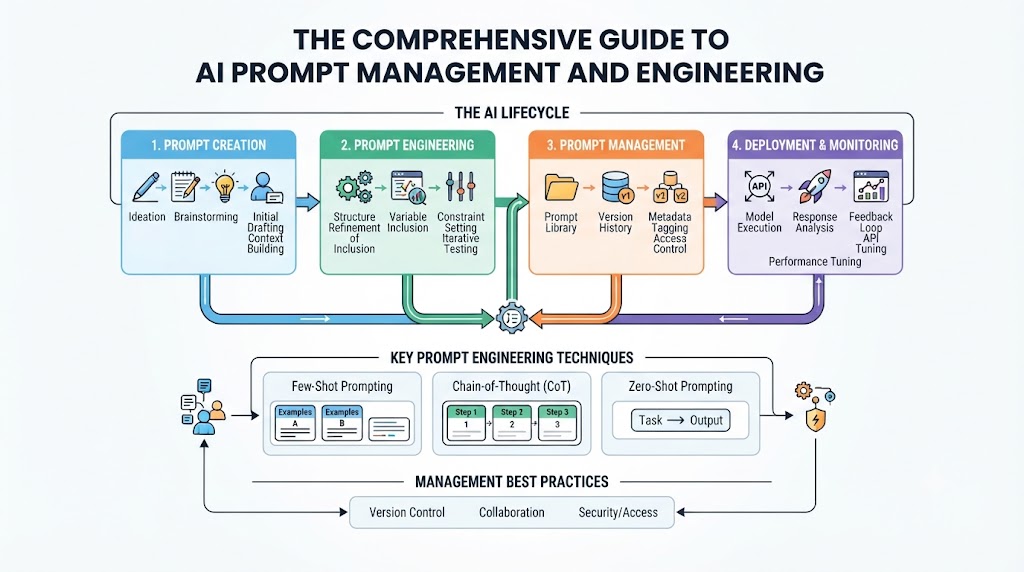
Introduction
As artificial intelligence becomes deeply integrated into daily professional tasks, mastering how we communicate with AI models is more critical than ever. Effective AI prompts dictate the quality, relevance, and accuracy of generated outputs across every imaginable industry. However, as workflows scale, individuals and teams quickly encounter the friction of disorganized prompt storage, lost iterations, and inconsistent results. Managing your digital instructions efficiently is no longer an optional luxury; it is the foundation of modern digital productivity. Implementing a robust, reusable prompt system allows creators, developers, and businesses to capture their best ideas, refine instructions iteratively, and scale high-performing workflows effortlessly. In this guide, you will learn the core principles of prompt engineering, how to structure reusable prompt libraries, and how an advanced AI prompt management tool can transform your interaction with generative artificial intelligence into a streamlined, predictable asset-building process.
What Is an AI Prompt Management Tool?
Definition
An AI prompt management tool is a specialized software platform designed to help users create, store, organize, edit, test, and share artificial intelligence prompts. Rather than scattering valuable text snippets across local text files, browser bookmarks, or team chat channels, these platforms centralize your instructions into a dedicated ecosystem.
Why Prompt Management Matters
Without centralized organization, successful prompts are easily lost. When a specific phrase yields phenomenal results in a large language model, failing to record it means reinventing the wheel the next time a similar task arises. Effective management safeguards your prompt history and institutional knowledge.
Common Prompt Challenges
- Scattered prompt storage across personal notes and messaging apps.
- Inability to track which prompt version produced a specific output.
- Lack of team-wide visibility into high-performing prompt patterns.
- Time wasted rewriting complex instructions from memory.
Benefits of Organized Prompt Libraries
Transitioning to a structured AI prompt library empowers users to access proven templates instantly, maintain naming conventions, categorize prompts by use case, and share optimized instructions seamlessly across distributed teams.
Understanding Prompt Engineering
What Prompt Engineering Is
Prompt engineering is the systematic practice of structuring, refining, and optimizing text instructions to guide generative AI models toward producing accurate, relevant, and useful outputs. According to guidelines from leading model providers like OpenAI documentation, clear framing directly correlates with reduced token waste and higher-quality completions.
Prompt Components
A well-engineered prompt is rarely a single sentence; it is a modular structure composed of distinct, purposeful building blocks.
Context
Context provides the background information, setting the stage for the AI model so it understands the operational environment, target audience, and underlying objective.
Instructions
Instructions dictate the exact actions the model must perform, outlining step-by-step directives to eliminate ambiguity.
Variables
Variables act as dynamic placeholders that transform a static prompt into a flexible template usable across diverse scenarios.
Output Formatting
Explicitly defining how the response should look—such as markdown tables, bulleted lists, or JSON schemas—ensures direct integration into your downstream workflows.
Constraints
Constraints establish boundaries, setting negative instructions (what not to do), length limitations, and tone restrictions. For instance, exploring a dedicated prompt engineering platform helps developers enforce these constraints systematically before deploying prompts to production environments.
Building an Organized AI Prompt Library
Categories
Grouping prompts into logical categories—such as Content Creation, Software Development, Data Analysis, and Customer Support—ensures rapid retrieval when working under tight deadlines.
Tags
Implementing granular tags allows you to filter prompts by AI model compatibility, complexity level, or specific project milestones.
Variables
Incorporating dynamic input fields prevents repetitive copy-pasting, letting you swap out parameters while retaining the core prompt logic.
Search
Advanced search functionality indexes prompt titles, bodies, and tags, making it effortless to find specific instructions within seconds.
Prompt Collections
Grouping related prompts into curated collections facilitates collaborative projects and multi-step AI workflows.
Prompt Reusability
Maximizing prompt reusability transforms ad-hoc queries into standardized organizational assets. Utilizing a powerful AI prompt organizer ensures that every team member benefits from collective experimentation and refinement.
AI Prompt Optimization
Improving Prompt Clarity
Clarity is paramount in generative AI interactions. Ambiguous phrasing leads to unpredictable model behavior and hallucinations.
Better Instructions
Refining active verbs and precise commands ensures the model executes tasks precisely as intended, drawing from best practices outlined in Google AI documentation.
Output Consistency
Optimized prompts yield consistent results across multiple runs, reducing the variance that often plagues casual prompt drafting.
Role Definition
Assigning a persona (e.g., “Act as an expert senior software architect”) primes the model’s neural network to adopt a specialized vocabulary and analytical perspective.
Context Enhancement
Adding rich, relevant background details bridges the gap between vague concepts and highly actionable AI responses.
Reducing Ambiguity
Eliminating double-entendres and contradictory statements ensures streamlined execution. Leveraging an automated AI prompt optimizer helps users spot logical gaps and refine sentence structures instantly.
AI Prompt Analysis
Prompt Structure
Analyzing the structural integrity of a prompt ensures it follows logical progression from high-level context down to specific formatting rules.
Goal Identification
An analytical review verifies whether the primary objective of the prompt is clearly articulated and easily parseable by the underlying model.
Variable Detection
Detecting missing or redundant variables prevents runtime errors when executing dynamic prompt templates.
Output Expectations
Ensuring that expected outputs align with the prompt instructions prevents frustrating mismatches between user intent and generated results.
Safety Considerations
Reviewing prompts for compliance and safety standards mitigates the risk of generating biased or harmful content.
Prompt Quality Evaluation
Utilizing a specialized AI prompt analyzer provides deep diagnostic insights, helping creators diagnose why a prompt underperforms and how to fix it.
Prompt Quality Checking
Clarity
Evaluating whether instructions can be easily interpreted by both human users and AI models.
Context
Ensuring sufficient background information is present to guide the model accurately.
Structure
Checking for logical organization, separation of concerns, and clean formatting.
Reusability
Assessing whether the prompt can be adapted for multiple use cases through variable integration.
Safety
Verifying that the prompt adheres to ethical guidelines and model safety guardrails.
Practical Value
Measuring the utility and real-world efficiency gains provided by the prompt.
Scoring Systems
Employing an automated prompt quality checker assigns objective metrics to your prompts, gamifying the optimization process and establishing high standards across your prompt repository.
Version Control for AI Prompts
Why Version History Matters
Just like source code in software engineering, prompts evolve through continuous iteration. Maintaining a detailed version history prevents losing a brilliant modification during experimentation.
Prompt Evolution
Tracking how a prompt changes over time helps teams understand which incremental tweaks produced performance breakthroughs.
Team Collaboration
Version control prevents teammates from overwriting each other’s work and establishes a transparent audit trail for prompt modifications.
Tracking Improvements
Comparing historical versions side-by-side highlights performance gains and regressions clearly.
Managing Experiments
Running parallel prompt experiments becomes simple when you can branch, test, and merge prompt versions using a dedicated prompt version control tool.
Testing AI Prompts
Comparing Outputs
Evaluating how different prompt variations perform against the exact same input data.
Measuring Consistency
Running repeated tests to ensure the prompt maintains high output stability across multiple executions.
A/B Prompt Testing
Systematically comparing Prompt Version A against Prompt Version B to determine superior performance metrics.
Prompt Experiments
Executing controlled tests to discover optimal phrasing, constraints, and temperature settings.
Community Evaluation
Gathering peer feedback on prompt effectiveness within collaborative workspaces. Utilizing an advanced AI prompt testing tool streamlines this entire validation lifecycle before deployment.
Reusable AI Prompt Templates
Writing
Standardized prompts for blog outlines, copywriting, proofreading, and stylistic adaptations.
Coding
Reusable templates for bug fixing, code refactoring, unit test generation, and architectural design.
Marketing
Campaign brief generators, social media calendar creation, and ad copy variations.
Customer Support
Empathetic response templates, escalation summaries, and FAQ generation scripts.
Research
Literature review synthesizers, data extraction prompts, and comparative analysis frameworks.
Education
Lesson plan creators, quiz generators, and concept explanation prompts for diverse learning levels.
Business
Strategic planning frameworks, meeting summary parsers, and financial report analyzers.
Productivity
Email drafting templates, task breakdown assistants, and scheduling optimizers. Adopting reusable AI prompt templates eliminates repetitive drafting and accelerates daily output across all these domains.
Promptosia for Different User Types
Writers
Authors and copywriters use Promptosia to maintain consistent brand voices, brainstorm narrative arcs, and structure long-form content efficiently.
Developers
Software engineers leverage the platform to manage system prompts, test API instructions, and version control codebase-integrated LLM queries.
Marketers
Marketing professionals organize campaign briefs, ad variations, and social media schedules into reusable, high-performing collections.
Students
Learners use structured prompts to summarize complex academic texts, generate study guides, and practice problem-solving frameworks.
Researchers
Academics and data analysts rely on Promptosia to structure research queries, synthesize literature, and extract structured insights from unstructured text.
Educators
Teachers build interactive lesson prompts, automated grading rubrics, and personalized quiz generators for their classrooms.
Businesses
Enterprises standardize internal AI workflows, ensuring compliance, brand safety, and shared institutional prompt assets across departments.
Content Creators
Video producers, podcasters, and social media managers organize script outlines, video hooks, and repurposing workflows in one place.
Agencies
Digital agencies collaborate seamlessly on client-specific prompt libraries, maintaining high quality and rapid turnaround times.
AI Professionals
AI specialists utilize advanced analytics, version control, and rigorous testing tools to optimize complex multi-step agentic workflows.
Best Practices for Prompt Management
- Save successful prompts immediately after achieving desired results.
- Organize prompt repositories by clear, intuitive categories and subcategories.
- Use descriptive titles that convey the exact purpose of the prompt.
- Add dynamic variables to transform static text into flexible templates.
- Test prompts regularly against updated foundation models.
- Maintain comprehensive version history to track performance evolution.
- Improve prompts continuously based on empirical testing data.
- Document successful workflows to onboard team members faster.
Common Prompt Engineering Mistakes
- Vague instructions: Leaving too much room for model interpretation leads to erratic outputs. Always be explicit about desired actions.
- Missing context: Failing to provide background information forces the model to guess your underlying intent.
- Overly long prompts: Packing too many unrelated directives into a single prompt overwhelms the model’s attention span.
- Poor formatting: Neglecting clear section headers or markdown structure makes it difficult for models to parse instructions correctly.
- Lack of testing: Deploying prompts without rigorous evaluation risks silent failures in production workflows.
- No version tracking: Relying on memory or chaotic text files makes it impossible to reproduce past successes.
- Ignoring prompt optimization: Sticking with the first draft instead of refining instructions limits your generative AI ROI.
Comparison Table
| Feature | Manual Prompt Storage | Promptosia |
| Organization | Disorganized notes & local files | Centralized, tag-based library |
| Version Control | None (overwritten files) | Comprehensive branch & version history |
| Search | Basic keyword lookup | Advanced multi-parameter indexing |
| Testing | Manual trial-and-error | Systematic A/B testing tools |
| Quality Analysis | Subjective guesswork | Automated quality scoring & analytics |
| Collaboration | Difficult copy-pasting | Seamless team workspaces & sharing |
The Future of Prompt Engineering
As foundation models evolve rapidly, the discipline of prompt engineering is shifting from ad-hoc text tweaking to rigorous systems engineering. Industry standards are emerging around reusable AI assets, automated prompt optimization, and collaborative prompt marketplaces. Organizations that treat prompts as valuable intellectual property rather than disposable chat inputs will secure a massive competitive advantage. Embracing enterprise AI adoption requires robust workflow automation, standardization, and platforms designed to elevate prompt management into a core operational pillar, aligning with technical frameworks discussed in Microsoft Learn (AI).
How Promptosia Helps Users Build Better Prompts
Promptosia serves as a comprehensive ecosystem designed to elevate how individuals and teams interact with generative artificial intelligence. By combining a centralized prompt library with powerful optimization utilities, the platform addresses every pain point in the prompt lifecycle. Users can analyze prompt structure, track incremental changes with version management, and execute rigorous testing protocols to guarantee consistent output quality. Features like community sharing, specialized prompt passports, and collaborative prompt duels foster continuous skill improvement. Whether you are scaling enterprise AI workflows or organizing personal writing templates, Promptosia provides the exact infrastructure needed to transform chaotic text inputs into high-value, reusable digital assets.
Frequently Asked Questions (FAQ)
What is an AI prompt management tool?
An AI prompt management tool is a centralized digital platform designed to help users store, organize, optimize, version, and share artificial intelligence prompts. It replaces messy local files and browser bookmarks with a structured repository, allowing individuals and teams to build reusable prompt libraries, streamline workflows, and ensure consistent output quality across different generative AI models and projects.
Why should I save AI prompts?
Saving successful AI prompts preserves your best work and prevents you from having to reinvent effective instructions from scratch. When a specific phrase or structure yields exceptional results, storing it in an organized library ensures you can instantly reuse, adapt, and share that asset for future tasks, saving time and maintaining consistent high-quality outputs across all your generative AI workflows.
What is prompt engineering?
Prompt engineering is the practice of structuring, refining, and optimizing text instructions to guide generative AI models toward producing accurate, relevant, and useful outputs. It involves combining clear context, specific directives, dynamic variables, and strict formatting rules to minimize model hallucinations, reduce token waste, and maximize the overall performance and reliability of artificial intelligence responses.
How does prompt optimization work?
Prompt optimization involves analyzing and refining your initial instructions to enhance clarity, reduce ambiguity, and improve model comprehension. By structuring sentences effectively, defining specific roles, adding necessary context, and establishing clear output constraints, optimization ensures the AI model understands your precise intent, resulting in more consistent, accurate, and actionable responses every single time.
Why is prompt testing important?
Prompt testing is vital because slight changes in wording, context, or formatting can drastically alter an AI model’s output. Systematic testing allows you to compare prompt variations, measure output consistency, conduct A/B experiments, and validate performance before deploying prompts into production environments or sharing them with your team, ensuring reliable and predictable results.
What is prompt version control?
Prompt version control is the practice of tracking, managing, and reviewing historical iterations of an AI prompt as it evolves over time. Similar to code version control in software engineering, it allows you to compare different versions, revert to previous successful states, understand which incremental tweaks improved performance, and collaborate safely without overwriting team modifications.
How does an AI prompt analyzer help?
An AI prompt analyzer evaluates the structural integrity, clarity, goal identification, and variable usage of your prompts. It provides deep diagnostic insights and quality scores, helping you identify logical gaps, missing context, or potential safety issues. This analytical feedback guides you in making precise improvements to make your prompts significantly more effective.
What makes a high-quality prompt?
A high-quality prompt features clear and unambiguous instructions, relevant background context, well-defined output formatting, and appropriate constraints. It often incorporates dynamic variables for reusability and has been rigorously tested across multiple model runs. High-quality prompts eliminate guesswork, reduce iteration cycles, and consistently elicit precise, accurate, and actionable responses from generative AI models.
Can teams collaborate on prompt libraries?
Yes, modern prompt management platforms allow distributed teams to collaborate seamlessly on shared prompt libraries. Team members can contribute proven templates, review version histories, share optimized workflows, and maintain consistent brand guidelines and operational standards across all departmental AI initiatives, boosting collective productivity and organizational knowledge sharing.
Who should use Promptosia?
Promptosia is designed for a wide range of users, including writers, developers, marketers, researchers, students, educators, business professionals, content creators, and agencies. Anyone who relies on generative AI models can benefit from Promptosia’s centralized prompt library, optimization tools, version control, and testing features to streamline their workflows and build reusable prompt assets.
Conclusion
Mastering prompt engineering and establishing a structured approach to managing your AI instructions is essential for thriving in an AI-driven world. By moving away from scattered notes and embracing systematic organization, optimization, version control, and rigorous testing, you unlock the true potential of generative artificial intelligence. Treating your prompts as valuable digital assets accelerates your productivity, ensures consistent output quality, and scales your workflows effortlessly. Start exploring the power of organized prompt systems today and watch your AI interactions transform from unpredictable trial-and-error into a streamlined, high-performance asset-building process.
