Introduction
The modern software landscape demands a shift from traditional security silos to integrated, automated pipelines. If you are looking to elevate your career, the Certified DevSecOps Professional program is designed to bridge the gap between development, operations, and security. This guide provides a comprehensive roadmap for engineers and managers navigating the complex world of aiopsschool and broader cloud-native security practices. We aim to help you make informed decisions about your professional growth by clarifying the value, prerequisites, and real-world outcomes of this certification.
What is the Certified DevSecOps Professional?
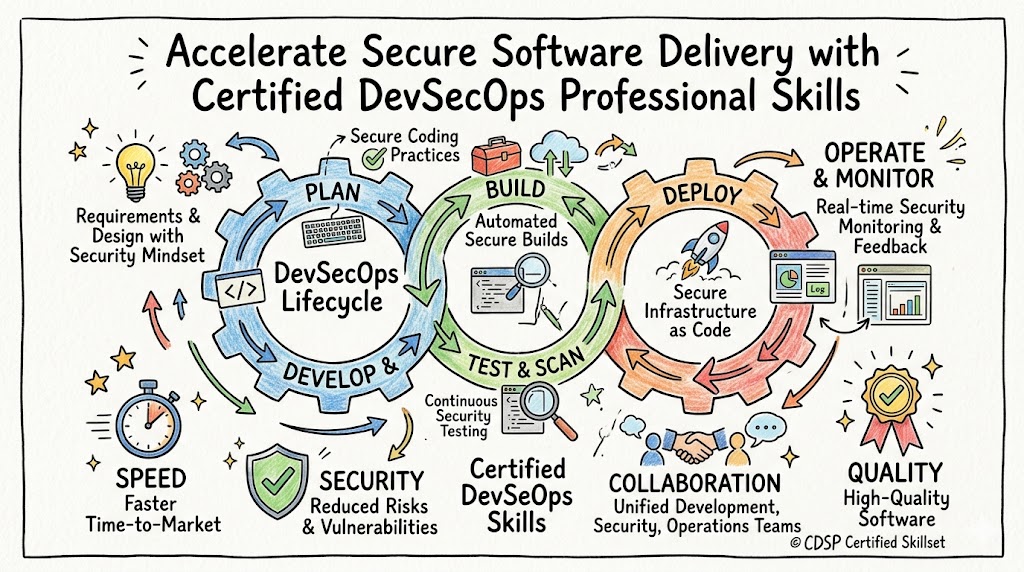
The Certified DevSecOps Professional represents a vendor-neutral, practice-oriented standard for professionals tasked with integrating security into the CI/CD lifecycle. It exists to solve the critical problem of security as a bottleneck by providing a framework where security is treated as code. Rather than focusing on abstract theory, this credential emphasizes production-focused learning, ensuring that candidates understand how to manage vulnerabilities, automate compliance, and maintain security posture in high-velocity environments. It aligns directly with modern enterprise practices where security is a shared responsibility across the entire engineering organization.
Who Should Pursue Certified DevSecOps Professional?
This certification is designed for a broad spectrum of technical professionals, including software engineers, DevOps practitioners, Site Reliability Engineers, and cloud architects. It is equally valuable for security analysts looking to transition into cloud-native security and data professionals managing sensitive information within automated pipelines. Whether you are a practitioner looking to build a secure foundation or an experienced lead aiming to standardize security practices across a team, this program offers relevant insights. It is structured to be globally applicable, providing highly practical strategies that are particularly relevant for the rapidly evolving engineering ecosystems in India and beyond.
Why Certified DevSecOps Professional
In the current professional climate, the demand for engineers who can balance speed with security is higher than ever. This certification provides long-term value because it focuses on methodologies rather than just temporary tool trends, helping professionals stay relevant as the tech stack evolves. By earning this credential, you demonstrate an enterprise-grade understanding of risk management and automated security, which significantly boosts your marketability. It offers a strong return on your time and career investment by providing a clear framework for reducing production incidents and fostering a culture of collective security ownership.
Certified DevSecOps Professional Certification Overview
The program is delivered through the official course portal at the Certified DevSecOps Professional website and is hosted on devopsschool. The certification process is designed to be rigorous yet accessible, utilizing an assessment approach that tests practical application rather than rote memorization. It is structured to validate your ability to implement security controls within a real-world pipeline. By focusing on ownership and operational excellence, the program ensures that candidates can immediately apply their knowledge to secure infrastructure, manage secrets, and automate security testing in their daily work.
Certified DevSecOps Professional Certification Tracks & Levels
The certification hierarchy is divided into foundation, professional, and advanced levels, allowing for a structured career progression. The foundation level focuses on core concepts, while the professional level delves into deep-dive engineering practices and complex implementation scenarios. Advanced tracks allow for further specialization, such as SRE-focused security, FinOps-integrated security, and automated threat modeling. This multi-level approach ensures that your certification aligns with your specific career phase, whether you are entering the workforce or leading complex digital transformations.
Complete Certified DevSecOps Professional Certification Table
| Track | Level | Who it’s for | Prerequisites | Skills Covered | Recommended Order |
| Security | Foundation | Developers, SysAdmins | Basic Linux/Cloud | Vulnerability Scanning | 1 |
| Security | Professional | DevOps/SRE Engineers | 1-2 years exp | DevSecOps Pipeline | 2 |
| Security | Advanced | Lead Engineers/Architects | Professional Cert | Security Architecture | 3 |
| Security | Specialist | Managers/Lead Consultants | Advanced Cert | Compliance & Policy | 4 |
Detailed Guide for Each Certified DevSecOps Professional Certification
Certified DevSecOps Professional – Professional Level
What it is
This certification validates your ability to architect, implement, and maintain an automated security pipeline within a production-grade DevOps environment.
Who should take it
This is intended for DevOps engineers, SREs, and security professionals with at least one to two years of hands-on experience in cloud or containerized environments.
Skills you’ll gain
- Implementing SAST and DAST in CI/CD pipelines.
- Container and Kubernetes security best practices.
- Infrastructure as Code security scanning.
- Secrets management and IAM hardening.
Real-world projects you should be able to do
- Create an automated pipeline that fails builds upon detecting high-severity vulnerabilities.
- Establish a secure secrets management system using Vault or cloud-native alternatives.
- Perform a baseline security hardening audit on a production Kubernetes cluster.
Preparation plan
- 7–14 days: Focus on core security concepts and tool documentation to build a mental framework.
- 30 days: Engage in hands-on lab exercises, focusing on integrating security tools into a sample Jenkins or GitLab pipeline.
- 60 days: Review enterprise security architecture patterns and complete practice exam modules to identify knowledge gaps.
Common mistakes
Candidates often focus too much on specific tool versions rather than the underlying security philosophy, or they underestimate the importance of policy-as-code.
Best next certification after this
- Same-track option: Advanced Certified DevSecOps Architect.
- Cross-track option: Certified SRE Professional.
- Leadership option: Certified DevOps Lead Manager.
Choose Your Learning Path
DevOps Path
The DevOps path focuses on the marriage of speed and stability through automated CI/CD processes. You will learn how to integrate security early in the development lifecycle to prevent costly refactoring. This path is essential for engineers who want to build high-performance, automated software delivery systems.
DevSecOps Path
The DevSecOps path is a specialized journey focusing on security as code, automated compliance, and threat intelligence. You will master the art of securing containers, cloud infrastructure, and APIs. This path prepares you for roles that demand deep technical security expertise in fast-paced cloud environments.
SRE Path
The SRE path emphasizes reliability, scalability, and observability, with security as a pillar of system uptime. You will learn how to build self-healing systems and secure the infrastructure that supports global-scale applications. This path is perfect for those who view security through the lens of operational stability.
AIOps Path
The AIOps path focuses on leveraging machine learning to automate operational tasks, including security monitoring. You will explore how to detect anomalies and automate incident responses in complex distributed systems. This path is for forward-thinking engineers ready to embrace automated, intelligent operations.
MLOps Path
The MLOps path centers on the lifecycle of machine learning models, specifically security in data pipelines and model integrity. You will learn how to protect training data, model weights, and inference endpoints from emerging threats. This path is vital for those working at the intersection of AI and production engineering.
DataOps Path
The DataOps path emphasizes the secure orchestration of data across the enterprise, focusing on privacy, compliance, and governance. You will learn how to build pipelines that ensure data integrity while automating security controls at scale. This path is ideal for professionals handling large-scale data architecture.
FinOps Path
The FinOps path centers on the intersection of cloud financial management and security. You will learn how to optimize cloud spend without compromising the security posture of your infrastructure. This path is critical for leaders who need to manage budgets while maintaining high-level enterprise security.
Role → Recommended Certified DevSecOps Professional Certifications
| Role | Recommended Certifications |
| DevOps Engineer | Professional DevSecOps |
| SRE | SRE & DevSecOps Professional |
| Platform Engineer | Advanced DevSecOps Architect |
| Cloud Engineer | Professional DevSecOps |
| Security Engineer | Advanced DevSecOps |
| Data Engineer | DataOps & DevSecOps |
| FinOps Practitioner | FinOps & DevSecOps |
| Engineering Manager | Certified Lead Architect |
Next Certifications to Take After Certified DevSecOps Professional
Same Track Progression
Once you have mastered the professional level, the logical next step is to pursue the Advanced Architect track. This level moves away from tool-specific execution and into systemic design, focusing on organizational-wide security governance, advanced threat modeling, and disaster recovery strategies for complex cloud-native architectures.
Cross-Track Expansion
Broadening your skillset is highly recommended for modern engineering leaders. You might consider the SRE or FinOps tracks to understand how security impacts system reliability and cost-efficiency. Combining DevSecOps with DataOps allows you to specialize in the security of data-intensive AI and ML platforms.
Leadership & Management Track
For those transitioning into management, focus on certifications that emphasize organizational transformation, team leadership, and security strategy. These programs help you align technical security goals with business objectives, allowing you to advocate for the right budget and cultural changes within your organization.
Training & Certification Support Providers for Certified DevSecOps Professional
DevOpsSchool offers deep-dive technical training and comprehensive certification programs focused on real-world industry demands.
Cotocus provides expert-led mentoring and intensive workshops designed to prepare engineers for professional-level certifications and technical challenges.
Scmgalaxy focuses on agile and DevOps cultural transformation, providing practical guidance on the tooling and methodology required for modern delivery.
BestDevOps provides curated resources and hands-on training tracks aimed at improving individual technical proficiency in fast-paced environments.
devsecopsschool is your primary resource for security-focused engineering certifications, providing specialized curricula for the security-conscious professional.
sreschool delivers dedicated SRE training, bridging the gap between operations and reliability engineering through hands-on practice.
aiopsschool provides advanced learning paths for professionals looking to integrate intelligence into their operational and security workflows.
dataopsschool focuses on the secure, automated management of data pipelines, preparing you for modern data-driven architectural challenges.
finopsschool offers specialized education in cloud financial management, ensuring your infrastructure is both cost-optimized and secure.
Frequently Asked Questions
- How difficult is the Certified DevSecOps Professional exam?
The exam is designed to be challenging by requiring hands-on problem-solving skills, but it is highly achievable for any professional with regular production experience. - How long does it take to prepare for this certification?
While this depends on your starting point, most professionals find that a structured 30 to 60-day plan allows for thorough preparation. - Are there any formal prerequisites for enrollment?
You should have a foundational understanding of Linux, cloud platforms, and basic DevOps CI/CD principles before enrolling. - What is the ROI of getting certified?
The ROI is significant, as it validates your ability to handle modern security threats, which is a top priority for companies worldwide. - Does the certification expire?
Certifications are generally kept relevant through ongoing learning and periodic updates, ensuring your knowledge stays current with industry standards. - Can this help me land a job as a remote engineer?
Yes, as this certification proves that you can independently manage secure automated workflows, a key requirement for remote roles. - Is this training better for developers or security professionals?
It is designed for both, as it bridges the gap by teaching developers to build securely and security professionals to code. - How does this certification handle tool changes in the industry?
The program emphasizes principles and methodologies rather than specific vendor tools, keeping your skills relevant for years. - Can I take the exam online?
Yes, the certification exams are typically offered in an online proctored format for global convenience. - How does this differ from traditional security certs?
Traditional certifications are often theoretical, while this program is built on practical, hands-on production-grade implementation. - Will this help me move into a Lead or Architect role?
Absolutely, as the advanced levels specifically focus on architectural decision-making and organizational security design. - Is there a community I can join after certifying?
Yes, certified professionals often gain access to exclusive forums and networks for ongoing industry collaboration.
FAQs on Certified DevSecOps Professional
- What specific security tools will I learn to use?
You will gain hands-on experience with industry-standard tools for SAST, DAST, SCA, and secrets management in CI/CD. - Is this certification recognized by global enterprises?
Yes, it is increasingly valued by enterprises looking to standardize their secure delivery practices across teams. - How does the training prepare me for real-world production?
The training uses real-world scenarios, forcing you to solve common bottlenecks and security failures found in live environments. - Can I apply this knowledge to an existing legacy infrastructure?
Absolutely, the principles taught are modular and designed to be integrated into existing pipelines incrementally. - Is there a focus on Kubernetes security in this course?
Container and Kubernetes security are core components, given their central role in modern cloud-native architectures. - How does this help with compliance auditing?
You will learn to implement policy-as-code, which automates much of the manual work required for compliance audits. - Are the practice labs similar to the final exam?
Yes, the labs are designed to mirror the actual assessment environment, ensuring you are fully prepared for the final test. - Who creates the content for this certification?
The content is authored by industry veterans with decades of experience in DevOps, security, and enterprise engineering.
Final Thoughts: Is Certified DevSecOps Professional Worth It?
If you are an engineer or manager looking to solidify your technical authority, this certification is a strategic investment. It moves you beyond basic tool usage and into the realm of architectural thinking and secure-by-design engineering. While no certification can replace hands-on experience, this program provides the structured learning path necessary to accelerate your growth and bridge critical skill gaps. In an era where security incidents can compromise entire business models, being the professional who can confidently secure the pipeline is a unique and highly sought-after advantage. Approach your learning with a mindset of practical application, and you will find the return on your time and effort to be substantial.
