Introduction
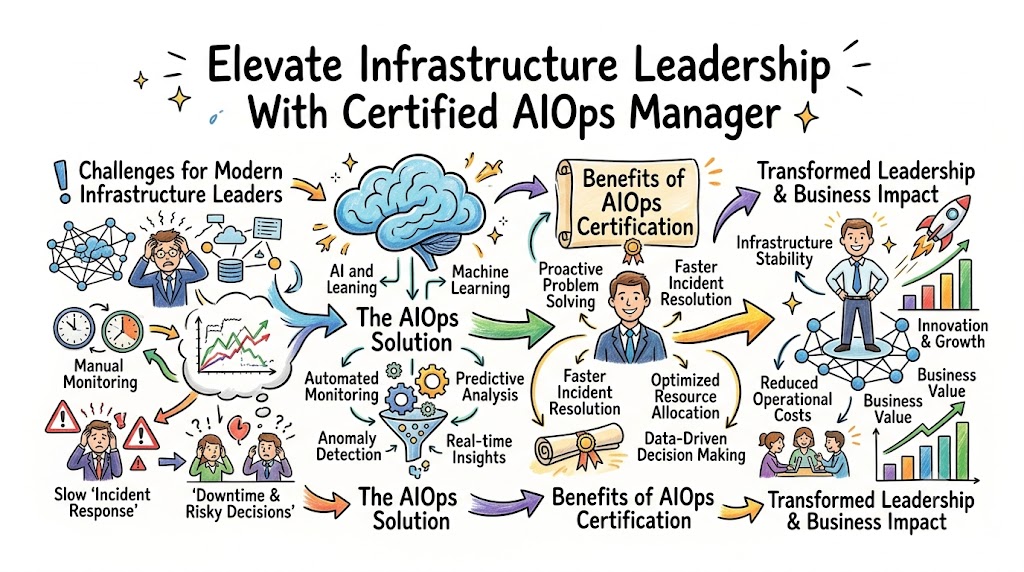
Modern technology infrastructure has outgrown human capacity to monitor it manually. As systems grow increasingly complex, the sheer volume of logs, metrics, and traces creates an operational wall that traditional monitoring setups simply cannot climb. This comprehensive career guide breaks down everything you need to know about the Certified AIOps Manager program. It is written for engineers, platform leads, and technical managers who want to understand how data-driven automation alters the daily realities of production environments. Navigating this shift requires an objective, practical roadmap rather than empty industry trends. By understanding how this specific training framework operates within the aiopsschool ecosystem, professionals can make calculated decisions about their career growth. This analysis cuts through the noise to help you plan your next major professional move.
What is the Certified AIOps Manager?
The Certified AIOps Manager designation represents a structured validation of an engineer’s ability to implement machine learning pipelines and automated reasoning within active operational environments. It exists to solve a specific enterprise problem: the massive delta between theoretical data science models and actual live system uptime. Rather than focusing on building algorithms from a pure academic perspective, this program prioritizes the deployment, monitoring, and scaling of automated event correlation and predictive alerting tools. It aligns directly with modern enterprise engineering workflows by treating system noise as an addressable data pipeline challenge. Ultimately, it provides companies with a predictable framework for implementing self-healing infrastructure patterns without compromising deployment speed.
Who Should Pursue Certified AIOps Manager?
This professional path is designed specifically for working infrastructure practitioners, including site reliability engineers, cloud architects, DevOps specialists, and data operations leaders. Beginners with a strong grasp of Linux and basic cloud concepts can use it as a definitive roadmap, while experienced managers rely on it to establish enterprise-wide operational governance. In both the Indian technology sectors and international enterprise markets, the requirement for professionals who can tame alert fatigue through automation is expanding rapidly. Whether you are running microservices clusters in local technology hubs or supervising cross-regional hybrid cloud infrastructure globally, this framework gives you the architectural vocabulary to lead modern engineering initiatives.
Why Certified AIOps Manager
The true value of this certification lies in its focus on core architectural methodologies rather than specific, short-lived software tools. Platforms change and vendors consolidate, but the underlying principles of data ingestion, noise reduction, and algorithmic root cause analysis remain constant over time. This focus ensures your skills remain highly relevant even when your corporate tooling stack undergoes a complete overhaul. The return on investment for your career comes from learning how to build systems that significantly reduce the time it takes to identify and mitigate severe production outages. Organizations prioritize hiring and promoting individuals who possess this knowledge because they directly impact system availability and corporate profitability.
Certified AIOps Manager Certification Overview
The training program is delivered through the official course outline and hosted entirely on the aiopsschool platform. The assessment methodology is deliberately structured around real-world scenarios, testing your actual engineering judgment rather than simple factual memorization. The program evaluates how well you can architect automated monitoring pipelines, supervise data ingestion health, and lead engineering teams through operational transformations. It functions as an objective industry standard for checking whether an engineer is ready to handle large-scale, intelligent infrastructure configurations. Holding this credential shows that you understand both the underlying technical metrics and the high-level operational management required for enterprise systems.
Certified AIOps Manager Certification Tracks & Levels
The certification structure is built across three progressive tiers to match different stages of your professional development. The foundational tier focuses on understanding how algorithmic operations handle basic telemetry streams and alert normalization. The professional tier shifts heavily toward active system implementation, detailing how to deploy predictive models and handle complex correlation across distributed cloud environments. The advanced tier is tailored explicitly for engineering managers and directors who need to handle technical budgets, vendor choices, and high-level data governance policies. These clear levels allow you to scale your skills gradually as your responsibilities move from individual code execution to organizational strategy.
Complete Certified AIOps Manager Certification Table
| Track | Level | Who it’s for | Prerequisites | Skills Covered | Recommended Order |
| Operational Fundamentals | Foundational | Support Engineers, Junior Systems Admins | Basic Command Line and Cloud Infrastructure | Telemetry ingestion, alert filtering, core automation concepts | Step 1 |
| System Engineering | Professional | SREs, DevOps Engineers, Cloud Architects | 2+ Years Production Experience, Python/Bash | ML model deployment, telemetry architecture, automated remediation | Step 2 |
| Enterprise Strategy | Advanced | Engineering Managers, Infrastructure Directors | 5+ Years Technical Team Leadership | Automation governance, budget mapping, operational metrics | Step 3 |
Detailed Guide for Each Certified AIOps Manager Certification
Certified AIOps Manager – Foundational Level
What it is
This entry-level certification confirms that a professional understands the core concepts of automated telemetry ingestion, modern observability architecture, and basic incident patterns.
Who should take it
Systems administrators, technical support specialists, and junior engineers looking to pivot away from manual ticket queues into automated platform engineering roles.
Skills you’ll gain
- Mapping out the paths data takes through an enterprise logging setup.
- Understanding how automated filters separate critical alerts from non-actionable background noise.
- Setting up intelligent threshold markers on standard cloud monitoring software.
Real-world projects you should be able to do
- Configure a unified data logging receiver that normalizes text streams from multiple distinct server applications.
- Create an alert mitigation rule that filters out repetitive notifications during an isolated cluster network drop.
Preparation plan
- 7-14 Days: Focus heavily on standard dictionary terms regarding telemetry metrics and go over all practice study guides on the portal.
- 30 Days: Set up a local test virtual machine using open-source monitoring software to see how altering data inputs changes alert triggers.
- 60 Days: This time frame is generally unnecessary for the foundation tier if study patterns remain consistent over the first few weeks.
Common mistakes
- Getting lost in complex mathematical machine learning theories instead of learning how basic operational data flows from servers to dashboards.
- Neglecting standard systems administration concepts like syslog structures and metric collection types.
Best next certification after this
- Same-track option: Certified AIOps Manager – Professional Level
- Cross-track option: Cloud Infrastructure Foundational Certificate
- Leadership option: Technical Team Lead Introduction
Certified AIOps Manager – Professional Level
What it is
This mid-tier certification proves an engineer’s practical capability to deploy, maintain, and tune active automation systems that process live corporate infrastructure data.
Who should take it
DevOps engineers, infrastructure specialists, and site reliability practitioners who are directly responsible for system uptime and platform stability.
Skills you’ll gain
- Running machine learning models tailored for recognizing unusual anomalies within massive system logs.
- Designing distributed data handling pipelines that remain functional under heavy real-time traffic spikes.
- Writing automated scripts that attempt to fix known system issues before human intervention is required.
Real-world projects you should be able to do
- Build a functional event correlation pipeline that accurately groups related alerts from database and application layers during a service outage.
- Deploy an anomaly tracking agent on a Kubernetes production setup that correctly identifies resource exhaustion patterns ahead of time.
Preparation plan
- 7-14 Days: Identify your personal weak spots in system programming or API usage and review the core pillars of modern platform observability.
- 30 Days: Write functional automation tasks that ingest sample operational logs, testing how well your scripts handle simulated cluster dropouts.
- 60 Days: Study advanced production architecture diagrams, analyze historical infrastructure failure reports, and complete multi-stage practice tests.
Common mistakes
- Treating advanced algorithmic platforms as simple extensions of old-school static threshold alert configurations.
- Overlooking the need to continuously monitor data inputs for drift, which can cause automation models to lose accuracy over time.
Best next certification after this
- Same-track option: Certified AIOps Manager – Advanced Level
- Cross-track option: Enterprise Site Reliability Architect
- Leadership option: Professional Platform Engineering Manager
Certified AIOps Manager – Advanced Level
What it is
This upper-level tier validates a leader’s ability to build corporate automation strategies, coordinate data compliance policies, and oversee large engineering teams.
Who should take it
Technical leads, operations managers, and systems directors who are responsible for infrastructure spending, compliance, and multi-team resource allocation.
Skills you’ll gain
- Building clear financial models that demonstrate the fiscal value of moving to automated operations stacks.
- Constructing data protection protocols for log files that satisfy strict international security and privacy rules.
- Connecting low-level infrastructure uptime numbers directly with high-level corporate performance metrics.
Real-world projects you should be able to do
- Write a detailed migration plan explaining how to transition a traditional corporate monitoring setup to an intelligent automation model safely.
- Create an operational onboarding matrix and staffing plan for a global engineering department adopting automated workflows.
Preparation plan
- 7-14 Days: Concentrate fully on the strategic management portions of the syllabus, mastering the business language used to justify system changes.
- 30 Days: Evaluate formal case studies of large-scale tech migrations to pinpoint why certain corporate automation rollouts succeeded or failed.
- 60 Days: Build a fictional enterprise rollout plan from scratch, checking your architectural choices against the grading requirements of the certification.
Common mistakes
- Getting bogged down in micro-level programming tasks while failing to address high-level business issues like staffing, training, and long-term budgeting.
- Ignoring the cultural change strategies needed to help classic operations teams feel comfortable trusting automated system corrections.
Best next certification after this
- Same-track option: Technology Governance Fellow
- Cross-track option: Global Cloud FinOps Director
- Leadership option: Technology Executive Development Track
Choose Your Learning Path
DevOps Path
Engineers on this route focus on embedding automated telemetry evaluation directly into delivery chains. The goal is identifying deployment code anomalies during staging environments before they reach users. This approach minimizes human error by using dynamic resource baselines that adapt to routine traffic fluctuations rather than relying on brittle, fixed thresholds.
DevSecOps Path
This track blends infrastructure log processing with automated threat detection routines. Professionals learn to build pipelines that watch for unusual access behavior, triggering isolation protocols automatically if security baselines are breached. It emphasizes maintaining strong compliance and audit trails while handling data streams at high operational speeds.
SRE Path
Reliability professionals focus entirely on maximizing application availability and cutting down system repair timelines. This path teaches engineers how to construct intricate event grouping engines that point directly to the root cause of an outage. The focus centers on replacing repetitive manual tasks with durable, self-healing automation loops.
AIOps Path
This dedicated track centers on the core engineering behind intelligence platforms, prioritizing data scaling and ingestion mechanics. Engineers learn how to manage massive telemetry streams, ensure high data quality, and maintain underlying processing engines. It prepares you to act as the primary platform architect for intelligent operations.
MLOps Path
This path isolates the deployment lifecycles of machine learning models used within production code setups. Engineers study how to track data drift, automate model retraining schedules, and ensure containerized inference endpoints perform efficiently. It is a critical set of skills for teams managing software containing user-facing predictive tools.
DataOps Path
Data pipeline engineers focus on maintaining data cleanliness, security, and flow rate across enterprise messaging lines. This track teaches you how to implement automated testing and performance monitoring on active databases and streaming networks. The objective is ensuring downstream analytics platforms always receive accurate information.
FinOps Path
Financial infrastructure specialists align system resource usage data directly with business cloud spending. Practitioners learn to build automated rules that shut down or downsize inactive development environments based on predictive workload timelines. This path enables professionals to keep cloud deployment expenses strictly inside corporate budget guidelines.
Role → Recommended Certified AIOps Manager Certifications
| Role | Recommended Certifications |
| DevOps Engineer | Certified AIOps Manager – Professional Level |
| SRE | Certified AIOps Manager – Professional Level |
| Platform Engineer | Certified AIOps Manager – Professional Level |
| Cloud Engineer | Certified AIOps Manager – Foundational Level |
| Security Engineer | Certified AIOps Manager – Professional Level (Security Focus) |
| Data Engineer | Certified AIOps Manager – Professional Level (Data Focus) |
| FinOps Practitioner | Certified AIOps Manager – Foundational Level |
| Engineering Manager | Certified AIOps Manager – Advanced Level |
Next Certifications to Take After Certified AIOps Manager
Same Track Progression
After completing the core architecture and management requirements, deepening your knowledge means specializing in heavy data engineering. This involves studying how high-volume messaging lines process millions of raw system events without drops or delays. The final progression steps lead to tailoring specialized analytics models for edge compute setups where resource limits are tight.
Cross-Track Expansion
Broadening your technical footprint involves blending your automation insights with sister fields like security engineering or platform reliability. Discovering how to plug automated incident indicators directly into enterprise access management tools makes you incredibly valuable to modern teams. Alternatively, expanding into FinOps lets you translate operational efficiency directly into measurable cloud infrastructure cost savings.
Leadership & Management Track
Moving fully into executive technical paths means putting aside daily coding tasks to focus completely on business operations, technology roadmap planning, and team cultivation. The management skills validated at the advanced level provide the baseline needed to run large enterprise engineering divisions. This path trains you to pitch major platform updates directly to corporate financial boards.
Training & Certification Support Providers for Certified AIOps Manager
DevOpsSchool delivers core learning paths focused heavily on building the strong continuous integration and deployment systems needed to supply data platforms cleanly.
Cotocus provides targeted, hands-on infrastructure environments where enterprise engineering teams can practice resolving simulated production system failures in real time.
Scmgalaxy maintains a highly detailed database of technical documentation, installation guides, and configuration blueprints for open-source system logging frameworks.
BestDevOps specializes in running direct retraining camps intended to help traditional systems administrators move rapidly into modern automated cloud engineering roles.
devsecopsschool centers its training approach on weaving automated security validation checkpoints directly into existing enterprise telemetry networks.
sreschool provides distinct study paths focused on site reliability engineering, managing error budgets, and dropping alert volumes to prevent engineer burnout.
aiopsschool functions as the primary curriculum developer and platform host for this certification track, providing core study resources and official exam environments.
dataopsschool focuses on helping data professionals construct highly scalable ingestion paths that filter and organize system telemetry before it hits analytical tools.
finopsschool teaches teams how to connect infrastructure usage data directly with cloud accounting methods to optimize computing spend across the company.
Frequently Asked Questions (General)
- How does an algorithmic approach differ from traditional system monitoring?Traditional setups require engineers to manually specify fixed limit markers for alerts, while an algorithmic approach uses data models to dynamically adjust warning markers based on historical usage trends.
- Is deep software programming experience necessary for the professional level tier?A functional understanding of scripting with languages like Python or Bash is highly valuable, as creating automated self-healing reactions requires writing clear deployment scripts.
- Can an operations manager skip directly to the advanced track without the foundation certificate?Yes, individuals who possess documented, long-term technical leadership experience in the industry can enter the advanced track directly to focus on governance rather than command-line configuration.
- What is the typical preparation time frame for a working professional aiming for the professional exam?Most active engineers spend roughly thirty to forty-five days preparing, setting aside about an hour each day for documentation review and laboratory practice.
- Is the course material restricted to a single corporate technology vendor?No, the syllabus is entirely vendor-neutral, highlighting overarching architectural frameworks, pipeline methodologies, and team management strategies that apply to any modern toolset.
- What clear professional advantage does a senior SRE gain from this certification?It offers objective proof of your ability to manage massive telemetry platforms, setting you apart from engineers who only know how to handle standard, basic alert setups.
- How often are the curriculum materials updated to match shifting tech trends?The core study paths are reviewed on an annual basis to ensure that all technical blueprints, security rules, and case studies match modern corporate production environments.
- Are active virtual laboratory setups included with the learning materials?Yes, the training path provides access to simulated platform spaces where candidates must resolve real infrastructure anomalies to complete practical course requirements.
- Which industries show the most rapid adoption of automated operations frameworks?Financial institutions, massive e-commerce networks, cloud software companies, and telecom providers display the highest demand due to the massive scale of their computing needs.
- How does the certification address accuracy loss in automation tools over time?The professional and advanced tracks dedicate specific chapters to continuous model evaluation, data formatting validation, and setting up automated retraining loops.
- Does the certificate require ongoing maintenance to remain valid after passing?Yes, technical professionals must submit continuing education points or show proof of active infrastructure project involvement every two years to maintain their active credential status.
- Can these automation frameworks be used inside legacy, on-premises data centers?Yes, while the material emphasizes cloud native architecture, the principles of telemetry processing and event grouping work perfectly well on traditional on-prem server setups.
FAQs on Certified AIOps Manager
- What specific leadership skills are validated by the Certified AIOps Manager track?It certifies your capability to handle technology budgets, design engineering team structures, conduct vendor evaluations, and implement enterprise-wide data collection governance.
- Will this course teach me how to write machine learning mathematical formulas from scratch?No, the program focuses strictly on the practical deployment, architectural arrangement, scaling, and daily management of ready-made models within active corporate networks.
- How does a Certified AIOps Manager contribute directly to corporate cost reduction?By deploying predictive scaling metrics that downsize unused servers automatically and identifying deep software issues before they spiral into expensive platform outages.
- What baseline metrics indicate that an automation manager is succeeding?Key indicators include major drops in the mean time required to fix problems, reduced alert noise levels, and better retention rates among engineers who no longer face manual toil.
- How does the curriculum handle international user data privacy laws during log collection?The advanced strategy track features clear implementation patterns for scrubbing personally identifiable data before log streams are sent into central analytical engines.
- Can a technical project manager without hands-on system administration background pass the exams?They can comfortably clear the foundational and advanced leadership tracks, but the professional level tier requires a baseline understanding of networking and script logic.
- What is the manager’s primary role during a critical live corporate infrastructure outage?They supervise the automated tracking tools that pinpoint the core problem, ensuring engineering teams focus on exact fixes rather than spending hours guessing.
- How does this credential benefit a professional working in the competitive Indian IT sector?It marks them clearly as an advanced technical leader capable of orchestrating modern optimization projects, moving them well beyond standard, repetitive infrastructure administration.
Final Thoughts: Is Certified AIOps Manager Worth It?
Choosing to invest your time into an advanced certification should always come down to practical utility rather than industry marketing. As business computing environments continue to grow, shifting from manual oversight to automated, data-driven systems management is simply a necessity of scale. The Certified AIOps Manager track offers a direct, pragmatic framework for mastering this operational shift, making it an excellent investment for anyone managing complex cloud setups. It does not replace basic infrastructure experience, but it acts as a powerful professional multiplier for seasoned engineers and organizational leaders. If you want to design, manage, and scale high-throughput automated platforms while ensuring your long-term career value, this training path offers a completely logical way forward.
