Introduction
As infrastructure scales beyond the limits of human monitoring, the ability to interpret massive streams of telemetry data has become the most sought-after skill for senior engineers. The Certified AIOps Professional credential bridges the divide between standard infrastructure management and the future of self-healing, predictive systems. This guide is written for those who are ready to transition from reactive firefighting to proactive, data-informed engineering. By utilizing the expert resources available at aiopsschool,professionals can gain a clear, actionable perspective on how to integrate artificial intelligence into their existing operational workflows, ultimately making more strategic decisions for their career growth and organizational success.
What is the Certified AIOps Professional?
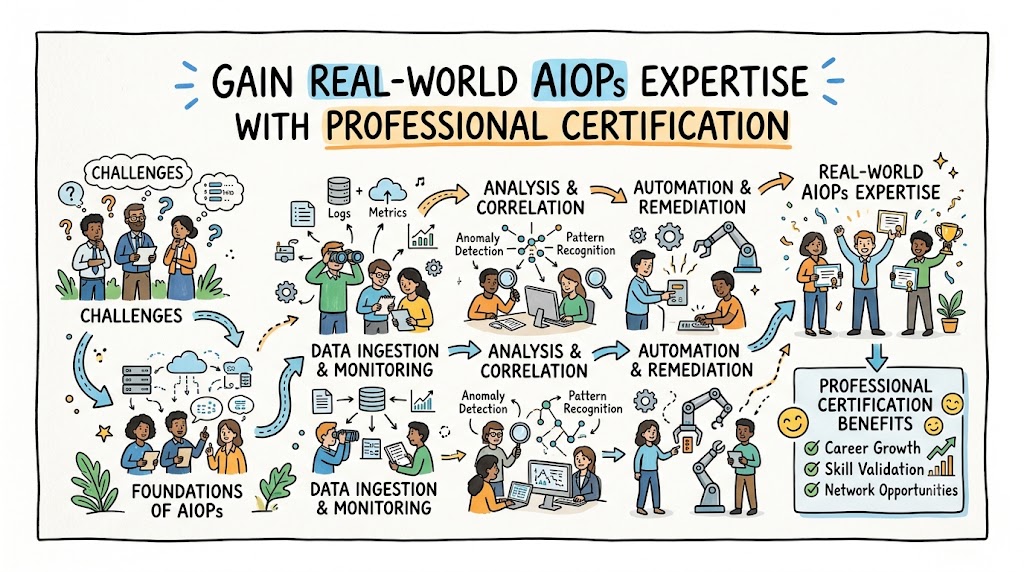
At its core, this certification is a framework for mastering the convergence of machine learning and large-scale system operations. It moves beyond buzzwords, focusing on the gritty reality of production environments where noise reduction, automated root cause analysis, and capacity optimization are not luxuries but daily requirements. This program exists to validate that an engineer can successfully move from manual, ticket-based resolution to automated, high-velocity incident management. It is built for those who understand that modern architecture demands an intelligent layer capable of processing data faster than any human operator could.
Who Should Pursue Certified AIOps Professional?
This path is crafted for the engineer who is tired of alert fatigue and manual toil. It is ideal for SREs, DevOps engineers, and Platform architects who are already comfortable with the stack but want to master the intelligence layer. Data engineers and Security practitioners who manage operational telemetry will also find this certification expands their toolset significantly. Whether you are leading a team in a fast-paced Indian tech hub or architecting global cloud solutions, the principles taught here are universal and highly transferable to any modern enterprise environment.
Why Certified AIOps Professional
In a technical landscape defined by complexity, the ability to automate diagnostic processes is the defining factor of a senior engineer’s value. This certification proves you possess the competence to manage systems that are too complex for traditional manual oversight. It secures your relevance in an industry where infrastructure is becoming increasingly dynamic and ephemeral. By investing time in this certification, you are not just checking a box; you are acquiring the foundational knowledge needed to lead the next generation of resilient, high-performance IT environments.
Certified AIOps Professional Certification Overview
The training is provided by and is hosted on aiopsschool. The certification is structured to be practical and result-oriented, focusing on real-world scenarios rather than rote memorization. It requires candidates to demonstrate that they can apply machine learning models to solve actual operational bottlenecks. This approach ensures that when you earn the designation, it is a testament to your hands-on ability to reduce downtime and improve the stability of your production systems.
Certified AIOps Professional Certification Tracks & Levels
The learning structure is tiered, starting with fundamental concepts that define the AIOps landscape and progressing to complex implementation strategies. The professional level focuses on the application of specific tools and algorithms, while the advanced level is built for those designing enterprise-wide intelligent architectures. These tracks allow engineers to customize their learning path based on their current role—whether they are focused on incident response, security automation, or cloud cost optimization—ensuring that the certification supports their specific career goals.
Complete Certified AIOps Professional Certification Table
| Track | Level | Who it’s for | Prerequisites | Skills Covered |
| Foundation | Entry | SysAdmins | Basic Linux/Cloud | Core Telemetry, Log Basics |
| Professional | Intermediate | SRE/DevOps | Foundation | Anomaly Detection, Incident Correlation |
| Advanced | Expert | Architects | Professional | Predictive Modeling, Scaling AI |
Detailed Guide for Each Certified AIOps Professional Certification
Certified AIOps Professional – Professional Track
What it is
This is a technical validation of your capability to deploy and manage automated decision-making systems within a live, high-traffic IT production environment.
Who should take it
It is tailored for engineers who are already managing monitoring systems and want to shift their focus from monitoring to intelligent, automated incident management.
Skills you’ll gain
- Designing automated alert suppression logic.
- Implementing real-time log analysis and event correlation.
- Managing feedback loops between alerts and resolution scripts.
Real-world projects you should be able to do
- Creating an automated baseline for system performance metrics in a microservices setup.
- Setting up an intelligent incident routing system based on historical performance data.
- Integrating machine learning agents into existing monitoring stacks to identify silent failures.
Preparation plan
- 7–14 days: Deep dive into the core methodologies of log processing and event clustering.
- 30 days: Build three distinct operational experiments in a local sandbox or staging environment.
- 60 days: Conduct a full end-to-end simulation of an automated incident response cycle.
Common mistakes
- Trying to force an AI solution onto a problem that requires a simple script.
- Neglecting the importance of clean, structured data for model training.
- Expecting immediate results without allowing models time to learn the system’s “normal” behavior.
Best next certification after this
- Same-track: Advanced AIOps Strategy.
- Cross-track: Certified DataOps Specialist.
- Leadership: Engineering Manager for Automated Systems.
Choose Your Learning Path
DevOps Path
The DevOps path emphasizes how to integrate predictive analytics into CI/CD pipelines. You will learn to use data to stop bad deployments before they impact users, turning release management into a highly predictable, automated process.
DevSecOps Path
The DevSecOps path teaches you to spot security anomalies in real time. It is about using machine learning to detect patterns indicative of a breach that traditional firewall rules or static alerts would inevitably miss.
SRE Path
The SRE path is focused on the metrics that matter—SLIs and SLOs. You will learn to use automated intelligence to manage error budgets, ensuring that your reliability efforts are always focused on the most critical system risks.
AIOps Path
The AIOps path is your primary route to becoming an expert in intelligent operations. It covers the full stack, from ingestion to inference, giving you the deep technical knowledge required to lead an AIOps transformation.
MLOps Path
The MLOps path is designed for those who want to manage the machine learning lifecycle. It covers model versioning, retraining, and production deployment, ensuring your models stay accurate as your infrastructure evolves.
DataOps Path
The DataOps path focuses on the flow of information. You will learn how to build robust, scalable pipelines that provide the high-quality telemetry needed to power the intelligence layer of your enterprise operations.
FinOps Path
The FinOps path centers on cost efficiency. You will learn how to use operational data to identify wasted resources and automate rightsizing, ensuring your cloud expenditure is always aligned with actual system demand.
Role → Recommended Certified AIOps Professional Certifications
| Role | Recommended Certifications |
| DevOps Engineer | Certified AIOps Professional (Professional) |
| SRE | Certified AIOps Professional (Professional) |
| Platform Engineer | Certified AIOps Professional (Advanced) |
| Cloud Engineer | Certified AIOps Professional (Foundation) |
| Security Engineer | Certified AIOps Professional (Professional) |
| Data Engineer | Certified AIOps Professional (Professional) |
| FinOps Practitioner | Certified AIOps Professional (Professional) |
| Engineering Manager | Certified AIOps Professional (Advanced) |
Next Certifications to Take After Certified AIOps Professional
Same Track Progression
Progressing deeper into the AIOps track means moving toward architectural design. Here, you transition from implementing individual models to designing entire ecosystems that handle observability and self-healing across multiple cloud environments.
Cross-Track Expansion
Diversifying your skill set with DataOps or MLOps creates a powerful combination. It allows you to move from being an expert in operations to being an expert in the entire data-driven engineering lifecycle, from collection to model deployment.
Leadership & Management Track
For those aiming for management, the goal is to bridge the technical and business sides. Certifications focused on leadership in automated organizations help you advocate for the right tools and build the teams necessary to support intelligent infrastructure.
Training & Certification Support Providers for Certified AIOps Professional
DevOpsSchool offers deep-dive, practical training that focuses on the real-world application of engineering principles, ensuring that students can handle actual production challenges immediately upon completion.
Cotocus specializes in enterprise-level training, providing a structured approach for teams looking to transition their entire operational stack to an intelligent, AI-driven model.
Scmgalaxy provides robust certification paths that integrate modern automation and version control with the core concepts of AIOps, perfect for engineers looking to modernize their workflow.
BestDevOps focuses on project-based learning, ensuring candidates gain the necessary experience to pass exams by solving real-world, high-stakes infrastructure problems in a simulated environment.
devsecopsschool bridges the gap between security and AIOps, training engineers to use intelligent monitoring to secure infrastructure and automate threat response in cloud-native environments.
sreschool provides targeted training for SREs, emphasizing how to use automated intelligence to reduce toil and improve system availability through better incident management.
aiopsschool is the primary authority for this certification, offering the most comprehensive curriculum and direct access to industry experts in the field of intelligent IT operations.
dataopsschool focuses on the critical data pipelines needed for AIOps, teaching engineers how to build, maintain, and secure the data foundations that power all modern intelligent systems.
finopsschool focuses on the economic side of cloud operations, teaching how to use intelligent monitoring to optimize infrastructure spend and maximize the value of your cloud investment.
Frequently Asked Questions (General)
- What is the primary benefit of becoming a Certified AIOps Professional?The main benefit is gaining a validated skill set in automating complex operations, which significantly increases your efficiency, lowers your system’s downtime, and makes you indispensable to any engineering team.
- How much hands-on practice is involved in this program?The program is built around hands-on lab work; you are expected to spend a significant portion of your study time implementing models and testing them against simulated production failures.
- Can this certification help me if I work with legacy infrastructure?Yes, the principles of AIOps—observability, noise reduction, and predictive analysis—can be applied to legacy systems to improve their stability while you prepare to migrate them to modern architectures.
- Is this certification only for those who work in the cloud?While heavily focused on cloud-native environments, the underlying concepts apply to any large-scale distributed system, whether on-premises, hybrid, or entirely in the cloud.
- How does this certification impact my salary potential?By moving you into a high-demand, specialized niche, this certification often acts as a catalyst for salary growth by demonstrating your expertise in managing the future of IT infrastructure.
- Are there any required programming languages?You should be comfortable with basic scripting, particularly in Python, as it is the standard language for most data-related tasks in the modern DevOps and AIOps ecosystem.
- How often is the content updated?The curriculum is updated regularly to ensure that it reflects the latest developments in AI and machine learning, ensuring you are learning modern, relevant skills.
- Can I manage this certification alongside a full-time job?Absolutely, the certification is designed to be flexible, allowing working professionals to balance their studies with their day-to-day responsibilities through modular learning.
- What kind of support is available if I get stuck?Most providers offer access to forums, mentor support, or office hours to ensure you have the guidance you need when navigating complex technical concepts.
- Is this certification recognized by large enterprises?Yes, the skills validated by this certification are highly valued by organizations looking to modernize their operations and reduce the costs associated with manual system management.
- Do I need a background in data science?You do not need to be a data scientist; you need a solid foundation in operations, as the focus is on applying data techniques to solve IT problems rather than developing models from scratch.
- How do I choose the best provider for my needs?Consider your current career goals and which provider offers the specific specialization tracks that align with your desired path in the DevOps or SRE ecosystems.
FAQs on Certified AIOps Professional
- How does this certification handle noise in my incident management?It teaches you how to implement correlation algorithms that group related alerts together, effectively silencing the noise and highlighting only the root causes.
- Can this help me predict system crashes before they happen?Yes, that is a core pillar of the certification; you learn to identify early warning signs in telemetry data that precede system instability, allowing for preemptive action.
- What happens if my AI model makes a wrong decision?The certification teaches “human-in-the-loop” design, ensuring that you maintain control and that automated decisions are subject to safety checks and thresholds.
- Is this just about monitoring?No, it is about transformation; monitoring tells you what happened, while AIOps uses that information to automate the response and improve the system.
- How does this change my daily workflow as an SRE?It shifts your daily focus from reacting to individual tickets to optimizing the automated systems that handle those tickets for you, allowing you to work on higher-level architecture.
- Will this certification help me with my cloud bill?If you choose the FinOps-related tracks or modules, you will gain specific skills for using data to rightsizing resources, which is the most effective way to lower cloud costs.
- Do I need access to expensive software to study for this?Most of the labs can be completed using open-source tools, so you don’t need a massive software budget to gain the necessary practical experience.
- What is the most challenging part of the certification?For many, it is the transition from thinking in “if-then” logic to thinking in probabilistic models, which is the foundational shift required for AIOps success.
Final Thoughts: Is Certified AIOps Professional Worth It?
The decision to pursue the Certified AIOps Professional is ultimately a choice to invest in your own evolution. The industry is moving quickly away from the manual, ticket-based operational models of the past. By gaining these skills, you are positioning yourself as a leader who understands how to build the resilient, self-optimizing infrastructures that the future requires. It is not an easy path, but it is one that offers significant rewards in terms of career stability, professional growth, and the ability to solve the most meaningful technical challenges of our time. Stay focused, stay hands-on, and look at this certification as the first step in a long, impactful career as an architect of the intelligent future.
