Introduction
Navigating the intersection of infrastructure design and artificial intelligence is one of the most defining challenges for today’s engineering teams. The MLOps Foundation Certification offers a clear roadmap for systems professionals who want to master the art of deploying, scaling, and managing machine learning models safely in production. This comprehensive guide strips away the marketing hype to deliver an honest, experience-driven analysis of how this credential fits into modern cloud-native systems. Whether you are looking to expand your existing engineering toolkit or guide your team through an upcoming AI infrastructure shift, understanding this roadmap via aiopsschool is a practical place to start.
What is the MLOps Foundation Certification?
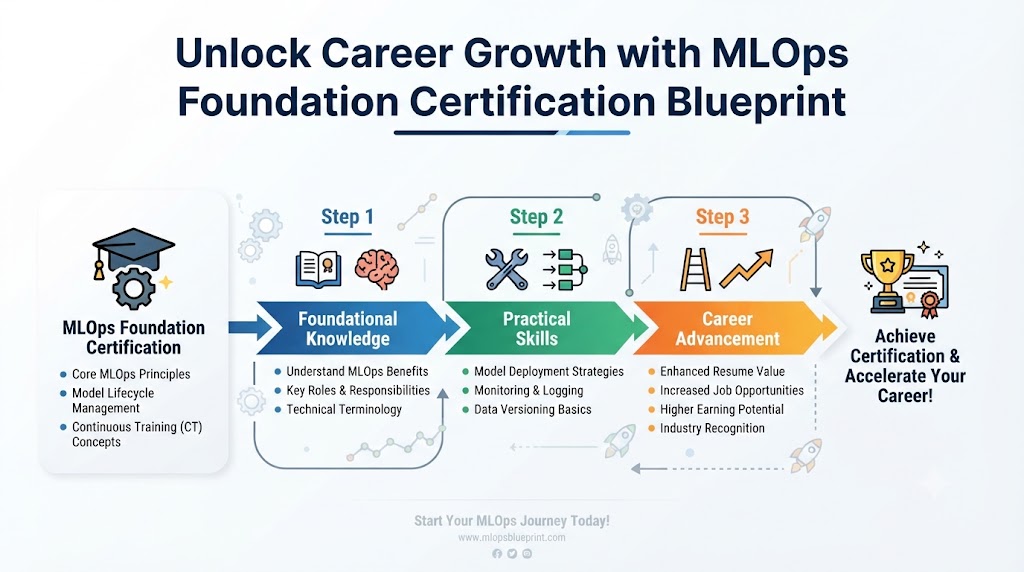
The MLOps Foundation Certification is a formal validation of an engineer’s capability to run machine learning pipelines with the exact same architectural discipline used for traditional microservices. Rather than focusing on abstract mathematical theories or pure data science research, this program focuses entirely on the practical operational lifecycle of models. It establishes a standard framework for automated training, continuous model validation, secure artifact storage, and high-availability serving. By grounding its core curriculum in real-world production challenges, the program ensures that certified individuals know how to build resilient systems that prevent live software deployment failures.
Who Should Pursue MLOps Foundation Certification?
This educational pathway is tailor-made for systems engineers, site reliability specialists, and cloud architects who find themselves increasingly responsible for hosting resource-heavy AI workloads. It is equally valuable for data engineers who need to ensure that upstream data pipelines feed automated training loops without causing system downtime or schema mismatches. Technical leaders, project managers, and engineering directors will also benefit by gaining the specific vocabulary and architectural context needed to oversee cross-functional operations. From the fast-growing technology centers across India to global enterprise engineering teams, this certification serves as a universal standard for infrastructure professionals.
Why MLOps Foundation Certification
As organizations invest heavily in production-grade artificial intelligence, the need for specialists who can reliably manage these complex lifecycles has skyrocketed. This certification offers lasting career value because it prioritizes fundamental structural design patterns over the superficial syntax of individual open-source tools. By focusing on deep infrastructure concepts like model state tracking, immutable data versioning, and environment decoupling, your skills remain highly relevant even when specific software frameworks change. The long-term return on your time investment is an undeniable ability to reduce operational overhead and eliminate development bottlenecks.
MLOps Foundation Certification Overview
The certification process uses an online testing framework to evaluate how well a candidate understands the practical steps required to sustain machine learning models over time. Rather than relying on simple rote memorization, the assessment uses scenario-based challenges that replicate real-world system failures, configuration errors, and pipeline performance drops. The underlying curriculum is actively maintained and reviewed by veteran platform architects to ensure it stays fully aligned with modern infrastructure standards. Professionals can expect a balanced assessment covering automated configuration strategies, model registries, and the telemetry systems used to track live production workloads.
MLOps Foundation Certification Tracks & Levels
The educational path is broken down into progressive tiers designed to support professionals as their architectural responsibilities grow within an organization. The introductory level establishes core concepts, teaching candidates how to manage data lineages, containerize workloads, and configure baseline deployment configurations. As engineers advance into professional and master levels, the focus shifts toward designing high-performance topologies, automated model retraining loops, and distributed serving clusters. This multi-tiered structure allows engineering professionals to match their educational journey directly with their actual day-to-day enterprise projects.
Complete MLOps Foundation Certification Table
| Track | Level | Who it’s for | Prerequisites | Skills Covered | Recommended Order |
|---|---|---|---|---|---|
| Core Systems | Foundation | Infrastructure Teams, SysAdmins | General cloud and Linux literacy | Core pipeline automation, tracking, container setups | First |
| Pipeline Engineering | Professional | DevOps Engineers, SREs | Foundational credential, scripting | Continuous retraining, data validation, scaling | Second |
| System Architecture | Advanced | Principal Architects, Tech Leads | Professional credential, design skills | Enterprise governance, multi-region setups, compliance | Third |
Detailed Guide for Each MLOps Foundation Certification
MLOps Foundation Certification – Foundational Level
What it is
This credential verifies that a candidate understands how to manage the lifecycle of machine learning workflows, maintain clean data pipelines, and use automation to keep infrastructure stable.
Who should take it
Traditional systems administrators, application developers, and cloud engineers who want to break into the field of AI infrastructure management and master the core principles of model tracking.
Skills you’ll gain
- Tracking code, parameters, and datasets using modern versioning systems.
- Building repeatable and isolated runtime environments using container technologies.
- Understanding key operational metrics like telemetry collection and infrastructure drift.
- Constructing basic continuous integration pipelines to validate input data quality.
Real-world projects you should be able to do
- Set up a continuous integration pipeline that automatically verifies data schema integrity before triggering a test run.
- Deploy an open-source tracking dashboard to monitor and log configuration parameters across multiple experimental runs.
Preparation plan
- 7–14 Days: Focus on mastering the specialized vocabulary of data engineering, learning how model tracking works, and reviewing standard version control workflows.
- 30 Days: Work directly inside sandbox environments to build simple containerized services, run basic automation tasks, and read through standard architectural patterns.
- 60 Days: Complete multiple practice assessments, build an end-to-end pipeline connecting a data store to a central model registry, and study troubleshooting documentation.
Common mistakes
- Managing massive datasets with the exact same version control tools and approaches used for lightweight application source code.
- Implementing complex, multi-layered orchestration platforms before mastering basic container configurations and simple automation flows.
- Spending too much time learning how to write machine learning models instead of learning how to host, package, and monitor them.
Best next certification after this
- Same-track option: MLOps Professional Certification
- Cross-track option: Enterprise Cloud Architecture Certification
- Leadership option: Technical Engineering Management Certification
Choose Your Learning Path
DevOps Path
Engineers on this track focus on expanding standard continuous integration and deployment pipelines to handle unique machine learning artifacts. This includes configuring automated testing for incoming data streams, establishing immutable infrastructure patterns, and ensuring smooth deployment transitions between staging and live environments. The primary goal is to make model updates as predictable and routine as deploying a standard microservice update.
DevSecOps Path
Security-focused professionals learn how to build automated compliance and vulnerability checks directly into data processing and model generation pipelines. This pathway covers securing container supply chains, managing fine-grained access controls over sensitive training files, and creating unalterable audit trails for compliance validation. Candidates ensure that security safeguards protect the environment without slowing down the development lifecycle.
SRE Path
Site reliability practitioners prioritize the uptime, performance, and operational efficiency of the infrastructure hosting live prediction endpoints. This path focuses on building self-healing systems, setting clear service level objectives for inference services, and managing computing power under fluctuating traffic conditions. Engineers learn to handle sudden volume spikes while keeping latency within strict, pre-defined boundaries.
AIOps Path
Engineers following this path use algorithmic data and machine learning telemetry to optimize traditional IT infrastructure management. The curriculum teaches professionals how to process large amounts of log output, predict potential cluster failures before they disrupt operations, and automate root-cause discovery across distributed networks. It shifts infrastructure management from a reactive practice to a proactive system.
MLOps Path
This path centers on the day-to-day integration of data science workflows with production engineering pipelines to ensure continuous delivery. Practitioners spend their time configuring enterprise feature stores, managing central model registries, and setting up automated monitoring systems to detect live performance drops. The focus is on keeping the loop between data updates and live serving entirely seamless.
DataOps Path
Data-focused specialists concentrate on building high-throughput pipelines that clean, validate, and deliver raw information to training systems. This path highlights automated quality testing, lineage mapping, and schema checks to ensure that training environments are never corrupted by bad data inputs. By treating data as a product, these practitioners build the baseline for all subsequent automation.
FinOps Path
Financial infrastructure specialists focus on tracking, reporting, and optimizing the significant cloud compute costs tied to model training and active serving. This path provides practical strategies for identifying underutilized graphics processing hardware, managing cloud budgets, and choosing cost-efficient serverless hosting models. Specialists ensure that advanced technical operations remain sustainable and within corporate budgetary goals.
Role → Recommended MLOps Foundation Certification Certifications
| Role | Recommended Certifications |
|---|---|
| DevOps Engineer | MLOps Foundation, Professional Automation Specialist |
| SRE | MLOps Foundation, High-Availability Systems Engineer |
| Platform Engineer | MLOps Foundation, Cloud Infrastructure Architect |
| Cloud Engineer | MLOps Foundation, Multi-Tenant Cluster Specialist |
| Security Engineer | MLOps Foundation, Secure Pipeline Practitioner |
| Data Engineer | MLOps Foundation, Automated Data Quality Specialist |
| FinOps Practitioner | MLOps Foundation, Compute Efficiency Consultant |
| Engineering Manager | MLOps Foundation, Technology Leadership Specialist |
Next Certifications to Take After MLOps Foundation Certification
Same Track Progression
After securing this foundational baseline, the most practical next step is moving into professional automation certifications. This deeper focus introduces complex topics like automated retraining loops, global cluster load balancing, and advanced feature store integrations. This pathway helps engineers establish themselves as true technical leads capable of designing enterprise-grade automation infrastructures from scratch.
Cross-Track Expansion
Professionals who want to increase their overall versatility should consider cross-training in adjacent areas like enterprise Cloud Architecture or DevSecOps. Earning certifications in these domains helps you understand how specialized data workflows fit within broader corporate security perimeters, identity access networks, and governance guidelines. This creates a multi-dimensional engineer who can work across different core infrastructure teams.
Leadership & Management Track
For individuals who want to step away from daily command-line configuration and move toward high-level strategy, certifications in technical product management or engineering leadership are ideal. These tracks focus on managing delivery schedules, predicting infrastructure budgets, and aligning cross-functional teams. This training equips senior engineers with the tools needed to lead large-scale digital transformation projects successfully.
Training & Certification Support Providers for MLOps Foundation Certification
DevOpsSchool delivers highly practical training programs built to help software professionals master the foundational concepts of configuration management, automated deployment, and modern cloud architecture patterns.
Cotocus provides structured technical courses along with hands-on sandbox laboratories that focus on container management, open-source automation systems, and enterprise cluster configuration.
Scmgalaxy operates as an online learning community and knowledge base that helps infrastructure professionals keep their skills sharp regarding version control setups, continuous integration tools, and build mechanics.
BestDevOps specializes in intensive training bootcamps focused on real-world system delivery standards, reliability tracking, and the practical implementation of scalable enterprise infrastructure.
devsecopsschool focuses entirely on teaching engineers how to embed automated vulnerability checks, compliance policies, and identity safeguards directly into continuous delivery environments.
sreschool provides targeted educational modules focused on measuring system availability, defining practical service level agreements, and debugging complex distributed cloud systems under stress.
aiopsschool offers authoritative, expert-led training programs focused on utilizing operational data patterns to build responsive, self-managing enterprise infrastructure.
dataopsschool focuses on training systems engineers to build robust, automated pipelines that ensure consistent quality, clear lineage tracking, and dependable delivery of enterprise data.
finopsschool teaches systems architects and finance teams how to track resource utilization patterns, reduce cloud spending, and build budget-aware infrastructure deployments.
Frequently Asked Questions (General)
- What is the core objective of an infrastructure foundation certification? The core objective is to teach engineers how to bring traditional automation, testing, and continuous deployment workflows to complex data systems and software artifacts.
- How much time should I dedicate to studying for a foundational systems exam? Most professionals with a basic understanding of cloud computing and version control require between thirty to sixty days of structured study to prepare fully.
- Are there strict professional prerequisites required before booking the exam? No formal prerequisites are mandatory, but having a working knowledge of Linux administration, command-line interfaces, and basic Git operations will make the material much easier to learn.
- Can earning this certification help a standard application developer change paths? Yes, it provides a very clear path for understanding infrastructure operations, helping software developers shift smoothly into modern platform engineering or systems roles.
- Is an extensive background in programming required to clear the test? Deep software development skills are not required, though candidates should feel comfortable reading simple configuration scripts written in formats like YAML or JSON.
- How long does a foundational operational credential stay valid? The certification typically remains valid for a period of two to three years, after which you can recertify by passing an advanced examination.
- What is the standard format of the certification assessment? The test uses multiple-choice questions alongside practical, scenario-based problems designed to check an engineer’s real-world problem-solving and troubleshooting abilities.
- Why should an engineering manager consider pursuing a foundational certification? It helps technical leaders understand production infrastructure challenges, allowing them to accurately estimate project timelines, manage resource costs, and lead engineering teams effectively.
- Does the curriculum focus on a single specific public cloud vendor? The underlying principles are completely cloud-agnostic, giving you foundational skills that apply across AWS, Microsoft Azure, Google Cloud Platform, or private on-premise setups.
- How does this training help an engineer resolve live issues faster? By teaching a structured approach to systems monitoring, error logging, and artifact tracking, it allows engineers to quickly determine whether an issue stems from code or infrastructure.
- Are there official practice tests available to check my readiness? Yes, standard training packages include structured practice exams that closely match the layout, time limits, and overall difficulty of the official certification test.
- What is the typical score needed to pass the foundational exam? While exact passing requirements can change slightly between test versions, candidates generally need to score around seventy percent to pass the evaluation.
FAQs on MLOps Foundation Certification
- How exactly does the MLOps Foundation Certification differ from a typical DevOps cert? Standard DevOps tracks focus on automating static application environments and compiled code files, while this certification teaches you how to manage the unique lifecycle of changing datasets and model weights.
- Which open-source tools should I spend time studying during my preparation? You should focus on understanding the roles of container management platforms like Kubernetes, experiment tracking systems like MLflow, feature stores, and automated data processing tools.
- Do I need to know how to build complex machine learning algorithms to pass? No, you do not need to write or train complex neural networks, as the exam focuses entirely on the infrastructure pipelines that package, deploy, and monitor those models.
- How does this certification influence career opportunities in the tech sector in India? Because enterprise organizations face an acute shortage of infrastructure engineers who understand data lifecycles, certified professionals frequently command premium engineering roles.
- What role does performance monitoring play in the certification blueprint? Continuous monitoring is a critical pillar of the exam, focusing heavily on how to track live performance degradation, operational system usage, and changes in input data distributions.
- Can data scientists gain real professional value from this operational track? Yes, it helps data scientists understand production infrastructure limits, which allows them to write cleaner, more deployable code that transitions smoothly to operations teams.
- How does the curriculum handle data security and enterprise compliance? The training covers critical security patterns, including configuring access controls for cloud storage buckets, building secure container images, and keeping unalterable logs of model versions.
- Is this certification recognized by major enterprise organizations and global employers? Yes, because it addresses the universal enterprise challenge of scaling artificial intelligence safely, the credential is highly respected by technology employers globally.
Final Thoughts: Is MLOps Foundation Certification Worth It?
Earning the MLOps Foundation Certification is a smart, pragmatic choice for any infrastructure professional who recognizes that machine learning is becoming a standard part of enterprise software systems. This credential avoids short-term tool hype and instead focuses on the core principles required to keep complex, data-driven systems stable and predictable over time. For engineers seeking a clear path forward, it removes the guesswork by validating the exact skills that modern platform engineering teams are looking for. If you want to move past basic system maintenance and start designing advanced, automated pipelines for enterprise applications, this program provides a rock-solid foundation for long-term career growth.
