Introduction
The landscape of modern infrastructure is shifting rapidly toward high-availability, scalable systems. In this era, the Certified Site Reliability Professional stands as a benchmark for engineers committed to system stability and operational excellence. Whether you are navigating the complexities of cloud-native architecture or looking to refine your incident response strategies, this certification provides the rigorous framework necessary for success. By aligning your expertise with global standards provided by sreschool, you position yourself to thrive in competitive environments. This guide is designed for software engineers, platform architects, and infrastructure leads who seek to deepen their technical proficiency and validate their skills. We will explore the nuances of the curriculum, preparation strategies, and how this path integrates with specialized training centers like aiopsschool to future-proof your career.
What is the Certified Site Reliability Professional?
The Certified Site Reliability Professional represents a dedicated professional credential aimed at mastering the art and science of site reliability engineering. It moves beyond theoretical concepts to address the brutal reality of production environments where uptime, latency, and error budgets are critical KPIs. This program exists to standardize the operational practices that define successful, large-scale systems management.
It focuses heavily on the automation of manual tasks, the implementation of observability, and the development of sustainable on-call cultures. By emphasizing a production-first mindset, it bridges the gap between software development and system administration. It aligns perfectly with modern agile workflows, ensuring that engineering teams remain productive while maintaining the high standards of stability expected in enterprise-grade infrastructure.
Who Should Pursue Certified Site Reliability Professional?
This certification is intended for professionals who are already working within the software development lifecycle or infrastructure operations. Software engineers looking to move into full-stack reliability roles will find this curriculum essential for understanding the infrastructure their code runs upon. Similarly, existing SREs can use this to formalize their experience and gain insights into more sophisticated error budget management.
Cloud engineers and platform architects will find value in the architectural patterns discussed, which focus on self-healing and fault-tolerant design. Managers and technical leads who are responsible for building or optimizing their site reliability teams will also benefit from understanding these methodologies. In the context of the global and Indian tech markets, where the demand for high-availability systems is exploding, this certification serves as a vital differentiator for your professional profile.
Why Certified Site Reliability Professional
In an era where system downtime can cost millions of dollars, the demand for individuals who can guarantee reliability is at an all-time high. This credential provides a structured approach to solving complex operational problems, ensuring you remain valuable regardless of which cloud provider or specific toolset your organization decides to adopt. It creates a common language for reliability that is recognized across diverse technical teams.
Furthermore, this certification helps professionals maintain relevance in a market that constantly shifts between emerging technologies. By focusing on core reliability principles—such as automation, observability, and incident post-mortems—you gain skills that are fundamentally transferable and long-lasting. It is an investment in your ability to manage large-scale systems effectively, providing a tangible return in terms of career advancement and increased technical confidence.
Certified Site Reliability Professional Certification Overview
The program is delivered via the official course page at and is hosted on sreschool. The assessment approach is designed to test practical application rather than rote memorization, ensuring that those who earn the credential can actually perform the duties of an SRE in a live environment.
The structure of the certification is tiered, catering to different levels of expertise and career focus. It emphasizes ownership of production systems and the ability to influence design decisions that prioritize reliability from the ground up. By completing this program, you demonstrate not only your technical ability to manage incidents but also your commitment to the strategic management of production systems.
Certified Site Reliability Professional Certification Tracks & Levels
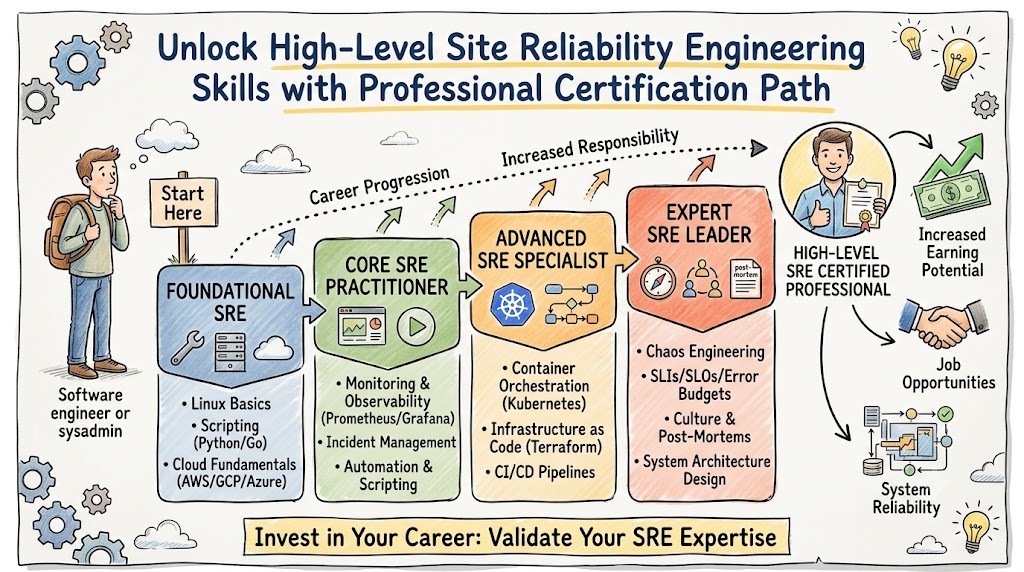
The certification is structured into foundation, professional, and advanced levels, allowing for a clear progression as you gain more experience. Foundation levels focus on the core principles of SRE, such as error budgets and service level objectives. The professional level deepens the practical knowledge, requiring candidates to engage with more complex failure modes and architectural patterns.
Specialization tracks are also available, allowing engineers to focus on areas like DevOps, SRE, or FinOps, depending on their current role and career trajectory. This leveling allows for a customized learning path that evolves with your career. Whether you are a newcomer to the SRE discipline or a seasoned veteran, there is a track that provides the depth and challenge required to take your career to the next level.
Complete Certified Site Reliability Professional Certification Table
| Track | Level | Who it’s for | Prerequisites | Skills Covered | Recommended Order |
| Core SRE | Foundation | Junior Engineers | Basics of Cloud | Observability, SLIs, SLOs | 1 |
| Core SRE | Professional | SREs | Foundation Cert | Incident Response, Automation | 2 |
| Advanced | Advanced | Architects | Professional Cert | Scaling, SRE Leadership | 3 |
| Specialized | FinOps | SREs/FinOps | Professional Cert | Cloud Cost Optimization | 4 |
Detailed Guide for Each Certified Site Reliability Professional Certification
Certified Site Reliability Professional – Foundation
What it is This certification validates your core understanding of site reliability engineering principles, including the fundamental relationship between reliability, deployment velocity, and error budgets.
Who should take it It is designed for junior software engineers, cloud administrators, or those transitioning into operations roles who need a strong theoretical and practical grounding.
Skills you’ll gain
- Mastery of SLIs, SLOs, and SLAs definition.
- Understanding of how to manage error budgets.
- Basics of monitoring, logging, and alerting strategies.
- Foundation of incident response workflows.
Real-world projects you should be able to do
- Define SLOs for a web application and document the error budget policy.
- Configure a basic alerting dashboard using industry-standard observability tools.
- Draft an initial incident response plan for a minor system outage.
Preparation plan
- 7–14 days: Focus on understanding the core SRE handbook concepts and definitions.
- 30 days: Implement basic SLO tracking in a sandbox environment and practice common commands.
- 60 days: Review all course materials, complete practice quizzes, and simulate a mock incident.
Common mistakes Focusing too much on tooling rather than the underlying methodology is a frequent pitfall that hinders true comprehension of SRE.
Best next certification after this
- Same-track option: Certified Site Reliability Professional – Professional.
- Cross-track option: Certified DevOps Professional.
- Leadership option: Certified Engineering Management Professional.
Choose Your Learning Path
DevOps Path
The DevOps path focuses on the intersection of development and operations, emphasizing CI/CD pipelines and infrastructure as code. It is essential for those who want to build the automated systems that make reliability possible. You will learn to integrate reliability checks directly into your deployment cycles to catch issues early.
DevSecOps Path
This path integrates security practices into the reliability framework, ensuring that production systems are not only stable but also hardened against modern threats. You will focus on vulnerability management, automated compliance, and secure configuration. It is perfect for those bridging the gap between security engineering and SRE.
SRE Path
The core SRE path is the deepest dive into system reliability, focusing on high availability, disaster recovery, and complex system design. It is the gold standard for engineers dedicated to managing large-scale, production-critical infrastructure. This path prepares you for high-pressure environments where system uptime is the primary concern.
AIOps Path
The AIOps path explores the application of machine learning and data analytics to IT operations. You will learn how to leverage predictive modeling to anticipate system failures before they occur. This is an advanced path for those looking to modernize their monitoring stacks with intelligent automation.
MLOps Path
MLOps focuses on the reliability of machine learning models in production environments. It deals with data versioning, model monitoring, and the unique challenges of scaling AI services. This path is crucial for those working in the growing field of machine learning infrastructure and production AI.
DataOps Path
DataOps emphasizes the reliable management of data pipelines and storage systems. You will learn how to maintain data integrity, optimize database performance, and ensure that data is available when needed. This is a specialized path for engineers working heavily with big data and analytics infrastructure.
FinOps Path
FinOps is critical for managing the cost of cloud infrastructure, ensuring that high reliability does not lead to unsustainable cloud bills. You will learn how to align operational decisions with budgetary constraints. This path is increasingly important as companies look to optimize their cloud spend alongside their uptime.
Role → Recommended Certified Site Reliability Professional Certifications
| Role | Recommended Certifications |
| DevOps Engineer | Certified DevOps Professional |
| SRE | Certified Site Reliability Professional |
| Platform Engineer | Certified Platform Engineering Professional |
| Cloud Engineer | Certified Cloud Architect Professional |
| Security Engineer | Certified DevSecOps Professional |
| Data Engineer | Certified DataOps Professional |
| FinOps Practitioner | Certified FinOps Professional |
| Engineering Manager | Certified Engineering Management Professional |
Next Certifications to Take After Certified Site Reliability Professional
Same Track Progression
Once you have mastered the professional level, you should look toward advanced architectural certifications. These delve into multi-region disaster recovery, complex global load balancing, and large-scale incident command structures. This deepens your ability to lead high-stakes reliability initiatives.
Cross-Track Expansion
Consider adding a certification in a complementary domain like FinOps or DevSecOps. Expanding your skillset helps you understand the broader implications of your reliability work on security or budget. This makes you a more holistic engineer capable of making balanced decisions.
Leadership & Management Track
If you are moving into a leadership role, focus on certifications that emphasize organizational design and team culture. You will learn how to build an SRE culture within a team, manage on-call rotations, and communicate system health to stakeholders. This is essential for scaling your impact beyond individual contributions.
Training & Certification Support Providers for Certified Site Reliability Professional
DevOpsSchool is a premier provider focusing on real-world industry applications of SRE and DevOps methodologies. They offer comprehensive training programs designed to bridge the gap between academic learning and production-grade engineering excellence for professionals globally.
Cotocus provides specialized training solutions that emphasize practical, hands-on learning experiences. Their approach is highly collaborative, ensuring that engineers are prepared to face the unique challenges of modern, distributed system architectures through guided mentorship and structured curriculum.
Scmgalaxy offers a wide range of training modules that cater to both technical and managerial aspects of the engineering lifecycle. Their support for SRE certifications ensures that candidates gain a solid understanding of both the tools and the culture required for success.
BestDevOps specializes in delivering high-quality certification preparation for modern engineering roles. They focus on clear, actionable learning paths that allow professionals to quickly gain the skills necessary to excel in complex, rapidly evolving cloud environments.
devsecopsschool offers focused training for professionals looking to secure their infrastructure. By combining reliability practices with security-first methodologies, they provide an essential service for engineers working in environments where both uptime and data protection are non-negotiable.
sreschool is the primary authority for reliability-focused certifications. Their curriculum is meticulously designed to cover all aspects of site reliability, providing the most relevant and up-to-date knowledge for engineers aiming to become certified professionals in the field.
aiopsschool focuses on the intersection of artificial intelligence and operations. Their training is perfect for those who want to understand how automation and machine learning are transforming the future of system reliability and infrastructure management.
dataopsschool provides deep expertise in managing data-heavy environments. Their training helps engineers ensure that data pipelines remain resilient and performant, which is a critical component of modern reliability engineering for data-centric organizations.
finopsschool offers essential training for professionals responsible for the financial health of their cloud infrastructure. They teach the necessary skills to manage costs effectively without compromising the reliability or performance of production systems.
Frequently Asked Questions
- What is the typical difficulty level of the Certified Site Reliability Professional? The difficulty is intermediate to advanced, as it requires both theoretical knowledge of SRE principles and the practical ability to apply them to real-world scenarios.
- How much time should I invest in studying for this certification? On average, professionals spend between 60 to 90 days of consistent study, depending on their existing background in operations and cloud architecture.
- Are there any prerequisites I need before starting this journey? While not strictly required, a strong understanding of Linux, basic networking, and experience with a cloud provider like AWS, Azure, or GCP is highly recommended.
- Is this certification recognized globally by employers? Yes, the skills validated by this program are universal and are highly sought after by enterprise organizations looking to build robust, reliable infrastructure globally.
- Does the certification expire or require periodic renewal? It is recommended to refresh your knowledge regularly, though the core principles taught remain valid as long as you stay aligned with current industry best practices.
- Can I pursue this certification if I am currently in a management role? Absolutely, as understanding the SRE framework is invaluable for managers who need to oversee reliable delivery and manage technical teams effectively.
- How does this certification impact my salary or career progression? Professionals with validated reliability skills often see significant career advancement and salary growth due to the high demand for experts who can minimize costly downtime.
- Are there practice exams available to help me prepare? Yes, most authorized training providers offer mock exams and practice scenarios to help you assess your readiness before attempting the actual certification.
- Can I take this certification if I am from a non-technical background? It is challenging; it is recommended to build a solid foundation in basic system administration and software development before attempting this specialized certification.
- Does this certification cover specific cloud provider tools? The program focuses on methodology and platform-agnostic principles, though you will learn how to apply these concepts across major cloud environments.
- How do I choose the right training provider from the list? Evaluate the providers based on their specific focus area, such as AIOps or FinOps, and choose one that best aligns with your career goals and current skill gaps.
- Is there a lab-based component to the examination? The examination is designed to test your ability to think through real-world scenarios, often involving practical assessment of architecture and incident management strategies.
FAQs on Certified Site Reliability Professional
- What specific production challenges does this certification address? It covers critical areas such as managing error budgets, designing for failure, implementing observability, and conducting effective incident post-mortems.
- How does this program handle the transition from DevOps to SRE? It clarifies the shift from pipeline-focused work to system-focused reliability, emphasizing long-term service stability over feature delivery speed.
- Is coding knowledge required to become a Certified Site Reliability Professional? Yes, proficiency in at least one scripting or programming language is necessary for the automation and operational tasks required in SRE roles.
- How does this certification differ from other cloud-specific certs? It focuses on the “reliability” methodology rather than specific vendor interfaces, making it much more applicable across diverse, multi-cloud enterprise setups.
- Will this help me if I am working in an on-premise environment? The principles of SRE—such as SLIs, SLOs, and incident management—are equally vital for on-premise systems as they are for cloud-native setups.
- How do I apply the concepts learned if my team is resistant to change? The training includes strategies for building a blameless culture and effectively communicating the value of reliability to non-technical stakeholders and management.
- Does this certification help with modern observability tool selection? It provides the framework to evaluate monitoring tools based on their ability to track SLOs rather than just vanity metrics, guiding better tool decisions.
- What is the main takeaway for an engineer after completing this? The ability to balance the competing demands of system stability and rapid software deployment using data-driven decision-making.
Final Thoughts: Is Certified Site Reliability Professional Worth It?
Investing time and effort into the Certified Site Reliability Professional is a strategic move for any engineer serious about their craft. It is not a shortcut, nor is it a magic badge; it is a rigorous validation of your ability to keep complex systems running under pressure. In the current engineering climate, the ability to architect for failure and manage uptime proactively is the hallmark of a senior engineer.
If you are looking to distinguish yourself from the crowd and gain a deeper understanding of the systems you build and maintain, this certification provides that edge. Take the time to understand the curriculum, choose a learning path that excites you, and approach your preparation with the intent to master the principles, not just pass a test. Success in this field belongs to those who view reliability as a foundational engineering requirement, not an afterthought.
