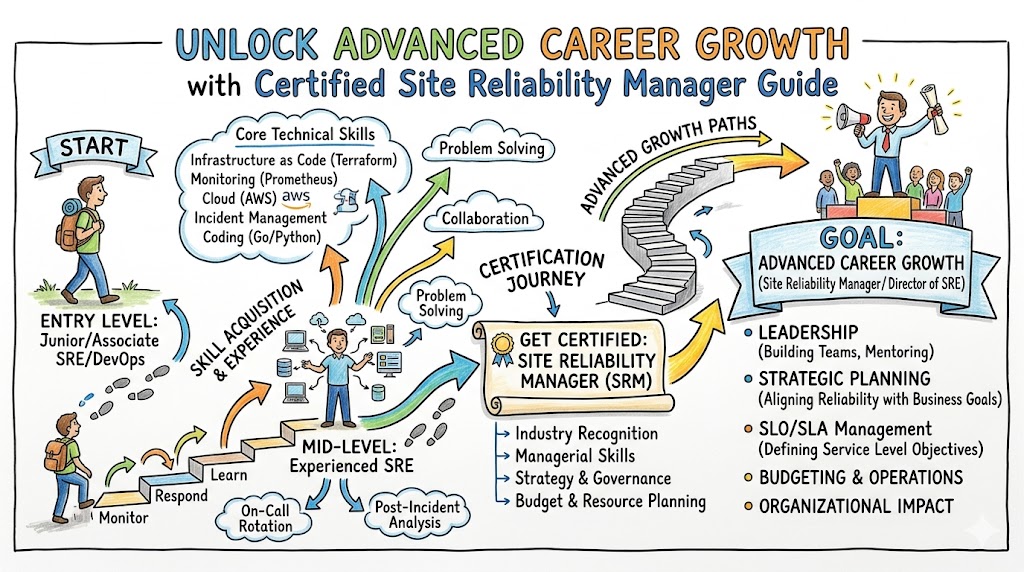
Introduction
The Certified Site Reliability Manager is a specialized program designed for engineers and technical leaders aiming to master production-grade reliability practices. This guide is intended for DevOps, SRE, cloud, security, and data professionals who want practical, real-world skills to manage scalable and resilient systems. Understanding this certification helps professionals plan their career trajectory, improve operational efficiency, and align their expertise with enterprise cloud-native workflows. By the end of this guide, readers will know how the certification maps to roles, the skills gained, and the best learning paths to accelerate their career. Access the full program via Certified Site Reliability Manager.
What is the Certified Site Reliability Manager?
The Certified Site Reliability Manager represents a structured learning approach to managing highly available, resilient, and scalable systems. Unlike theoretical courses, it emphasizes practical, production-focused learning, including incident management, service reliability, monitoring, and automation. The certification aligns with real-world workflows in DevOps, cloud platforms, and enterprise-scale operations. Professionals acquire the knowledge to implement SLOs, SLIs, error budgets, and reliability dashboards while understanding organizational processes that maintain uptime in dynamic environments.
Who Should Pursue Certified Site Reliability Manager?
This certification benefits software engineers, DevOps practitioners, SREs, cloud engineers, security specialists, and data professionals. Beginners looking to specialize in reliability, experienced engineers seeking to formalize skills, and managers aiming to lead SRE teams all gain value. The program is globally relevant and particularly valuable for professionals in India entering cloud-native and enterprise-grade operational roles. It caters to a range of experience levels and provides tangible career benefits in technical leadership and platform reliability.
Why Certified Site Reliability Manager
The Certified Site Reliability Manager enhances career longevity by equipping professionals with high-demand operational skills. Organizations increasingly rely on SRE practices to maintain reliability in complex systems. This certification demonstrates mastery over production monitoring, incident response, and reliability engineering—skills that remain relevant even as tools evolve. For professionals, it offers a strong return on learning investment, positioning them for leadership roles, higher pay, and greater influence in platform engineering and DevOps teams.
Certified Site Reliability Manager Certification Overview
Delivered through Certified Site Reliability Manager and hosted on sreschool, the program offers structured tracks across foundation, professional, and advanced levels. Assessments emphasize practical application and scenario-based evaluations rather than multiple-choice tests. Candidates gain ownership of reliability principles, tool mastery, and production-ready problem-solving. The structure balances theory and practice, ensuring participants can implement reliability strategies in real-world environments immediately.
Certified Site Reliability Manager Certification Tracks & Levels
The program offers three primary levels: foundation, professional, and advanced. Each level addresses a stage of career progression, from learning core SRE principles to leading reliability initiatives. Specialization tracks exist for DevOps, SRE, FinOps, AIOps, MLOps, and DataOps. These tracks ensure professionals acquire targeted skills relevant to their career goals. Level progression aligns with real-world responsibilities, from individual contributor tasks to strategic leadership oversight.
Complete Certified Site Reliability Manager Certification Table
| Track | Level | Who it’s for | Prerequisites | Skills Covered | Recommended Order |
|---|---|---|---|---|---|
| SRE | Foundation | Beginner engineers, DevOps entrants | Basic programming, cloud familiarity | SRE fundamentals, monitoring, error budgets | Foundation → Professional → Advanced |
| SRE | Professional | Experienced engineers, SREs | Foundation knowledge or equivalent | Incident response, SLO/SLI creation, reliability automation | Professional → Advanced |
| SRE | Advanced | Technical leads, managers | Professional SRE experience | Leadership, large-scale system reliability, cross-team coordination | Advanced |
| DevOps | Foundation | DevOps engineers, platform engineers | Cloud basics | CI/CD, automation, monitoring | Foundation → Professional → Advanced |
| DevOps | Professional | Mid-level engineers | Foundation knowledge | Deployment pipelines, observability, infrastructure as code | Professional → Advanced |
| DevOps | Advanced | Technical managers | Professional knowledge | Platform reliability leadership, enterprise DevOps | Advanced |
| FinOps | Foundation | Finance + ops engineers | Accounting basics | Cloud cost management, budgeting | Foundation → Professional → Advanced |
| FinOps | Professional | Mid-level FinOps | Foundation knowledge | Cloud cost optimization, forecasting | Professional → Advanced |
| FinOps | Advanced | FinOps leaders | Professional knowledge | Strategic cost planning, governance | Advanced |
| DataOps | Foundation | Data engineers | SQL / Python basics | Data reliability, monitoring, pipeline stability | Foundation → Professional → Advanced |
Detailed Guide for Each Certified Site Reliability Manager Certification
Certified Site Reliability Manager – Foundation
What it is
Validates understanding of core SRE principles, basic monitoring, and incident response frameworks.
Who should take it
Beginners or early-career engineers seeking entry into reliability engineering.
Skills you’ll gain
- Monitoring fundamentals and dashboards
- SLO/SLI understanding
- Basic incident response workflows
- Automation principles
Real-world projects you should be able to do
- Implement basic uptime dashboards
- Configure alerts and error budgets
- Document incident response processes
Preparation plan
- 7–14 days: Review SRE fundamentals and practice with small cloud projects
- 30 days: Set up mock monitoring and alert systems
- 60 days: Participate in simulated incidents, document resolutions
Common mistakes
- Ignoring the importance of SLIs and error budgets
- Over-relying on specific tools without understanding principles
- Skipping documentation of incidents
Best next certification after this
- Same-track: Professional SRE
- Cross-track: DevOps Professional
- Leadership: Advanced SRE
Certified Site Reliability Manager – Professional
What it is
Validates incident management, automation, and production-grade reliability skills.
Who should take it
Mid-level engineers, platform specialists, SREs with foundational knowledge.
Skills you’ll gain
- Advanced monitoring and alerting
- Automation of reliability tasks
- Incident response at scale
- SLO governance
Real-world projects you should be able to do
- Automate incident detection
- Manage error budgets across multiple services
- Lead post-incident reviews
Preparation plan
- 7–14 days: Deep dive into SLO/SLI creation
- 30 days: Implement monitoring and automation pipelines
- 60 days: Conduct incident simulations and reliability audits
Common mistakes
- Treating certification as a theoretical exercise
- Failing to implement hands-on projects
- Underestimating cross-team coordination
Best next certification after this
- Same-track: Advanced SRE
- Cross-track: DevOps Advanced
- Leadership: SRE Manager
Certified Site Reliability Manager – Advanced
What it is
Focuses on leadership, strategic reliability, and enterprise-scale system management.
Who should take it
Technical leads, managers, SRE team leaders.
Skills you’ll gain
- Enterprise reliability strategy
- Cross-team SRE governance
- Leadership in incident management
- Platform-wide observability
Real-world projects you should be able to do
- Lead reliability initiatives across departments
- Design and enforce SLOs enterprise-wide
- Mentor junior engineers on reliability practices
Preparation plan
- 7–14 days: Review leadership frameworks for SRE
- 30 days: Participate in strategic planning exercises
- 60 days: Lead reliability projects in production environments
Common mistakes
- Focusing only on technical skills, neglecting leadership
- Overlooking organizational processes
- Not mentoring juniors effectively
Best next certification after this
- Same-track: Advanced SRE Leader
- Cross-track: DevOps Leadership
- Leadership: CTO/VP Engineering
Choose Your Learning Path
DevOps Path
This path emphasizes automation, CI/CD pipelines, and deployment reliability. Engineers gain skills to integrate SRE practices with DevOps workflows. Focus is on observability, error management, and efficient incident response. Professionals can progress from foundational DevOps to advanced SRE-aligned operations.
DevSecOps Path
Combines security with reliability. Professionals learn secure deployments, vulnerability monitoring, and automated compliance checks. This path ensures systems are resilient and secure, aligning security practices with SRE principles. Suitable for security engineers and DevOps specialists managing sensitive workloads.
SRE Path
Dedicated to site reliability practices, incident management, and large-scale systems. Engineers develop expertise in SLOs, SLIs, error budgets, and production monitoring. Professionals progress from foundational reliability to enterprise-scale leadership roles, overseeing teams and service reliability.
AIOps / MLOps Path
Focuses on integrating AI/ML-driven operations. Professionals learn predictive monitoring, automated anomaly detection, and AI-assisted incident response. This path equips engineers to leverage machine learning for system reliability and proactive problem resolution.
DataOps Path
Focuses on data pipeline reliability, monitoring, and incident management for analytics systems. Engineers gain skills in building resilient pipelines, automating data quality checks, and handling large-scale data workflows effectively.
FinOps Path
Focuses on cloud financial operations combined with reliability practices. Engineers and finance professionals learn to optimize costs while maintaining service reliability. Skills include cost monitoring, forecasting, and balancing operational efficiency with financial oversight.
Role → Recommended Certified Site Reliability Manager Certifications
| Role | Recommended Certifications |
|---|---|
| DevOps Engineer | Foundation DevOps, Professional DevOps |
| SRE | Foundation SRE, Professional SRE |
| Platform Engineer | DevOps Professional, SRE Professional |
| Cloud Engineer | DevOps Professional, SRE Professional |
| Security Engineer | DevSecOps Professional |
| Data Engineer | DataOps Foundation, DataOps Professional |
| FinOps Practitioner | FinOps Foundation, FinOps Professional |
| Engineering Manager | SRE Advanced, DevOps Advanced |
Next Certifications to Take After Certified Site Reliability Manager
Same Track Progression
Deepen specialization by moving from foundation to professional to advanced SRE or DevOps roles. Gain leadership in system reliability, incident strategy, and enterprise observability.
Cross-Track Expansion
Broaden skills by pursuing adjacent tracks like DevOps, DataOps, or FinOps. Acquire additional capabilities in automation, cloud cost management, or data reliability to complement SRE expertise.
Leadership & Management Track
Transition to leadership by taking advanced SRE, DevOps leadership, or engineering management certifications. Focus on team guidance, strategic oversight, and enterprise reliability planning.
Training & Certification Support Providers for Certified Site Reliability Manager
DevOpsSchool
Offers structured courses, hands-on labs, and mentoring for SRE and DevOps professionals. Provides enterprise-aligned training paths, real-world projects, and career guidance for long-term reliability expertise.
Cotocus
Specializes in platform reliability training with scenario-based learning. Emphasizes monitoring, incident response, and automation best practices for production environments.
Scmgalaxy
Focuses on DevOps and SRE integration. Provides workshops, labs, and mentorship for cloud-native systems and reliability pipelines.
BestDevOps
Delivers practical SRE and DevOps certification preparation with project-driven exercises and real-world case studies.
devsecopsschool
Integrates security with SRE and DevOps learning. Provides courses on compliance, secure reliability, and automated security workflows.
sreschool
Official host for the Certified Site Reliability Manager program. Offers end-to-end certification tracks, practical labs, and scenario-based assessments.
aiopsschool
Specializes in AI/ML-driven reliability operations. Provides courses on predictive monitoring, anomaly detection, and AIOps frameworks.
dataopsschool
Focuses on data pipeline reliability, automated data quality, and resilient analytics workflows.
finopsschool
Trains on cloud financial operations aligned with reliability and cost optimization principles.
Frequently Asked Questions (General)
- How difficult is the Certified Site Reliability Manager program?
It requires a combination of practical experience and theoretical understanding. Candidates with cloud and DevOps background find it approachable, while beginners may need more preparation. - What are the prerequisites for this certification?
Basic programming, familiarity with cloud platforms, and foundational DevOps/SRE knowledge are recommended. Advanced levels require prior SRE or DevOps experience. - How long does it take to complete each level?
Foundation can be completed in 2–4 weeks, professional in 4–8 weeks, and advanced in 2–3 months with consistent study and hands-on practice. - Is the certification globally recognized?
Yes, the program aligns with international SRE and DevOps standards, making it relevant for professionals in India and worldwide. - What is the ROI of earning this certification?
It enhances employability, leadership potential, and salary prospects. Professionals gain hands-on skills applicable to enterprise operations. - Can beginners pursue this certification?
Foundation level is accessible to early-career engineers, but prior cloud and DevOps knowledge will accelerate learning. - Do I need to retake courses for updates?
Best practice is to refresh skills periodically. Tools may change, but core SRE principles remain stable. - Which learning path should I follow first?
Start with foundation in your primary track (SRE or DevOps) before progressing to professional and advanced levels. - Are there hands-on projects included?
Yes, all levels emphasize production-like scenarios, labs, and incident simulations. - Does it help in management roles?
Advanced levels prepare candidates for leading SRE or platform engineering teams. - Can this certification complement other tracks?
Absolutely, combining SRE with DevOps, FinOps, or DataOps broadens your operational expertise. - Is this suitable for remote and cloud-first roles?
Yes, the curriculum is aligned with cloud-native and distributed system operations.
FAQs on Certified Site Reliability Manager
- What does the certification validate?
It validates production-grade reliability skills, incident management, SLO/SLI implementation, and leadership in enterprise systems. - How hands-on is the program?
Highly hands-on, with labs, project simulations, and practical incident response exercises. - Is it vendor-specific?
No, it focuses on principles and practices applicable across cloud platforms and tools. - Will it help in career advancement?
Yes, it positions professionals for senior SRE, platform, and engineering leadership roles. - Do I need prior SRE experience?
Foundation level can be attempted by beginners; higher levels require experience managing systems reliability. - How is the assessment structured?
Assessments are scenario-based, testing practical knowledge in real-world simulations rather than multiple-choice exams. - Are there specialization options?
Yes, tracks include DevOps, SRE, FinOps, DataOps, and AIOps/MLOps. - Can managers benefit from this certification?
Advanced certification equips managers with the skills to lead teams and implement enterprise-level reliability strategies.
Final Thoughts: Is Certified Site Reliability Manager Worth It?
The Certified Site Reliability Manager is a highly practical, career-accelerating certification for engineers, SREs, and technical leaders. It goes beyond theory, equipping professionals with skills they can apply immediately in production environments. Whether you aim to deepen SRE expertise, expand into DevOps or FinOps, or transition into leadership roles, this program provides a structured path for advancement. By mastering reliability practices, professionals can elevate operational efficiency, reduce incidents, and gain a strategic advantage in enterprise engineering. For ambitious engineers and managers, investing time in this certification unlocks opportunities, prepares you for evolving cloud-native roles, and positions you as a go-to expert for system resilience.
