Introduction
Digital Forensics & Incident Response (DFIR) Suites are cybersecurity platforms designed to help organizations investigate, contain, analyze, and recover from cyber incidents, data breaches, ransomware attacks, insider threats, and advanced persistent threats (APTs). These platforms combine digital forensics, endpoint investigation, threat hunting, incident response orchestration, evidence collection, and operational analytics into centralized security workflows.
In DFIR suites have become increasingly important as organizations face sophisticated ransomware campaigns, cloud-native attacks, identity-based threats, supply chain compromises, and AI-assisted cyberattacks. Modern environments generate massive volumes of endpoint, network, cloud, and telemetry data, making rapid investigation and automated response essential for reducing operational disruption and regulatory exposure.
Common real-world use cases include:
- Ransomware investigation and containment
- Endpoint and memory forensics
- Insider threat investigations
- Threat hunting and malware analysis
- Regulatory breach investigations and evidence collection
When evaluating DFIR suites, buyers should consider:
- Endpoint visibility and forensic depth
- Incident response automation capabilities
- Threat hunting functionality
- Memory and disk forensic analysis
- Cloud and hybrid environment support
- Integration with SIEM and EDR platforms
- Scalability across distributed infrastructure
- Evidence preservation and chain-of-custody controls
- Security and compliance features
- Ease of investigation workflows
Best for: Enterprises, SOC teams, incident response teams, MSSPs, government agencies, financial institutions, healthcare organizations, and organizations managing sensitive digital infrastructure.
Not ideal for: Small organizations without dedicated security operations teams or environments requiring only basic antivirus and endpoint monitoring.
Key Trends in Digital Forensics & Incident Response (DFIR) Suites
- AI-assisted threat investigation is becoming more common.
- Cloud-native forensics support is expanding rapidly.
- Automated incident containment workflows are improving.
- Identity-based attack investigations are increasing.
- Threat hunting and EDR workflows are converging.
- Memory forensics and live response capabilities are advancing.
- DFIR platforms are integrating more deeply with SIEM ecosystems.
- SaaS and cloud telemetry collection is becoming essential.
- Automated evidence correlation is reducing investigation time.
- Zero Trust and identity telemetry are becoming core forensic inputs.
How We Selected These Tools (Methodology)
The platforms in this list were selected using a balanced evaluation framework focused on forensic capabilities, investigation depth, operational scalability, and ecosystem maturity.
Selection criteria included:
- Market adoption and enterprise trust
- Endpoint and forensic investigation depth
- Threat hunting and incident response workflows
- Integration ecosystem breadth
- Automation and orchestration capabilities
- Cloud and hybrid environment support
- Scalability and operational reliability
- Security and compliance visibility
- Documentation and support quality
- Community and industry recognition
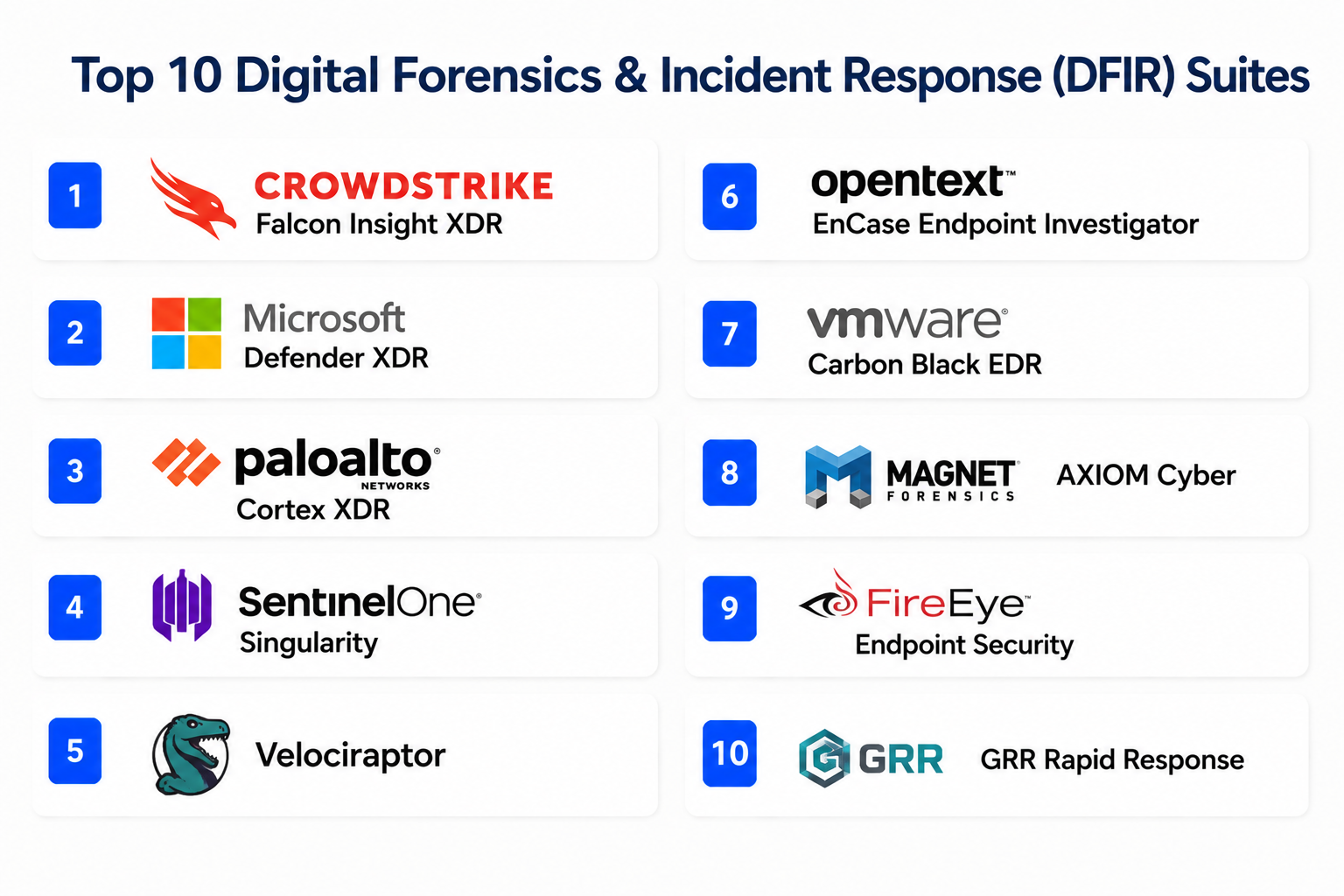
Digital Forensics & Incident Response (DFIR) Suites
#1 — CrowdStrike Falcon Insight XDR
Short description :
CrowdStrike Falcon Insight XDR is a cloud-native DFIR and endpoint detection platform focused on threat hunting, endpoint visibility, incident response, and forensic investigation across enterprise environments. The platform combines behavioral analytics, AI-driven detection, and operational response workflows.
Key Features
- Endpoint detection and response
- Threat hunting workflows
- Incident investigation
- Behavioral analytics
- Cloud-native telemetry
- Automated containment
- Real-time endpoint visibility
Pros
- Strong cloud-native architecture
- Advanced threat hunting capabilities
- Rapid incident response workflows
Cons
- Premium enterprise pricing
- Advanced workflows may require expertise
- Large telemetry environments may require tuning
Platforms / Deployment
- Windows / macOS / Linux / iOS / Android
- Cloud
Security & Compliance
- RBAC
- MFA
- Audit logs
- SSO/SAML
- Encryption support
Integrations & Ecosystem
CrowdStrike integrates deeply into enterprise security ecosystems.
- SIEM platforms
- SOAR systems
- Cloud providers
- Identity platforms
- Threat intelligence feeds
- Security analytics tools
Support & Community
CrowdStrike provides enterprise onboarding, incident response services, training, and strong technical support programs.
#2 — Microsoft Defender XDR
Short description :
Microsoft Defender XDR is a unified security operations and DFIR platform that combines endpoint detection, threat investigation, identity analytics, cloud security visibility, and automated incident response.
Key Features
- Unified XDR workflows
- Endpoint investigation
- Identity threat detection
- Automated response actions
- Threat analytics
- Cloud security visibility
- AI-assisted investigations
Pros
- Strong Microsoft ecosystem integration
- Unified security telemetry
- Advanced identity-based threat analysis
Cons
- Best suited for Microsoft-centric environments
- Licensing complexity
- Advanced workflows may require expertise
Platforms / Deployment
- Windows / macOS / Linux / iOS / Android
- Cloud / Hybrid
Security & Compliance
- RBAC
- MFA
- Audit logs
- SSO/SAML
- Compliance support
Integrations & Ecosystem
Microsoft Defender integrates across Microsoft security ecosystems.
- Microsoft Sentinel
- Azure
- Microsoft 365
- SIEM platforms
- Identity providers
- Endpoint management systems
Support & Community
Microsoft offers enterprise support, technical documentation, certifications, and security training resources.
#3 — Palo Alto Networks Cortex XDR
Short description :
Cortex XDR is an extended detection and response platform focused on endpoint forensics, threat hunting, incident investigation, and operational response across hybrid environments.
Key Features
- Endpoint forensics
- Threat hunting
- Incident analytics
- Behavioral detection
- Automated response workflows
- Malware investigation
- Cloud telemetry analysis
Pros
- Strong behavioral analytics
- Good incident correlation capabilities
- Unified endpoint visibility
Cons
- Enterprise-focused pricing
- Complex policy management for large environments
- Advanced workflows may require tuning
Platforms / Deployment
- Windows / macOS / Linux
- Cloud
Security & Compliance
- RBAC
- MFA
- Audit logs
- Encryption support
- Compliance visibility
Integrations & Ecosystem
Cortex XDR integrates into enterprise security environments.
- SIEM platforms
- Threat intelligence feeds
- Firewall ecosystems
- Cloud providers
- SOAR systems
- Identity security tools
Support & Community
Palo Alto Networks provides enterprise onboarding, documentation, training, and support services.
#4 — SentinelOne Singularity
Short description :
SentinelOne Singularity is an AI-powered endpoint security and DFIR platform designed for automated threat detection, forensic investigation, operational analytics, and incident response automation.
Key Features
- Autonomous threat detection
- Endpoint forensics
- Behavioral analytics
- Automated remediation
- Threat hunting
- Cloud-native management
- Incident investigation
Pros
- Strong autonomous response capabilities
- Good operational visibility
- Scalable cloud-native architecture
Cons
- Advanced customization varies
- Large enterprise tuning may be required
- Premium features may increase costs
Platforms / Deployment
- Windows / macOS / Linux
- Cloud / Hybrid
Security & Compliance
- RBAC
- MFA
- Audit logs
- SSO/SAML
- Encryption support
Integrations & Ecosystem
SentinelOne integrates into modern security ecosystems.
- SIEM platforms
- Cloud providers
- SOAR systems
- Threat intelligence tools
- Identity platforms
- DevSecOps workflows
Support & Community
SentinelOne provides enterprise onboarding, training, documentation, and incident response support.
#5 — Velociraptor
Short description :
Velociraptor is an open-source DFIR and endpoint visibility platform designed for digital investigations, threat hunting, forensic collection, and live response workflows across enterprise environments.
Key Features
- Endpoint visibility
- Live forensic collection
- Threat hunting
- Artifact collection
- Memory analysis
- Open-source workflows
- Incident investigation
Pros
- Strong DFIR flexibility
- Open-source customization
- Good live response capabilities
Cons
- Requires operational expertise
- Smaller commercial ecosystem
- Advanced deployments may require tuning
Platforms / Deployment
- Windows / macOS / Linux
- Self-hosted
Security & Compliance
- RBAC support
- Audit logging
- Encryption support
- Access controls
Integrations & Ecosystem
Velociraptor integrates into DFIR and security operations ecosystems.
- SIEM platforms
- Threat hunting tools
- Security analytics systems
- Endpoint tools
- Open-source forensic workflows
- Cloud environments
Support & Community
Velociraptor benefits from strong DFIR community adoption and open-source documentation resources.
#6 — OpenText EnCase Endpoint Investigator
Short description :
EnCase Endpoint Investigator is a digital forensics platform focused on evidence collection, endpoint investigation, forensic analysis, and legal-grade investigative workflows.
Key Features
- Disk forensics
- Endpoint evidence collection
- Memory analysis
- Legal-grade investigations
- Threat hunting
- Remote endpoint analysis
- Evidence preservation
Pros
- Strong forensic investigation depth
- Widely recognized forensic workflows
- Legal evidence handling capabilities
Cons
- Traditional forensic workflows may feel complex
- Enterprise-focused deployment
- Advanced investigations require training
Platforms / Deployment
- Windows
- Self-hosted / Hybrid
Security & Compliance
- RBAC
- Audit logs
- Encryption support
- Chain-of-custody controls
Integrations & Ecosystem
EnCase integrates into enterprise forensic ecosystems.
- SIEM systems
- Endpoint tools
- Investigation workflows
- Legal compliance systems
- Security operations platforms
- Threat intelligence feeds
Support & Community
OpenText provides enterprise training, documentation, certifications, and support programs.
#7 — VMware Carbon Black EDR
Short description :
VMware Carbon Black EDR is an endpoint detection and incident response platform designed for threat hunting, behavioral analysis, endpoint forensics, and operational investigations.
Key Features
- Endpoint visibility
- Behavioral analytics
- Threat hunting
- Incident investigation
- Live response workflows
- Malware analysis
- Real-time telemetry
Pros
- Strong endpoint telemetry
- Good threat hunting workflows
- Mature enterprise deployment support
Cons
- Operational complexity for large environments
- Interface learning curve
- Advanced analytics may require tuning
Platforms / Deployment
- Windows / macOS / Linux
- Cloud / Hybrid
Security & Compliance
- RBAC
- MFA
- Audit logs
- Encryption support
- Compliance visibility
Integrations & Ecosystem
Carbon Black integrates into enterprise security ecosystems.
- SIEM platforms
- Threat intelligence tools
- VMware environments
- SOAR platforms
- Identity security systems
- Cloud providers
Support & Community
VMware provides enterprise support, documentation, onboarding, and training resources.
#8 — Magnet AXIOM Cyber
Short description :
Magnet AXIOM Cyber is a digital forensic investigation platform focused on endpoint forensics, cloud evidence analysis, artifact collection, and incident response investigations.
Key Features
- Endpoint forensics
- Cloud evidence collection
- Artifact analysis
- Timeline reconstruction
- Memory analysis
- Incident investigation
- Remote acquisition workflows
Pros
- Strong forensic analysis capabilities
- Good evidence visualization
- Effective investigative workflows
Cons
- Specialized DFIR learning curve
- Enterprise-focused pricing
- Operational scaling may require planning
Platforms / Deployment
- Windows
- Self-hosted
Security & Compliance
- RBAC
- Audit logs
- Encryption support
- Evidence handling controls
Integrations & Ecosystem
Magnet AXIOM integrates into DFIR and investigation ecosystems.
- Cloud services
- Endpoint tools
- Threat intelligence feeds
- Investigation platforms
- Security analytics systems
- Evidence management workflows
Support & Community
Magnet provides DFIR training, certifications, technical documentation, and enterprise support.
#9 — FireEye Endpoint Security (Trellix)
Short description :
Trellix Endpoint Security combines endpoint detection, incident investigation, threat intelligence, and DFIR workflows for enterprise security operations teams.
Key Features
- Endpoint detection
- Incident investigation
- Threat intelligence integration
- Behavioral analytics
- Automated response workflows
- Threat hunting
- Operational visibility
Pros
- Strong enterprise security heritage
- Good threat intelligence integration
- Mature investigation workflows
Cons
- Enterprise-focused deployment complexity
- Interface modernization varies
- Advanced tuning may be required
Platforms / Deployment
- Windows / macOS / Linux
- Cloud / Hybrid
Security & Compliance
- RBAC
- MFA
- Audit logs
- Encryption support
- Compliance visibility
Integrations & Ecosystem
Trellix integrates into enterprise security operations ecosystems.
- SIEM platforms
- Threat intelligence feeds
- SOAR systems
- Cloud providers
- Security analytics platforms
- Identity systems
Support & Community
Trellix provides enterprise onboarding, incident response support, documentation, and training.
#10 — GRR Rapid Response
Short description :
GRR Rapid Response is an open-source remote live forensics and incident response framework designed for endpoint investigations, evidence collection, and operational threat hunting.
Key Features
- Remote live forensics
- Endpoint investigations
- Artifact collection
- Threat hunting workflows
- Automated evidence gathering
- Open-source architecture
- Distributed investigations
Pros
- Flexible open-source framework
- Strong remote investigation capabilities
- Good scalability for distributed environments
Cons
- Requires operational expertise
- Smaller commercial ecosystem
- Advanced deployments may require customization
Platforms / Deployment
- Windows / macOS / Linux
- Self-hosted
Security & Compliance
- Access controls
- Audit logging
- Encryption support
- RBAC support varies
Integrations & Ecosystem
GRR integrates into open-source DFIR ecosystems.
- Security analytics systems
- Endpoint platforms
- Threat hunting workflows
- SIEM tools
- Cloud environments
- Open-source investigation frameworks
Support & Community
GRR benefits from open-source community support and DFIR practitioner adoption.
Comparison Table (Top 10)
| Tool Name | Best For | Platform(s) Supported | Deployment | Standout Feature | Public Rating |
|---|---|---|---|---|---|
| CrowdStrike Falcon Insight XDR | Cloud-native DFIR | Multi-platform | Cloud | Threat hunting and endpoint visibility | N/A |
| Microsoft Defender XDR | Microsoft security environments | Multi-platform | Hybrid | Unified XDR telemetry | N/A |
| Cortex XDR | Behavioral analytics | Windows/macOS/Linux | Cloud | Incident correlation | N/A |
| SentinelOne Singularity | Autonomous response workflows | Windows/macOS/Linux | Hybrid | AI-powered remediation | N/A |
| Velociraptor | Open-source DFIR | Multi-platform | Self-hosted | Live forensic collection | N/A |
| OpenText EnCase Endpoint Investigator | Legal-grade investigations | Windows | Hybrid | Evidence preservation | N/A |
| VMware Carbon Black EDR | Enterprise endpoint visibility | Multi-platform | Hybrid | Behavioral telemetry | N/A |
| Magnet AXIOM Cyber | Digital forensic investigations | Windows | Self-hosted | Timeline reconstruction | N/A |
| FireEye Endpoint Security (Trellix) | Enterprise DFIR workflows | Multi-platform | Hybrid | Threat intelligence integration | N/A |
| GRR Rapid Response | Open-source remote investigations | Multi-platform | Self-hosted | Distributed forensics | N/A |
Evaluation & Digital Forensics & Incident Response (DFIR) Suites
| Tool Name | Core (25%) | Ease (15%) | Integrations (15%) | Security (10%) | Performance (10%) | Support (10%) | Value (15%) | Weighted Total (0–10) |
|---|---|---|---|---|---|---|---|---|
| CrowdStrike Falcon Insight XDR | 10 | 8 | 9 | 9 | 9 | 8 | 7 | 8.7 |
| Microsoft Defender XDR | 9 | 8 | 9 | 9 | 9 | 8 | 8 | 8.5 |
| Cortex XDR | 9 | 7 | 8 | 9 | 8 | 8 | 7 | 8.0 |
| SentinelOne Singularity | 9 | 8 | 8 | 9 | 8 | 8 | 7 | 8.1 |
| Velociraptor | 8 | 6 | 7 | 7 | 8 | 7 | 9 | 7.5 |
| OpenText EnCase Endpoint Investigator | 9 | 6 | 7 | 9 | 8 | 8 | 6 | 7.7 |
| VMware Carbon Black EDR | 8 | 7 | 8 | 8 | 8 | 8 | 7 | 7.8 |
| Magnet AXIOM Cyber | 8 | 6 | 7 | 8 | 8 | 8 | 7 | 7.5 |
| FireEye Endpoint Security (Trellix) | 8 | 7 | 8 | 8 | 8 | 8 | 7 | 7.8 |
| GRR Rapid Response | 7 | 5 | 6 | 7 | 7 | 6 | 9 | 6.8 |
These scores are comparative and intended to help organizations evaluate forensic depth, incident response capabilities, operational usability, integration flexibility, and security maturity. Enterprise-focused platforms typically provide broader automation and centralized telemetry visibility, while open-source solutions emphasize flexibility and investigative customization. Buyers should prioritize tools aligned with security operations maturity, infrastructure scale, and investigation requirements.
Which Digital Forensics & Incident Response (DFIR) Suites
Solo / Freelancer
Independent consultants and smaller environments may benefit from open-source platforms like Velociraptor or GRR Rapid Response for flexible investigation workflows.
SMB
SMBs commonly benefit from Microsoft Defender XDR and SentinelOne Singularity because of easier deployment and integrated operational visibility.
Mid-Market
Mid-market organizations should evaluate CrowdStrike Falcon Insight XDR, SentinelOne Singularity, and Cortex XDR for balanced automation, visibility, and operational scalability.
Enterprise
Large enterprises often require advanced threat hunting, forensic analytics, and centralized incident orchestration. CrowdStrike, Microsoft Defender XDR, Cortex XDR, and Service-focused enterprise DFIR platforms are strong choices.
Budget vs Premium
Open-source frameworks provide strong investigative flexibility at lower cost, while enterprise DFIR suites justify premium pricing through automation, telemetry visibility, and operational scalability.
Feature Depth vs Ease of Use
EnCase and Magnet AXIOM provide deeper forensic investigation capabilities, while CrowdStrike and Microsoft Defender emphasize operational simplicity and unified visibility.
Integrations & Scalability
Organizations operating hybrid and multi-cloud environments should prioritize SIEM integrations, cloud telemetry support, API ecosystems, and endpoint scalability.
Security & Compliance Needs
Regulated industries should prioritize audit logging, chain-of-custody controls, encryption support, RBAC, MFA, and centralized evidence management.
Frequently Asked Questions (FAQs)
1. What are DFIR suites?
DFIR suites are platforms designed for digital forensics, incident response, threat hunting, evidence collection, and cyberattack investigation workflows.
2. Why are DFIR platforms important in 2026?
Modern cyberattacks are increasingly sophisticated, cloud-native, and identity-driven, requiring automated investigation and rapid operational response capabilities.
3. What is the difference between EDR and DFIR?
EDR focuses on endpoint detection and response, while DFIR suites include broader forensic investigation, evidence analysis, and incident response workflows.
4. Can DFIR tools investigate ransomware attacks?
Yes. DFIR platforms are widely used for ransomware containment, endpoint investigation, malware analysis, and operational recovery workflows.
5. What are live response capabilities?
Live response allows investigators to collect evidence, analyze systems, and execute investigation workflows on active endpoints without requiring physical access.
6. Are open-source DFIR tools still relevant?
Yes. Open-source platforms like Velociraptor and GRR remain widely used for flexible threat hunting and forensic investigations.
7. What integrations are most important?
Important integrations include SIEM systems, SOAR platforms, cloud providers, identity platforms, endpoint management tools, and threat intelligence feeds.
8. What security features should buyers prioritize?
Organizations should prioritize RBAC, MFA, audit logs, encryption support, chain-of-custody controls, and evidence integrity protections.
9. Is implementation difficult?
Implementation complexity depends on telemetry volume, endpoint scale, investigation workflows, and operational maturity.
10. What is threat hunting?
Threat hunting is the proactive investigation of systems and telemetry data to identify hidden threats, suspicious activity, or advanced attacker behavior.
Conclusion
Digital Forensics & Incident Response (DFIR) Suites have become essential cybersecurity platforms for organizations defending increasingly complex hybrid infrastructure, cloud-native applications, distributed workforces, and sophisticated threat environments. Traditional antivirus and basic endpoint protection are no longer sufficient in a world of ransomware campaigns, identity-based attacks, insider threats, and advanced persistent threats that can move rapidly across interconnected environments. Modern DFIR platforms combine endpoint telemetry, threat hunting, forensic analytics, operational automation, and AI-assisted investigation workflows to improve incident response speed and investigative accuracy.
