Introduction
Container Image Scanners are security tools designed to analyze container images for vulnerabilities, malware, misconfigurations, secrets exposure, and compliance risks before deployment into production environments. These tools help organizations secure Docker images, Kubernetes workloads, and cloud-native applications throughout the software delivery lifecycle.
In container security has become a critical priority because modern applications increasingly rely on containers, Kubernetes orchestration, and microservices architectures. Attackers now frequently target vulnerable base images, outdated packages, exposed secrets, and insecure configurations embedded inside containerized environments. Regulatory requirements and software supply chain security standards have also pushed organizations to implement continuous image scanning across development and runtime environments.
Common real-world use cases include:
- Scanning Docker images during CI/CD builds
- Detecting vulnerable operating system packages and libraries
- Securing Kubernetes workloads before deployment
- Preventing malicious or unauthorized container images
- Monitoring runtime container security risks
When evaluating Container Image Scanners, buyers should consider:
- Vulnerability detection accuracy
- Kubernetes and cloud-native support
- Runtime versus static image analysis
- CI/CD and registry integrations
- Policy enforcement capabilities
- SBOM generation support
- False positive reduction
- Compliance and governance tooling
- Scalability across clusters and repositories
- Ease of developer adoption
Best for: DevSecOps teams, platform engineers, cloud-native organizations, Kubernetes operators, SaaS providers, enterprises adopting microservices, and security teams managing containerized infrastructure.
Not ideal for: Organizations not using containers or Kubernetes extensively, teams running mostly monolithic legacy applications, or environments with minimal cloud-native workloads.
Key Trends in Container Image Scanners
- AI-assisted vulnerability prioritization is helping reduce remediation fatigue.
- Runtime-aware scanning is becoming more common to identify actively exploitable vulnerabilities.
- SBOM generation and software supply chain visibility are now standard enterprise requirements.
- Kubernetes-native security integrations are increasingly important for large-scale deployments.
- Shift-left security workflows continue to expand into developer IDEs and build pipelines.
- Multi-cloud and hybrid-cloud support are becoming baseline expectations.
- Secret detection and IaC scanning are often bundled with image scanning platforms.
- Policy-as-code capabilities are gaining popularity in regulated industries.
- Lightweight open-source scanners remain highly popular for cloud-native environments.
- Compliance automation for CIS benchmarks and container hardening standards is growing rapidly.
How We Selected These Tools (Methodology)
The tools in this list were selected based on technical capabilities, enterprise adoption, and relevance for modern containerized infrastructure.
Selection criteria included:
- Market recognition and industry adoption
- Kubernetes and container ecosystem compatibility
- Breadth of vulnerability database coverage
- Runtime and static scanning capabilities
- CI/CD and registry integrations
- Enterprise governance and compliance support
- Scalability across large container environments
- Developer workflow integrations
- Open-source and commercial balance
- Community reputation and ecosystem maturity
Container Image Scanners
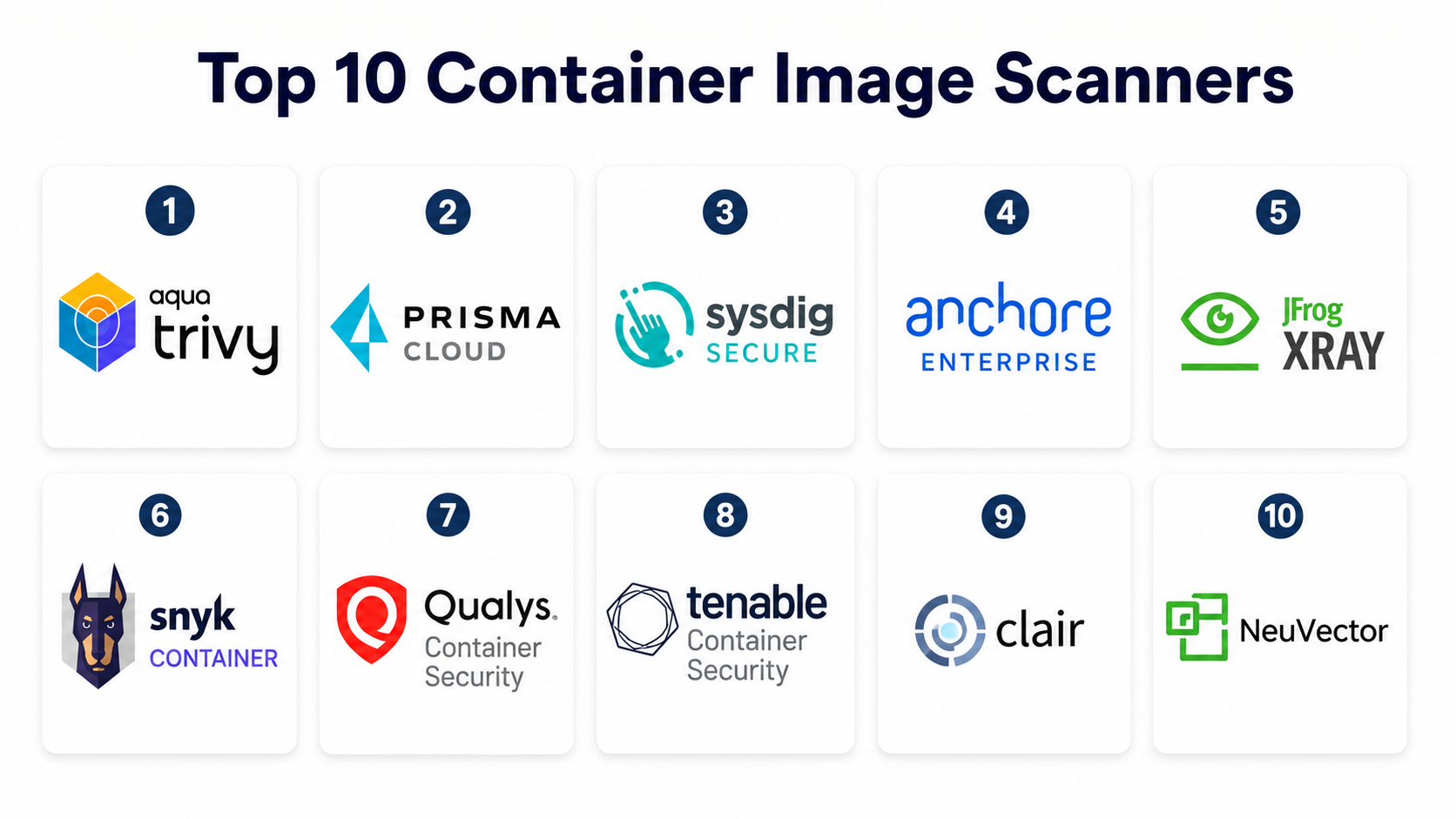
#1 — Aqua Trivy
Short description :
Trivy is one of the most widely adopted open-source container image scanners in the cloud-native ecosystem. Developed by Aqua Security, it scans container images, filesystems, repositories, Kubernetes environments, and Infrastructure-as-Code configurations for vulnerabilities and misconfigurations. Trivy is especially popular among DevOps and Kubernetes teams due to its lightweight architecture and fast scanning performance. It integrates easily into CI/CD pipelines and developer workflows.
Key Features
- Container image vulnerability scanning
- Kubernetes security analysis
- SBOM generation
- Secret detection
- IaC misconfiguration scanning
- Multi-language package support
- Lightweight CLI workflows
Pros
- Free and open-source
- Fast scanning performance
- Excellent Kubernetes support
Cons
- Limited enterprise governance without Aqua platform
- CLI-first interface may challenge non-technical teams
- Advanced reporting features are limited
Platforms / Deployment
- Windows / macOS / Linux
- Self-hosted / Cloud integrations
Security & Compliance
- Encryption support varies by deployment
- Compliance support through Aqua integrations
- RBAC varies by environment
Integrations & Ecosystem
Trivy integrates well into cloud-native and DevSecOps pipelines.
- GitHub Actions
- GitLab CI
- Jenkins
- Docker
- Kubernetes
- Terraform
Support & Community
Trivy has a large open-source community with strong GitHub activity and cloud-native adoption. Commercial support is available through Aqua Security.
#2 — Prisma Cloud
Short description :
Prisma Cloud by Palo Alto Networks is a comprehensive cloud-native application protection platform that includes advanced container image scanning capabilities. It helps organizations identify vulnerabilities, compliance issues, and runtime threats across containerized environments. Prisma Cloud is widely used by enterprises operating large Kubernetes and multi-cloud infrastructures. The platform combines posture management, workload protection, and runtime security into a unified solution.
Key Features
- Container image vulnerability scanning
- Runtime container defense
- Kubernetes posture management
- Compliance automation
- CI/CD security integration
- Threat detection and analytics
- Multi-cloud security visibility
Pros
- Strong enterprise-grade cloud security
- Excellent runtime protection capabilities
- Broad Kubernetes and cloud support
Cons
- Enterprise pricing can be expensive
- Feature-rich platform may require training
- Smaller teams may find deployment complex
Platforms / Deployment
- Web / Linux
- Cloud / Hybrid
Security & Compliance
- SSO/SAML
- MFA
- RBAC
- Audit logs
- Compliance automation support
- Encryption in transit and at rest
Integrations & Ecosystem
Prisma Cloud integrates into enterprise cloud and DevSecOps ecosystems.
- AWS
- Azure
- Google Cloud
- Kubernetes
- Jenkins
- GitHub
Support & Community
Palo Alto Networks provides enterprise onboarding, premium support tiers, and strong documentation resources.
#3 — Sysdig Secure
Short description :
Sysdig Secure is a cloud-native security platform focused heavily on container and Kubernetes security. It offers image scanning, runtime threat detection, compliance monitoring, and Kubernetes security analytics. Sysdig is particularly strong for organizations requiring runtime visibility alongside pre-deployment scanning. The platform is widely used by cloud-native and Kubernetes-centric operations teams.
Key Features
- Container vulnerability scanning
- Runtime threat detection
- Kubernetes security monitoring
- Compliance reporting
- Falco-powered runtime analysis
- CI/CD integration
- Risk prioritization
Pros
- Excellent runtime security capabilities
- Strong Kubernetes observability
- Good cloud-native integrations
Cons
- Advanced features may require expertise
- Enterprise-focused pricing
- Smaller teams may underutilize full platform
Platforms / Deployment
- Web / Linux
- Cloud / Hybrid
Security & Compliance
- SSO/SAML
- MFA
- RBAC
- Audit logs
- Compliance monitoring features
Integrations & Ecosystem
Sysdig integrates deeply with Kubernetes and cloud infrastructure.
- Kubernetes
- AWS
- Azure
- Google Cloud
- GitHub
- Jenkins
Support & Community
Sysdig provides enterprise support, technical onboarding, and active cloud-native community participation.
#4 — Anchore Enterprise
Short description :
Anchore Enterprise is a container security platform focused on image scanning, policy enforcement, and software supply chain security. It supports SBOM generation, compliance validation, and vulnerability analysis for containerized applications. Anchore is commonly used by organizations seeking flexible deployment options and strong governance controls for container environments.
Key Features
- Container image vulnerability analysis
- SBOM generation
- Policy enforcement engine
- Compliance validation
- Kubernetes integrations
- CI/CD pipeline support
- Software supply chain visibility
Pros
- Strong SBOM capabilities
- Flexible deployment options
- Good policy customization
Cons
- Enterprise setup can require expertise
- UI may feel technical for non-security users
- Smaller ecosystem than larger vendors
Platforms / Deployment
- Linux
- Cloud / Self-hosted / Hybrid
Security & Compliance
- RBAC
- Audit logging
- Encryption support
- Compliance-oriented controls
Integrations & Ecosystem
Anchore integrates into container and software supply chain workflows.
- Kubernetes
- Docker
- Jenkins
- GitHub Actions
- GitLab
- CI/CD systems
Support & Community
Anchore offers enterprise support and maintains a respected presence within the open-source security ecosystem.
#5 — JFrog Xray
Short description :
JFrog Xray provides container image scanning and software supply chain security capabilities tightly integrated with the JFrog ecosystem. It scans container images, binaries, and dependencies for vulnerabilities and compliance issues. Organizations already using Artifactory often adopt Xray for centralized security visibility and governance.
Key Features
- Container image vulnerability scanning
- Binary and dependency analysis
- Recursive layer analysis
- Policy enforcement
- Compliance management
- CI/CD security workflows
- Impact analysis
Pros
- Excellent integration with JFrog ecosystem
- Strong artifact visibility
- Scalable for enterprise DevOps
Cons
- Best value requires JFrog adoption
- Interface complexity for smaller teams
- Advanced features may require tuning
Platforms / Deployment
- Web / Linux
- Cloud / Self-hosted / Hybrid
Security & Compliance
- SSO/SAML
- MFA
- RBAC
- Audit logs
- Encryption support
Integrations & Ecosystem
JFrog Xray integrates into DevOps and artifact management workflows.
- Artifactory
- Jenkins
- GitHub
- Docker
- Kubernetes
- Azure DevOps
Support & Community
JFrog provides enterprise support tiers, onboarding assistance, and extensive technical documentation.
#6 — Snyk Container
Short description :
Snyk Container is the container security component of the broader Snyk platform. It helps developers and security teams identify vulnerabilities in container images, Dockerfiles, and Kubernetes workloads. Snyk Container emphasizes developer-first workflows and actionable remediation guidance. The platform is especially popular among agile engineering teams adopting DevSecOps practices.
Key Features
- Container image vulnerability scanning
- Dockerfile analysis
- Kubernetes security checks
- Automated remediation suggestions
- CI/CD integrations
- Policy management
- Developer-focused workflows
Pros
- Excellent developer usability
- Strong remediation guidance
- Easy CI/CD integration
Cons
- Enterprise pricing may scale quickly
- Advanced governance requires higher tiers
- Some runtime features are limited
Platforms / Deployment
- Web / Windows / macOS / Linux
- Cloud / Hybrid
Security & Compliance
- SSO/SAML
- MFA
- RBAC
- SOC 2
- Encryption support
Integrations & Ecosystem
Snyk Container integrates deeply into developer and DevOps pipelines.
- GitHub
- GitLab
- Bitbucket
- Kubernetes
- Docker
- Jenkins
Support & Community
Snyk offers strong onboarding documentation, active developer communities, and enterprise support options.
#7 — Qualys Container Security
Short description :
Qualys Container Security provides vulnerability management and runtime monitoring for containerized environments. It enables organizations to scan container images across registries and CI/CD pipelines while monitoring runtime activity. The platform is often adopted by enterprises already using broader Qualys security solutions.
Key Features
- Container image vulnerability scanning
- Runtime monitoring
- Registry integrations
- Kubernetes security visibility
- Compliance reporting
- CI/CD pipeline integration
- Risk prioritization
Pros
- Strong enterprise security ecosystem
- Good compliance visibility
- Centralized security management
Cons
- UI complexity for smaller teams
- Enterprise-oriented deployment model
- Learning curve for advanced policies
Platforms / Deployment
- Web / Linux
- Cloud / Hybrid
Security & Compliance
- SSO/SAML
- MFA
- RBAC
- Audit logs
- Compliance monitoring
Integrations & Ecosystem
Qualys integrates into enterprise infrastructure and cloud ecosystems.
- AWS
- Azure
- Kubernetes
- Docker
- Jenkins
- CI/CD platforms
Support & Community
Qualys provides enterprise support, onboarding assistance, and detailed documentation resources.
#8 — Tenable Container Security
Short description :
Tenable Container Security helps organizations secure containerized applications through vulnerability scanning, configuration analysis, and runtime visibility. It is designed for enterprises operating hybrid and cloud-native infrastructures. The platform integrates with broader Tenable exposure management capabilities.
Key Features
- Container vulnerability scanning
- Kubernetes security analysis
- Runtime monitoring
- Compliance validation
- Risk-based prioritization
- CI/CD integration
- Cloud-native visibility
Pros
- Strong exposure management capabilities
- Good enterprise scalability
- Broad cloud integration support
Cons
- Enterprise pricing structure
- Smaller developer ecosystem
- Advanced configurations may require expertise
Platforms / Deployment
- Web / Linux
- Cloud / Hybrid
Security & Compliance
- SSO/SAML
- RBAC
- Audit logs
- Compliance-oriented tooling
- Encryption support
Integrations & Ecosystem
Tenable integrates with enterprise cloud and vulnerability management ecosystems.
- AWS
- Azure
- Kubernetes
- Jenkins
- GitHub
- CI/CD systems
Support & Community
Tenable provides enterprise onboarding, training resources, and technical support programs.
#9 — Clair
Short description :
Clair is an open-source container vulnerability scanner originally developed for analyzing container image layers and associated vulnerabilities. It is commonly integrated into container registries and cloud-native workflows. Clair is often used by organizations seeking customizable and lightweight scanning capabilities within Kubernetes ecosystems.
Key Features
- Container layer analysis
- Vulnerability database matching
- Registry integrations
- API-based scanning workflows
- Lightweight deployment
- Open-source extensibility
- Automated image analysis
Pros
- Open-source flexibility
- Lightweight architecture
- Good registry integration support
Cons
- Limited enterprise governance features
- Requires technical expertise
- UI and reporting capabilities are basic
Platforms / Deployment
- Linux
- Self-hosted
Security & Compliance
- Varies / N/A
- Security controls depend on deployment environment
Integrations & Ecosystem
Clair integrates into container registry and Kubernetes workflows.
- Kubernetes
- Docker
- Quay
- CI/CD pipelines
- Container registries
Support & Community
Clair benefits from open-source community support and cloud-native ecosystem adoption.
#10 — NeuVector
Short description :
NeuVector is a container and Kubernetes security platform that combines image scanning, runtime protection, network security, and compliance monitoring. It focuses strongly on Kubernetes-native security controls and zero-trust container networking. NeuVector is commonly adopted by organizations seeking runtime enforcement alongside image scanning capabilities.
Key Features
- Container image scanning
- Runtime threat protection
- Kubernetes-native firewalling
- Network segmentation
- Compliance monitoring
- Admission control policies
- Zero-trust container security
Pros
- Strong runtime protection
- Excellent Kubernetes networking controls
- Good compliance visibility
Cons
- Advanced networking concepts may require expertise
- Enterprise deployments can be complex
- Smaller ecosystem than larger vendors
Platforms / Deployment
- Linux
- Cloud / Self-hosted / Hybrid
Security & Compliance
- RBAC
- Audit logs
- Compliance controls
- Encryption support
Integrations & Ecosystem
NeuVector integrates closely with Kubernetes and container orchestration platforms.
- Kubernetes
- Rancher
- Docker
- CI/CD pipelines
- Cloud-native platforms
Support & Community
NeuVector provides enterprise support and has growing adoption within Kubernetes-focused organizations.
Comparison Table (Top 10)
| Tool Name | Best For | Platform(s) Supported | Deployment | Standout Feature | Public Rating |
|---|---|---|---|---|---|
| Aqua Trivy | Open-source cloud-native security | Windows, macOS, Linux | Self-hosted | Lightweight scanning | N/A |
| Prisma Cloud | Enterprise cloud-native security | Web, Linux | Cloud / Hybrid | Runtime protection | N/A |
| Sysdig Secure | Kubernetes runtime security | Web, Linux | Cloud / Hybrid | Falco-based runtime analytics | N/A |
| Anchore Enterprise | SBOM and policy management | Linux | Hybrid | Supply chain security visibility | N/A |
| JFrog Xray | Artifact-centric DevOps | Web, Linux | Hybrid | Recursive dependency analysis | N/A |
| Snyk Container | Developer-first container security | Web, Windows, macOS, Linux | Cloud / Hybrid | Developer remediation workflows | N/A |
| Qualys Container Security | Enterprise vulnerability management | Web, Linux | Cloud / Hybrid | Centralized visibility | N/A |
| Tenable Container Security | Exposure management | Web, Linux | Cloud / Hybrid | Risk prioritization | N/A |
| Clair | Lightweight open-source scanning | Linux | Self-hosted | Registry integration flexibility | N/A |
| NeuVector | Kubernetes runtime enforcement | Linux | Hybrid | Zero-trust container networking | N/A |
Evaluation & Container Image Scanners
| Tool Name | Core (25%) | Ease (15%) | Integrations (15%) | Security (10%) | Performance (10%) | Support (10%) | Value (15%) | Weighted Total (0–10) |
|---|---|---|---|---|---|---|---|---|
| Aqua Trivy | 9 | 8 | 8 | 7 | 9 | 7 | 10 | 8.5 |
| Prisma Cloud | 9 | 7 | 9 | 10 | 9 | 8 | 6 | 8.3 |
| Sysdig Secure | 8 | 7 | 8 | 9 | 8 | 8 | 7 | 7.9 |
| Anchore Enterprise | 8 | 7 | 8 | 8 | 8 | 7 | 8 | 7.9 |
| JFrog Xray | 8 | 7 | 9 | 8 | 8 | 8 | 7 | 7.9 |
| Snyk Container | 9 | 9 | 9 | 8 | 8 | 8 | 7 | 8.5 |
| Qualys Container Security | 8 | 6 | 8 | 9 | 8 | 8 | 6 | 7.6 |
| Tenable Container Security | 8 | 6 | 8 | 8 | 8 | 8 | 6 | 7.5 |
| Clair | 7 | 6 | 7 | 6 | 8 | 6 | 10 | 7.1 |
| NeuVector | 8 | 6 | 8 | 9 | 8 | 7 | 7 | 7.7 |
These scores are comparative and intended to help buyers evaluate relative strengths across categories. Open-source tools tend to score highly on value but may lack advanced enterprise governance. Enterprise platforms often provide stronger compliance and runtime capabilities while increasing operational complexity and pricing requirements. Organizations should prioritize the categories most aligned with their security maturity and deployment scale.
Which Container Image Scanners
Solo / Freelancer
Aqua Trivy and Clair are excellent for solo developers and independent DevOps engineers because they are lightweight, open-source, and easy to integrate into personal CI/CD workflows.
SMB
SMBs often benefit from Snyk Container because of its developer-friendly experience and automated remediation guidance. Anchore Enterprise is another strong option for organizations needing stronger governance without excessive complexity.
Mid-Market
Mid-market companies should consider Sysdig Secure or JFrog Xray for broader Kubernetes visibility, scalable integrations, and stronger policy enforcement.
Enterprise
Large enterprises typically require runtime protection, compliance automation, and multi-cloud visibility. Prisma Cloud, Qualys Container Security, and Tenable Container Security are strong enterprise-focused choices.
Budget vs Premium
Budget-conscious teams may prefer Trivy or Clair due to their open-source flexibility. Premium platforms such as Prisma Cloud and Sysdig Secure deliver broader runtime visibility and governance capabilities.
Feature Depth vs Ease of Use
Snyk Container focuses heavily on developer usability, while Prisma Cloud and NeuVector provide deeper runtime and governance functionality at the cost of operational complexity.
Integrations & Scalability
Organizations operating large Kubernetes environments should prioritize tools with strong registry, CI/CD, and orchestration integrations such as Prisma Cloud, Sysdig Secure, and JFrog Xray.
Security & Compliance Needs
Highly regulated industries often require runtime monitoring, audit logging, compliance validation, and policy enforcement. Prisma Cloud, Qualys, and NeuVector are particularly strong in these environments.
Frequently Asked Questions (FAQs)
1. What is a Container Image Scanner?
A Container Image Scanner analyzes container images for vulnerabilities, insecure configurations, malware, and exposed secrets before deployment into production environments.
2. Why are container vulnerabilities dangerous?
Vulnerable container images can expose cloud infrastructure, Kubernetes clusters, and sensitive applications to attackers. Compromised base images may affect thousands of workloads simultaneously.
3. Do image scanners only scan Docker images?
No. Most modern tools support Docker, OCI images, Kubernetes workloads, container registries, and often Infrastructure-as-Code templates as well.
4. What is runtime container security?
Runtime security monitors containers during execution to detect suspicious activity, privilege escalation, malware behavior, or unauthorized network activity.
5. Are open-source image scanners reliable?
Yes. Tools like Trivy and Clair are widely trusted in cloud-native environments. However, enterprises may still require commercial governance and compliance features.
6. What is SBOM support?
SBOM support provides a detailed inventory of components and dependencies inside container images, helping organizations improve supply chain transparency and compliance.
7. How are these platforms typically deployed?
Most scanners support cloud deployment, self-hosted environments, or hybrid models depending on organizational security and compliance requirements.
8. Can these tools integrate into CI/CD pipelines?
Yes. Most modern scanners integrate directly into Jenkins, GitHub Actions, GitLab CI, Azure DevOps, and Kubernetes deployment pipelines.
9. What are common mistakes when implementing container security?
Common mistakes include scanning only at deployment time, ignoring runtime security, failing to secure base images, and neglecting Kubernetes configuration risks.
10. Which industries benefit most from container image scanning?
Technology companies, SaaS providers, financial services, healthcare organizations, e-commerce businesses, and cloud-native enterprises benefit heavily from container security platforms.
Conclusion
Container Image Scanners are now essential components of modern cloud-native security strategies. As organizations increasingly adopt Kubernetes, containers, and microservices architectures, securing container images throughout the software lifecycle has become critical for reducing supply chain risk and maintaining compliance. Modern platforms now combine vulnerability detection, runtime monitoring, SBOM generation, compliance automation, and Kubernetes-native security into integrated DevSecOps workflows.
