Introduction
SaaS Management Platforms (SMPs) help organizations discover, manage, optimize, secure, and govern Software-as-a-Service (SaaS) applications across modern cloud-first environments. These platforms provide centralized visibility into SaaS usage, spending, licenses, identities, integrations, shadow IT, employee onboarding/offboarding workflows, and security risks. As organizations continue adopting hundreds of SaaS tools across departments, SaaS management has become essential for operational efficiency, compliance, and cost optimization.
In SaaS sprawl has become one of the biggest operational and security challenges for IT and finance teams. Organizations often use hundreds or even thousands of SaaS applications, many of which are unmanaged or underutilized. SaaS Management Platforms help reduce software waste, improve license efficiency, automate lifecycle management, strengthen identity governance, and improve visibility into shadow IT and SaaS-related security risks.
Common real-world use cases include:
- SaaS license optimization and cost reduction
- Shadow IT discovery and application visibility
- Employee onboarding and offboarding automation
- SaaS security and compliance monitoring
- Centralized SaaS vendor and contract management
When evaluating SaaS Management Platforms, buyers should consider:
- SaaS discovery capabilities
- License utilization analytics
- Workflow automation depth
- Identity and access management integrations
- Shadow IT visibility
- Vendor and contract tracking
- Security posture and compliance visibility
- API and integration ecosystem
- Reporting and analytics quality
- Scalability for multi-department environments
Best for: IT operations teams, CIOs, procurement teams, finance departments, security teams, managed service providers, remote-first companies, and enterprises managing large SaaS portfolios.
Not ideal for: Small businesses with very limited SaaS usage, organizations operating primarily on legacy on-premises software, or teams without centralized IT management processes.
Key Trends in SaaS Management Platforms
- AI-driven SaaS spend optimization is becoming more common.
- Shadow IT discovery is increasingly integrated with security workflows.
- Identity governance and SaaS management are converging.
- Employee lifecycle automation is expanding across HR and IT operations.
- Vendor risk and compliance tracking are becoming major priorities.
- SaaS security posture visibility is increasingly integrated into SMPs.
- API-first integration ecosystems are rapidly expanding.
- Usage analytics are becoming more predictive and AI-assisted.
- Finance and procurement teams are playing larger roles in SaaS governance.
- Unified IT asset management and SaaS management platforms are emerging.
How We Selected These Tools (Methodology)
The tools in this list were selected using a balanced evaluation framework focused on operational maturity, SaaS visibility depth, automation capabilities, enterprise adoption, and integration ecosystems.
Selection criteria included:
- Market adoption and enterprise usage
- SaaS discovery and visibility capabilities
- License optimization functionality
- Workflow automation depth
- Identity and access integration support
- Reporting and analytics maturity
- Security and compliance visibility
- API ecosystem and extensibility
- Customer support and onboarding quality
- Scalability for SMB and enterprise environments
SaaS Management Platforms
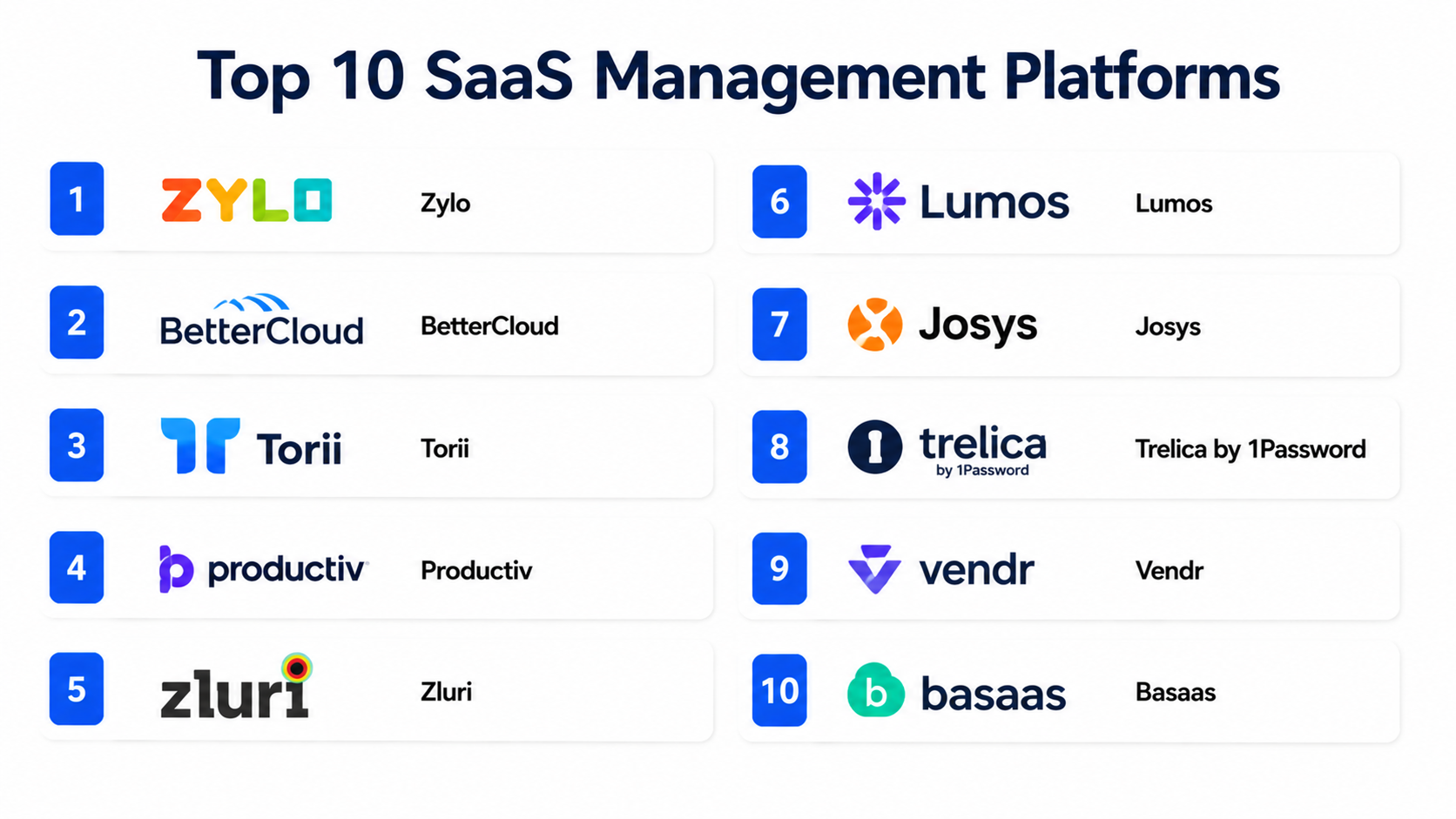
#1 — Zylo
Short description :
Zylo is one of the most recognized SaaS Management Platforms focused on SaaS discovery, spend management, license optimization, and vendor governance. The platform provides organizations with centralized visibility into SaaS usage across departments and cloud environments. Zylo is commonly used by enterprises aiming to reduce software waste and improve operational governance.
Key Features
- SaaS discovery and inventory management
- License utilization analytics
- SaaS spend optimization
- Vendor and renewal tracking
- Workflow automation
- Shadow IT visibility
- Reporting and benchmarking analytics
Pros
- Strong SaaS spend visibility
- Mature enterprise governance capabilities
- Broad SaaS discovery coverage
Cons
- Enterprise-focused pricing
- Advanced configurations may require onboarding support
- SMB feature requirements may vary
Platforms / Deployment
- Web
- Cloud
Security & Compliance
- SSO/SAML
- RBAC
- Audit logs
- MFA
- Compliance support
Integrations & Ecosystem
Zylo integrates into IT operations, finance, procurement, and identity ecosystems.
- Okta
- Microsoft Entra ID
- Slack
- ERP systems
- HR systems
- Financial platforms
Support & Community
Zylo provides enterprise onboarding, customer success programs, analytics guidance, and technical support.
#2 — BetterCloud
Short description :
BetterCloud is a SaaS operations and management platform focused on SaaS automation, employee lifecycle management, and SaaS governance. The platform helps organizations automate onboarding, offboarding, permissions management, and SaaS administration across cloud environments.
Key Features
- SaaS operations automation
- User lifecycle management
- Access and permissions governance
- Workflow automation engine
- Shadow IT discovery
- SaaS configuration monitoring
- Compliance visibility
Pros
- Strong workflow automation
- Excellent onboarding and offboarding support
- Broad SaaS administration coverage
Cons
- Advanced reporting varies by deployment
- Enterprise workflows may require customization
- Pricing can scale with integrations
Platforms / Deployment
- Web
- Cloud
Security & Compliance
- SSO/SAML
- MFA
- RBAC
- Audit logs
- Compliance-oriented controls
Integrations & Ecosystem
BetterCloud integrates deeply into SaaS administration ecosystems.
- Google Workspace
- Microsoft 365
- Slack
- Okta
- Zoom
- Dropbox
Support & Community
BetterCloud provides onboarding assistance, workflow templates, and strong SaaS operations documentation.
#3 — Torii
Short description :
Torii is a modern SaaS Management Platform designed to help organizations discover shadow IT, optimize software usage, automate workflows, and improve SaaS governance. The platform is popular among mid-market organizations and remote-first businesses.
Key Features
- Shadow IT discovery
- SaaS usage analytics
- Workflow automation
- License management
- Employee lifecycle automation
- SaaS spend visibility
- Application ownership tracking
Pros
- User-friendly interface
- Strong automation workflows
- Good shadow IT visibility
Cons
- Advanced enterprise governance may vary
- Large-scale customization can require support
- Some analytics depth varies by plan
Platforms / Deployment
- Web
- Cloud
Security & Compliance
- MFA
- SSO/SAML
- RBAC
- Audit logging
- Compliance support
Integrations & Ecosystem
Torii integrates into HR, IT, and collaboration ecosystems.
- Slack
- Okta
- Google Workspace
- Microsoft 365
- HR systems
- Financial platforms
Support & Community
Torii offers customer onboarding, workflow guidance, and responsive technical support.
#4 — Productiv
Short description :
Productiv is a SaaS intelligence and management platform focused on SaaS optimization, employee productivity analytics, application governance, and operational insights. The platform emphasizes data-driven SaaS decision-making for IT and finance teams.
Key Features
- SaaS utilization analytics
- Productivity intelligence
- License optimization
- Vendor management
- SaaS spend reporting
- Employee engagement insights
- Shadow IT monitoring
Pros
- Strong analytics capabilities
- Good finance and procurement visibility
- Useful operational insights
Cons
- Analytics-focused workflows may exceed SMB needs
- Advanced reporting may require configuration
- Premium features vary by plan
Platforms / Deployment
- Web
- Cloud
Security & Compliance
- SSO/SAML
- MFA
- RBAC
- Audit support
- Compliance visibility
Integrations & Ecosystem
Productiv integrates into productivity and operational ecosystems.
- Slack
- Microsoft 365
- Salesforce
- Okta
- HR platforms
- Financial systems
Support & Community
Productiv provides onboarding services, analytics consulting, and customer support resources.
#5 — Zluri
Short description :
Zluri is a SaaS management and identity governance platform focused on SaaS discovery, automation, access management, and spend optimization. The platform combines SaaS management with identity-centric governance capabilities for modern organizations.
Key Features
- SaaS discovery
- Access management
- License optimization
- Employee onboarding automation
- Shadow IT visibility
- Vendor management
- Identity governance workflows
Pros
- Strong identity-centric management
- Good automation workflows
- Modern user interface
Cons
- Enterprise customization may vary
- Advanced governance depth differs by deployment
- Some integrations require configuration
Platforms / Deployment
- Web
- Cloud
Security & Compliance
- MFA
- RBAC
- SSO/SAML
- Audit logs
- Compliance support
Integrations & Ecosystem
Zluri integrates into identity and SaaS ecosystems.
- Okta
- Microsoft Entra ID
- Slack
- Google Workspace
- HR systems
- Finance platforms
Support & Community
Zluri provides onboarding guidance, SaaS governance support, and customer success resources.
#6 — Lumos
Short description :
Lumos is an identity-first SaaS management platform designed to automate application access, employee provisioning, and SaaS governance. The platform focuses heavily on identity automation and access lifecycle management.
Key Features
- Identity-driven SaaS management
- Automated provisioning
- Access governance
- Employee lifecycle workflows
- SaaS visibility
- Role-based access controls
- Shadow IT detection
Pros
- Strong identity automation
- Good onboarding workflows
- Modern access governance approach
Cons
- Smaller ecosystem than legacy vendors
- Enterprise customization varies
- Reporting depth may differ by plan
Platforms / Deployment
- Web
- Cloud
Security & Compliance
- SSO/SAML
- MFA
- RBAC
- Audit logs
- Compliance controls
Integrations & Ecosystem
Lumos integrates into identity and workforce ecosystems.
- Okta
- Google Workspace
- Microsoft 365
- Slack
- HR systems
- Ticketing platforms
Support & Community
Lumos offers onboarding assistance, identity governance guidance, and technical support resources.
#7 — Josys
Short description :
Josys is a SaaS and device management platform focused on centralized IT operations, application lifecycle management, and employee provisioning workflows. The platform helps organizations manage SaaS applications alongside endpoint assets.
Key Features
- SaaS inventory management
- Device management visibility
- User provisioning workflows
- SaaS usage analytics
- Access management
- License tracking
- Asset management integration
Pros
- Unified SaaS and device visibility
- Good IT operations workflows
- Simplified administration
Cons
- Advanced analytics depth varies
- Enterprise governance features may be lighter
- Ecosystem breadth smaller than large competitors
Platforms / Deployment
- Web
- Cloud
Security & Compliance
- MFA
- RBAC
- Audit logs
- SSO/SAML
- Compliance visibility
Integrations & Ecosystem
Josys integrates into IT operations and productivity ecosystems.
- Microsoft 365
- Google Workspace
- Slack
- HR systems
- Device management tools
- Identity providers
Support & Community
Josys provides onboarding support, workflow guidance, and IT operations documentation.
#8 — Trelica by 1Password
Short description :
Trelica by 1Password is a SaaS management platform focused on SaaS discovery, spend optimization, access governance, and shadow IT visibility. The platform combines SaaS governance with identity and access management capabilities.
Key Features
- SaaS discovery
- Spend optimization
- License management
- Shadow IT visibility
- Access governance
- Employee lifecycle workflows
- Vendor management
Pros
- Good visibility into SaaS usage
- Identity-focused governance capabilities
- Strong operational simplicity
Cons
- Enterprise customization depth varies
- Large-scale governance workflows may require tuning
- Advanced analytics may differ by tier
Platforms / Deployment
- Web
- Cloud
Security & Compliance
- MFA
- RBAC
- Audit logs
- SSO/SAML
- Compliance support
Integrations & Ecosystem
Trelica integrates into SaaS and identity ecosystems.
- Okta
- Google Workspace
- Microsoft 365
- Slack
- HR platforms
- Financial systems
Support & Community
Trelica provides onboarding resources, operational guidance, and technical documentation.
#9 — Vendr
Short description :
Vendr is a SaaS procurement and management platform designed to help organizations optimize SaaS purchasing, renewals, contract negotiations, and spend management. The platform combines procurement workflows with SaaS visibility and vendor management.
Key Features
- SaaS procurement workflows
- Vendor negotiation support
- Contract management
- Spend optimization
- Renewal management
- SaaS inventory visibility
- Financial reporting
Pros
- Strong procurement capabilities
- Good vendor negotiation workflows
- Helpful spend optimization visibility
Cons
- Governance depth lighter than full SMP suites
- IT automation functionality varies
- Operational focus more finance-oriented
Platforms / Deployment
- Web
- Cloud
Security & Compliance
- MFA
- Audit logs
- RBAC
- SSO/SAML
- Compliance support varies
Integrations & Ecosystem
Vendr integrates into procurement and finance ecosystems.
- ERP systems
- Financial platforms
- Slack
- HR systems
- Identity providers
- SaaS inventory tools
Support & Community
Vendr offers procurement guidance, onboarding support, and SaaS purchasing expertise.
#10 — Basaas
Short description :
Basaas is a workplace and SaaS management platform designed to centralize SaaS applications, employee access, and workflow management into a unified operational environment. The platform focuses on productivity and application governance.
Key Features
- SaaS workspace management
- Application centralization
- Access management
- Workflow integrations
- Employee productivity support
- SaaS visibility
- Collaboration features
Pros
- Simplified SaaS workspace experience
- Good collaboration integration support
- User-friendly operational workflows
Cons
- Advanced enterprise governance depth limited
- Procurement features lighter than competitors
- Large-scale customization varies
Platforms / Deployment
- Web
- Cloud
Security & Compliance
- MFA
- RBAC
- Audit logging
- SSO/SAML
- Compliance support varies
Integrations & Ecosystem
Basaas integrates into collaboration and SaaS productivity ecosystems.
- Microsoft 365
- Slack
- Google Workspace
- CRM platforms
- Collaboration tools
- HR systems
Support & Community
Basaas provides onboarding resources, user support, and SaaS productivity guidance.
Comparison Table (Top 10)
| Tool Name | Best For | Platform(s) Supported | Deployment | Standout Feature | Public Rating |
|---|---|---|---|---|---|
| Zylo | Enterprise SaaS governance | Web | Cloud | SaaS spend optimization | N/A |
| BetterCloud | SaaS operations automation | Web | Cloud | Employee lifecycle workflows | N/A |
| Torii | Shadow IT discovery | Web | Cloud | Automation and visibility | N/A |
| Productiv | SaaS analytics | Web | Cloud | Productivity intelligence | N/A |
| Zluri | Identity-centric SaaS management | Web | Cloud | Access governance integration | N/A |
| Lumos | Identity automation | Web | Cloud | Provisioning automation | N/A |
| Josys | SaaS and device visibility | Web | Cloud | Unified IT operations | N/A |
| Trelica by 1Password | SaaS governance | Web | Cloud | SaaS discovery and access visibility | N/A |
| Vendr | SaaS procurement optimization | Web | Cloud | Vendor negotiation workflows | N/A |
| Basaas | SaaS workspace management | Web | Cloud | Centralized application workspace | N/A |
Evaluation & SaaS Management Platforms
| Tool Name | Core (25%) | Ease (15%) | Integrations (15%) | Security (10%) | Performance (10%) | Support (10%) | Value (15%) | Weighted Total (0–10) |
|---|---|---|---|---|---|---|---|---|
| Zylo | 9 | 8 | 8 | 8 | 8 | 8 | 7 | 8.0 |
| BetterCloud | 9 | 8 | 9 | 8 | 8 | 8 | 7 | 8.2 |
| Torii | 8 | 9 | 8 | 7 | 8 | 8 | 8 | 8.1 |
| Productiv | 8 | 7 | 8 | 7 | 8 | 8 | 7 | 7.6 |
| Zluri | 8 | 8 | 8 | 8 | 8 | 7 | 8 | 8.0 |
| Lumos | 8 | 8 | 7 | 8 | 8 | 7 | 7 | 7.7 |
| Josys | 7 | 8 | 7 | 7 | 7 | 7 | 8 | 7.3 |
| Trelica by 1Password | 8 | 8 | 7 | 8 | 8 | 7 | 7 | 7.7 |
| Vendr | 7 | 8 | 7 | 7 | 7 | 8 | 8 | 7.4 |
| Basaas | 7 | 8 | 6 | 7 | 7 | 7 | 8 | 7.1 |
These scores are comparative and intended to help organizations evaluate trade-offs between automation depth, SaaS visibility, procurement management, identity governance, and operational simplicity. Enterprise-focused platforms generally provide stronger governance and analytics capabilities, while SMB-oriented tools often emphasize usability and rapid deployment. Buyers should prioritize features based on SaaS portfolio size, compliance requirements, and operational complexity.
Which SaaS Management Platforms
Solo / Freelancer
Freelancers and independent professionals usually do not require enterprise-grade SaaS management platforms unless managing multiple subscriptions and contractor workflows. Lightweight SaaS tracking or identity tools may be sufficient.
SMB
SMBs often benefit from Torii, Zluri, or Josys because of easier deployment, simplified workflows, and manageable operational overhead.
Mid-Market
Mid-market organizations should evaluate BetterCloud, Productiv, and Trelica for balanced automation, governance, and analytics capabilities.
Enterprise
Large enterprises typically require deep SaaS discovery, procurement governance, identity integrations, and workflow automation. Zylo, BetterCloud, and Zluri are strong enterprise-focused choices.
Budget vs Premium
Organizations focused on spend optimization may prioritize procurement and analytics capabilities, while larger enterprises often justify premium pricing for automation and governance depth.
Feature Depth vs Ease of Use
BetterCloud and Zylo provide broader operational and governance functionality, while Torii and Josys emphasize usability and streamlined workflows.
Integrations & Scalability
Organizations with large SaaS ecosystems should prioritize API availability, identity provider integrations, HR workflow compatibility, and financial system connectivity.
Security & Compliance Needs
Highly regulated organizations should prioritize audit logging, access governance, identity integrations, employee lifecycle controls, and shadow IT visibility.
Frequently Asked Questions (FAQs)
1. What is a SaaS Management Platform?
A SaaS Management Platform helps organizations discover, manage, optimize, secure, and govern SaaS applications across cloud environments.
2. Why are SaaS Management Platforms important in 2026?
Organizations increasingly rely on hundreds of SaaS tools, making visibility, governance, license optimization, and security management critical operational priorities.
3. What is shadow IT?
Shadow IT refers to SaaS applications or technology services used by employees without official IT approval or centralized management.
4. Can SaaS Management Platforms reduce software costs?
Yes. Many platforms identify underutilized licenses, duplicate tools, inactive accounts, and inefficient SaaS spending patterns.
5. Do these platforms integrate with identity providers?
Most modern SMPs integrate with Okta, Microsoft Entra ID, Google Workspace, and other identity providers for access visibility and lifecycle management.
6. Are SaaS Management Platforms suitable for SMBs?
Yes. Many vendors now offer simplified SaaS management workflows suitable for SMB and mid-market environments.
7. What departments use SaaS Management Platforms?
IT, finance, procurement, HR, security, operations, and compliance teams commonly use these platforms.
8. Do SaaS Management Platforms support onboarding and offboarding?
Yes. Many platforms automate employee provisioning, deprovisioning, and application access management workflows.
9. What is the difference between SaaS management and IT asset management?
SaaS management focuses specifically on cloud applications and subscriptions, while IT asset management also includes hardware, endpoints, and broader infrastructure assets.
10. How difficult is implementation?
Implementation complexity depends on the number of SaaS applications, integration requirements, identity infrastructure, and workflow automation goals. Cloud-based SMPs are generally easier to deploy than traditional enterprise IT management systems.
Conclusion
SaaS Management Platforms have become increasingly important as organizations continue adopting cloud-first operational models, distributed workforces, and rapidly expanding SaaS ecosystems. Managing software subscriptions, controlling SaaS spending, automating employee lifecycle workflows, and improving SaaS governance are now essential operational priorities for IT, finance, procurement, and security teams. Without centralized visibility, organizations often struggle with shadow IT, redundant software purchases, underutilized licenses, compliance gaps, and operational inefficiencies.
