Introduction
Shadow IT Discovery Tools help organizations identify unauthorized software, SaaS applications, devices, cloud services, and AI tools being used without formal IT approval. In simple terms, these platforms uncover the “hidden” technology ecosystem operating inside an organization outside official governance and security controls.
In shadow IT has evolved into a much broader challenge that now includes Shadow AI, unmanaged SaaS applications, unauthorized browser extensions, unsanctioned collaboration platforms, and disconnected identity systems. Remote work, decentralized purchasing, AI adoption, and self-service SaaS signups have dramatically increased visibility gaps for IT and security teams. Modern discovery tools now combine SaaS monitoring, network traffic analysis, browser telemetry, identity analytics, endpoint visibility, and AI-driven risk detection to help organizations regain operational and security control.
Common real-world use cases include:
- Discovering unauthorized SaaS applications
- Identifying shadow AI usage and data exposure risks
- Detecting unmanaged employee accounts and identities
- Monitoring unsanctioned cloud storage and collaboration tools
- Improving compliance and governance visibility
When evaluating Shadow IT Discovery Tools, buyers should consider:
- SaaS and cloud discovery coverage
- Network and browser-level visibility
- Identity and access monitoring
- Shadow AI detection capabilities
- Risk scoring and prioritization
- Workflow automation and remediation
- API ecosystem and integrations
- Compliance and audit support
- Scalability across hybrid environments
- Ease of deployment and operational management
Best for: Security teams, IT operations, CIOs, CISOs, compliance teams, enterprises with large SaaS ecosystems, remote-first organizations, and regulated industries.
Not ideal for: Small businesses with very limited SaaS usage, organizations operating primarily on isolated on-premises infrastructure, or teams without centralized IT governance requirements.
Key Trends in Shadow IT Discovery Tools
- Shadow AI discovery is becoming a core feature category.
- Browser-based telemetry is replacing legacy network-only discovery.
- Identity governance and shadow IT management are converging.
- AI-powered risk scoring and anomaly detection are expanding rapidly.
- Employee lifecycle automation is increasingly integrated into discovery platforms.
- SaaS management and CASB capabilities are becoming unified.
- API-based SaaS discovery is improving visibility into unmanaged applications.
- Governance workflows are shifting from blocking to guided remediation.
- Remote and hybrid workforce visibility is becoming a top priority.
- Continuous SaaS inventory management is replacing periodic audits.
How We Selected These Tools (Methodology)
The tools in this list were selected using a balanced evaluation framework focused on discovery depth, visibility coverage, governance capabilities, operational maturity, and enterprise adoption.
Selection criteria included:
- Market adoption and industry reputation
- Shadow IT and SaaS discovery capabilities
- Identity visibility and governance support
- Shadow AI monitoring capabilities
- Workflow automation and remediation
- API and integration ecosystem
- Reporting and analytics quality
- Security and compliance functionality
- Scalability across enterprise environments
- Customer support and onboarding quality
Shadow IT Discovery Tools
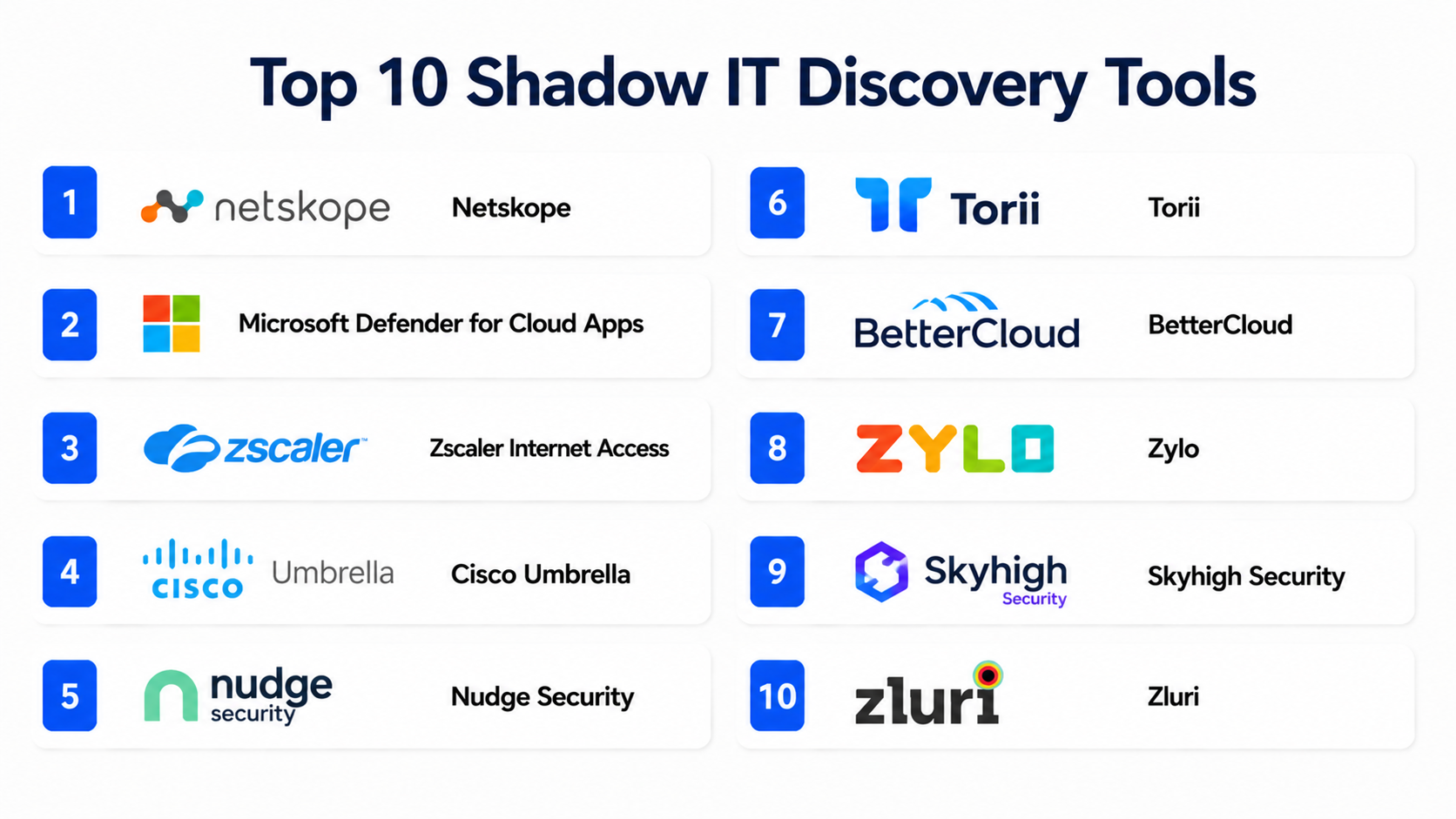
#1 — Netskope
Short description :
Netskope is a cloud security and Shadow IT discovery platform focused on SaaS visibility, cloud application governance, data protection, and Zero Trust security. The platform provides deep visibility into unmanaged SaaS applications, user activity, and cloud risks across enterprise environments. Netskope is widely adopted by large organizations requiring enterprise-grade cloud and shadow IT visibility.
Key Features
- Shadow IT and SaaS discovery
- Cloud application risk assessment
- User behavior analytics
- Data loss prevention
- Shadow AI visibility
- Real-time policy enforcement
- CASB and Zero Trust integration
Pros
- Strong cloud visibility capabilities
- Mature enterprise security controls
- Broad SaaS application coverage
Cons
- Enterprise-focused deployment complexity
- Premium pricing structure
- Advanced policy tuning may require expertise
Platforms / Deployment
- Web / Windows / macOS / Linux
- Cloud / Hybrid
Security & Compliance
- SSO/SAML
- MFA
- RBAC
- Audit logs
- Compliance support
- Encryption controls
Integrations & Ecosystem
Netskope integrates deeply into enterprise security ecosystems.
- Microsoft Entra ID
- Okta
- SIEM platforms
- Endpoint security tools
- Cloud providers
- SOC workflows
Support & Community
Netskope provides enterprise onboarding, security guidance, training resources, and premium support programs.
#2 — Microsoft Defender for Cloud Apps
Short description :
Microsoft Defender for Cloud Apps is a CASB and shadow IT discovery platform integrated into the Microsoft security ecosystem. The platform helps organizations identify unsanctioned cloud applications, monitor SaaS usage, and enforce security policies across hybrid work environments.
Key Features
- Shadow IT discovery
- Cloud app governance
- Risk scoring
- User activity monitoring
- Threat detection
- Conditional access integration
- SaaS visibility dashboards
Pros
- Strong Microsoft ecosystem integration
- Unified security operations visibility
- Scalable enterprise deployment
Cons
- Best experience within Microsoft-centric environments
- Advanced customization may require expertise
- Some third-party integrations vary
Platforms / Deployment
- Web
- Cloud
Security & Compliance
- MFA
- SSO/SAML
- Audit logging
- RBAC
- Compliance controls
Integrations & Ecosystem
Microsoft Defender integrates into enterprise identity and security ecosystems.
- Microsoft 365
- Microsoft Entra ID
- Defender XDR
- SIEM platforms
- Endpoint management systems
- Cloud providers
Support & Community
Microsoft provides extensive documentation, enterprise support tiers, and large community ecosystems.
#3 — Zscaler Internet Access (ZIA)
Short description :
Zscaler Internet Access combines secure web gateway functionality with shadow IT discovery and SaaS governance capabilities. The platform helps organizations monitor application usage, discover unmanaged cloud services, and secure internet traffic across distributed workforces.
Key Features
- Shadow IT discovery
- Secure web gateway
- SaaS risk analysis
- User activity monitoring
- Data protection controls
- Cloud access governance
- Zero Trust architecture
Pros
- Strong remote workforce visibility
- Mature Zero Trust capabilities
- Broad cloud application monitoring
Cons
- Advanced policy configuration complexity
- Enterprise deployment learning curve
- Premium enterprise pricing
Platforms / Deployment
- Web / Windows / macOS / Linux / iOS / Android
- Cloud
Security & Compliance
- MFA
- RBAC
- SSO/SAML
- Audit logs
- Encryption support
- Compliance controls
Integrations & Ecosystem
Zscaler integrates into enterprise networking and security ecosystems.
- SIEM platforms
- Identity providers
- Endpoint security platforms
- Cloud providers
- SOC tools
- CASB integrations
Support & Community
Zscaler provides enterprise support, onboarding assistance, and security operations guidance.
#4 — Cisco Umbrella
Short description :
Cisco Umbrella is a cloud-delivered security platform offering DNS-layer security, secure web gateway functionality, and shadow IT discovery capabilities. The platform helps organizations monitor internet activity, identify unauthorized applications, and secure distributed environments.
Key Features
- DNS-layer monitoring
- Shadow IT visibility
- SaaS risk analysis
- Secure web gateway
- Threat intelligence integration
- Cloud application discovery
- Reporting and analytics
Pros
- Easy deployment model
- Strong DNS security visibility
- Good remote workforce coverage
Cons
- Advanced SaaS governance lighter than CASB-focused tools
- Deep customization varies
- Some enterprise analytics require tuning
Platforms / Deployment
- Web / Windows / macOS / Linux / iOS / Android
- Cloud
Security & Compliance
- MFA
- SSO/SAML
- Audit logs
- RBAC
- Compliance support
Integrations & Ecosystem
Cisco Umbrella integrates into Cisco and third-party security ecosystems.
- Cisco SecureX
- SIEM platforms
- Identity providers
- Endpoint security tools
- SOC workflows
- Threat intelligence systems
Support & Community
Cisco provides enterprise support programs, training resources, and broad security documentation.
#5 — Nudge Security
Short description :
Nudge Security is a modern shadow IT and SaaS discovery platform designed to identify unmanaged SaaS applications, AI tools, and employee-driven cloud adoption. The platform emphasizes behavioral governance and visibility into applications connected to corporate identities.
Key Features
- SaaS discovery
- Shadow AI visibility
- Identity-centric discovery
- Behavioral governance
- OAuth application monitoring
- Employee risk workflows
- Continuous SaaS inventory
Pros
- Strong modern SaaS discovery approach
- Good shadow AI visibility
- Lightweight deployment model
Cons
- Smaller ecosystem than legacy vendors
- Advanced enterprise governance still evolving
- Large-scale customization varies
Platforms / Deployment
- Web
- Cloud
Security & Compliance
- SSO/SAML
- MFA
- RBAC
- Audit logs
- Compliance visibility
Integrations & Ecosystem
Nudge Security integrates into SaaS and identity ecosystems.
- Google Workspace
- Microsoft 365
- Okta
- Slack
- HR systems
- SIEM platforms
Support & Community
Nudge Security offers onboarding guidance, SaaS governance resources, and customer support.
#6 — Torii
Short description :
Torii is a SaaS management and shadow IT discovery platform focused on SaaS visibility, workflow automation, and license optimization. The platform helps organizations identify unmanaged applications and automate governance processes across cloud environments.
Key Features
- Shadow IT discovery
- SaaS inventory management
- Workflow automation
- License optimization
- Employee lifecycle workflows
- SaaS governance
- Reporting dashboards
Pros
- User-friendly interface
- Strong automation capabilities
- Good SaaS operational visibility
Cons
- Enterprise governance depth varies
- Advanced reporting may require configuration
- Large-scale customization differs by deployment
Platforms / Deployment
- Web
- Cloud
Security & Compliance
- MFA
- RBAC
- Audit logs
- SSO/SAML
- Compliance support
Integrations & Ecosystem
Torii integrates into productivity and SaaS ecosystems.
- Slack
- Okta
- Google Workspace
- Microsoft 365
- HR systems
- Finance platforms
Support & Community
Torii provides onboarding resources, automation guidance, and customer success support.
#7 — BetterCloud
Short description :
BetterCloud is a SaaS operations and governance platform that includes shadow IT discovery, SaaS administration, and employee lifecycle automation capabilities. The platform helps IT teams manage SaaS access, visibility, and operational governance across cloud-first environments.
Key Features
- Shadow IT monitoring
- SaaS operations automation
- Access governance
- User lifecycle management
- Workflow orchestration
- SaaS visibility dashboards
- Compliance reporting
Pros
- Strong workflow automation
- Broad SaaS administration coverage
- Good onboarding and offboarding workflows
Cons
- Enterprise customization complexity
- Advanced analytics vary by deployment
- Pricing scales with integrations
Platforms / Deployment
- Web
- Cloud
Security & Compliance
- SSO/SAML
- MFA
- RBAC
- Audit logs
- Compliance-oriented controls
Integrations & Ecosystem
BetterCloud integrates into workforce and SaaS ecosystems.
- Google Workspace
- Microsoft 365
- Slack
- Zoom
- Okta
- Dropbox
Support & Community
BetterCloud offers onboarding assistance, workflow templates, and enterprise support resources.
#8 — Zylo
Short description :
Zylo is an enterprise SaaS management platform that includes shadow IT discovery, SaaS spend visibility, and license optimization capabilities. The platform helps organizations identify unmanaged SaaS usage and centralize SaaS governance workflows.
Key Features
- SaaS discovery
- Shadow IT visibility
- License optimization
- Spend analytics
- Vendor management
- Renewal tracking
- SaaS inventory management
Pros
- Strong SaaS spend visibility
- Mature governance workflows
- Enterprise-focused analytics
Cons
- Enterprise-oriented pricing
- Advanced workflows may require onboarding
- SMB requirements may vary
Platforms / Deployment
- Web
- Cloud
Security & Compliance
- MFA
- RBAC
- SSO/SAML
- Audit logs
- Compliance visibility
Integrations & Ecosystem
Zylo integrates into SaaS governance ecosystems.
- Okta
- Microsoft Entra ID
- ERP systems
- Financial platforms
- HR systems
- Collaboration tools
Support & Community
Zylo provides enterprise onboarding, analytics consulting, and technical support programs.
#9 — Skyhigh Security
Short description :
Skyhigh Security provides CASB and shadow IT discovery capabilities designed to help organizations monitor cloud application usage, enforce policies, and secure SaaS environments. The platform evolved from McAfee Enterprise cloud security technologies.
Key Features
- Shadow IT discovery
- CASB functionality
- SaaS governance
- Risk scoring
- User activity monitoring
- Data protection controls
- Compliance reporting
Pros
- Mature CASB heritage
- Strong enterprise policy controls
- Good cloud application monitoring
Cons
- Interface complexity for some teams
- Advanced tuning may require expertise
- Deployment complexity varies
Platforms / Deployment
- Web / Windows / macOS / Linux
- Cloud / Hybrid
Security & Compliance
- MFA
- RBAC
- SSO/SAML
- Audit logging
- Compliance support
Integrations & Ecosystem
Skyhigh Security integrates into enterprise security ecosystems.
- SIEM platforms
- Endpoint protection tools
- Identity providers
- Cloud providers
- DLP systems
- SOC workflows
Support & Community
Skyhigh Security provides enterprise onboarding, support services, and operational guidance.
#10 — Zluri
Short description :
Zluri is a SaaS management and shadow IT discovery platform focused on SaaS visibility, license optimization, and identity governance. The platform uses multiple discovery methods to uncover unauthorized SaaS applications and improve governance visibility.
Key Features
- SaaS discovery
- License optimization
- Identity visibility
- Shadow IT monitoring
- Employee lifecycle workflows
- Spend optimization
- Automated governance workflows
Pros
- Multi-source discovery capabilities
- Good automation workflows
- Modern operational interface
Cons
- Enterprise customization varies
- Advanced governance depth differs by deployment
- Reporting capabilities vary by plan
Platforms / Deployment
- Web
- Cloud
Security & Compliance
- SSO/SAML
- MFA
- RBAC
- Audit logs
- Compliance support
Integrations & Ecosystem
Zluri integrates into SaaS and identity ecosystems.
- Okta
- Microsoft Entra ID
- Slack
- Google Workspace
- HR systems
- Finance platforms
Support & Community
Zluri offers onboarding assistance, governance guidance, and customer success resources.
Comparison Table (Top 10)
| Tool Name | Best For | Platform(s) Supported | Deployment | Standout Feature | Public Rating |
|---|---|---|---|---|---|
| Netskope | Enterprise cloud visibility | Web, Windows, macOS, Linux | Hybrid | CASB and Zero Trust integration | N/A |
| Microsoft Defender for Cloud Apps | Microsoft-centric organizations | Web | Cloud | Native Microsoft integration | N/A |
| Zscaler Internet Access | Remote workforce security | Multi-platform | Cloud | Zero Trust web access | N/A |
| Cisco Umbrella | DNS-layer visibility | Multi-platform | Cloud | DNS-based discovery | N/A |
| Nudge Security | Shadow AI discovery | Web | Cloud | Identity-centric SaaS discovery | N/A |
| Torii | SaaS operations visibility | Web | Cloud | Workflow automation | N/A |
| BetterCloud | SaaS governance automation | Web | Cloud | Employee lifecycle automation | N/A |
| Zylo | Enterprise SaaS governance | Web | Cloud | SaaS spend optimization | N/A |
| Skyhigh Security | CASB-focused enterprises | Multi-platform | Hybrid | Cloud access governance | N/A |
| Zluri | Identity-driven SaaS visibility | Web | Cloud | Multi-source discovery | N/A |
Evaluation & Shadow IT Discovery Tools
| Tool Name | Core (25%) | Ease (15%) | Integrations (15%) | Security (10%) | Performance (10%) | Support (10%) | Value (15%) | Weighted Total (0–10) |
|---|---|---|---|---|---|---|---|---|
| Netskope | 9 | 7 | 9 | 9 | 8 | 8 | 7 | 8.2 |
| Microsoft Defender for Cloud Apps | 9 | 8 | 9 | 8 | 8 | 8 | 8 | 8.4 |
| Zscaler Internet Access | 9 | 7 | 8 | 9 | 8 | 8 | 7 | 8.0 |
| Cisco Umbrella | 8 | 8 | 8 | 8 | 8 | 8 | 8 | 8.0 |
| Nudge Security | 8 | 8 | 7 | 8 | 7 | 7 | 8 | 7.7 |
| Torii | 8 | 9 | 8 | 7 | 8 | 8 | 8 | 8.1 |
| BetterCloud | 8 | 8 | 8 | 8 | 8 | 8 | 7 | 7.9 |
| Zylo | 8 | 7 | 8 | 8 | 8 | 8 | 7 | 7.8 |
| Skyhigh Security | 8 | 6 | 8 | 9 | 8 | 7 | 6 | 7.4 |
| Zluri | 8 | 8 | 8 | 8 | 8 | 7 | 8 | 8.0 |
These scores are comparative and intended to help organizations evaluate trade-offs between discovery depth, operational simplicity, governance maturity, and cloud security visibility. Enterprise-focused CASB platforms generally provide stronger policy enforcement and compliance controls, while SaaS-centric discovery platforms often emphasize usability and operational automation. Buyers should align scoring priorities with their security maturity, SaaS complexity, and governance requirements.
Which Shadow IT Discovery Tools
Solo / Freelancer
Freelancers and independent users usually do not require enterprise-grade shadow IT discovery platforms unless handling regulated data or large contractor ecosystems.
SMB
SMBs commonly benefit from Torii, Zluri, or Cisco Umbrella because of easier deployment models and operational simplicity.
Mid-Market
Mid-market organizations should evaluate BetterCloud, Microsoft Defender for Cloud Apps, and Nudge Security for balanced governance and discovery capabilities.
Enterprise
Large enterprises often require advanced CASB capabilities, policy enforcement, AI risk visibility, and identity governance integration. Netskope, Zscaler, and Skyhigh Security are strong enterprise-focused options.
Budget vs Premium
Organizations focused on SaaS visibility and operational workflows may prioritize simpler SaaS-centric platforms, while highly regulated enterprises often justify premium CASB pricing for governance and compliance depth.
Feature Depth vs Ease of Use
Netskope and Zscaler provide deeper enterprise security functionality, while Torii and Zluri emphasize operational simplicity and faster deployment.
Integrations & Scalability
Organizations with large SaaS ecosystems should prioritize API availability, SIEM integrations, identity provider support, and automation capabilities.
Security & Compliance Needs
Highly regulated industries should prioritize audit logging, DLP capabilities, policy enforcement, encryption support, and continuous SaaS risk monitoring.
Frequently Asked Questions (FAQs)
1. What are Shadow IT Discovery Tools?
Shadow IT Discovery Tools help organizations identify unauthorized software, cloud services, SaaS applications, devices, and AI tools operating outside official IT governance.
2. Why are Shadow IT Discovery Tools important in 2026?
Modern organizations use hundreds of SaaS and AI applications, creating major visibility and compliance challenges. Shadow IT can introduce security risks, unmanaged identities, and data exposure concerns.
3. What is Shadow AI?
Shadow AI refers to unauthorized or unmanaged AI tools being used by employees without official IT approval or governance oversight.
4. How do these tools discover shadow IT?
Most platforms use network telemetry, browser monitoring, identity integrations, API connections, DNS analysis, and financial system monitoring to identify unmanaged applications.
5. Are CASB platforms the same as Shadow IT Discovery Tools?
Not exactly. CASB platforms often include shadow IT discovery capabilities, but some modern SaaS management tools focus more heavily on operational governance and SaaS visibility.
6. Can these tools detect unmanaged AI applications?
Yes. Many modern platforms now include Shadow AI monitoring and governance capabilities due to rapid enterprise AI adoption.
7. Do Shadow IT Discovery Tools support compliance initiatives?
Yes. Many tools provide audit logs, risk scoring, governance workflows, and compliance visibility to help organizations meet regulatory requirements.
8. Are these platforms suitable for remote workforces?
Yes. Most modern platforms are designed specifically for hybrid and distributed work environments with cloud-first architectures.
9. What departments use Shadow IT Discovery Tools?
Security operations, IT operations, compliance, procurement, governance, and executive leadership teams commonly use these platforms.
10. How difficult is deployment?
Deployment complexity depends on organizational size, integration requirements, and governance maturity. Cloud-native SaaS discovery platforms are generally easier to deploy than legacy enterprise CASB environments.
Conclusion
Shadow IT Discovery Tools have become essential security and governance platforms as organizations continue expanding their SaaS ecosystems, remote work environments, and AI adoption strategies. What was once primarily a visibility challenge around unmanaged SaaS applications has evolved into a broader operational and security problem that now includes Shadow AI, unmanaged identities, unauthorized browser extensions, disconnected cloud services, and decentralized technology purchasing. Without centralized discovery and governance capabilities, organizations face growing risks related to compliance violations, data leakage, identity sprawl, and operational inefficiencies.
