Introduction
Secrets Scanning Tools are security platforms designed to detect and prevent accidental exposure of sensitive information such as API keys, passwords, tokens, certificates, and cryptographic secrets in code, repositories, CI/CD pipelines, and cloud environments.
In secrets exposure remains one of the most common causes of cloud security breaches. As development velocity increases with AI-assisted coding, microservices, and distributed DevOps pipelines, sensitive credentials are often unintentionally committed into source code or configuration files. Secrets scanning tools help reduce this risk by continuously detecting, blocking, and remediating exposed credentials before they reach production.
Common use cases include:
- Scanning Git repositories for leaked API keys and tokens
- Detecting secrets in CI/CD pipelines before deployment
- Monitoring cloud storage and configuration files
- Preventing hardcoded credentials in application code
- Securing Infrastructure as Code (IaC) templates
- Continuous monitoring of public and private repositories
- Detecting leaked secrets in logs or build artifacts
- Enforcing secure development policies in DevSecOps pipelines
When evaluating Secrets Scanning Tools, organizations should consider:
- Detection accuracy and false-positive rate
- Support for multiple secret types (API keys, tokens, passwords)
- Real-time vs batch scanning capabilities
- CI/CD pipeline integration
- Git provider support (GitHub, GitLab, Bitbucket)
- Cloud and container scanning coverage
- Auto-remediation and revocation features
- Performance impact on repositories and pipelines
- Compliance and audit reporting
- Ease of deployment and developer experience
Best for: DevSecOps teams, security engineers, platform engineering teams, and organizations managing large-scale software development pipelines.
Not ideal for: Very small static projects with minimal external integrations or low security exposure.
Key Trends in Secrets Scanning Tools
- Shift from reactive scanning to real-time pre-commit detection
- AI-assisted secret classification and risk scoring
- Native integration into Git platforms and IDEs
- Automatic secret revocation and rotation workflows
- Expansion into cloud and runtime secret detection
- Unified DevSecOps platforms combining SAST, DAST, and secrets scanning
- Increased focus on reducing false positives using contextual analysis
- Policy-as-code integration for secret handling rules
- Support for multi-cloud and Kubernetes environments
- Shift toward developer-first lightweight security tooling
How We Selected These Tools (Methodology)
The tools listed below were selected based on adoption in DevSecOps ecosystems, detection accuracy, scalability, integration depth, and enterprise readiness.
Selection criteria included:
- Accuracy of secret detection algorithms
- Coverage of secret types and formats
- CI/CD and Git integration support
- Real-time scanning capabilities
- Enterprise scalability and performance
- Security automation and remediation features
- Ecosystem maturity and adoption
- Ease of developer onboarding
- Compliance and audit readiness
- Multi-cloud and container support
Secrets Scanning Tools
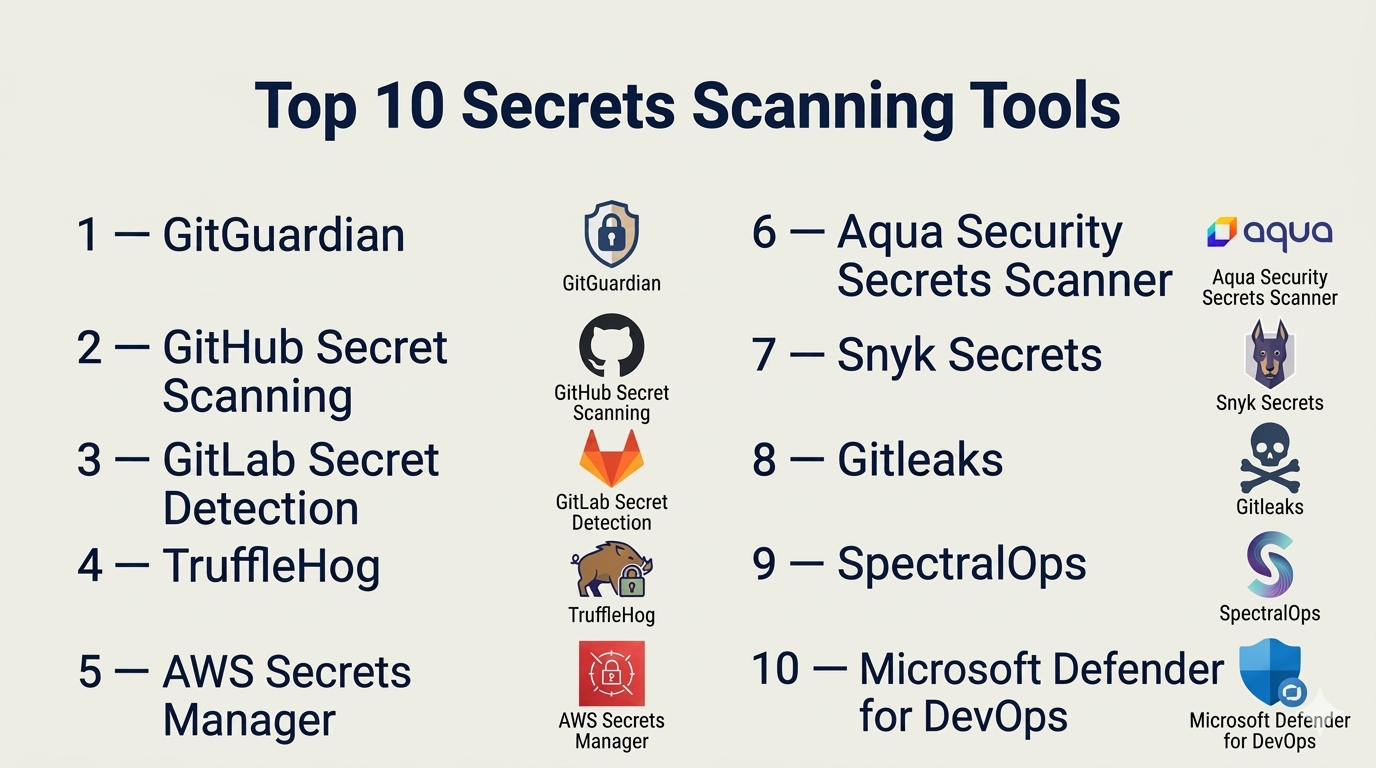
#1 — GitGuardian
Short description :
GitGuardian is a widely used Secrets Detection platform that continuously scans public and private repositories to detect exposed secrets and provides automated remediation workflows for DevSecOps teams.
Key Features
- Real-time repository scanning
- Pre-commit and post-commit detection
- API key and token identification
- CI/CD pipeline integration
- Incident management dashboard
- Secret revocation workflows
- Multi-repository monitoring
Pros
- Strong detection accuracy
- Excellent Git integration
- Good remediation workflows
Cons
- Enterprise features can be complex
- Requires tuning for large-scale environments
- Some false positives in complex codebases
Platforms / Deployment
- Cloud / SaaS / Self-hosted (enterprise options vary)
Security & Compliance
- Role-based access control
- Audit logs
- Encryption in transit and at rest
- Compliance reporting features
- Incident tracking system
Integrations & Ecosystem
- GitHub, GitLab, Bitbucket
- CI/CD tools
- Slack, Jira, incident tools
- Cloud provider APIs
- Security orchestration systems
Support & Community
Strong enterprise support and active DevSecOps community.
#2 — GitHub Secret Scanning
Short description :
GitHub Secret Scanning is a native security feature that automatically detects exposed secrets in GitHub repositories and alerts repository owners in real time.
Key Features
- Native GitHub integration
- Automatic repository scanning
- Push protection (pre-commit blocking)
- Secret pattern detection
- Partner integration ecosystem
- Alerting and remediation guidance
- Public repository scanning
Pros
- Seamless GitHub integration
- No additional setup required
- Strong real-time protection
Cons
- Limited outside GitHub ecosystem
- Less customizable detection rules
- Enterprise features required for advanced controls
Platforms / Deployment
- Cloud (GitHub-native)
Security & Compliance
- GitHub security alerts
- Role-based repository access
- Audit logs
- Encryption handled by GitHub
- Compliance reporting (varies by plan)
Integrations & Ecosystem
- GitHub Actions
- CI/CD pipelines
- Security partners ecosystem
- Developer tools
- Issue tracking systems
Support & Community
Strong GitHub enterprise support.
#3 — GitLab Secret Detection
Short description :
GitLab Secret Detection is a built-in DevSecOps feature that scans repositories and CI pipelines for exposed secrets during development and deployment.
Key Features
- CI pipeline secret scanning
- Pre-commit and merge request detection
- Built-in DevSecOps integration
- Customizable detection rules
- Vulnerability reporting dashboard
- Secret pattern library
- Security merge request workflows
Pros
- Deep GitLab CI integration
- Strong DevSecOps workflow alignment
- Easy pipeline enforcement
Cons
- Best within GitLab ecosystem
- Requires configuration for advanced rules
- Limited external platform support
Platforms / Deployment
- Cloud / Self-hosted (GitLab)
Security & Compliance
- RBAC support
- Audit logs
- Security dashboards
- Compliance pipelines
- Encrypted storage
Integrations & Ecosystem
- GitLab CI/CD
- Kubernetes
- Security scanners
- DevOps toolchains
- Issue tracking
Support & Community
Strong enterprise and open-source ecosystem.
#4 — TruffleHog
Short description :
TruffleHog is an open-source secrets scanning tool designed to detect high-entropy secrets and known credential patterns across repositories and cloud environments.
Key Features
- High-entropy secret detection
- Git repository scanning
- Cloud and SaaS integration scanning
- CI/CD pipeline support
- Pre-commit hooks
- Deep commit history scanning
- Regex-based detection rules
Pros
- Very strong open-source adoption
- Highly flexible scanning engine
- Works across multiple environments
Cons
- Requires tuning for accuracy
- Can produce false positives
- Limited enterprise features
Platforms / Deployment
- CLI / Cloud / Self-hosted
Security & Compliance
- Audit logging via integrations
- CI-based enforcement
- Secure scanning pipelines
- Secret detection reports
- Compliance support via pipelines
Integrations & Ecosystem
- Git repositories
- CI/CD systems
- Cloud providers
- DevSecOps tools
- Container pipelines
Support & Community
Strong open-source community.
#5 — AWS Secrets Manager (Detection Integration Layer)
Short description :
AWS Secrets Manager is primarily a secret storage and rotation service, but it integrates with security tools and workflows to help detect and manage exposed secrets in AWS environments.
Key Features
- Secure secrets storage
- Automatic secret rotation
- IAM-based access control
- Integration with AWS services
- Audit logging
- Encryption at rest and in transit
- Application-level secret retrieval
Pros
- Strong AWS ecosystem integration
- Automated secret rotation
- High security reliability
Cons
- Not a full secrets scanning tool
- AWS-only ecosystem
- Requires integration with scanning tools
Platforms / Deployment
- Cloud (AWS-only)
Security & Compliance
- IAM policies
- CloudTrail audit logs
- KMS encryption
- Compliance support (AWS frameworks)
- Secure rotation workflows
Integrations & Ecosystem
- AWS Lambda
- EC2, ECS, EKS
- CI/CD pipelines
- Security tools
- Monitoring systems
Support & Community
Strong AWS enterprise support.
#6 — Aqua Security Secrets Scanner
Short description :
Aqua Security provides secrets scanning as part of its cloud-native security platform, focusing on container, Kubernetes, and CI/CD pipeline security.
Key Features
- Container image scanning
- Kubernetes secrets detection
- CI/CD pipeline integration
- Runtime security correlation
- Policy-based scanning
- Multi-cloud support
- Vulnerability correlation with secrets
Pros
- Strong container security integration
- Enterprise-grade platform
- Good Kubernetes support
Cons
- Enterprise-focused pricing
- Complex setup
- Requires platform adoption
Platforms / Deployment
- Cloud / Self-hosted / Hybrid
Security & Compliance
- RBAC support
- Audit logs
- Policy enforcement
- Compliance reporting
- Runtime protection
Integrations & Ecosystem
- Kubernetes
- CI/CD pipelines
- Cloud providers
- Container registries
- Security platforms
Support & Community
Strong enterprise security support.
#7 — Snyk Secrets
Short description :
Snyk Secrets is a developer-first security tool that detects exposed secrets in code repositories, CI pipelines, and infrastructure configurations.
Key Features
- Real-time secrets scanning
- Git repository integration
- CI/CD pipeline scanning
- Developer-friendly alerts
- Risk prioritization
- Security reporting dashboards
- Integration with Snyk ecosystem
Pros
- Easy developer onboarding
- Strong ecosystem integration
- Fast detection capabilities
Cons
- Best within Snyk ecosystem
- Some features require enterprise plan
- Limited deep customization
Platforms / Deployment
- Cloud / SaaS
Security & Compliance
- RBAC support
- Audit logs
- Encrypted data handling
- Compliance reporting
- Security policy enforcement
Integrations & Ecosystem
- GitHub, GitLab
- CI/CD pipelines
- IDE plugins
- Container security tools
- DevSecOps platforms
Support & Community
Strong developer and enterprise support.
#8 — Gitleaks
Short description :
Gitleaks is a fast and lightweight open-source secrets scanning tool designed to detect hardcoded secrets in Git repositories and CI pipelines.
Key Features
- Git repository scanning
- Pre-commit hooks
- Custom regex rule support
- CI/CD integration
- Fast scanning engine
- History scanning
- Configurable policies
Pros
- Very fast performance
- Simple CLI usage
- Highly customizable rules
Cons
- Limited enterprise features
- Requires manual tuning
- No built-in remediation
Platforms / Deployment
- CLI / Self-hosted
Security & Compliance
- CI-based enforcement
- Log outputs for audits
- Custom policy rules
- Secure scanning workflows
- Compliance reporting via pipelines
Integrations & Ecosystem
- Git platforms
- CI/CD systems
- DevSecOps tools
- Container pipelines
- Automation scripts
Support & Community
Strong open-source community.
#9 — SpectralOps (Spectral)
Short description :
SpectralOps is a security scanning platform that detects secrets, misconfigurations, and sensitive data exposure across code, APIs, and cloud environments.
Key Features
- Multi-layer secrets detection
- API security scanning
- CI/CD integration
- Cloud configuration scanning
- Machine learning-based detection
- Risk scoring engine
- Policy enforcement workflows
Pros
- Broad security coverage
- Strong detection intelligence
- Good enterprise workflows
Cons
- Enterprise-focused pricing
- Complex setup
- Requires tuning for accuracy
Platforms / Deployment
- Cloud / Hybrid
Security & Compliance
- RBAC support
- Audit logs
- Policy enforcement
- Compliance dashboards
- Encrypted scanning workflows
Integrations & Ecosystem
- Git providers
- CI/CD pipelines
- Cloud platforms
- Security tools
- DevSecOps systems
Support & Community
Enterprise-grade support.
#10 — Microsoft Defender for DevOps (Secrets Scanning Layer)
Short description :
Microsoft Defender for DevOps includes secrets detection capabilities as part of its broader DevSecOps security platform, integrated with Azure and Git repositories.
Key Features
- Repository secrets scanning
- CI/CD pipeline security checks
- Azure DevOps integration
- Risk-based alerting
- Security posture management
- Multi-cloud visibility
- Threat intelligence correlation
Pros
- Strong Azure ecosystem integration
- Unified DevSecOps platform
- Enterprise security coverage
Cons
- Best within Microsoft ecosystem
- Requires Azure setup
- Complex configuration
Platforms / Deployment
- Cloud / Hybrid (Azure-centric)
Security & Compliance
- Azure AD integration
- RBAC controls
- Audit logging
- Compliance dashboards
- Threat detection integration
Integrations & Ecosystem
- Azure DevOps
- GitHub
- CI/CD pipelines
- Security Center
- SIEM tools
Support & Community
Strong Microsoft enterprise support.
Comparison Table (Top 10)
| Tool Name | Best For | Platform(s) Supported | Deployment | Standout Feature | Public Rating |
|---|---|---|---|---|---|
| GitGuardian | Enterprise secrets detection | Multi-platform | Cloud | Real-time repo scanning | N/A |
| GitHub Secret Scanning | GitHub-native protection | GitHub | Cloud | Native push protection | N/A |
| GitLab Secret Detection | DevSecOps pipelines | GitLab | Cloud | CI-integrated scanning | N/A |
| TruffleHog | Open-source scanning | Multi-platform | CLI | High-entropy detection | N/A |
| AWS Secrets Manager | Secret lifecycle mgmt | AWS | Cloud | Secure secret rotation | N/A |
| Aqua Security | Container security | Multi-cloud | Hybrid | Kubernetes integration | N/A |
| Snyk Secrets | Developer-first security | Multi-platform | SaaS | Fast CI integration | N/A |
| Gitleaks | Lightweight scanning | Multi-platform | CLI | Fast scanning engine | N/A |
| SpectralOps | AI-driven security scanning | Multi-cloud | Hybrid | ML-based detection | N/A |
| Microsoft Defender for DevOps | Azure DevSecOps | Azure | Hybrid | Unified security platform | N/A |
Evaluation & Secrets Scanning Tools
| Tool Name | Core (25%) | Ease (15%) | Integrations (15%) | Security (10%) | Performance (10%) | Support (10%) | Value (15%) | Weighted Total |
|---|---|---|---|---|---|---|---|---|
| GitGuardian | 10 | 9 | 10 | 10 | 9 | 9 | 9 | 9.4 |
| GitHub Secret Scanning | 9 | 10 | 10 | 10 | 9 | 9 | 9 | 9.3 |
| GitLab Secret Detection | 9 | 9 | 10 | 10 | 9 | 9 | 9 | 9.2 |
| TruffleHog | 9 | 8 | 9 | 9 | 9 | 8 | 10 | 8.8 |
| AWS Secrets Manager | 8 | 9 | 9 | 10 | 9 | 9 | 8 | 8.6 |
| Aqua Security | 9 | 7 | 9 | 10 | 9 | 9 | 8 | 8.7 |
| Snyk Secrets | 9 | 9 | 9 | 9 | 9 | 9 | 9 | 9.0 |
| Gitleaks | 8 | 9 | 8 | 9 | 10 | 8 | 10 | 8.7 |
| SpectralOps | 9 | 8 | 9 | 10 | 9 | 9 | 8 | 8.8 |
| Microsoft Defender | 9 | 8 | 9 | 10 | 9 | 9 | 8 | 8.8 |
Which Secrets Scanning Tools
Solo / Freelancer
- Gitleaks
- TruffleHog
- Snyk Secrets
SMB
- Snyk Secrets
- GitHub Secret Scanning
- GitLab Secret Detection
Mid-Market
- GitGuardian
- Snyk Secrets
- SpectralOps
Enterprise
- GitGuardian
- Aqua Security
- Microsoft Defender for DevOps
Budget vs Premium
- Budget-friendly: Gitleaks, TruffleHog
- Balanced: Snyk Secrets, GitLab/GitHub tools
- Premium enterprise: GitGuardian, Aqua Security, Microsoft Defender
Feature Depth vs Ease of Use
- Easiest: GitHub Secret Scanning, Gitleaks
- Most powerful detection: GitGuardian
- Best DevSecOps ecosystem: Snyk Secrets
Integrations & Scalability
- Best ecosystem: GitGuardian
- Best Git-native: GitHub / GitLab tools
- Best enterprise security: Aqua Security, Microsoft Defender
Security & Compliance Needs
Highly regulated environments should prioritize:
- GitGuardian
- Microsoft Defender for DevOps
- Aqua Security
- GitLab Secret Detection
Frequently Asked Questions (FAQs)
1. What is a secrets scanning tool?
It is a tool that detects sensitive credentials like API keys and passwords in code or repositories.
2. Why are secrets scanning tools important?
They prevent accidental exposure of credentials that can lead to security breaches.
3. Do these tools work in CI/CD pipelines?
Yes, most modern tools integrate directly into CI/CD workflows.
4. Can secrets scanners prevent commits?
Yes, many tools support pre-commit or push protection.
5. Are open-source tools reliable?
Yes, tools like Gitleaks and TruffleHog are widely used in production.
6. What types of secrets can be detected?
API keys, tokens, passwords, certificates, and cloud credentials.
7. Do these tools support cloud environments?
Yes, many support multi-cloud and SaaS scanning.
8. What is false positive in secrets scanning?
It is when a tool incorrectly flags non-sensitive data as a secret.
9. Can leaked secrets be automatically fixed?
Some tools support automatic revocation or rotation workflows.
10. What is the future of secrets scanning?
It is moving toward AI-driven detection and real-time prevention at the developer level.
Conclusion
Secrets Scanning Tools are essential for modern DevSecOps practices, helping organizations prevent one of the most common and dangerous security risks—exposed credentials. As development becomes faster and more distributed, automated secrets detection has become a baseline requirement rather than an optional safeguard. GitGuardian leads enterprise-grade detection, while GitHub and GitLab provide strong native options within their ecosystems. Lightweight tools like Gitleaks and TruffleHog remain popular for developer-first workflows, and platforms like Snyk and Microsoft Defender offer integrated DevSecOps coverage.
