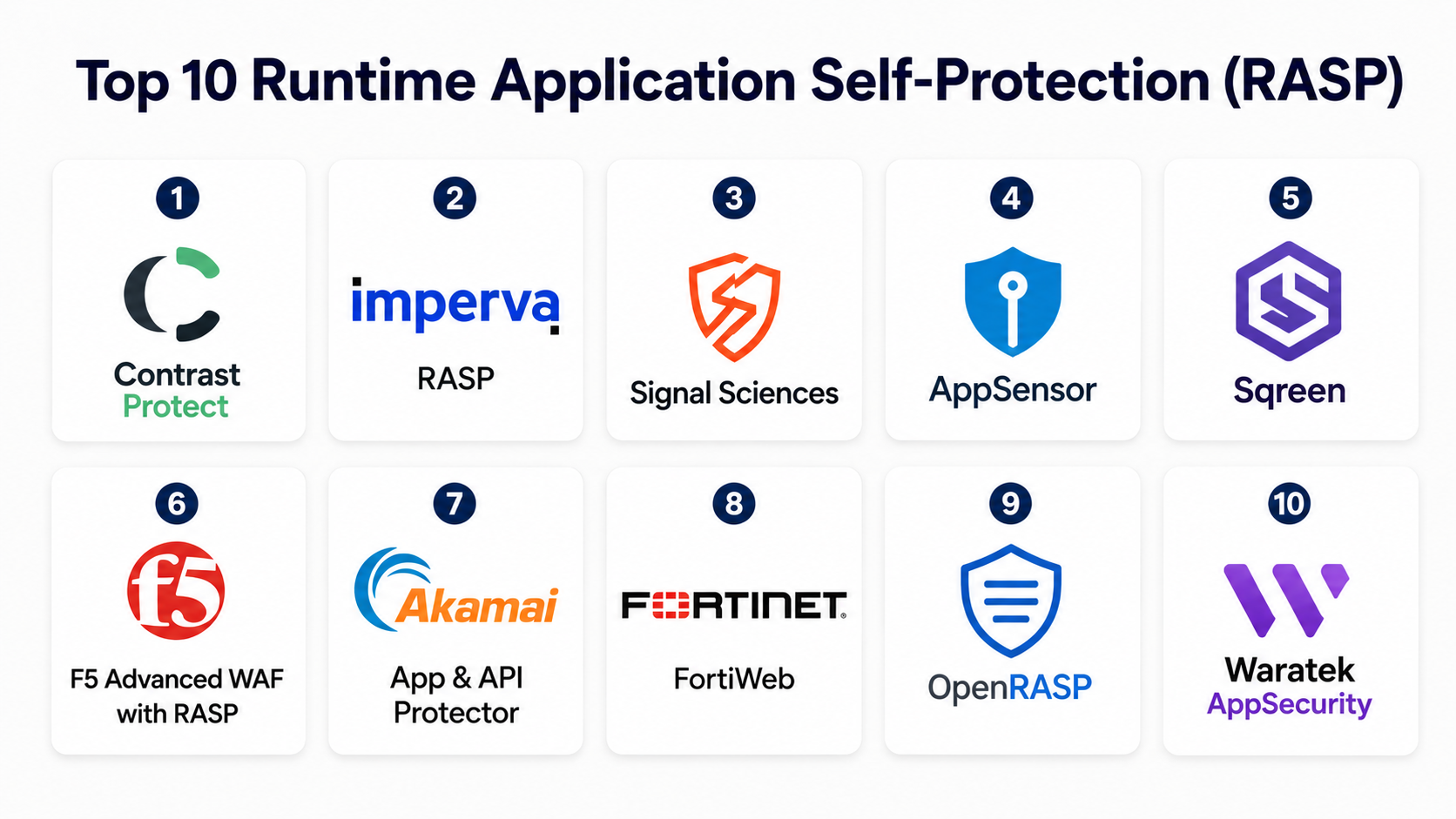
Introduction
Runtime Application Self-Protection (RASP) is an application security technology that integrates directly into running applications to detect and block attacks in real time. Unlike traditional perimeter-focused security tools, RASP solutions operate inside the application runtime environment, giving them visibility into application behavior, code execution, user sessions, and attack attempts.
In RASP has become increasingly important as organizations adopt cloud-native applications, APIs, microservices, and distributed architectures that traditional web application firewalls alone may not fully protect. Modern attacks targeting APIs, business logic flaws, and runtime vulnerabilities require context-aware protection directly within the application layer.
Common real-world use cases include:
- Blocking SQL injection and remote code execution attacks
- Protecting APIs and microservices in runtime environments
- Detecting abnormal application behavior
- Preventing account takeover and session manipulation
- Supporting zero-trust application security models
When evaluating RASP solutions, buyers should consider:
- Runtime performance overhead
- Supported programming languages and frameworks
- API and microservices protection
- Cloud-native deployment compatibility
- AI-driven threat detection capabilities
- Integration with SIEM and DevSecOps tools
- False positive management
- Compliance and audit visibility
- Real-time blocking versus monitoring-only modes
- Ease of deployment and operational management
Best for: Enterprises, SaaS providers, financial institutions, healthcare organizations, API-driven businesses, DevSecOps teams, and organizations requiring runtime application protection.
Not ideal for: Small static websites, low-risk internal applications, or environments where traditional WAF protection is already sufficient and runtime integration complexity is unnecessary.
Key Trends in Runtime Application Self-Protection (RASP)
- AI-assisted runtime threat detection is becoming more common in modern RASP platforms.
- API-focused runtime protection is rapidly expanding due to API-centric architectures.
- Cloud-native RASP deployment models are replacing traditional appliance-heavy approaches.
- Integration with CNAPP, XDR, and SIEM platforms is becoming standard.
- Runtime behavioral analytics are improving attack detection accuracy.
- Zero-trust application security models are driving adoption of embedded runtime controls.
- Low-overhead instrumentation is becoming a major competitive differentiator.
- RASP solutions increasingly support Kubernetes and serverless environments.
- DevSecOps integration into CI/CD pipelines is improving policy automation.
- Runtime telemetry and observability features are expanding significantly.
How We Selected These Tools (Methodology)
The tools in this list were selected based on market recognition, runtime security capabilities, cloud-native readiness, and enterprise operational maturity.
Selection criteria included:
- Industry adoption and market credibility
- Runtime attack detection and prevention capabilities
- Cloud-native and Kubernetes support
- API and microservices security functionality
- Performance and scalability
- Developer and DevSecOps integrations
- Security analytics and observability
- Compliance and governance features
- Multi-language application support
- Enterprise support and ecosystem maturity
Runtime Application Self-Protection (RASP)
#1 — Contrast Protect
Short description :
Contrast Protect is one of the most recognized RASP solutions in the application security market. It integrates directly into applications to provide runtime attack detection, prevention, and application observability. Contrast focuses heavily on developer-friendly instrumentation and contextual security analytics. The platform is widely used in DevSecOps environments where runtime protection and vulnerability visibility are both priorities.
Key Features
- Runtime attack prevention
- Application instrumentation
- Vulnerability observability
- Real-time exploit detection
- API protection
- DevSecOps integrations
- Runtime behavioral analysis
Pros
- Strong runtime visibility
- Developer-friendly deployment approach
- Excellent application context awareness
Cons
- Enterprise pricing structure
- Instrumentation may require tuning
- Smaller organizations may find deployment complex
Platforms / Deployment
- Windows / Linux / Kubernetes
- Cloud / Self-hosted / Hybrid
Security & Compliance
- SSO/SAML
- RBAC
- MFA
- Audit logs
- Encryption support
- Compliance-oriented reporting
Integrations & Ecosystem
Contrast integrates into modern DevSecOps and observability ecosystems.
- Jenkins
- GitHub
- Kubernetes
- Splunk
- Azure DevOps
- Jira
Support & Community
Contrast provides enterprise onboarding, technical guidance, and strong application security documentation.
#2 — Imperva RASP
Short description :
Imperva RASP extends Imperva’s application security portfolio with runtime application protection capabilities. It focuses on detecting and blocking attacks directly inside application environments while integrating with broader web and API security controls. Imperva is commonly adopted by enterprises operating high-value customer-facing applications.
Key Features
- Runtime attack detection
- API security protection
- Behavioral analysis
- Threat intelligence integration
- Real-time blocking
- Web application security integration
- Centralized visibility dashboards
Pros
- Strong enterprise security ecosystem
- Good API protection capabilities
- Mature threat intelligence integration
Cons
- Enterprise-focused pricing
- Deployment complexity for smaller teams
- Advanced tuning may require expertise
Platforms / Deployment
- Windows / Linux
- Cloud / Hybrid
Security & Compliance
- SSO/SAML
- MFA
- RBAC
- Audit logging
- Compliance support
Integrations & Ecosystem
Imperva integrates into enterprise security operations environments.
- SIEM platforms
- Kubernetes
- Splunk
- AWS
- Azure
- API gateways
Support & Community
Imperva provides enterprise-grade support, onboarding assistance, and professional services.
#3 — Signal Sciences
Short description :
Signal Sciences, now part of Fastly, provides runtime web and API protection capabilities designed for cloud-native environments. It combines RASP-style behavioral analysis with modern application and API security controls. Signal Sciences is especially popular among high-scale SaaS providers and DevOps-focused engineering teams.
Key Features
- Runtime attack detection
- API protection
- Cloud-native deployment
- Behavioral analytics
- Real-time threat blocking
- Kubernetes support
- Observability integrations
Pros
- Strong cloud-native architecture
- Low operational overhead
- Good API security visibility
Cons
- Advanced enterprise capabilities may require premium tiers
- Smaller ecosystem than legacy vendors
- Runtime instrumentation varies by deployment
Platforms / Deployment
- Linux / Kubernetes
- Cloud / Hybrid
Security & Compliance
- SSO/SAML
- RBAC
- Audit logging
- Encryption support
Integrations & Ecosystem
Signal Sciences integrates into modern DevSecOps and cloud platforms.
- AWS
- Kubernetes
- Splunk
- Datadog
- CI/CD systems
- API gateways
Support & Community
Fastly provides enterprise support and maintains strong cloud-native documentation resources.
#4 — AppSensor
Short description :
AppSensor is an open-source application intrusion detection and response framework inspired by RASP concepts. It allows developers to build runtime attack detection directly into applications using event-based detection logic. AppSensor is commonly used by security-focused development teams seeking customizable runtime protection approaches.
Key Features
- Runtime intrusion detection
- Event-based attack monitoring
- Custom detection logic
- Open-source extensibility
- Application-aware security controls
- Developer customization
- Real-time alerting
Pros
- Open-source flexibility
- Highly customizable detection logic
- Strong educational value for secure development
Cons
- Requires developer implementation effort
- Limited enterprise automation
- Smaller ecosystem and tooling support
Platforms / Deployment
- Windows / Linux
- Self-hosted
Security & Compliance
- Varies / N/A
- Security controls depend on deployment implementation
Integrations & Ecosystem
AppSensor integrates into custom application security architectures.
- Java applications
- SIEM systems
- Logging platforms
- CI/CD environments
Support & Community
AppSensor benefits from OWASP-related community resources and developer-driven adoption.
#5 — Sqreen
Short description :
Sqreen was a developer-focused RASP and application security platform emphasizing runtime protection for modern applications and APIs. The platform focused heavily on real-time monitoring, attack detection, and developer observability. Sqreen gained popularity among cloud-native engineering teams before its acquisition by Datadog.
Key Features
- Runtime application monitoring
- Attack detection and blocking
- API security visibility
- Real-time instrumentation
- Cloud-native deployment
- Threat analytics
- Developer-focused observability
Pros
- Strong developer usability
- Good cloud-native support
- Lightweight instrumentation
Cons
- Product direction changed after acquisition
- Availability and packaging may vary
- Enterprise governance depth limited
Platforms / Deployment
- Linux / Kubernetes
- Cloud
Security & Compliance
- RBAC
- Encryption support
- Audit visibility varies
Integrations & Ecosystem
Sqreen integrated into developer and observability ecosystems.
- Kubernetes
- Datadog
- AWS
- CI/CD systems
- Logging platforms
Support & Community
Support and ecosystem maturity vary due to platform transitions after acquisition.
#6 — F5 Advanced WAF with RASP
Short description :
F5 Advanced WAF includes runtime-aware application protection features alongside traditional web application firewall capabilities. It provides attack prevention, behavioral analysis, API security, and application-layer visibility for enterprise environments. F5 is commonly adopted by organizations managing large-scale customer-facing applications.
Key Features
- Runtime application awareness
- API security controls
- Behavioral analysis
- Advanced WAF protections
- Threat intelligence integration
- Bot protection
- Centralized policy management
Pros
- Strong enterprise security ecosystem
- Good hybrid infrastructure support
- Mature API protection features
Cons
- Operational complexity
- Enterprise pricing model
- Smaller teams may find deployment heavy
Platforms / Deployment
- Windows / Linux / Virtual appliances
- Cloud / Self-hosted / Hybrid
Security & Compliance
- SSO/SAML
- MFA
- RBAC
- Audit logs
- Compliance support
Integrations & Ecosystem
F5 integrates into enterprise networking and security infrastructures.
- SIEM platforms
- Kubernetes
- AWS
- Azure
- API gateways
- DevOps pipelines
Support & Community
F5 provides enterprise support, professional services, and extensive technical documentation.
#7 — Akamai App & API Protector
Short description :
Akamai App & API Protector combines web application firewalling, API protection, and runtime-aware threat detection for modern applications. It focuses strongly on edge security, application-layer attack prevention, and API risk management. Akamai is widely adopted by enterprises with globally distributed web applications.
Key Features
- Runtime-aware attack detection
- API security protection
- Behavioral analytics
- Edge-based threat mitigation
- DDoS integration
- Threat intelligence feeds
- Centralized security visibility
Pros
- Strong global edge infrastructure
- Excellent DDoS protection integration
- Mature enterprise-grade platform
Cons
- Premium enterprise pricing
- Configuration complexity
- Smaller developer-focused ecosystem
Platforms / Deployment
- Web / Linux
- Cloud / Hybrid
Security & Compliance
- SSO/SAML
- MFA
- RBAC
- Audit logs
- Compliance-oriented controls
Integrations & Ecosystem
Akamai integrates into enterprise web and API security ecosystems.
- SIEM systems
- Kubernetes
- AWS
- Azure
- API gateways
- Security analytics platforms
Support & Community
Akamai provides enterprise support programs and extensive technical documentation.
#8 — Fortinet FortiWeb
Short description :
FortiWeb is Fortinet’s web application and API protection platform that includes runtime-aware application security features. It provides behavioral analysis, attack prevention, bot mitigation, and application-layer security for hybrid infrastructures. FortiWeb is commonly used by enterprises already invested in the Fortinet ecosystem.
Key Features
- Runtime attack detection
- API protection
- Machine learning analytics
- Bot mitigation
- Compliance reporting
- Threat intelligence integration
- Centralized security management
Pros
- Strong Fortinet ecosystem integration
- Good hybrid deployment support
- Mature threat intelligence capabilities
Cons
- Best value within Fortinet environments
- Enterprise operational complexity
- Advanced tuning may require expertise
Platforms / Deployment
- Windows / Linux / Virtual appliances
- Cloud / Self-hosted / Hybrid
Security & Compliance
- SSO/SAML
- RBAC
- MFA
- Audit logs
- Compliance reporting
Integrations & Ecosystem
FortiWeb integrates into Fortinet and enterprise security environments.
- FortiGate
- Kubernetes
- AWS
- Azure
- SIEM platforms
- API gateways
Support & Community
Fortinet provides enterprise support programs, onboarding resources, and certification training.
#9 — OpenRASP
Short description :
OpenRASP is an open-source RASP platform originally developed by Baidu to provide runtime attack detection for web applications. It focuses on detecting exploit behavior directly inside application runtimes without relying solely on vulnerability signatures. OpenRASP supports several common application frameworks and runtime environments.
Key Features
- Runtime exploit detection
- Open-source deployment
- Application instrumentation
- Behavioral analysis
- SQL injection protection
- Remote code execution detection
- Lightweight deployment model
Pros
- Free and open-source
- Good runtime exploit visibility
- Lightweight operational footprint
Cons
- Smaller ecosystem adoption
- Enterprise governance features limited
- Documentation maturity varies
Platforms / Deployment
- Windows / Linux
- Self-hosted
Security & Compliance
- Varies / N/A
- Security controls depend on deployment environment
Integrations & Ecosystem
OpenRASP integrates into application runtime environments and logging systems.
- Java
- PHP
- Kubernetes
- Logging platforms
- SIEM systems
Support & Community
OpenRASP has open-source community support and moderate adoption among security-focused developers.
#10 — Waratek AppSecurity
Short description :
Waratek AppSecurity is a virtualization-based runtime application security platform focused on protecting Java applications. It combines RASP functionality with application hardening and virtual patching capabilities. Waratek is commonly used in enterprise environments running legacy Java workloads that require runtime protection without code changes.
Key Features
- Java runtime protection
- Virtual patching
- Runtime exploit prevention
- Application hardening
- Behavioral analytics
- Legacy application support
- Compliance-oriented controls
Pros
- Strong Java application protection
- Useful for legacy systems
- Virtual patching reduces remediation pressure
Cons
- Primarily Java-focused
- Smaller ecosystem visibility
- Limited broader cloud-native focus
Platforms / Deployment
- Windows / Linux
- Cloud / Self-hosted / Hybrid
Security & Compliance
- RBAC
- Audit logging
- Encryption support
- Compliance reporting
Integrations & Ecosystem
Waratek integrates into enterprise Java application environments.
- Java middleware
- SIEM systems
- Logging platforms
- Enterprise application stacks
Support & Community
Waratek provides enterprise support and onboarding assistance focused on enterprise Java environments.
Comparison Table (Top 10)
| Tool Name | Best For | Platform(s) Supported | Deployment | Standout Feature | Public Rating |
|---|---|---|---|---|---|
| Contrast Protect | DevSecOps runtime visibility | Windows, Linux, Kubernetes | Hybrid | Deep application instrumentation | N/A |
| Imperva RASP | Enterprise API protection | Windows, Linux | Hybrid | Threat intelligence integration | N/A |
| Signal Sciences | Cloud-native applications | Linux, Kubernetes | Cloud / Hybrid | Low-overhead runtime analytics | N/A |
| AppSensor | Custom runtime detection | Windows, Linux | Self-hosted | Open-source extensibility | N/A |
| Sqreen | Developer-focused observability | Linux, Kubernetes | Cloud | Lightweight runtime monitoring | N/A |
| F5 Advanced WAF | Enterprise hybrid environments | Windows, Linux | Hybrid | Integrated WAF and RASP controls | N/A |
| Akamai App & API Protector | Global edge application security | Web, Linux | Cloud / Hybrid | Edge-based runtime protection | N/A |
| Fortinet FortiWeb | Fortinet-centric environments | Windows, Linux | Hybrid | Machine learning analytics | N/A |
| OpenRASP | Open-source runtime protection | Windows, Linux | Self-hosted | Runtime exploit detection | N/A |
| Waratek AppSecurity | Legacy Java protection | Windows, Linux | Hybrid | Virtual patching | N/A |
Evaluation & Runtime Application Self-Protection (RASP)
| Tool Name | Core (25%) | Ease (15%) | Integrations (15%) | Security (10%) | Performance (10%) | Support (10%) | Value (15%) | Weighted Total (0–10) |
|---|---|---|---|---|---|---|---|---|
| Contrast Protect | 9 | 8 | 9 | 9 | 8 | 8 | 7 | 8.3 |
| Imperva RASP | 8 | 7 | 8 | 9 | 8 | 8 | 6 | 7.7 |
| Signal Sciences | 9 | 8 | 8 | 8 | 9 | 8 | 7 | 8.1 |
| AppSensor | 7 | 6 | 6 | 7 | 7 | 6 | 9 | 6.9 |
| Sqreen | 7 | 8 | 7 | 7 | 8 | 6 | 7 | 7.2 |
| F5 Advanced WAF | 8 | 6 | 8 | 9 | 8 | 8 | 6 | 7.6 |
| Akamai App & API Protector | 8 | 7 | 8 | 9 | 9 | 8 | 6 | 7.9 |
| Fortinet FortiWeb | 8 | 7 | 8 | 8 | 8 | 8 | 7 | 7.7 |
| OpenRASP | 7 | 6 | 6 | 7 | 8 | 6 | 9 | 7.0 |
| Waratek AppSecurity | 8 | 6 | 7 | 8 | 8 | 7 | 7 | 7.4 |
These scores are comparative and intended to help organizations evaluate trade-offs between runtime protection depth, cloud-native compatibility, usability, and operational complexity. Open-source platforms often provide strong value and flexibility, while enterprise-focused solutions generally deliver broader governance, analytics, and support capabilities. Buyers should prioritize the categories most aligned with their application architecture and security maturity.
Which Runtime Application Self-Protection (RASP)
Solo / Freelancer
OpenRASP and AppSensor are suitable for developers and smaller security teams experimenting with runtime application protection concepts in self-managed environments.
SMB
SMBs often benefit from Signal Sciences or Contrast Protect because they balance usability, runtime visibility, and modern cloud-native deployment flexibility.
Mid-Market
Mid-market organizations should evaluate Contrast Protect, Fortinet FortiWeb, and Imperva RASP for broader integrations and stronger operational governance.
Enterprise
Large enterprises typically require advanced runtime analytics, API protection, compliance reporting, and hybrid infrastructure support. Akamai, F5, and Imperva are strong enterprise-focused options.
Budget vs Premium
Budget-conscious teams may prefer OpenRASP or AppSensor due to their open-source flexibility. Premium enterprise platforms provide stronger governance, analytics, and managed operational capabilities.
Feature Depth vs Ease of Use
Signal Sciences and Contrast Protect emphasize developer usability and cloud-native workflows, while F5 and Akamai provide broader enterprise security functionality with higher complexity.
Integrations & Scalability
Organizations operating large multi-cloud or API-heavy infrastructures should prioritize platforms with strong SIEM, Kubernetes, and DevSecOps integrations.
Security & Compliance Needs
Highly regulated industries often require runtime observability, audit logging, API governance, and centralized reporting. Contrast Protect, Imperva, and Akamai are particularly strong in these areas.
Frequently Asked Questions (FAQs)
1. What is Runtime Application Self-Protection (RASP)?
RASP is a security technology that integrates directly into running applications to detect and block attacks in real time using application-level visibility and runtime context.
2. How is RASP different from a WAF?
A WAF operates primarily at the network or HTTP layer, while RASP operates inside the application runtime, allowing deeper visibility into application behavior and attack execution.
3. What attacks can RASP detect?
RASP solutions commonly detect SQL injection, remote code execution, deserialization attacks, account takeover attempts, API abuse, and suspicious runtime behavior.
4. Does RASP affect application performance?
Modern RASP platforms aim to minimize runtime overhead, but performance impact depends on instrumentation depth, traffic volume, and application architecture.
5. Is RASP suitable for cloud-native applications?
Yes. Many modern RASP solutions are designed specifically for Kubernetes, APIs, microservices, and cloud-native application environments.
6. Can RASP replace traditional application security testing?
No. RASP complements static and dynamic application security testing by providing runtime protection rather than replacing secure development practices.
7. What programming languages are commonly supported?
Most enterprise RASP platforms support Java, .NET, Node.js, Python, PHP, and increasingly cloud-native application frameworks.
8. How difficult is RASP deployment?
Deployment complexity varies. Some platforms use lightweight instrumentation agents, while others require deeper runtime integration and policy tuning.
9. What industries benefit most from RASP?
Financial services, healthcare, SaaS providers, e-commerce platforms, telecommunications, and API-driven enterprises benefit heavily from runtime application protection.
10. Can RASP integrate with SIEM and observability platforms?
Yes. Most modern RASP tools integrate with SIEM, XDR, logging, and observability platforms for centralized threat visibility and incident response.
Conclusion
Runtime Application Self-Protection (RASP) has evolved into a critical layer of modern application security, particularly as organizations adopt cloud-native architectures, APIs, and distributed microservices environments. Unlike traditional perimeter defenses, RASP solutions provide real-time visibility and protection directly inside application runtimes, helping organizations detect and block sophisticated attacks with greater context and accuracy.
