Introduction
Web Application Scanners are security tools designed to automatically identify vulnerabilities, misconfigurations, insecure APIs, authentication flaws, and other security risks in websites and web applications. These tools simulate attacker behavior by crawling applications, testing inputs, analyzing responses, and detecting exploitable weaknesses such as SQL injection, cross-site scripting (XSS), broken authentication, insecure headers, and exposed APIs.
In web application security has become even more critical because organizations increasingly rely on cloud-native applications, APIs, AI-powered services, microservices, and rapid CI/CD release cycles. Modern web applications are more dynamic and distributed than ever before, creating a larger attack surface for cybercriminals. Automated web application scanners help organizations continuously validate security posture and reduce risk before vulnerabilities are exploited.
Common real-world use cases include:
- Continuous security testing for production web applications
- Automated vulnerability scanning inside CI/CD pipelines
- API security validation for modern applications
- Compliance and audit readiness assessments
- Security testing for cloud-native and microservices environments
When evaluating web application scanners, buyers should consider:
- DAST and API testing capabilities
- JavaScript and SPA application support
- False positive reduction
- CI/CD and DevSecOps integrations
- Authentication and session handling
- Cloud-native and Kubernetes support
- Compliance reporting capabilities
- Scalability across applications and teams
- AI-assisted prioritization and remediation
- Ease of deployment and usability
Best for: Security teams, DevSecOps organizations, SaaS companies, cloud-native engineering teams, penetration testers, enterprises, and regulated industries requiring continuous web application security validation.
Not ideal for: Organizations without externally accessible applications, static brochure websites with minimal interactivity, or extremely small internal-only environments with limited attack exposure.
Key Trends in Web Application Scanners
- AI-assisted vulnerability analysis is improving scan accuracy and prioritization.
- API security testing is becoming a standard feature in modern scanners.
- Runtime-aware DAST scanning is reducing false positives.
- JavaScript-heavy SPA application scanning support continues to improve.
- Cloud-native and Kubernetes-aware scanning is expanding rapidly.
- Unified AppSec platforms are combining DAST, SAST, SCA, and API testing.
- Continuous scanning inside CI/CD pipelines is becoming standard practice.
- AI-generated code security testing is emerging as a major focus area.
- Behavioral analysis and exploit validation are improving remediation workflows.
- Compliance automation and governance reporting are increasingly integrated.
How We Selected These Tools (Methodology)
The tools in this list were selected using a balanced evaluation framework focused on security depth, enterprise adoption, developer usability, and ecosystem maturity.
Selection criteria included:
- Industry reputation and market adoption
- DAST and API scanning effectiveness
- JavaScript and cloud-native application support
- CI/CD and DevSecOps integration quality
- False positive handling capabilities
- Scalability across enterprise environments
- Compliance and governance functionality
- Runtime visibility and reporting depth
- Developer remediation workflows
- Documentation, support quality, and community strength
Community discussions and industry comparisons also highlighted the importance of runtime context, API visibility, and integration maturity when selecting modern web application scanners.
Web Application Scanners
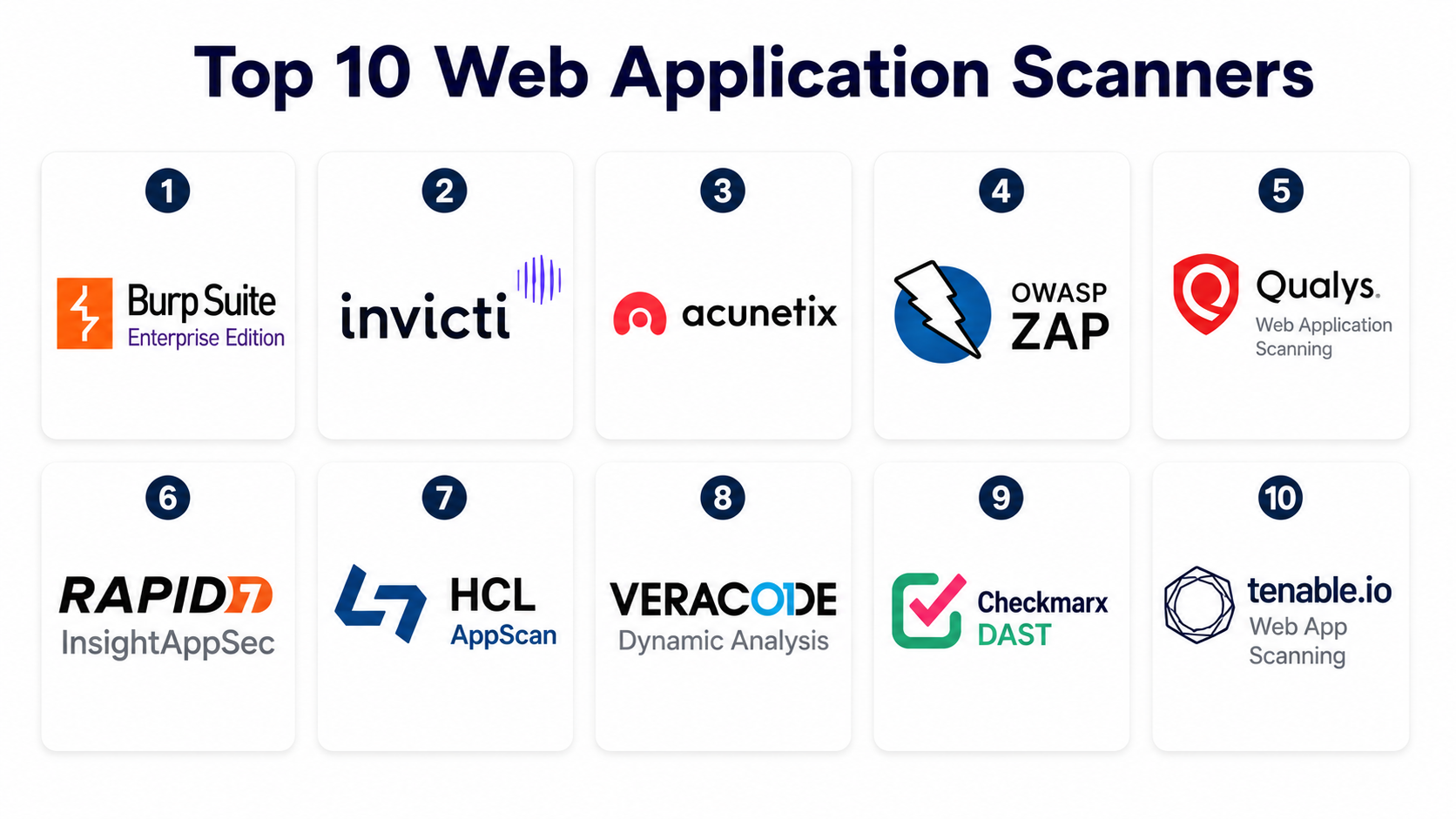
#1 — Burp Suite Enterprise Edition
Short description :
Burp Suite Enterprise Edition is one of the most widely recognized web application security testing platforms used by penetration testers, AppSec teams, and enterprises. Built on the popular Burp Suite ecosystem, it combines automated DAST scanning with manual testing workflows. The platform is highly regarded for advanced vulnerability analysis, API testing, and flexible security research capabilities. Burp Suite is commonly adopted by organizations requiring both automation and deep manual testing functionality.
Key Features
- Automated DAST scanning
- API security testing
- Advanced web vulnerability analysis
- Manual penetration testing workflows
- Authentication handling support
- CI/CD integrations
- Scheduling and reporting automation
Pros
- Strong penetration testing reputation
- Excellent flexibility for advanced testing
- Large security community ecosystem
Cons
- Advanced features require expertise
- Enterprise deployment can be complex
- SAST functionality is limited
Platforms / Deployment
- Windows / macOS / Linux
- Self-hosted / Hybrid
Security & Compliance
- RBAC
- Audit logging
- Encryption support
- Compliance reporting varies
Integrations & Ecosystem
Burp Suite integrates into AppSec and DevSecOps workflows.
- Jenkins
- GitHub
- Jira
- API testing tools
- CI/CD pipelines
- Security testing environments
Support & Community
Burp Suite has one of the strongest security testing communities available, with extensive documentation, tutorials, and enterprise support options.
#2 — Invicti
Short description :
Invicti is an enterprise-grade web application and API vulnerability scanning platform focused on proof-based DAST scanning and exploit validation. The platform emphasizes reducing false positives while improving remediation efficiency. Invicti supports cloud-native environments, DevSecOps workflows, and enterprise application security programs. It is widely used by organizations needing scalable automated web security testing.
Key Features
- Proof-based DAST scanning
- API security testing
- AI-assisted risk prioritization
- CI/CD automation
- Compliance reporting
- Asset discovery
- Centralized vulnerability management
Pros
- Strong false positive reduction
- Mature enterprise AppSec platform
- Good API security coverage
Cons
- Enterprise pricing structure
- Complex deployments may require tuning
- Advanced workflows can require expertise
Platforms / Deployment
- Windows / Linux
- Cloud / Self-hosted / Hybrid
Security & Compliance
- SSO/SAML
- MFA
- RBAC
- Audit logs
- Compliance-oriented reporting
Integrations & Ecosystem
Invicti integrates deeply into enterprise DevSecOps environments.
- GitHub
- Jenkins
- Jira
- ServiceNow
- Kubernetes
- Azure DevOps
Support & Community
Invicti provides enterprise onboarding, support services, training, and strong documentation resources.
#3 — Acunetix
Short description :
Acunetix is a popular automated web application scanner focused on vulnerability detection, API testing, and continuous security validation. It is commonly used by SMBs and mid-market organizations because of its balance between usability and scanning depth. Acunetix supports modern web applications, APIs, and scheduled automated testing workflows.
Key Features
- Automated DAST scanning
- API security testing
- Continuous monitoring
- Compliance reporting
- Scheduling automation
- Authentication support
- CI/CD integrations
Pros
- Easy deployment and management
- Good automated scanning capabilities
- Strong usability for smaller teams
Cons
- Enterprise governance depth is lighter
- Advanced customization varies
- SAST capabilities are limited
Platforms / Deployment
- Windows / Linux
- Cloud / Self-hosted
Security & Compliance
- RBAC
- Audit support
- Encryption support
- Compliance reporting capabilities
Integrations & Ecosystem
Acunetix integrates into security and DevSecOps workflows.
- GitHub
- Jira
- Jenkins
- Azure DevOps
- CI/CD systems
Support & Community
Acunetix provides onboarding resources, documentation, and enterprise support options.
#4 — OWASP ZAP
Short description :
OWASP ZAP (Zed Attack Proxy) is one of the most widely used open-source web application security scanners. It provides automated DAST scanning, proxy interception, vulnerability analysis, and API security testing capabilities. OWASP ZAP is especially popular among developers, learners, penetration testers, and organizations seeking flexible open-source security tooling. Community recommendations consistently highlight ZAP as a strong starting point for web application security testing.
Key Features
- Open-source DAST scanning
- API testing support
- Proxy interception
- Automated vulnerability detection
- Scripting and automation support
- CI/CD integration
- Community plugins
Pros
- Free and open-source
- Strong community ecosystem
- Flexible testing workflows
Cons
- Enterprise governance features are limited
- Advanced tuning may require expertise
- Reporting workflows can vary
Platforms / Deployment
- Windows / macOS / Linux
- Self-hosted
Security & Compliance
- RBAC varies by deployment
- Audit logging support
- Encryption support varies
Integrations & Ecosystem
OWASP ZAP integrates into open-source and DevSecOps ecosystems.
- Jenkins
- GitHub Actions
- Docker
- Kubernetes
- CI/CD pipelines
- Security automation workflows
Support & Community
OWASP ZAP has a very large global community with extensive tutorials, plugins, and educational resources.
#5 — Qualys Web Application Scanning (WAS)
Short description :
Qualys WAS provides cloud-based web application scanning, API testing, and vulnerability management capabilities for enterprise environments. The platform focuses on continuous monitoring, compliance reporting, and scalable cloud-based security operations. Qualys is commonly adopted by organizations already invested in the Qualys security ecosystem.
Key Features
- Cloud-based DAST scanning
- API security testing
- Continuous monitoring
- Compliance automation
- Asset inventory visibility
- Risk prioritization
- Enterprise reporting
Pros
- Strong enterprise scalability
- Mature cloud security ecosystem
- Good compliance support
Cons
- Enterprise operational complexity
- UI learning curve for some users
- Advanced workflows require tuning
Platforms / Deployment
- Web / Linux
- Cloud
Security & Compliance
- SSO/SAML
- MFA
- RBAC
- Audit logs
- Compliance reporting
Integrations & Ecosystem
Qualys integrates into enterprise vulnerability management environments.
- SIEM platforms
- AWS
- Azure
- Kubernetes
- Ticketing systems
- CI/CD pipelines
Support & Community
Qualys provides enterprise support programs, onboarding assistance, and extensive documentation.
#6 — Rapid7 InsightAppSec
Short description :
Rapid7 InsightAppSec is a cloud-native DAST platform focused on scalable web application and API security testing. The platform emphasizes automation, runtime analysis, and DevSecOps integration. Rapid7 is commonly adopted by organizations seeking unified visibility across vulnerability management and application security operations.
Key Features
- Dynamic application security testing
- API security testing
- Cloud-native scanning
- CI/CD automation
- Risk analytics
- Attack simulation
- Compliance reporting
Pros
- Strong cloud-native capabilities
- Good integration ecosystem
- Unified security operations visibility
Cons
- Advanced configurations may require expertise
- Enterprise pricing structure
- Reporting customization varies
Platforms / Deployment
- Windows / Linux
- Cloud
Security & Compliance
- SSO/SAML
- MFA
- RBAC
- Audit logs
- Compliance support
Integrations & Ecosystem
Rapid7 integrates into broader security operations environments.
- Jira
- GitHub
- AWS
- Azure
- SIEM systems
- Kubernetes
Support & Community
Rapid7 offers enterprise support, documentation, and customer onboarding programs.
#7 — HCL AppScan
Short description :
HCL AppScan provides enterprise-grade DAST, SAST, API security testing, and interactive application security testing capabilities. It is widely adopted in regulated industries and large enterprise environments requiring centralized governance and compliance visibility. AppScan supports both cloud and on-premises deployments.
Key Features
- Dynamic application security testing
- API security testing
- Interactive application testing
- Compliance automation
- CI/CD integrations
- Centralized vulnerability management
- Enterprise reporting
Pros
- Broad AppSec testing capabilities
- Strong compliance support
- Flexible deployment models
Cons
- Enterprise operational complexity
- UI modernization varies
- Advanced workflows may require expertise
Platforms / Deployment
- Windows / Linux
- Cloud / Self-hosted / Hybrid
Security & Compliance
- SSO/SAML
- MFA
- RBAC
- Audit logs
- Compliance-oriented reporting
Integrations & Ecosystem
AppScan integrates into enterprise security ecosystems.
- Jenkins
- GitHub
- Azure DevOps
- SIEM platforms
- Kubernetes
- Jira
Support & Community
HCL provides enterprise onboarding, technical support, and professional services.
#8 — Veracode Dynamic Analysis
Short description :
Veracode Dynamic Analysis is part of Veracode’s broader application security platform focused on web application and API security testing. The platform emphasizes governance, developer remediation workflows, and compliance reporting for enterprise AppSec programs. It is commonly adopted by organizations with mature secure SDLC initiatives.
Key Features
- Dynamic application scanning
- API security testing
- Compliance reporting
- Risk prioritization
- Developer remediation guidance
- CI/CD integration
- Governance dashboards
Pros
- Strong enterprise governance
- Good developer remediation workflows
- Mature AppSec ecosystem
Cons
- Premium pricing structure
- Scanning times may vary
- Complex onboarding for large environments
Platforms / Deployment
- Web / Linux
- Cloud / Hybrid
Security & Compliance
- SSO/SAML
- MFA
- RBAC
- Audit logs
- SOC 2 support
Integrations & Ecosystem
Veracode integrates into enterprise development environments.
- GitHub
- Jenkins
- Azure DevOps
- Jira
- IDE plugins
- CI/CD systems
Support & Community
Veracode provides enterprise support, onboarding assistance, and secure development resources.
#9 — Checkmarx DAST
Short description :
Checkmarx DAST is part of the Checkmarx One application security platform that combines SAST, DAST, SCA, API security, and cloud-native security testing. The platform focuses heavily on DevSecOps automation, unified governance, and scalable enterprise security testing workflows. Community feedback frequently highlights its consolidated AppSec capabilities.
Key Features
- Dynamic application security testing
- API security scanning
- Unified AppSec platform
- CI/CD integrations
- Risk prioritization
- Compliance reporting
- Cloud-native testing support
Pros
- Unified application security visibility
- Strong enterprise integrations
- Broad AppSec capabilities
Cons
- Enterprise pricing can be expensive
- Advanced deployment complexity
- Smaller teams may not require full feature set
Platforms / Deployment
- Windows / Linux / Kubernetes
- Cloud / Self-hosted / Hybrid
Security & Compliance
- SSO/SAML
- MFA
- RBAC
- Audit logs
- Compliance reporting
Integrations & Ecosystem
Checkmarx integrates deeply into DevSecOps ecosystems.
- GitHub
- GitLab
- Jenkins
- Azure DevOps
- Kubernetes
- Jira
Support & Community
Checkmarx offers enterprise onboarding, training, and technical support programs.
#10 — Tenable.io Web App Scanning
Short description :
Tenable.io Web App Scanning extends Tenable’s vulnerability management ecosystem into web application security testing. The platform focuses on scalable web application scanning, centralized risk visibility, and integration with broader cyber exposure management workflows. It is commonly used by enterprises already invested in Tenable infrastructure security products.
Key Features
- Web application scanning
- API security testing
- Asset discovery
- Risk prioritization
- Continuous monitoring
- Vulnerability analytics
- Compliance reporting
Pros
- Strong vulnerability management ecosystem
- Good enterprise scalability
- Unified exposure visibility
Cons
- Advanced AppSec workflows are lighter than specialized platforms
- Enterprise-oriented pricing
- API depth varies by deployment
Platforms / Deployment
- Windows / Linux
- Cloud
Security & Compliance
- SSO/SAML
- MFA
- RBAC
- Audit logs
- Compliance reporting
Integrations & Ecosystem
Tenable integrates into enterprise vulnerability management ecosystems.
- AWS
- Azure
- SIEM platforms
- Jira
- Kubernetes
- CI/CD systems
Support & Community
Tenable provides enterprise support services, onboarding programs, and technical documentation.
Comparison Table (Top 10)
| Tool Name | Best For | Platform(s) Supported | Deployment | Standout Feature | Public Rating |
|---|---|---|---|---|---|
| Burp Suite Enterprise | Penetration testing and advanced DAST | Windows, macOS, Linux | Hybrid | Manual and automated testing workflows | N/A |
| Invicti | Enterprise proof-based scanning | Windows, Linux | Hybrid | Proof-based exploit validation | N/A |
| Acunetix | SMB and mid-market web scanning | Windows, Linux | Cloud / Self-hosted | Easy automated scanning | N/A |
| OWASP ZAP | Open-source security testing | Windows, macOS, Linux | Self-hosted | Free and flexible DAST platform | N/A |
| Qualys WAS | Enterprise cloud-based scanning | Web, Linux | Cloud | Continuous monitoring | N/A |
| Rapid7 InsightAppSec | Cloud-native application security | Windows, Linux | Cloud | Unified security visibility | N/A |
| HCL AppScan | Regulated enterprise environments | Windows, Linux | Hybrid | Broad AppSec testing coverage | N/A |
| Veracode Dynamic Analysis | Governance-heavy AppSec programs | Web, Linux | Cloud / Hybrid | Enterprise compliance workflows | N/A |
| Checkmarx DAST | Unified AppSec programs | Windows, Linux, Kubernetes | Hybrid | Integrated AppSec ecosystem | N/A |
| Tenable.io WAS | Cyber exposure management integration | Windows, Linux | Cloud | Unified vulnerability visibility | N/A |
Evaluation & Web Application Scanners
| Tool Name | Core (25%) | Ease (15%) | Integrations (15%) | Security (10%) | Performance (10%) | Support (10%) | Value (15%) | Weighted Total (0–10) |
|---|---|---|---|---|---|---|---|---|
| Burp Suite Enterprise | 9 | 7 | 8 | 8 | 8 | 9 | 7 | 8.0 |
| Invicti | 9 | 8 | 9 | 9 | 8 | 8 | 7 | 8.4 |
| Acunetix | 8 | 8 | 7 | 7 | 8 | 7 | 8 | 7.7 |
| OWASP ZAP | 7 | 7 | 8 | 7 | 7 | 9 | 10 | 7.9 |
| Qualys WAS | 8 | 7 | 8 | 9 | 8 | 8 | 7 | 7.9 |
| Rapid7 InsightAppSec | 8 | 8 | 8 | 8 | 8 | 8 | 7 | 7.9 |
| HCL AppScan | 8 | 6 | 8 | 9 | 8 | 8 | 6 | 7.5 |
| Veracode Dynamic Analysis | 8 | 7 | 8 | 9 | 8 | 8 | 6 | 7.6 |
| Checkmarx DAST | 9 | 7 | 9 | 9 | 8 | 8 | 6 | 8.0 |
| Tenable.io WAS | 7 | 7 | 8 | 8 | 8 | 8 | 7 | 7.5 |
These scores are comparative and designed to help organizations evaluate trade-offs between automation depth, enterprise governance, scalability, and operational usability. Open-source tools often provide excellent flexibility and value, while enterprise platforms focus more heavily on compliance, integrations, and centralized governance. Buyers should prioritize the criteria most aligned with their security maturity and development workflows.
Which Web Application Scanners
Solo / Freelancer
OWASP ZAP and Burp Suite Community Edition are strong choices for individual developers, learners, and independent penetration testers needing affordable or open-source scanning capabilities.
SMB
SMBs often benefit from Acunetix or Rapid7 InsightAppSec because of easier deployment, automation workflows, and manageable operational complexity.
Mid-Market
Mid-market organizations should evaluate Invicti, Qualys WAS, and Burp Suite Enterprise for stronger scalability and broader AppSec integration support.
Enterprise
Large enterprises typically require governance dashboards, API security testing, compliance reporting, and DevSecOps integration. Invicti, Checkmarx, HCL AppScan, and Veracode are strong enterprise-oriented choices.
Budget vs Premium
Open-source tools like OWASP ZAP provide excellent value for smaller teams, while premium enterprise platforms offer deeper automation, governance, and compliance capabilities.
Feature Depth vs Ease of Use
Burp Suite and Invicti provide advanced testing depth, while Acunetix focuses more heavily on usability and deployment simplicity.
Integrations & Scalability
Organizations operating CI/CD pipelines and cloud-native applications should prioritize Kubernetes, API gateway, SIEM, and DevOps integrations.
Security & Compliance Needs
Regulated industries often require audit logs, centralized governance, policy enforcement, and compliance reporting. Veracode, HCL AppScan, and Checkmarx are especially strong in these areas.
Frequently Asked Questions (FAQs)
1. What is a web application scanner?
A web application scanner is a security tool that automatically tests websites and applications for vulnerabilities such as SQL injection, XSS, insecure configurations, and authentication weaknesses.
2. Why are web application scanners important in 2026?
Modern applications rely heavily on APIs, cloud-native services, JavaScript frameworks, and rapid deployment pipelines, significantly increasing the web attack surface.
3. What is the difference between DAST and SAST?
DAST tests running applications externally, while SAST analyzes source code and binaries without executing the application.
4. Can web application scanners test APIs?
Yes. Most modern scanners now support REST APIs, GraphQL APIs, and increasingly gRPC security testing.
5. Are open-source scanners reliable?
Yes. Tools like OWASP ZAP are widely respected and heavily used in both education and enterprise environments.
6. What are false positives in web application scanning?
False positives occur when a scanner incorrectly flags secure behavior as vulnerable, increasing remediation workload for developers and security teams.
7. Can these tools integrate into CI/CD pipelines?
Most modern scanners integrate with Jenkins, GitHub Actions, GitLab CI, Azure DevOps, and Kubernetes workflows.
8. Do web application scanners replace penetration testing?
No. Automated scanners complement but do not fully replace manual penetration testing and advanced security assessments.
9. Which industries benefit most from web application scanners?
Financial services, healthcare, SaaS providers, e-commerce companies, government agencies, and telecommunications organizations benefit heavily from continuous web security testing.
10. How difficult is implementation?
Implementation complexity depends on application architecture, authentication requirements, CI/CD maturity, and compliance needs. SaaS-based scanners are generally easier to deploy than large enterprise hybrid environments.
Conclusion
Web Application Scanners have become foundational components of modern application security programs. As organizations increasingly depend on APIs, cloud-native architectures, JavaScript-heavy applications, and rapid software delivery pipelines, continuous web security validation is essential for reducing attack exposure and maintaining compliance. Modern scanners now go beyond traditional DAST capabilities by supporting API security, runtime analytics, AI-assisted prioritization, and cloud-native integrations.
