Introduction
The complexity of modern, distributed cloud infrastructure requires more than just traditional software development or basic system administration. Today, enterprises demand architecture that is resilient, scalable, and inherently self-healing. This comprehensive guide is designed for software engineers, platform specialists, and engineering managers who want to validate their architectural capability through the Certified Site Reliability Architect framework. As systems scale exponentially, understanding the blueprint of high-availability infrastructure becomes a core requirement rather than an optional skill. Navigating the evolving ecosystem of modern operations, including specialized domains like aiopsschool, requires a structured approach to learning. This guide provides an unbiased, experience-driven roadmap to help professionals make informed decisions about their career trajectory, skill acquisition, and long-term professional growth in platform engineering.
What is the Certified Site Reliability Architect?
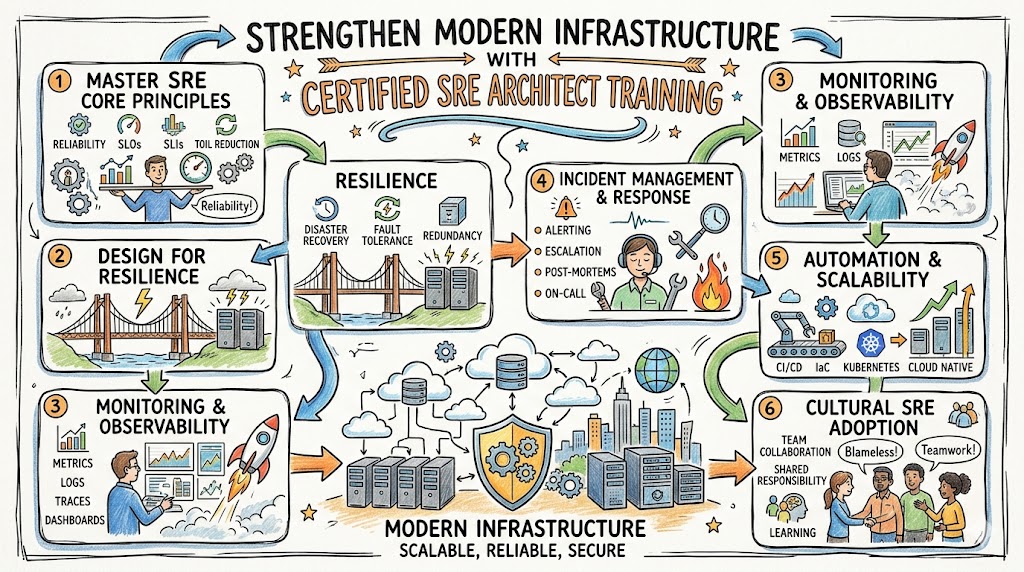
The Certified Site Reliability Architect designation represents a rigorous validation of an engineer’s ability to design, deploy, and maintain large-scale, fault-tolerant systems. It exists to bridge the gap between theoretical software engineering principles and production-grade operational realities. Unlike certifications that focus solely on the syntax of a specific cloud provider’s tools, this framework emphasizes systemic architecture, resilience engineering, and the cultural philosophy of site reliability. The curriculum aligns directly with modern enterprise workflows, focusing on automated governance, comprehensive observability, and systemic risk mitigation. By focusing heavily on production-focused scenarios, it ensures that certified professionals can confidently lead complex infrastructure migrations, manage distributed system failures, and build frameworks that support continuous, reliable deployment.
Who Should Pursue Certified Site Reliability Architect?
This architectural certification is built primarily for mid-level to senior professionals who manage, design, or secure production workloads. Systems engineers, cloud architects, and dedicated site reliability specialists will find the curriculum directly applicable to their day-to-day challenges of maintaining system uptime. Additionally, security professionals and data engineers who need to design reliable data pipelines and secure infrastructure boundaries benefit from the structural discipline the framework teaches. For engineering managers and technical directors in India and across global markets, this certification provides the vocabulary and structural framework needed to lead modern engineering teams. Whether you are an experienced engineer looking to formalize your architectural knowledge or a technical manager aiming to scale your engineering organization safely, this certification provides measurable career value.
Why Certified Site Reliability Architect
The modern enterprise tech stack is in a state of constant evolution, making tool-specific knowledge rapidly obsolete. The value of the Certified Site Reliability Architect program lies in its focus on core architectural principles that remain constant regardless of whether you use specific cloud vendors or underlying container orchestration platforms. Organizations worldwide are facing massive financial and reputational risks due to system downtime, driving a massive surge in demand for architects who can guarantee reliability. Investing time and effort into this certification delivers a high return on investment by positioning you as a high-value specialist capable of reducing operational overhead. By mastering systemic design, fault isolation, and automated remediation, you secure long-term career longevity and remain highly relevant even as individual tools come and go.
Certified Site Reliability Architect Certification Overview
The formal certification program is delivered through the official channels of sreschool, establishing a standardized baseline for architectural excellence. The assessment methodology goes beyond simple multiple-choice formats, incorporating practical evaluations that test an individual’s problem-solving capability under simulated production pressure. The program is structured into clear tiers that accommodate varying levels of professional experience, ensuring a logical progression from foundational concepts to advanced enterprise design. Ownership of this certification indicates that a professional has met rigorous industry standards for managing system availability, performance, and efficiency. The overall structure is highly practical, ensuring that every hour spent studying translates directly into actionable skills that can be deployed immediately within an enterprise production environment.
Certified Site Reliability Architect Certification Tracks & Levels
The certification framework is divided into three distinct levels to mirror typical career progression within an enterprise engineering organization. The Foundation level introduces core reliability metrics, basic automation concepts, and foundational observability patterns required by junior or transitioning engineers. Moving upward, the Professional level focuses on complex distributed system patterns, advanced incident response mechanisms, and comprehensive multi-region deployment strategies. Finally, the Advanced level is tailored for principal engineers and enterprise architects who design overarching governance frameworks and direct corporate infrastructure strategy. Specialization tracks allow professionals to align their studies with specific operational philosophies, ensuring that whether your focus is on cost optimization, security integration, or automated telemetry, there is a clear roadmap to follow.
Complete Certified Site Reliability Architect Certification Table
| Track | Level | Who it’s for | Prerequisites | Skills Covered | Recommended Order |
| Core SRE Architecture | Foundation | Associate Engineers, Systems Administrators | 1+ Year Linux & Cloud Basis | SLO/SLI Formulation, Basic Observability, GitOps | First |
| Enterprise Resilience | Professional | Senior DevOps, Infrastructure Engineers | 3+ Years Production Experience | Chaos Engineering, Multi-Region Failover, Mesh Networks | Second |
| Infrastructure Governance | Advanced | Principal Architects, Technical Directors | 5+ Years Architecture Design | Cost Optimization, Global Traffic Management, Compliance | Third |
Detailed Guide for Each Certified Site Reliability Architect Certification
Certified Site Reliability Architect – Foundation Level
What it is
This level validates a professional’s understanding of foundational site reliability principles, core deployment metrics, and baseline automation techniques. It ensures that the candidate can contribute effectively to an existing operational team without requiring constant supervision.
Who should take it
Junior cloud engineers, system administrators transitioning to DevOps, and software developers who want to understand the operational impact of their code changes.
Skills you’ll gain
- Defining accurate Service Level Indicators and Service Level Objectives.
- Implementing basic log aggregation and metric collection dashboards.
- Writing configuration management scripts for predictable environment provisioning.
Real-world projects you should be able to do
- Configure a standardized Prometheus and Grafana stack to monitor a microservices application.
- Automate the deployment of a basic staging environment using modern Infrastructure as Code tools.
Preparation plan
- 7 Days: Focus on memorizing foundational core terminology, understanding reliability formulas, and mastering basic architectural terminology.
- 30 Days: Read core architectural whitepapers, build out sample monitoring dashboards in a personal lab, and complete all foundational practice scenarios.
- 60 Days: Conduct extensive practical review, simulate minor system outages to test alerting configurations, and review sample case studies on production failure modes.
Common mistakes
- Spending too much time studying specific cloud provider tools instead of learning platform-agnostic architectural principles.
- Neglecting the cultural and philosophical aspects of reliability, such as post-mortem documentation and blameless culture.
Best next certification after this
- Same-track option: Certified Site Reliability Architect – Professional Level
- Cross-track option: Enterprise DevSecOps Foundations
- Leadership option: Technical Team Lead Certification
Certified Site Reliability Architect – Professional Level
What it is
This certification validates advanced expertise in designing distributed, resilient systems that can withstand major infrastructure degradations. It confirms that an engineer can lead incident response efforts and architect complex automated recovery systems.
Who should take it
Senior DevOps engineers, dedicated platform specialists, and infrastructure consultants with multiple years of hands-on production experience under their belt.
Skills you’ll gain
- Designing multi-region, active-active deployment topologies with zero data loss.
- Implementing automated chaos engineering experiments to discover system weaknesses.
- Advanced traffic routing, canary deployments, and zero-downtime service mesh configurations.
Real-world projects you should be able to do
- Architect a fully automated cross-region database failover mechanism that triggers during a simulated provider outage.
- Deploy a production-grade service mesh that enforces strict mutual TLS and handles traffic splitting for canary releases.
Preparation plan
- 7 Days: Deep dive into advanced networking topologies, distributed consensus protocols, and complex data replication models.
- 30 Days: Implement real-world chaos engineering experiments using specialized tools in an isolated sandbox environment.
- 60 Days: Review complex architecture failure case studies, participate in simulated incident response drills, and complete comprehensive mock exams.
Common mistakes
- Overcomplicating system designs by adding unnecessary layers of microservices or caching systems when simpler solutions exist.
- Inadequate preparation for real-world scenarios that test data consistency during network partitions.
Best next certification after this
- Same-track option: Certified Site Reliability Architect – Advanced Level
- Cross-track option: Advanced Cloud Security Architect
- Leadership option: Engineering Manager Operations Track
Certified Site Reliability Architect – Advanced Level
What it is
This tier validates an individual’s ability to define global infrastructure strategy, manage multi-million dollar infrastructure budgets, and establish organization-wide governance policies. It marks the pinnacle of technical operational leadership.
Who should take it
Principal engineers, enterprise infrastructure architects, and technical directors responsible for the reliability of massive global systems.
Skills you’ll gain
- Formulating corporate-wide disaster recovery and business continuity frameworks.
- Establishing financial operations boundaries and programmatic cost-control mechanisms across multiple cloud vendors.
- Defining architectural standards that guarantee compliance with international security and data privacy laws.
Real-world projects you should be able to do
- Design a comprehensive global infrastructure strategy that accommodates strict compliance, data sovereignty, and low-latency user access.
- Audit an entire enterprise cloud footprint to engineer a programmatically enforced cost-reduction framework that saves significant budget.
Preparation plan
- 7 Days: Focus on global compliance standards, high-level financial models, and corporate risk management frameworks.
- 30 Days: Draft comprehensive architectural blueprints addressing complex multi-cloud requirements and enterprise-scale migrations.
- 60 Days: Engage in peer reviews of architectural designs, analyze large-scale industry failure events, and refine high-level communication strategies for executives.
Common mistakes
- Focus excessively on small technical configurations rather than looking at overarching business goals, cost structures, and organizational risk management.
- Ignoring the cultural challenges of driving adoption for new architectural standards across disparate engineering teams.
Best next certification after this
- Same-track option: Executive Technical Fellowship
- Cross-track option: Enterprise Security Director
- Leadership option: Chief Technology Officer Certification
Choose Your Learning Path
DevOps Path
The DevOps path focuses heavily on the continuous integration and delivery aspects of system architecture. Professionals choosing this route learn how to build secure, automated pipelines that rapidly push code to production while maintaining stability. The curriculum emphasizes automated testing frameworks, artifact management, and immutable infrastructure patterns. By aligning this path with architectural reliability, engineers ensure that high deployment velocity does not result in systemic instability.
DevSecOps Path
The DevSecOps path injects security controls directly into every layer of the modern automated infrastructure lifecycle. Candidates study automated vulnerability scanning, compliance as code, and secrets management architectures within distributed environments. This path ensures that security is never treated as an afterthought or a manual gateway at the end of a release cycle. Instead, security mechanisms are natively woven into the architecture, ensuring continuous compliance at scale.
SRE Path
The SRE path represents the pure application of software engineering practices to solve complex operational problems. This track focuses intensively on tracking system performance metrics, managing error budgets, and conducting blameless post-mortems. Engineers learn how to write complex software tools that automate away manual operational tasks, commonly known as toil. The primary goal of this path is to create fully self-healing systems that optimize availability automatically.
AIOps Path
The AIOps path leverages machine learning algorithms and advanced data analytics to automate operational monitoring and incident response. Professionals exploring this path study anomaly detection, automated root-cause analysis, and predictive capacity planning. By integrating intelligent algorithms into monitoring pipelines, engineers transition from reactive incident management to proactive system optimization. This path is crucial for managing scale where human analysis becomes a bottleneck.
MLOps Path
The MLOps path bridges the distinct gap between data science experimentation and production-grade machine learning system engineering. This specialty path covers the continuous delivery of machine learning models, automated data versioning, and specialized model monitoring infrastructure. Engineers learn how to manage the unique lifecycle of data models, ensuring they remain reliable, performant, and accurate over time. This track prevents model drift and ensures compute resource efficiency.
DataOps Path
The DataOps path applies agile manufacturing and automated development principles directly to complex, large-scale data pipelines. This path focuses on ensuring data quality, reducing the cycle time of data analytics data flows, and stabilizing distributed data storage architectures. Engineers learn how to orchestrate complex data processing engines, manage distributed data stores, and ensure reliable data delivery. This ensures enterprise analytics remain accurate and available.
FinOps Path
The FinOps path combines finance, engineering, and operational discipline to optimize cloud expenditures across the enterprise. Professionals specializing here master cloud cost allocation models, programmatic waste reduction, and real-time budgeting systems. This path teaches engineers to view architectural decisions through a financial lens, ensuring that infrastructure remains highly performant without becoming unsustainably expensive. It aligns technical choices with corporate financial performance.
Role → Recommended Certified Site Reliability Architect Certifications
| Role | Recommended Certifications |
| DevOps Engineer | Certified Site Reliability Architect – Foundation & Professional Levels |
| SRE | Certified Site Reliability Architect – Full Track (Foundation to Advanced) |
| Platform Engineer | Certified Site Reliability Architect – Professional Level |
| Cloud Engineer | Certified Site Reliability Architect – Foundation Level |
| Security Engineer | Certified Site Reliability Architect – Professional Level |
| Data Engineer | Certified Site Reliability Architect – Foundation Level |
| FinOps Practitioner | Certified Site Reliability Architect – Professional Level |
| Engineering Manager | Certified Site Reliability Architect – Advanced Level |
Next Certifications to Take After Certified Site Reliability Architect
Same Track Progression
Once you master the architectural frameworks within this program, the logical progression leads toward deep specialization in advanced resilience methods. This involves pursuing highly specialized certifications in advanced chaos engineering frameworks, deep network performance tuning, and complex multi-cloud orchestration methods. Staying within this track allows you to refine your skillset until you reach the principal engineer or technical fellow level within your enterprise.
Cross-Track Expansion
Broadening your technical horizons by stepping into adjacent tracks helps build a well-rounded skill profile. After achieving architectural certification, it is highly beneficial to look into specialized security architecture or cloud financial operations programs. This cross-pollination of skills creates cross-functional professionals who can design infrastructure that is simultaneously resilient, highly secure, and highly cost-optimized, giving you a distinct competitive advantage.
Leadership & Management Track
For professionals who wish to transition away from purely hands-on engineering toward organizational strategy, moving into the leadership track is the next logical step. This involves obtaining certifications focused on engineering team management, agile project governance, and corporate technology strategy. This path equips you to design not just the technical systems, but also the human organizational structures required to keep large enterprises operating smoothly.
Training & Certification Support Providers for Certified Site Reliability Architect
DevOpsSchool provides deep technical instruction focusing on continuous integration pipelines, automated environment delivery, and modern platform engineering methods necessary for infrastructure professionals.
Cotocus offers specialized boutique consulting and hands-on laboratory training sessions tailored to real-world cloud migrations and enterprise resilience architecture deployment strategies.
Scmgalaxy maintains an extensive community knowledge base, comprehensive study guides, and deep technical documentation to assist candidates preparing for complex technical certifications.
BestDevOps focuses on delivering highly practical bootcamps centered on containerization, platform automation, and microservices architecture management under real production workloads.
devsecopsschool offers highly focused training modules that integrate advanced automated security protocols directly into standard container pipelines and modern cloud architectures.
sreschool provides the primary, targeted educational paths, exam blueprints, and simulated testing environments required specifically for mastering site reliability architectural programs.
aiopsschool specializes in training engineers on how to leverage machine learning frameworks, automated alerting systems, and intelligent anomaly detection algorithms within enterprise platforms.
dataopsschool focuses on educating professionals in the management of reliable, automated, and highly scalable data processing pipelines and distributed storage infrastructure.
finopsschool delivers specialized curriculum focused on cloud financial optimization, cost allocation strategies, and governance models for senior engineering and financial professionals.
Frequently Asked Questions (General)
- What is the typical timeframe required to clear the professional level exam?Most candidates with prior operations experience require approximately 30 to 60 days of consistent study to fully master the material.
- Are there any hard mandatory prerequisites required before attempting the foundation tier?There are no administrative gates, but having a baseline understanding of Linux systems and public cloud infrastructure is highly recommended.
- How long does this specific architectural certification remain valid after passing?The certification remains valid for a period of three years, after which a recertification process is required to maintain active status.
- Does this training program focus on one specific cloud provider like AWS or Azure?No, the curriculum is intentionally cloud-agnostic, focusing on universal architectural patterns that apply to all major public and private clouds.
- What happens if a candidate fails the exam on their first attempt?The provider offers a standard retake policy, allowing candidates to register for a second attempt after a brief mandatory cooling-off period.
- How does this certification compare to standard vendor certificates?Vendor certificates focus on specific tool syntax, whereas this program focuses on systemic architecture, organizational reliability, and engineering philosophy.
- Is there a heavy programming or software development requirement in the exams?While deep software engineering is not the main focus, you must be comfortable reading code and writing automation scripts.
- Can an engineering manager benefit from this technical architectural program?Yes, the advanced levels provide managers with the frameworks and vocabulary needed to accurately evaluate infrastructure risks and direct engineering teams.
- Are the examinations conducted online or do they require physical center attendance?The testing process is fully supported online through secure, remotely proctored examination platforms, allowing global participation.
- What is the core focus of the practical laboratory assignments?The practical assignments challenge candidates to diagnose real-world system outages, configure monitoring stacks, and repair broken infrastructure deployments.
- Does this program cover containerization and modern orchestration platforms?Yes, modern container ecosystems and orchestration frameworks are treated as core components of modern reliable architecture designs.
- How highly regarded is this certification within the Indian corporate tech market?It is highly valued by major enterprise organizations and global technology centers in India that manage massive scale operations.
FAQs on Certified Site Reliability Architect
- How specifically does the Certified Site Reliability Architect program address the modern challenge of enterprise system downtime?The curriculum focuses deeply on teaching systemic isolation techniques, automated circuit breakers, and rapid failover topologies. Instead of teaching engineers how to simply react to production failures, it trains them to architect environments that automatically contain issues and self-heal before customers experience service degradation.
- Can someone transitioning from a traditional system administration background successfully pass this architectural examination track?Yes, but it requires shifting your mindset from manual server management to programmatic infrastructure automation. Traditional administrators will need to focus their study on software engineering concepts, continuous integration pipelines, and modern microservices telemetry to successfully bridge the knowledge gap required by the framework.
- What makes the sreschool delivery methodology different from other online technical training platforms?The platform focuses entirely on production-grade realities rather than idealized textbook scenarios. Their assessments test how an architect performs under simulated duress, ensuring that anyone holding the credential has proven practical capability to manage real enterprise infrastructure problems, not just memorize definitions.
- How do the advanced levels of this certification track address cloud cost management alongside system reliability?The advanced levels integrate modern financial governance directly into the architectural design process. Engineers learn how to build cost-optimized infrastructure, ensuring that high availability is achieved through elegant engineering patterns like auto-scaling and resource tuning rather than simply over-provisioning expensive hardware.
- What specific advantages does a cloud-agnostic certification provide over platform-specific credentials?Multi-cloud environments are standard in modern enterprises. A cloud-agnostic architecture credential proves that you understand the underlying engineering fundamentals of networking, storage, and computing. This enables you to design systems that transcend single vendor ecosystems and protect organizations from vendor lock-in.
- How does this certification validate an individual’s capability to handle incident response scenarios?The evaluation blueprints include specific sections on blameless incident post-mortems, root-cause analysis isolation, and modern alerting strategies. This ensures that a certified professional can structuredly lead engineering teams through high-pressure downtime events and establish practices that prevent repetitive system failures.
- In what ways does this architectural framework incorporate modern security principles within its core design?The program treats security as a fundamental pillar of system reliability rather than an external check. Candidates are trained in zero-trust network architectures, secure immutable infrastructure deployment methods, and automated secrets management, ensuring that security protocols scale naturally alongside production workloads.
- What role do observability and modern telemetry play throughout the various certification tiers?Observability is a foundational element across the entire track. The program moves past simple uptime monitoring to teach advanced distributed tracing, structured log aggregation, and real-time metric analysis. This ensures architects can gain clear, actionable insights into complex, distributed software behavior.
Final Thoughts: Is Certified Site Reliability Architect Worth It?
When evaluating whether to invest your limited professional development time into the Certified Site Reliability Architect program, look beyond industry hype. The reality of modern enterprise technology is that systems are becoming more distributed, harder to debug, and increasingly critical to business survival. Companies do not just need engineers who can write code or spin up virtual servers; they need architects who can guarantee that platforms remain stable under immense scale and pressure.
This certification track provides a structured, platform-agnostic framework that refines your operational instincts and validates your technical capability. If your goal is to transition into a principal engineering role, lead complex infrastructure teams, or master the art of building resilient distributed systems, this path offers a clear, highly practical roadmap. It is a commitment to mastering the foundational discipline of modern operations engineering, making it a highly valuable asset for long-term career growth.
