Introduction
Supply Chain Control Tower Platforms are centralized digital solutions that provide end-to-end visibility, monitoring, and decision-making capabilities across the entire supply chain. In simple terms, they act like a “control room” where businesses can track shipments, inventory, suppliers, and logistics operations in real time.
In today’s fast-moving global economy, supply chains are becoming more complex, fragmented, and risk-prone. With increasing disruptions, demand volatility, and rising customer expectations, control towers have become critical for predictive insights, faster decision-making, and operational resilience.
Real-world use cases include:
- Real-time shipment tracking and delay alerts
- Demand forecasting and inventory optimization
- Supplier risk monitoring and mitigation
- Logistics cost optimization and route planning
- Exception management and automated decision workflows
What buyers should evaluate:
- Real-time visibility capabilities
- AI/ML forecasting and predictive analytics
- Integration with ERP, TMS, WMS systems
- Scalability across global operations
- Data accuracy and latency
- User interface and dashboards
- Automation and workflow orchestration
- Security and compliance features
- Total cost of ownership
- Vendor support and ecosystem maturity
Best for: Large enterprises, global manufacturers, logistics companies, retail chains, and supply chain managers who need full visibility and proactive decision-making.
Not ideal for: Small businesses with simple supply chains, companies with minimal logistics complexity, or those relying on basic ERP reporting tools.
Key Trends in Supply Chain Control Tower Platforms
- AI-driven predictive analytics replacing reactive monitoring
- Autonomous supply chain orchestration with automation workflows
- Digital twins of supply chains for simulation and planning
- Real-time IoT integration for shipment tracking and condition monitoring
- Cloud-native platforms replacing legacy on-prem systems
- API-first architectures enabling deep integrations
- Sustainability tracking (carbon footprint, ESG reporting)
- Multi-tier supplier visibility beyond Tier-1 suppliers
- Event-driven architecture for instant alerts and responses
- Subscription-based pricing models replacing heavy upfront costs
How We Selected These Tools (Methodology)
- Evaluated market adoption and enterprise usage
- Assessed feature depth and innovation in AI and analytics
- Considered reliability and performance signals
- Reviewed security posture and compliance readiness
- Analyzed integration ecosystem and API capabilities
- Checked vendor maturity and global presence
- Compared usability and user experience
- Assessed scalability across industries and geographies
- Balanced enterprise-grade and mid-market solutions
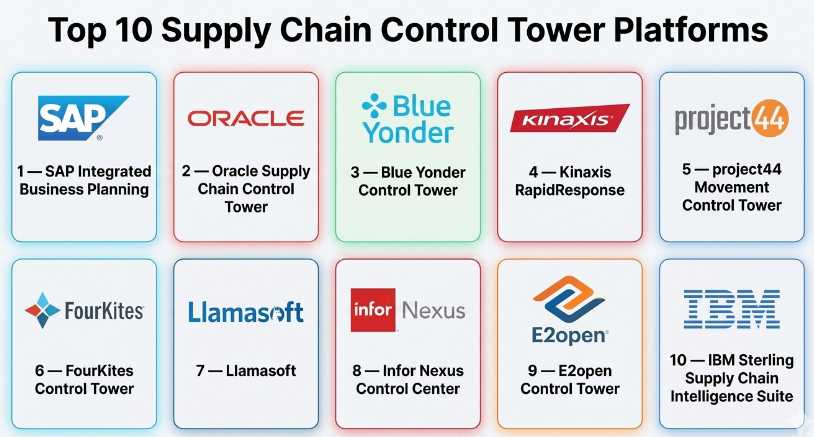
Top 10 Supply Chain Control Tower Platforms
#1 — SAP Integrated Business Planning (IBP)
Short description:
SAP IBP is an enterprise-grade control tower solution designed for large organizations. It offers advanced planning, forecasting, and real-time visibility integrated with SAP ecosystems. It is widely used in manufacturing, retail, and global supply chains for demand planning and supply optimization.
Key Features
- Demand forecasting with AI
- Inventory optimization
- Real-time supply chain visibility
- Scenario planning and simulations
- Integration with SAP ERP
- Collaboration tools for stakeholders
Pros
- Strong enterprise integration
- Advanced analytics capabilities
Cons
- Complex implementation
- High cost
Platforms / Deployment
Cloud / Hybrid
Security & Compliance
RBAC, encryption, SSO; other certifications not publicly stated
Integrations & Ecosystem
Strong SAP ecosystem integration with ERP, SCM, and analytics tools.
- SAP ERP
- SAP S/4HANA
- Third-party APIs
- Data lakes
Support & Community
Strong enterprise support, extensive documentation, large global user base
#2 — Oracle Supply Chain Control Tower
Short description:
Oracle’s platform provides unified visibility and predictive insights across supply chains. It focuses on real-time data aggregation and risk monitoring.
Key Features
- End-to-end visibility
- AI-based risk alerts
- Predictive analytics
- KPI dashboards
- Collaboration tools
Pros
- Strong analytics
- Scalable architecture
Cons
- Requires Oracle ecosystem alignment
- Learning curve
Platforms / Deployment
Cloud
Security & Compliance
Encryption, RBAC; other details not publicly stated
Integrations & Ecosystem
Integrates deeply with Oracle applications and third-party systems.
- Oracle ERP
- Logistics systems
- APIs
Support & Community
Enterprise-level support; documentation is structured but complex
#3 — Blue Yonder Control Tower
Short description:
Blue Yonder offers AI-powered supply chain visibility and execution capabilities, focusing on retail and logistics industries.
Key Features
- AI-driven forecasting
- Real-time alerts
- Demand and supply balancing
- Inventory optimization
- Exception management
Pros
- Strong AI capabilities
- Retail-focused strengths
Cons
- Implementation complexity
- Cost
Platforms / Deployment
Cloud
Security & Compliance
Not publicly stated
Integrations & Ecosystem
- ERP systems
- WMS/TMS
- APIs
Support & Community
Good enterprise support; moderate community presence
#4 — Kinaxis RapidResponse
Short description:
Kinaxis is known for real-time concurrent planning and rapid scenario analysis, ideal for dynamic supply chains.
Key Features
- Real-time planning
- Scenario simulation
- Demand-supply alignment
- Analytics dashboards
- Collaboration tools
Pros
- Fast decision-making
- User-friendly interface
Cons
- Limited customization
- Premium pricing
Platforms / Deployment
Cloud
Security & Compliance
SSO, encryption; others not publicly stated
Integrations & Ecosystem
- ERP systems
- Data integration tools
- APIs
Support & Community
Strong support and onboarding resources
#5 — project44 Movement Control Tower
Short description:
project44 focuses on logistics visibility, providing real-time tracking and predictive ETA capabilities.
Key Features
- Shipment tracking
- Predictive ETAs
- Carrier integration
- Risk alerts
- Analytics dashboards
Pros
- Excellent logistics visibility
- Strong carrier network
Cons
- Limited planning features
- Dependency on data quality
Platforms / Deployment
Cloud
Security & Compliance
Not publicly stated
Integrations & Ecosystem
- Carrier networks
- ERP systems
- APIs
Support & Community
Strong support; widely adopted in logistics sector
#6 — FourKites Control Tower
Short description:
FourKites provides real-time supply chain visibility with strong predictive analytics and automation.
Key Features
- Real-time tracking
- Predictive analytics
- Exception management
- Collaboration tools
- AI insights
Pros
- High data accuracy
- Strong analytics
Cons
- Pricing complexity
- Integration effort
Platforms / Deployment
Cloud
Security & Compliance
Not publicly stated
Integrations & Ecosystem
- ERP
- TMS
- IoT systems
Support & Community
Enterprise support; strong customer base
#7 — Llamasoft (Coupa Supply Chain Design & Planning)
Short description:
Llamasoft focuses on supply chain design and simulation with advanced modeling capabilities.
Key Features
- Supply chain modeling
- Scenario planning
- Network optimization
- Data analytics
- Simulation tools
Pros
- Strong modeling capabilities
- Strategic insights
Cons
- Less real-time focus
- Complex setup
Platforms / Deployment
Cloud
Security & Compliance
Not publicly stated
Integrations & Ecosystem
- ERP systems
- Data platforms
Support & Community
Good enterprise support
#8 — Infor Nexus Control Center
Short description:
Infor Nexus connects supply chain partners and provides visibility across global trade operations.
Key Features
- Multi-enterprise visibility
- Supplier collaboration
- Risk monitoring
- Logistics tracking
- Trade compliance
Pros
- Strong collaboration features
- Global network
Cons
- Interface complexity
- Limited customization
Platforms / Deployment
Cloud
Security & Compliance
Not publicly stated
Integrations & Ecosystem
- ERP
- Trade systems
- APIs
Support & Community
Moderate support; enterprise-focused
#9 — E2open Control Tower
Short description:
E2open offers a unified platform for supply chain planning, execution, and visibility.
Key Features
- End-to-end visibility
- Demand sensing
- Risk monitoring
- Supplier collaboration
- Analytics
Pros
- Comprehensive platform
- Strong partner network
Cons
- Complexity
- Pricing transparency
Platforms / Deployment
Cloud
Security & Compliance
Not publicly stated
Integrations & Ecosystem
- ERP
- Logistics systems
- APIs
Support & Community
Strong enterprise support
#10 — IBM Sterling Supply Chain Intelligence Suite
Short description:
IBM’s solution focuses on AI-driven insights and automation for supply chain optimization.
Key Features
- AI insights
- Risk alerts
- Real-time dashboards
- Automation workflows
- Integration with IBM ecosystem
Pros
- Strong AI capabilities
- Enterprise-grade reliability
Cons
- Complex implementation
- Requires IBM ecosystem
Platforms / Deployment
Cloud
Security & Compliance
Encryption, RBAC; others not publicly stated
Integrations & Ecosystem
- IBM Cloud
- ERP systems
- APIs
Support & Community
Strong enterprise support
Comparison Table (Top 10)
| Tool Name | Best For | Platform(s) Supported | Deployment | Standout Feature | Public Rating |
|---|---|---|---|---|---|
| SAP IBP | Enterprises | Web | Cloud/Hybrid | Advanced planning | N/A |
| Oracle Control Tower | Enterprises | Web | Cloud | Predictive analytics | N/A |
| Blue Yonder | Retail/logistics | Web | Cloud | AI forecasting | N/A |
| Kinaxis RapidResponse | Mid-large companies | Web | Cloud | Real-time planning | N/A |
| project44 | Logistics | Web | Cloud | Shipment visibility | N/A |
| FourKites | Logistics | Web | Cloud | Predictive ETAs | N/A |
| Llamasoft | Strategic planning | Web | Cloud | Simulation modeling | N/A |
| Infor Nexus | Global trade | Web | Cloud | Collaboration network | N/A |
| E2open | End-to-end SCM | Web | Cloud | Unified platform | N/A |
| IBM Sterling | Enterprises | Web | Cloud | AI insights | N/A |
Evaluation & Scoring of Supply Chain Control Tower Platforms
| Tool Name | Core (25%) | Ease (15%) | Integrations (15%) | Security (10%) | Performance (10%) | Support (10%) | Value (15%) | Weighted Total |
|---|---|---|---|---|---|---|---|---|
| SAP IBP | 9 | 6 | 9 | 8 | 9 | 9 | 6 | 8.1 |
| Oracle | 8 | 6 | 8 | 8 | 8 | 8 | 7 | 7.8 |
| Blue Yonder | 9 | 7 | 8 | 7 | 8 | 7 | 7 | 7.9 |
| Kinaxis | 8 | 8 | 7 | 7 | 8 | 8 | 7 | 7.8 |
| project44 | 7 | 8 | 8 | 6 | 8 | 7 | 8 | 7.6 |
| FourKites | 8 | 7 | 8 | 6 | 8 | 7 | 7 | 7.6 |
| Llamasoft | 8 | 6 | 7 | 6 | 7 | 7 | 7 | 7.1 |
| Infor Nexus | 7 | 6 | 7 | 6 | 7 | 7 | 7 | 6.9 |
| E2open | 8 | 6 | 8 | 7 | 8 | 8 | 7 | 7.6 |
| IBM Sterling | 8 | 6 | 8 | 8 | 8 | 8 | 6 | 7.7 |
How to interpret scores:
- Scores are comparative across this list, not absolute
- A higher score indicates stronger overall capability
- Weighting reflects real-world enterprise priorities
- Ease and value can vary significantly by organization
- Always validate through demos and pilots
Which Supply Chain Control Tower Platforms
Solo / Freelancer
Not typically required. Basic tools like spreadsheets or simple ERP modules are enough.
SMB
Consider lighter platforms like project44 or FourKites for visibility without heavy investment.
Mid-Market
Kinaxis and E2open provide a balance of features and usability.
Enterprise
SAP IBP, Oracle, IBM, and Blue Yonder are ideal for complex global operations.
Budget vs Premium
- Budget: project44, FourKites
- Premium: SAP, Oracle, IBM
Feature Depth vs Ease of Use
- Feature-rich: SAP, Oracle
- Easier to use: Kinaxis, FourKites
Integrations & Scalability
- Strong integrations: SAP, Oracle, IBM
- Moderate: Kinaxis, project44
Security & Compliance Needs
- High security: SAP, Oracle, IBM
- Moderate: Others
Frequently Asked Questions (FAQs)
1. What is a supply chain control tower?
It is a centralized platform that provides real-time visibility and decision-making tools across supply chains.
2. How much do these platforms cost?
Pricing varies widely based on scale and features; usually subscription-based.
3. How long does implementation take?
Typically ranges from a few weeks to several months depending on complexity.
4. Are these platforms cloud-based?
Most modern platforms are cloud-based, though hybrid options exist.
5. Do they support AI features?
Yes, many include AI for forecasting, alerts, and optimization.
6. Can small businesses use them?
Some lightweight versions exist, but full platforms are often enterprise-focused.
7. How do they integrate with ERP systems?
Through APIs and pre-built connectors for major ERP platforms.
8. Are they secure?
Most provide enterprise-grade security, but certifications vary.
9. What are common mistakes when choosing a platform?
Ignoring integration needs, underestimating implementation complexity, and focusing only on cost.
10. Can I switch platforms later?
Yes, but migration can be complex and requires planning.
Conclusion
Supply Chain Control Tower Platforms have become essential for organizations that want to move from reactive operations to proactive, data-driven decision-making. With increasing global complexity, disruptions, and customer expectations, these platforms provide the visibility and intelligence needed to stay competitive.