Introduction
Workplace Safety (EHS – Environment, Health, and Safety) software helps organizations manage safety processes, ensure regulatory compliance, and reduce workplace risks. These platforms centralize incident reporting, audits, inspections, training, and compliance tracking into a single system. Instead of relying on spreadsheets and manual processes, EHS software provides structured workflows, automation, and real-time visibility into safety performance.
In modern workplaces, especially across manufacturing, construction, energy, and healthcare, safety is not just a compliance requirement—it is a core business priority. With stricter regulations, remote operations, and increasing workforce diversity, organizations need scalable and intelligent systems to manage safety programs effectively.
Real-world use cases:
- Incident and accident reporting with root cause analysis
- Safety audits and inspections across sites
- Compliance tracking with regulatory frameworks
- Risk assessment and hazard identification
- Employee safety training and certifications
What buyers should evaluate:
- Incident management capabilities
- Compliance tracking and reporting
- Risk assessment tools
- Mobile accessibility for field workers
- Integration with ERP/HR systems
- Data analytics and dashboards
- Ease of use for non-technical staff
- Scalability across locations
- Security and data protection
- Customization and workflow automation
Best for: Safety managers, compliance officers, HR teams, operations leaders, and enterprises in high-risk industries like manufacturing, oil & gas, construction, and logistics.
Not ideal for: Very small businesses with minimal compliance needs or organizations with low-risk environments that can manage safety using simple tools.
Key Trends in Workplace Safety (EHS) Software
- AI-powered risk prediction: Identifying hazards before incidents occur
- Mobile-first safety reporting: Field workers submitting incidents via apps
- Real-time dashboards: Instant visibility into safety KPIs
- IoT integration: Sensors monitoring workplace conditions
- Automation of compliance workflows: Reducing manual reporting efforts
- Behavior-based safety analytics: Tracking unsafe actions
- Cloud-based deployment dominance: Easier scalability and access
- Integration with ESG reporting: Linking safety data to sustainability metrics
- Digital inspections and audits: Paperless safety processes
- Predictive analytics for incident prevention: Data-driven safety improvements
How We Selected These Tools (Methodology)
- Evaluated market leadership and adoption across industries
- Assessed core EHS functionality coverage
- Reviewed scalability and performance across large enterprises
- Analyzed security and compliance capabilities
- Evaluated integration ecosystems with enterprise tools
- Considered ease of use for frontline workers
- Assessed mobile capabilities and accessibility
- Reviewed innovation in AI and automation features
- Considered fit across SMB to enterprise segments
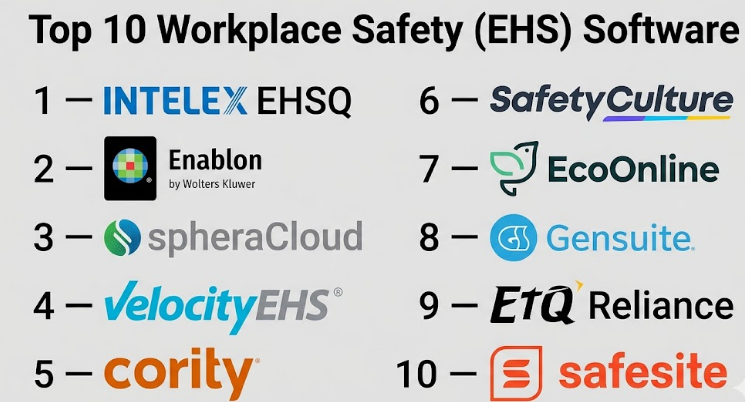
Top 10 Workplace Safety (EHS) Software
#1 — Intelex EHSQ
Short description:
Intelex EHSQ is a comprehensive enterprise-grade EHS platform designed for large organizations. It offers advanced safety, compliance, and quality management tools with strong customization capabilities.
Key Features
- Incident management and reporting
- Risk assessment tools
- Compliance tracking
- Audit and inspection workflows
- Advanced analytics dashboards
- Workflow automation
Pros
- Highly customizable
- Strong enterprise scalability
Cons
- Complex implementation
- Requires training for users
Platforms / Deployment
Web / Cloud
Security & Compliance
Not publicly stated
Integrations & Ecosystem
Intelex integrates with enterprise systems and supports APIs.
- ERP systems
- HR platforms
- Data analytics tools
Support & Community
Strong enterprise support and onboarding services.
#2 — Enablon
Short description:
Enablon is a leading EHS and sustainability platform used by global enterprises. It provides deep compliance and risk management features.
Key Features
- Incident and risk management
- Compliance tracking
- ESG integration
- Audit management
- Reporting and analytics
- Workflow automation
Pros
- Strong compliance capabilities
- Global enterprise adoption
Cons
- High cost
- Complex user interface
Platforms / Deployment
Web / Cloud
Security & Compliance
Not publicly stated
Integrations & Ecosystem
- SAP
- Oracle
- Enterprise analytics tools
Support & Community
Enterprise-grade support and consulting services.
#3 — SpheraCloud
Short description:
SpheraCloud offers EHS, risk management, and sustainability solutions with strong analytics and compliance features.
Key Features
- Risk management tools
- Incident tracking
- Compliance monitoring
- Data analytics
- Audit management
- ESG reporting
Pros
- Strong analytics capabilities
- Comprehensive feature set
Cons
- Complex setup
- Steep learning curve
Platforms / Deployment
Cloud
Security & Compliance
Not publicly stated
Integrations & Ecosystem
- Enterprise integrations
- API support
Support & Community
Professional support with onboarding.
#4 — VelocityEHS
Short description:
VelocityEHS is a cloud-based EHS platform focused on usability and real-time safety insights.
Key Features
- Incident reporting
- Risk assessment
- Safety training tools
- Mobile access
- Compliance tracking
- Real-time dashboards
Pros
- User-friendly interface
- Strong mobile capabilities
Cons
- Limited deep customization
- Some advanced features missing
Platforms / Deployment
Cloud
Security & Compliance
Not publicly stated
Integrations & Ecosystem
- HR systems
- ERP integrations
Support & Community
Good customer support and onboarding.
#5 — Cority
Short description:
Cority is a modular EHS platform offering strong compliance, health, and safety management capabilities.
Key Features
- Incident tracking
- Occupational health management
- Risk assessment
- Compliance management
- Reporting tools
- Analytics dashboards
Pros
- Modular flexibility
- Strong health and safety features
Cons
- Can become expensive
- Implementation complexity
Platforms / Deployment
Cloud
Security & Compliance
Not publicly stated
Integrations & Ecosystem
- Enterprise systems
- API integrations
Support & Community
Enterprise-level support.
#6 — SafetyCulture (iAuditor)
Short description:
SafetyCulture is a mobile-first EHS platform focused on inspections, audits, and frontline worker engagement.
Key Features
- Digital inspections
- Mobile reporting
- Incident tracking
- Checklist management
- Real-time analytics
- Collaboration tools
Pros
- Very easy to use
- Strong mobile experience
Cons
- Limited enterprise features
- Less advanced analytics
Platforms / Deployment
Web / iOS / Android / Cloud
Security & Compliance
Not publicly stated
Integrations & Ecosystem
- Integrates with productivity tools
- API support
Support & Community
Strong community and support resources.
#7 — EcoOnline
Short description:
EcoOnline focuses on chemical safety and workplace risk management, especially in regulated industries.
Key Features
- Chemical safety management
- Risk assessments
- Incident reporting
- Compliance tracking
- Training management
Pros
- Strong compliance tools
- Specialized chemical safety features
Cons
- Niche focus
- Limited general EHS features
Platforms / Deployment
Cloud
Security & Compliance
Not publicly stated
Integrations & Ecosystem
- Limited integrations
- API capabilities
Support & Community
Good support for regulated industries.
#8 — Gensuite
Short description:
Gensuite is an enterprise EHS platform known for ease of use and strong compliance features.
Key Features
- Incident management
- Compliance tracking
- Risk assessment
- Audits and inspections
- Reporting tools
Pros
- User-friendly
- Scalable
Cons
- Limited customization
- Moderate analytics
Platforms / Deployment
Cloud
Security & Compliance
Not publicly stated
Integrations & Ecosystem
- ERP integrations
- API support
Support & Community
Strong enterprise support.
#9 — ETQ Reliance
Short description:
ETQ Reliance provides EHS and quality management solutions with strong workflow automation.
Key Features
- Incident management
- Workflow automation
- Risk management
- Compliance tracking
- Reporting tools
Pros
- Strong workflow automation
- Flexible configuration
Cons
- Complex setup
- Learning curve
Platforms / Deployment
Cloud
Security & Compliance
Not publicly stated
Integrations & Ecosystem
- Enterprise integrations
- API support
Support & Community
Professional support services.
#10 — Safesite
Short description:
Safesite is a simple EHS platform designed for SMBs focusing on safety engagement and reporting.
Key Features
- Incident reporting
- Safety inspections
- Risk assessments
- Mobile reporting
- Safety engagement tools
Pros
- Easy to use
- Affordable
Cons
- Limited advanced features
- Not ideal for large enterprises
Platforms / Deployment
Web / Mobile / Cloud
Security & Compliance
Not publicly stated
Integrations & Ecosystem
Limited integrations
Support & Community
Basic support with onboarding.
Comparison Table (Top 10)
| Tool Name | Best For | Platform(s) Supported | Deployment | Standout Feature | Public Rating |
|---|---|---|---|---|---|
| Intelex EHSQ | Enterprises | Web | Cloud | Customization | N/A |
| Enablon | Global enterprises | Web | Cloud | Compliance depth | N/A |
| SpheraCloud | Risk-heavy industries | Web | Cloud | Analytics | N/A |
| VelocityEHS | Mid-market | Web | Cloud | Ease of use | N/A |
| Cority | Health & safety focus | Web | Cloud | Modular design | N/A |
| SafetyCulture | SMBs | Web, Mobile | Cloud | Mobile-first audits | N/A |
| EcoOnline | Chemical industries | Web | Cloud | Chemical safety | N/A |
| Gensuite | Enterprises | Web | Cloud | Simplicity | N/A |
| ETQ Reliance | Workflow automation | Web | Cloud | Automation | N/A |
| Safesite | SMBs | Web, Mobile | Cloud | Simplicity | N/A |
Evaluation & Workplace Safety (EHS) Software
| Tool Name | Core (25%) | Ease (15%) | Integrations (15%) | Security (10%) | Performance (10%) | Support (10%) | Value (15%) | Weighted Total |
|---|---|---|---|---|---|---|---|---|
| Intelex EHSQ | 9 | 7 | 8 | 8 | 8 | 9 | 7 | 8.1 |
| Enablon | 9 | 6 | 8 | 9 | 8 | 9 | 6 | 8.0 |
| SpheraCloud | 8 | 6 | 7 | 8 | 8 | 8 | 7 | 7.6 |
| VelocityEHS | 8 | 8 | 7 | 7 | 8 | 8 | 8 | 7.9 |
| Cority | 9 | 7 | 8 | 8 | 8 | 8 | 7 | 8.0 |
| SafetyCulture | 7 | 9 | 6 | 7 | 8 | 8 | 9 | 7.9 |
| EcoOnline | 7 | 7 | 6 | 8 | 7 | 7 | 7 | 7.1 |
| Gensuite | 8 | 8 | 7 | 7 | 8 | 8 | 7 | 7.8 |
| ETQ Reliance | 8 | 7 | 8 | 8 | 8 | 8 | 7 | 7.9 |
| Safesite | 6 | 8 | 6 | 6 | 7 | 7 | 9 | 7.0 |
How to interpret scores:
These scores are comparative within this category and reflect relative strengths. Organizations should prioritize criteria based on their needs rather than focusing only on total score.
Which Workplace Safety (EHS) Software
Solo / Freelancer
Use Safesite or SafetyCulture for simple safety tracking.
SMB
SafetyCulture and VelocityEHS offer ease of use and affordability.
Mid-Market
VelocityEHS and Gensuite provide balance between features and usability.
Enterprise
Intelex, Enablon, and SpheraCloud are best for large-scale operations.
Budget vs Premium
- Budget: Safesite, SafetyCulture
- Premium: Enablon, Intelex
Feature Depth vs Ease of Use
- Feature-rich: Enablon, SpheraCloud
- Easy to use: SafetyCulture, VelocityEHS
Integrations & Scalability
- Strong integrations: Intelex, Cority
- Limited integrations: Safesite
Security & Compliance Needs
- High compliance: Enablon, SpheraCloud
- Basic compliance: SMB tools
Frequently Asked Questions (FAQs)
1. What is EHS software?
It is a platform that helps organizations manage workplace safety, compliance, and risk.
2. Who should use EHS software?
Industries with safety risks like manufacturing, construction, and healthcare benefit most.
3. How much does EHS software cost?
Costs vary based on features, users, and deployment models.
4. Can EHS software integrate with other systems?
Yes, most platforms integrate with ERP, HR, and analytics systems.
5. Is EHS software required for compliance?
In many industries, it helps meet regulatory requirements efficiently.
6. What features are most important?
Incident tracking, compliance management, and reporting are key features.
7. Can small businesses use EHS software?
Yes, many tools are designed specifically for SMBs.
8. How long does implementation take?
It can range from a few days to several months depending on complexity.
9. Does EHS software improve safety outcomes?
Yes, by providing data insights and structured workflows.
10. What mistakes should companies avoid?
Choosing overly complex tools or ignoring user adoption.
Conclusion
Workplace Safety (EHS) software has become an essential part of modern organizational operations, especially in industries where risk and compliance are critical. These platforms go beyond simple reporting—they provide actionable insights, automation, and scalability to improve overall safety culture. However, the right choice depends heavily on your organization’s size, risk profile, and operational complexity. Large enterprises may prioritize advanced compliance and analytics, while smaller organizations benefit from ease of use and affordability.