Introduction
Legal Research Platforms are specialized software tools designed to help legal professionals find, analyze, and interpret laws, case rulings, statutes, regulations, and legal commentary. These platforms replace manual research across books and scattered databases with centralized, searchable, AI-assisted systems.
Environment, legal research is increasingly driven by AI, automation, and real-time updates. Law firms, corporate legal teams, and compliance departments face growing volumes of legal data and regulatory complexity. Fast, accurate research is critical not only for litigation but also for contract drafting, compliance audits, and risk mitigation.
Real-world use cases:
- Case law research for litigation preparation
- Regulatory compliance monitoring
- Legal opinion drafting
- Contract clause validation using precedents
- Due diligence and risk analysis
What buyers should evaluate:
- Depth and coverage of legal databases
- AI-powered search and summarization accuracy
- Jurisdiction coverage (global vs regional)
- Ease of use and search experience
- Integration with legal workflows and tools
- Security and data protection capabilities
- Pricing models and licensing flexibility
- Update frequency and legal accuracy
- Collaboration and annotation features
Best for: Law firms, in-house legal teams, compliance professionals, regulatory analysts, and legal researchers across industries such as finance, healthcare, and technology.
Not ideal for: Small teams with minimal legal research needs or organizations relying solely on external legal counsel.
Key Trends in Legal Research Platforms
- AI-driven legal search with natural language queries
- Generative AI summaries of case laws and statutes
- Predictive legal analytics for case outcomes
- Global jurisdiction expansion for cross-border compliance
- Integration with CLM and compliance platforms
- Real-time legal updates and alerts
- Voice-based and conversational legal queries
- Cloud-based access with mobile-first design
- Automated citation validation
- Shift toward all-in-one legal intelligence platforms
How We Selected These Tools (Methodology)
- Market leadership and adoption in legal industry
- Breadth and depth of legal content databases
- Accuracy and innovation in AI capabilities
- Performance and reliability across workloads
- Security posture and compliance features
- Integration with legal and enterprise ecosystems
- Usability and learning curve for professionals
- Coverage across jurisdictions and practice areas
- Vendor reputation and long-term viability
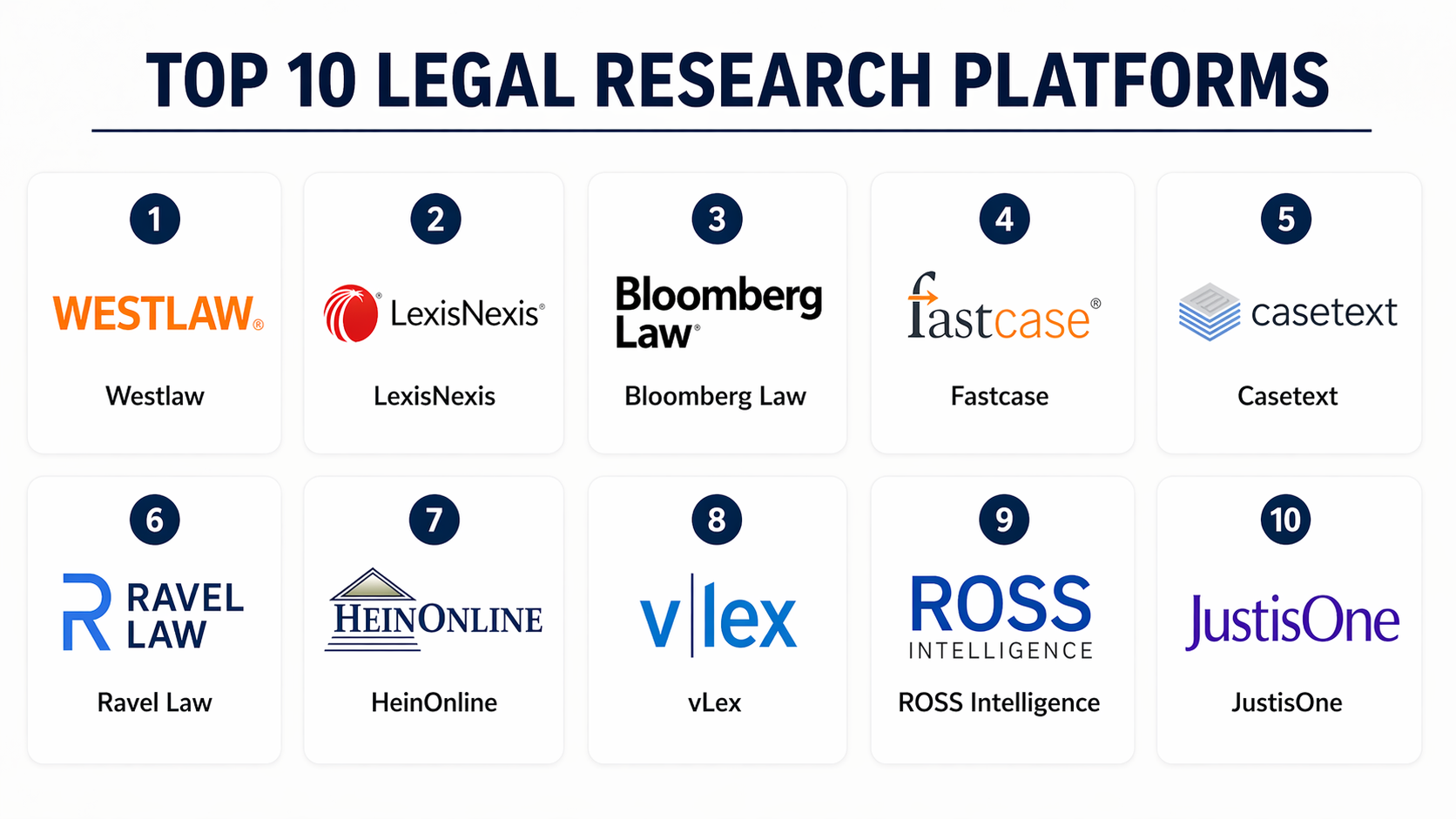
Top 10 Legal Research Platforms
#1 — Westlaw
Short description:
Westlaw is one of the most widely used legal research platforms globally. It provides extensive legal databases, advanced AI search, and editorial content. It is suitable for law firms and enterprise legal teams requiring deep research capabilities.
Key Features
- Comprehensive legal database
- AI-powered legal search
- Editorial insights and commentary
- Citation tracking
- Legal analytics tools
- Case law and statute coverage
- Alerts and monitoring
Pros
- Extremely comprehensive database
- Trusted by legal professionals worldwide
Cons
- Expensive
- Complex interface for beginners
Platforms / Deployment
Web
Cloud
Security & Compliance
Not publicly stated
Integrations & Ecosystem
Works within broader legal workflows and enterprise environments.
- Document management systems
- APIs
- Legal drafting tools
Support & Community
Strong enterprise support, training programs, and extensive documentation.
#2 — LexisNexis
Short description:
LexisNexis offers a powerful legal research platform with AI-enhanced analytics. It is widely used for case law research, compliance, and legal intelligence.
Key Features
- Legal research database
- AI-driven insights
- Legal analytics
- Case law search
- Regulatory tracking
- Citation tools
Pros
- Strong analytics capabilities
- Extensive global coverage
Cons
- Pricing complexity
- Learning curve
Platforms / Deployment
Web
Cloud
Security & Compliance
Not publicly stated
Integrations & Ecosystem
Broad integration ecosystem for legal workflows.
- APIs
- Enterprise systems
Support & Community
Comprehensive support and training.
#3 — Bloomberg Law
Short description:
Bloomberg Law combines legal research with business intelligence, offering legal content alongside financial and regulatory insights.
Key Features
- Legal and financial data integration
- AI search tools
- Case law database
- Regulatory tracking
- Analytics dashboards
Pros
- Strong financial/legal integration
- User-friendly interface
Cons
- Higher cost
- Limited niche coverage in some areas
Platforms / Deployment
Web
Cloud
Security & Compliance
Not publicly stated
Integrations & Ecosystem
Integrates with enterprise systems.
- Data analytics tools
- APIs
Support & Community
Good documentation and enterprise support.
#4 — Fastcase
Short description:
Fastcase provides affordable legal research tools with a focus on usability. It is widely used by smaller law firms and solo practitioners.
Key Features
- Case law search
- Citation analysis
- Visual search tools
- Legal database
- Mobile access
Pros
- Cost-effective
- Easy to use
Cons
- Limited advanced analytics
- Smaller database compared to leaders
Platforms / Deployment
Web / Mobile
Cloud
Security & Compliance
Not publicly stated
Integrations & Ecosystem
Basic integrations available.
- Legal apps
- APIs
Support & Community
Strong support for SMB users.
#5 — Casetext
Short description:
Casetext uses AI to streamline legal research with natural language queries and smart recommendations. It is popular for its ease of use.
Key Features
- AI-powered legal search
- Natural language queries
- Case analysis tools
- Smart recommendations
- Legal database
Pros
- Easy to use
- Strong AI capabilities
Cons
- Limited enterprise features
- Smaller dataset than premium tools
Platforms / Deployment
Web
Cloud
Security & Compliance
Not publicly stated
Integrations & Ecosystem
Focus on core legal workflows.
- APIs
- Document tools
Support & Community
Good onboarding and support.
#6 — Ravel Law
Short description:
Ravel Law focuses on legal analytics and visualization, helping users understand case patterns and judge behavior.
Key Features
- Legal analytics
- Case visualization
- Judge analytics
- Citation mapping
- Pattern recognition
Pros
- Strong visualization tools
- Useful for litigation strategy
Cons
- Limited database depth
- Not a full research platform
Platforms / Deployment
Web
Cloud
Security & Compliance
Not publicly stated
Integrations & Ecosystem
Limited integrations.
- APIs
Support & Community
Moderate support resources.
#7 — HeinOnline
Short description:
HeinOnline provides extensive historical legal documents and journals. It is widely used for academic and archival research.
Key Features
- Legal journals and archives
- Historical case law
- Law reviews
- Search tools
- Document access
Pros
- Rich historical data
- Strong academic use
Cons
- Limited AI features
- Less intuitive interface
Platforms / Deployment
Web
Cloud
Security & Compliance
Not publicly stated
Integrations & Ecosystem
Focused on research access.
- Limited integrations
Support & Community
Good academic support.
#8 — vLex
Short description:
vLex provides global legal research with AI-driven insights, covering multiple jurisdictions and legal systems.
Key Features
- Global legal database
- AI search
- Legal analytics
- Multilingual support
- Case law access
Pros
- Strong international coverage
- AI capabilities
Cons
- Interface complexity
- Pricing varies
Platforms / Deployment
Web
Cloud
Security & Compliance
Not publicly stated
Integrations & Ecosystem
Supports enterprise workflows.
- APIs
- Legal tools
Support & Community
Enterprise-level support.
#9 — ROSS Intelligence
Short description:
ROSS Intelligence focused on AI-powered legal research using natural language processing.
Key Features
- AI legal search
- Natural language queries
- Case law analysis
- Recommendation engine
Pros
- Strong AI innovation
- Easy search experience
Cons
- Limited availability
- Smaller dataset
Platforms / Deployment
Web
Cloud
Security & Compliance
Not publicly stated
Integrations & Ecosystem
Limited integrations.
- APIs
Support & Community
Not publicly stated
#10 — JustisOne
Short description:
JustisOne provides advanced case law research with powerful citation tools and legal analytics.
Key Features
- Case law database
- Citation analysis
- Legal research tools
- Analytics dashboards
- Search capabilities
Pros
- Strong citation tools
- Good legal analytics
Cons
- Limited global reach
- Interface complexity
Platforms / Deployment
Web
Cloud
Security & Compliance
Not publicly stated
Integrations & Ecosystem
Focused on legal research workflows.
- APIs
Support & Community
Moderate support availability.
Comparison Table (Top 10)
| Tool Name | Best For | Platform(s) Supported | Deployment | Standout Feature | Public Rating |
|---|---|---|---|---|---|
| Westlaw | Enterprise legal research | Web | Cloud | Comprehensive database | N/A |
| LexisNexis | Legal analytics | Web | Cloud | AI insights | N/A |
| Bloomberg Law | Legal + financial data | Web | Cloud | Data integration | N/A |
| Fastcase | SMB legal teams | Web/Mobile | Cloud | Affordable access | N/A |
| Casetext | AI search | Web | Cloud | Natural language queries | N/A |
| Ravel Law | Legal analytics | Web | Cloud | Visualization tools | N/A |
| HeinOnline | Academic research | Web | Cloud | Historical data | N/A |
| vLex | Global research | Web | Cloud | Multilingual coverage | N/A |
| ROSS Intelligence | AI research | Web | Cloud | NLP search | N/A |
| JustisOne | Case law research | Web | Cloud | Citation tools | N/A |
Evaluation & Legal Research Platforms
| Tool Name | Core (25%) | Ease (15%) | Integrations (15%) | Security (10%) | Performance (10%) | Support (10%) | Value (15%) | Weighted Total |
|---|---|---|---|---|---|---|---|---|
| Westlaw | 10 | 7 | 8 | 8 | 9 | 9 | 6 | 8.4 |
| LexisNexis | 9 | 7 | 8 | 8 | 9 | 9 | 6 | 8.2 |
| Bloomberg Law | 8 | 8 | 7 | 7 | 8 | 8 | 6 | 7.7 |
| Fastcase | 7 | 9 | 6 | 6 | 7 | 8 | 9 | 7.6 |
| Casetext | 8 | 9 | 6 | 6 | 7 | 8 | 8 | 7.8 |
| Ravel Law | 7 | 7 | 5 | 6 | 7 | 7 | 6 | 6.7 |
| HeinOnline | 7 | 6 | 4 | 6 | 7 | 7 | 7 | 6.6 |
| vLex | 8 | 7 | 7 | 7 | 8 | 8 | 7 | 7.6 |
| ROSS Intelligence | 7 | 8 | 5 | 6 | 7 | 6 | 7 | 6.9 |
| JustisOne | 7 | 7 | 5 | 6 | 7 | 7 | 6 | 6.8 |
How to interpret scores:
These scores are comparative across tools in this category. A higher “Core” score reflects stronger legal content and capabilities, while “Ease” focuses on usability. Choose based on your priorities—depth, cost, or simplicity.
Which Legal Research Platforms
Solo / Freelancer
Fastcase and Casetext are ideal due to affordability and ease of use.
SMB
Casetext and Fastcase provide good value and essential features.
Mid-Market
vLex and Bloomberg Law offer balanced capabilities.
Enterprise
Westlaw and LexisNexis are industry leaders with deep capabilities.
Budget vs Premium
- Budget: Fastcase, Casetext
- Premium: Westlaw, LexisNexis
Feature Depth vs Ease of Use
- Deep features: Westlaw, LexisNexis
- Ease of use: Casetext, Fastcase
Integrations & Scalability
- Strong integrations: Bloomberg Law, LexisNexis
- Moderate: vLex
Security & Compliance Needs
- Enterprise-grade: Westlaw, LexisNexis
- Basic: Fastcase
Frequently Asked Questions (FAQs)
1. What are Legal Research Platforms?
They are tools that help legal professionals search and analyze laws, cases, and regulations efficiently.
2. Are these tools expensive?
Pricing varies widely; enterprise tools are expensive while SMB tools are more affordable.
3. Do they use AI?
Yes, most modern platforms use AI for search, summarization, and analytics.
4. Can they replace lawyers?
No, they assist lawyers but do not replace legal expertise.
5. Are they secure?
Most platforms provide secure access, but compliance details vary.
6. Can they handle global laws?
Some platforms like vLex offer global coverage.
7. How long does onboarding take?
It depends on complexity—simple tools take days, enterprise tools take weeks.
8. Can they integrate with other tools?
Yes, many integrate with legal and enterprise systems.
9. What mistakes should be avoided?
Choosing tools without proper jurisdiction coverage or overpaying for unused features.
10. Are there alternatives?
Manual research or basic databases can be alternatives but lack efficiency.
Conclusion
Legal research platforms have become essential tools for modern legal teams, enabling faster, more accurate decision-making in an increasingly complex regulatory environment. From AI-powered search to predictive analytics, these platforms are transforming how legal professionals access and use information. However, the best choice depends on your specific needs—whether it’s deep legal coverage, ease of use, or affordability. Instead of choosing based on brand alone, shortlist two or three platforms, test their search capabilities, validate jurisdiction coverage, and ensure they integrate well with your workflows. This practical approach will help you make a confident, future-ready decision.