Introduction
Matter Management Systems are software tools used by legal teams to organize, track, and manage legal matters such as contracts, cases, disputes, compliance tasks, and regulatory activities. In simple terms, they act as a central system where all legal work is recorded, monitored, and controlled.
In today’s environment, especially with rising compliance requirements, cross-border regulations, and increasing legal workloads, these systems are no longer optional. Organizations need visibility into legal operations, better collaboration, and data-driven decisions.
Real-world use cases include:
- Managing corporate legal cases and litigation workflows
- Tracking contracts and legal documents across departments
- Monitoring regulatory compliance and audits
- Managing external counsel and legal spend
- Handling intellectual property portfolios
What buyers should evaluate:
- Ease of use and onboarding experience
- Workflow automation capabilities
- Integration with enterprise systems (ERP, CRM, DMS)
- Security and compliance features
- Reporting and analytics
- Scalability for future growth
- Cost vs value delivered
- Vendor support and ecosystem
Best for: Legal departments in enterprises, law firms, compliance teams, corporate governance teams, and regulated industries such as finance, healthcare, and manufacturing.
Not ideal for: Small teams with minimal legal workload or organizations that only need basic document storage—simple document management tools may be sufficient.
Key Trends in Matter Management Systems
- Increasing adoption of AI for contract analysis and risk detection
- Automation of legal workflows and approvals
- Integration with enterprise platforms like ERP and CRM
- Shift toward cloud-first deployment models
- Real-time dashboards for legal spend and case tracking
- Enhanced compliance tracking with regulatory mapping
- Role-based access control and granular permissions
- Expansion of mobile access for legal teams
- Subscription-based pricing replacing traditional licensing
- API-first platforms enabling customization and automation
How We Selected These Tools (Methodology)
- Evaluated tools with strong market presence and adoption
- Prioritized platforms with comprehensive feature sets
- Considered scalability across SMB to enterprise use cases
- Assessed reliability and system performance indicators
- Reviewed security capabilities and compliance readiness
- Evaluated integration capabilities with enterprise ecosystems
- Included tools suitable for different industries and use cases
- Considered user experience and onboarding complexity
- Looked at vendor support maturity and documentation quality
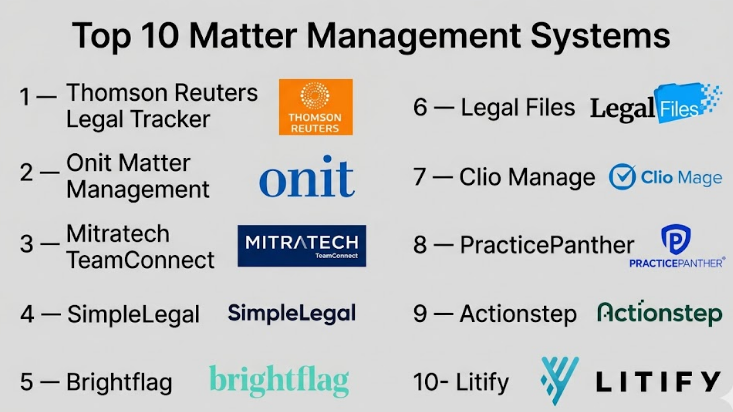
Top 10 Matter Management Systems
#1 — Thomson Reuters Legal Tracker
Short description:
A widely used enterprise-grade matter management platform designed for corporate legal departments. It focuses heavily on legal spend management and tracking external counsel performance.
Key Features
- Legal spend tracking and analytics
- Matter lifecycle management
- Vendor and law firm performance monitoring
- Invoice management and auditing
- Reporting dashboards
Pros
- Strong analytics for cost control
- Trusted by large enterprises
Cons
- Complex setup for smaller teams
- May require training for full utilization
Platforms / Deployment
- Web
- Cloud
Security & Compliance
- RBAC, audit logs
- Not publicly stated for certifications
Integrations & Ecosystem
Integrates with finance systems and legal tools.
- ERP systems
- Document management tools
- API support
Support & Community
Enterprise-level support with structured onboarding. Documentation is robust.
#2 — Onit Matter Management
Short description:
A flexible legal operations platform offering matter management along with workflow automation and AI capabilities.
Key Features
- Workflow automation
- AI-powered insights
- Matter tracking
- Contract lifecycle integration
- Reporting tools
Pros
- Highly customizable
- Strong automation capabilities
Cons
- Requires configuration effort
- Pricing not transparent
Platforms / Deployment
- Web
- Cloud
Security & Compliance
- SSO, RBAC
- Not publicly stated certifications
Integrations & Ecosystem
- ERP integrations
- CRM integrations
- Open APIs
Support & Community
Strong enterprise support, onboarding assistance available.
#3 — Mitratech TeamConnect
Short description:
A leading enterprise matter management system known for its scalability and compliance-focused features.
Key Features
- Matter and case tracking
- Compliance management
- Legal spend tracking
- Workflow automation
- Advanced reporting
Pros
- Highly scalable
- Strong compliance features
Cons
- Complex interface
- Implementation can be lengthy
Platforms / Deployment
- Web
- Cloud / On-premise
Security & Compliance
- RBAC, audit logs
- Not publicly stated certifications
Integrations & Ecosystem
- Financial systems
- HR systems
- API integrations
Support & Community
Enterprise support with detailed documentation.
#4 — SimpleLegal
Short description:
A modern, user-friendly matter management solution focused on simplicity and ease of use.
Key Features
- Matter tracking
- Legal spend management
- Reporting dashboards
- Vendor management
- Workflow automation
Pros
- Easy to use
- Fast onboarding
Cons
- Limited customization
- Not ideal for very complex needs
Platforms / Deployment
- Web
- Cloud
Security & Compliance
- MFA, encryption
- Not publicly stated certifications
Integrations & Ecosystem
- Accounting tools
- APIs
- Document tools
Support & Community
Good support for SMB and mid-market users.
#5 — Brightflag
Short description:
An AI-driven legal operations platform focusing on spend optimization and matter insights.
Key Features
- AI invoice review
- Matter tracking
- Spend analytics
- Vendor benchmarking
- Reporting
Pros
- Strong AI capabilities
- Excellent cost control
Cons
- Limited workflow customization
- Focused mainly on spend
Platforms / Deployment
- Web
- Cloud
Security & Compliance
- Encryption, RBAC
- Not publicly stated certifications
Integrations & Ecosystem
- Finance systems
- APIs
- Legal tools
Support & Community
Responsive support and onboarding.
#6 — Legal Files
Short description:
A long-standing legal case and matter management solution used by legal departments and government agencies.
Key Features
- Case management
- Document tracking
- Workflow automation
- Reporting tools
- Email integration
Pros
- Reliable and stable
- Suitable for government use
Cons
- Older UI
- Limited modern features
Platforms / Deployment
- Web / Windows
- Cloud / On-premise
Security & Compliance
- RBAC
- Not publicly stated certifications
Integrations & Ecosystem
- Email systems
- Document tools
Support & Community
Good documentation, moderate support responsiveness.
#7 — Clio Manage
Short description:
A popular cloud-based legal practice management platform widely used by small law firms.
Key Features
- Matter management
- Time tracking
- Billing
- Document management
- Client portal
Pros
- Easy to use
- Strong SMB adoption
Cons
- Limited enterprise features
- Less customization
Platforms / Deployment
- Web / iOS / Android
- Cloud
Security & Compliance
- Encryption, MFA
- Not publicly stated certifications
Integrations & Ecosystem
- Accounting tools
- Calendar apps
- API integrations
Support & Community
Strong community and support ecosystem.
#8 — PracticePanther
Short description:
A legal practice management platform designed for small to mid-sized law firms.
Key Features
- Matter tracking
- Billing and invoicing
- Task management
- Document storage
- Reporting
Pros
- User-friendly
- Affordable pricing
Cons
- Limited advanced analytics
- Not ideal for large enterprises
Platforms / Deployment
- Web / iOS / Android
- Cloud
Security & Compliance
- Encryption
- Not publicly stated certifications
Integrations & Ecosystem
- Payment systems
- CRM tools
Support & Community
Good support for smaller teams.
#9 — Actionstep
Short description:
A workflow-driven legal management platform with strong automation capabilities.
Key Features
- Workflow automation
- Matter management
- Document automation
- Billing and accounting
- CRM features
Pros
- Strong workflow engine
- Flexible platform
Cons
- Learning curve
- Setup complexity
Platforms / Deployment
- Web
- Cloud
Security & Compliance
- RBAC
- Not publicly stated certifications
Integrations & Ecosystem
- CRM systems
- Accounting tools
- API support
Support & Community
Moderate support with growing community.
#10 — Litify
Short description:
A Salesforce-based legal platform designed for law firms and corporate legal teams.
Key Features
- Matter management
- CRM integration
- Workflow automation
- Analytics dashboards
- Case tracking
Pros
- Strong Salesforce integration
- Highly customizable
Cons
- Requires Salesforce knowledge
- Cost can be high
Platforms / Deployment
- Web
- Cloud
Security & Compliance
- SSO, RBAC
- Not publicly stated certifications
Integrations & Ecosystem
- Salesforce ecosystem
- APIs
- Third-party apps
Support & Community
Strong support within Salesforce ecosystem.
Comparison Table (Top 10)
| Tool Name | Best For | Platform(s) Supported | Deployment | Standout Feature | Public Rating |
|---|---|---|---|---|---|
| Thomson Reuters Legal Tracker | Enterprises | Web | Cloud | Spend analytics | N/A |
| Onit Matter Management | Enterprises | Web | Cloud | Workflow automation | N/A |
| Mitratech TeamConnect | Enterprises | Web | Cloud/On-premise | Compliance focus | N/A |
| SimpleLegal | SMB/Mid-market | Web | Cloud | Ease of use | N/A |
| Brightflag | Enterprises | Web | Cloud | AI analytics | N/A |
| Legal Files | Government/Legal teams | Web/Windows | Cloud/On-premise | Case management | N/A |
| Clio Manage | Small firms | Web/Mobile | Cloud | Ease of use | N/A |
| PracticePanther | Small firms | Web/Mobile | Cloud | Affordable pricing | N/A |
| Actionstep | Mid-market | Web | Cloud | Workflow automation | N/A |
| Litify | Enterprises | Web | Cloud | Salesforce integration | N/A |
Evaluation & Matter Management Systems
| Tool Name | Core | Ease | Integrations | Security | Performance | Support | Value | Weighted Total |
|---|---|---|---|---|---|---|---|---|
| Thomson Reuters Legal Tracker | 9 | 7 | 8 | 8 | 8 | 8 | 7 | 8.0 |
| Onit Matter Management | 9 | 7 | 9 | 8 | 8 | 8 | 7 | 8.2 |
| Mitratech TeamConnect | 9 | 6 | 8 | 9 | 8 | 8 | 7 | 8.1 |
| SimpleLegal | 7 | 9 | 7 | 7 | 7 | 7 | 8 | 7.6 |
| Brightflag | 8 | 8 | 7 | 7 | 8 | 7 | 7 | 7.7 |
| Legal Files | 7 | 6 | 6 | 7 | 7 | 6 | 7 | 6.8 |
| Clio Manage | 7 | 9 | 7 | 7 | 7 | 8 | 8 | 7.8 |
| PracticePanther | 6 | 9 | 6 | 6 | 7 | 7 | 8 | 7.2 |
| Actionstep | 8 | 7 | 7 | 7 | 7 | 7 | 7 | 7.4 |
| Litify | 9 | 6 | 9 | 8 | 8 | 8 | 6 | 8.0 |
How to interpret scores:
- Scores are relative comparisons within this category
- Higher scores indicate better balance across features and usability
- Enterprise tools score higher in core and integrations
- SMB tools score higher in ease and value
- Choose based on your specific needs rather than overall score
Which Matter Management Systems
Solo / Freelancer
Clio Manage or PracticePanther are ideal due to simplicity and affordability.
SMB
SimpleLegal or Actionstep provide a balance between features and usability.
Mid-Market
Actionstep and Onit offer scalability and automation capabilities.
Enterprise
Mitratech TeamConnect, Onit, and Thomson Reuters Legal Tracker are best suited.
Budget vs Premium
Budget tools: PracticePanther, Clio
Premium tools: Onit, Mitratech
Feature Depth vs Ease of Use
- Feature-rich: Onit, Litify
- Easy to use: SimpleLegal, Clio
Integrations & Scalability
- Strong integrations: Litify, Onit
- Moderate: SimpleLegal
Security & Compliance Needs
- High compliance: Mitratech, Thomson Reuters
- Basic needs: Clio, PracticePanther
Frequently Asked Questions (FAQs)
1. What is a Matter Management System?
It is a platform used to track, manage, and organize legal matters, cases, and related workflows within an organization.
2. How much do these systems cost?
Pricing varies widely depending on features, users, and deployment. Most follow subscription-based models.
3. How long does implementation take?
It can range from a few days for simple tools to several months for enterprise platforms.
4. Are these systems secure?
Most platforms include encryption, RBAC, and audit logs, but certifications vary by vendor.
5. Can they integrate with other systems?
Yes, most modern tools offer APIs and integrations with ERP, CRM, and document systems.
6. What are common mistakes when choosing a tool?
Ignoring scalability, underestimating onboarding complexity, and not evaluating integrations.
7. Can small firms use these tools?
Yes, tools like Clio and PracticePanther are specifically designed for small firms.
8. Do these tools support compliance tracking?
Many enterprise tools include compliance tracking and reporting features.
9. Can I switch tools later?
Yes, but migration can be complex and requires planning.
10. Are there alternatives to matter management systems?
Basic alternatives include document management systems or spreadsheets, but they lack advanced capabilities.
Conclusion
Matter Management Systems have become essential for modern legal operations, especially as organizations deal with increasing complexity, compliance requirements, and legal workloads. While enterprise platforms like Onit and Mitratech offer deep functionality and scalability, simpler tools like Clio and PracticePanther provide ease of use for smaller teams. The right choice depends on your size, budget, and operational needs. Instead of chasing the “best” tool, focus on alignment with your workflows, integration requirements, and future growth. A practical next step is to shortlist two or three tools, run a pilot, and validate how well they integrate with your existing systems and processes before making a final decision.