Introduction
Crisis Management Platforms are software systems designed to help organizations prepare for, respond to, and recover from unexpected events such as cyberattacks, system outages, natural disasters, or reputational crises. These platforms centralize communication, incident tracking, decision-making workflows, and real-time coordination during high-pressure situations.
In today’s always-on digital environment, even a few minutes of downtime or miscommunication can lead to serious financial and reputational damage. With increasing cyber threats, regulatory pressure, and global operations, businesses need structured and automated crisis response systems rather than ad-hoc processes.
Real-world use cases include:
- Managing IT outages and service disruptions
- Coordinating response during cybersecurity incidents
- Handling PR or reputational crises
- Ensuring employee safety during emergencies
- Managing supply chain disruptions
What buyers should evaluate:
- Incident response automation and workflows
- Real-time communication capabilities
- Integration with IT and security tools
- Scalability and performance under stress
- Security and compliance readiness
- Ease of use during high-pressure situations
- Mobile accessibility
- Reporting and audit capabilities
- AI-driven insights and predictions
Best for: IT teams, security teams, operations leaders, enterprise risk managers, healthcare organizations, financial institutions, and global enterprises with distributed teams.
Not ideal for: Very small teams or freelancers who can manage incidents using simple communication tools like email, chat apps, or basic task managers.
Key Trends in Crisis Management Platforms
- AI-powered incident detection and response: Platforms are using AI to detect anomalies and suggest response actions.
- Automation-first workflows: Reduced manual intervention with pre-built runbooks and automated escalation.
- Unified communication hubs: Integration of SMS, email, voice, and app notifications into a single system.
- Mobile-first design: Crisis response from anywhere with fully functional mobile apps.
- Integration with DevOps and security tools: Deep integration with monitoring, SIEM, and ITSM platforms.
- Compliance-driven features: Built-in audit logs and regulatory reporting capabilities.
- Cloud-native deployments: Faster scaling and global accessibility.
- Real-time dashboards and analytics: Improved visibility into crisis response effectiveness.
- Zero-trust security approach: Stronger identity and access controls.
How We Selected These Tools (Methodology)
- Evaluated market adoption and industry reputation
- Assessed feature completeness across crisis lifecycle
- Reviewed performance reliability under high-load scenarios
- Considered security and compliance capabilities
- Analyzed integration ecosystem and API availability
- Evaluated ease of use during real incidents
- Included tools suitable for different company sizes
- Checked customer feedback patterns and enterprise usage
- Ensured a mix of enterprise-grade and flexible platforms
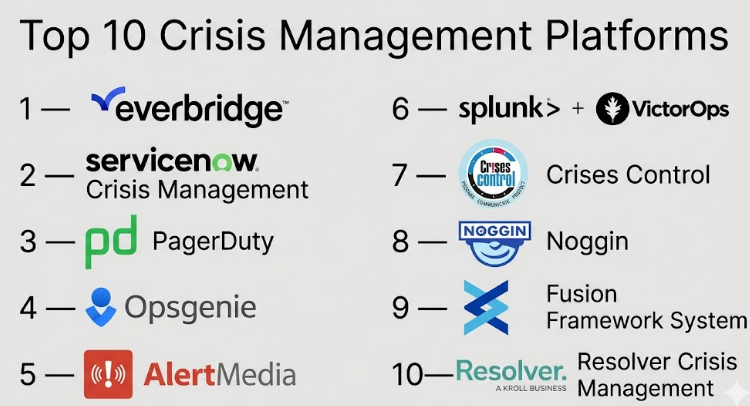
Top 10 Crisis Management Platforms
#1 — Everbridge
Short description:
Everbridge is a leading enterprise-grade crisis management platform designed for large organizations. It focuses on critical event management, enabling real-time communication, incident coordination, and situational awareness. It is widely used in government, healthcare, and large enterprises. The platform excels in mass notification and emergency response. It is ideal for organizations with complex operational environments.
Key Features
- Mass notification system
- Incident lifecycle management
- Real-time situational awareness
- Risk intelligence feeds
- Automated workflows
- Mobile alerting
- Crisis dashboards
Pros
- Strong enterprise capabilities
- Highly scalable platform
Cons
- Complex setup
- Higher cost
Platforms / Deployment
Cloud
Security & Compliance
SSO, MFA, encryption, audit logs (Specific certifications not publicly stated)
Integrations & Ecosystem
Integrates with IT systems, security tools, and communication platforms.
- SIEM tools
- HR systems
- Monitoring tools
- APIs available
Support & Community
Enterprise-grade support with onboarding services. Documentation is extensive.
#2 — ServiceNow Crisis Management
Short description:
ServiceNow offers crisis management as part of its broader ITSM ecosystem. It provides structured workflows, automation, and deep integration with IT operations. Best suited for organizations already using ServiceNow. It focuses on operational resilience and governance. Strong in regulated industries.
Key Features
- Workflow automation
- Incident and problem management
- Integrated dashboards
- Risk management tools
- Compliance tracking
- AI-driven insights
Pros
- Strong integration with ITSM
- Highly customizable
Cons
- Requires ServiceNow ecosystem
- Complex implementation
Platforms / Deployment
Cloud
Security & Compliance
SSO, RBAC, audit logs (Certifications not publicly stated)
Integrations & Ecosystem
Deep integration with enterprise systems.
- ITSM tools
- DevOps pipelines
- Security systems
Support & Community
Strong enterprise support with extensive documentation.
#3 — PagerDuty
Short description:
PagerDuty is widely known for incident response and on-call management. It helps teams detect and respond to incidents quickly. The platform is developer-friendly and integrates well with DevOps tools. It is commonly used in tech-driven organizations. Focuses on operational efficiency and uptime.
Key Features
- Incident alerting
- On-call scheduling
- Automation workflows
- Real-time analytics
- AI-based incident prioritization
Pros
- Easy to use
- Strong integrations
Cons
- Limited non-IT use cases
- Can become expensive
Platforms / Deployment
Cloud
Security & Compliance
SSO, MFA, audit logs (Certifications not publicly stated)
Integrations & Ecosystem
Strong DevOps ecosystem.
- Monitoring tools
- Slack, Teams
- Cloud platforms
Support & Community
Active community and good documentation.
#4 — Opsgenie
Short description:
Opsgenie, part of Atlassian, is designed for alerting and incident management. It provides strong scheduling and escalation features. It is ideal for DevOps teams and integrates well with Atlassian tools. It emphasizes quick response and collaboration.
Key Features
- Alert management
- Escalation policies
- Incident timelines
- Reporting tools
- Mobile alerts
Pros
- Strong alerting system
- Good integration with Atlassian
Cons
- Limited enterprise crisis features
- UI complexity
Platforms / Deployment
Cloud
Security & Compliance
SSO, encryption (Certifications not publicly stated)
Integrations & Ecosystem
- Jira
- Slack
- Monitoring tools
Support & Community
Good documentation and Atlassian support.
#5 — AlertMedia
Short description:
AlertMedia focuses on emergency communication and employee safety. It provides mass notification and threat intelligence. Ideal for organizations prioritizing workforce safety. Strong mobile-first design.
Key Features
- Mass alerts
- Threat monitoring
- Employee safety tracking
- Mobile notifications
- Communication templates
Pros
- Easy to deploy
- Strong communication features
Cons
- Limited IT incident features
- Less automation
Platforms / Deployment
Cloud
Security & Compliance
Not publicly stated
Integrations & Ecosystem
- HR systems
- Communication tools
Support & Community
Good customer support, moderate documentation.
#6 — Splunk On-Call (VictorOps)
Short description:
Splunk On-Call is designed for DevOps teams managing incidents in real time. It integrates with Splunk ecosystem for analytics and monitoring. It helps teams respond faster to alerts.
Key Features
- Incident alerting
- On-call management
- ChatOps integration
- Performance analytics
- Incident timelines
Pros
- Strong analytics integration
- Good for DevOps teams
Cons
- Requires Splunk ecosystem
- Limited non-IT use cases
Platforms / Deployment
Cloud
Security & Compliance
SSO, audit logs (Not publicly stated)
Integrations & Ecosystem
- Splunk tools
- Monitoring systems
- Chat tools
Support & Community
Good enterprise support.
#7 — Crises Control
Short description:
Crises Control is a dedicated crisis management platform focused on communication and incident coordination. It is suitable for mid-sized organizations and enterprises. It offers structured workflows and reporting.
Key Features
- Incident management
- Mass communication
- Task tracking
- Reporting dashboards
- Mobile alerts
Pros
- Easy to use
- Cost-effective
Cons
- Limited advanced automation
- Smaller ecosystem
Platforms / Deployment
Cloud
Security & Compliance
Not publicly stated
Integrations & Ecosystem
- APIs
- Communication tools
Support & Community
Responsive support, smaller community.
#8 — Noggin
Short description:
Noggin provides resilience, safety, and crisis management solutions. It focuses on operational risk and compliance. It is widely used in critical infrastructure industries.
Key Features
- Risk management
- Incident tracking
- Compliance tools
- Reporting
- Workflow automation
Pros
- Strong compliance features
- Industry-specific solutions
Cons
- Complex interface
- Higher learning curve
Platforms / Deployment
Cloud
Security & Compliance
Not publicly stated
Integrations & Ecosystem
- Enterprise systems
- APIs
Support & Community
Enterprise-level support.
#9 — Fusion Framework System
Short description:
Fusion provides a comprehensive resilience platform covering crisis management and business continuity. It focuses on enterprise resilience strategies.
Key Features
- Crisis planning
- Risk management
- Business continuity
- Reporting
- Scenario planning
Pros
- Strong enterprise features
- Comprehensive platform
Cons
- Expensive
- Complex setup
Platforms / Deployment
Cloud
Security & Compliance
Not publicly stated
Integrations & Ecosystem
- Enterprise tools
- APIs
Support & Community
Strong enterprise support.
#10 — Resolver Crisis Management
Short description:
Resolver focuses on risk intelligence and crisis management. It provides tools for incident tracking and investigation. Suitable for compliance-driven organizations.
Key Features
- Incident tracking
- Risk intelligence
- Investigation tools
- Reporting
- Workflow automation
Pros
- Strong risk features
- Good reporting
Cons
- Limited integrations
- UI can be complex
Platforms / Deployment
Cloud
Security & Compliance
Not publicly stated
Integrations & Ecosystem
- Enterprise systems
- APIs
Support & Community
Moderate support availability.
Comparison Table (Top 10)
| Tool Name | Best For | Platform(s) Supported | Deployment | Standout Feature | Public Rating |
|---|---|---|---|---|---|
| Everbridge | Enterprises | Web, Mobile | Cloud | Mass notification | N/A |
| ServiceNow Crisis Management | ITSM users | Web | Cloud | Workflow automation | N/A |
| PagerDuty | DevOps teams | Web, Mobile | Cloud | Incident response | N/A |
| Opsgenie | DevOps teams | Web, Mobile | Cloud | Alerting system | N/A |
| AlertMedia | Employee safety | Web, Mobile | Cloud | Emergency alerts | N/A |
| Splunk On-Call | DevOps teams | Web | Cloud | Analytics integration | N/A |
| Crises Control | SMBs | Web, Mobile | Cloud | Easy setup | N/A |
| Noggin | Compliance industries | Web | Cloud | Risk management | N/A |
| Fusion Framework System | Enterprises | Web | Cloud | Resilience planning | N/A |
| Resolver Crisis Management | Compliance teams | Web | Cloud | Risk intelligence | N/A |
Evaluation & Crisis Management Platforms
| Tool Name | Core (25%) | Ease (15%) | Integrations (15%) | Security (10%) | Performance (10%) | Support (10%) | Value (15%) | Weighted Total |
|---|---|---|---|---|---|---|---|---|
| Everbridge | 9 | 7 | 8 | 8 | 9 | 8 | 6 | 8.1 |
| ServiceNow | 9 | 6 | 9 | 8 | 9 | 8 | 6 | 8.0 |
| PagerDuty | 8 | 8 | 9 | 7 | 9 | 8 | 7 | 8.1 |
| Opsgenie | 8 | 7 | 8 | 7 | 8 | 7 | 7 | 7.6 |
| AlertMedia | 7 | 9 | 6 | 6 | 7 | 8 | 8 | 7.4 |
| Splunk On-Call | 8 | 7 | 8 | 7 | 9 | 8 | 7 | 7.9 |
| Crises Control | 7 | 8 | 6 | 6 | 7 | 7 | 8 | 7.2 |
| Noggin | 8 | 6 | 7 | 7 | 8 | 7 | 6 | 7.2 |
| Fusion | 9 | 6 | 7 | 7 | 8 | 8 | 6 | 7.6 |
| Resolver | 8 | 6 | 6 | 7 | 7 | 7 | 7 | 7.0 |
How to interpret:
- Scores are comparative, not absolute.
- Higher scores indicate stronger overall capability.
- Enterprises should prioritize core + integrations.
- SMBs should focus on ease and value.
- No single tool fits all scenarios.
Which Crisis Management Platforms
Solo / Freelancer
Simple communication tools or basic incident trackers are enough. Full platforms are usually overkill.
SMB
Choose tools like Crises Control or AlertMedia for ease of use and cost efficiency.
Mid-Market
PagerDuty or Opsgenie provide strong automation without enterprise complexity.
Enterprise
Everbridge, ServiceNow, or Fusion offer full-scale crisis management and compliance features.
Budget vs Premium
- Budget: Crises Control, AlertMedia
- Premium: Everbridge, ServiceNow
Feature Depth vs Ease of Use
- Deep features: ServiceNow, Fusion
- Easy to use: PagerDuty, AlertMedia
Integrations & Scalability
- Best integrations: PagerDuty, ServiceNow
- Moderate: Crises Control
Security & Compliance Needs
- High compliance: Noggin, Resolver
- Standard needs: PagerDuty, Opsgenie
Frequently Asked Questions (FAQs)
1. What is a crisis management platform?
It is software that helps organizations respond to emergencies with structured workflows, communication tools, and real-time coordination.
2. How much do these platforms cost?
Pricing varies widely. Most platforms use subscription-based models depending on users, features, and scale.
3. How long does implementation take?
Basic setups can take days, while enterprise deployments may take weeks or months.
4. Are these platforms only for IT incidents?
No. They are used for IT, security, HR, PR, and operational crises.
5. Do these tools support mobile devices?
Yes, most platforms provide mobile apps for real-time alerts and response.
6. What integrations are important?
Monitoring tools, communication platforms, HR systems, and security tools are key integrations.
7. Can small businesses use these tools?
Yes, but they should choose lightweight and cost-effective options.
8. How secure are these platforms?
Most offer enterprise-grade security features, but details vary by vendor.
9. What are common mistakes when choosing a tool?
Overbuying features, ignoring integrations, and underestimating training needs.
10. Can organizations switch platforms easily?
Switching is possible but requires planning, data migration, and retraining.
Conclusion
Crisis Management Platforms have become essential tools for modern organizations that cannot afford downtime, miscommunication, or delayed response. As risks grow in complexity—from cyber threats to global disruptions—having a structured and automated crisis response system is no longer optional. The right platform helps teams act faster, communicate clearly, and recover more efficiently.