Introduction
Public Transit Scheduling Tools are software platforms used by transit agencies to plan, optimize, and manage routes, timetables, vehicle assignments, and crew schedules. In simple terms, they help ensure buses, trains, and other public transport services run on time, efficiently, and cost-effectively.
In today’s environment, transit systems face rising demand, budget constraints, and increasing expectations for reliability and real-time updates. These tools have evolved beyond static scheduling into intelligent systems that use data, automation, and predictive analytics to optimize operations.
Real-world use cases:
- Designing efficient bus routes for urban transport systems
- Managing train timetables with minimal delays
- Allocating drivers and vehicles dynamically
- Responding to disruptions such as weather or traffic conditions
- Improving passenger satisfaction through reliable schedules
What buyers should evaluate:
- Route optimization capabilities
- Real-time scheduling and updates
- Integration with ticketing and fleet systems
- Scalability for large transit networks
- User interface and ease of planning
- Data analytics and reporting
- AI/automation features
- Security and compliance
- Deployment flexibility
- Vendor support and ecosystem
Best for: Public transport authorities, municipal transit agencies, railway operators, and mobility startups managing complex scheduling operations.
Not ideal for: Small private fleets or businesses with very simple routing needs, where basic GPS or dispatch tools may be sufficient.
Key Trends in Public Transit Scheduling Tools
- AI-driven route optimization improving efficiency and reducing fuel costs
- Real-time data integration from IoT devices and GPS systems
- Cloud-first deployments enabling scalability and remote access
- Predictive analytics for demand forecasting and disruption management
- Integration with smart city platforms and mobility ecosystems
- Mobile-first interfaces for field staff and operators
- Automation of crew scheduling and compliance checks
- Increased focus on sustainability and emission reduction
- API-driven ecosystems for seamless integration with third-party systems
- Subscription-based pricing models replacing traditional licensing
How We Selected These Tools (Methodology)
- Evaluated tools with strong adoption across global transit agencies
- Assessed feature completeness, especially in scheduling and optimization
- Considered reliability and performance in large-scale deployments
- Reviewed security capabilities and enterprise readiness
- Analyzed integration capabilities with transit ecosystems
- Included tools suitable for different organization sizes
- Balanced enterprise-grade platforms with flexible solutions
- Focused on innovation, including AI and predictive features
- Considered vendor reputation and long-term viability
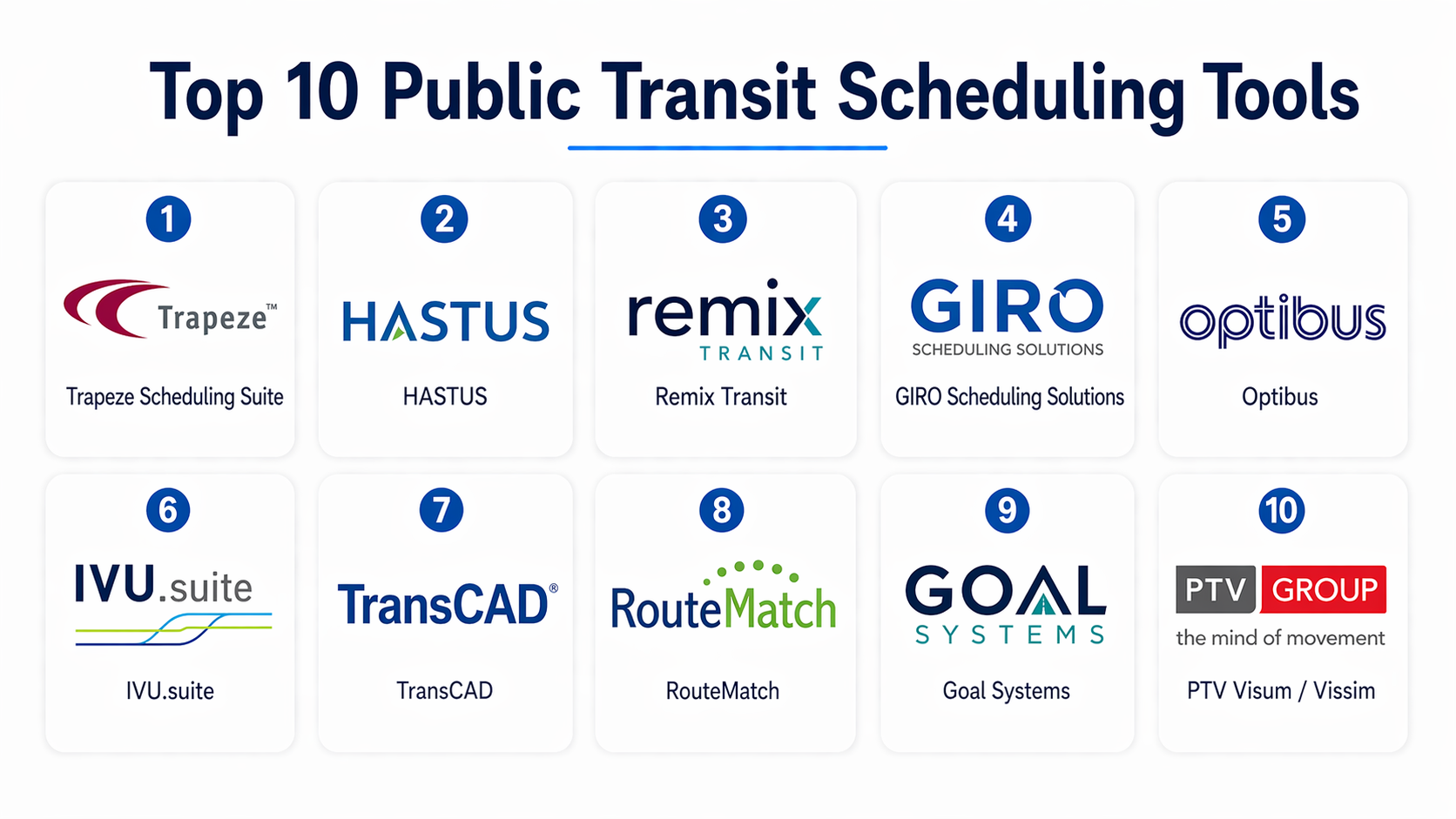
Top 10 Public Transit Scheduling Tools
#1 — Trapeze Scheduling Suite
Short description:
A widely used enterprise-grade solution designed for large transit agencies. It helps manage complex scheduling, route planning, and operations. Known for deep functionality and scalability, it supports both bus and rail systems. Ideal for agencies handling large fleets and multiple service types. Offers strong analytics and operational insights.
Key Features
- Advanced route and timetable planning
- Crew and vehicle scheduling
- Real-time operational adjustments
- Reporting and analytics tools
- Integration with AVL and fare systems
Pros
- Highly scalable for large networks
- Comprehensive feature set
Cons
- Complex implementation
- Higher cost for smaller agencies
Platforms / Deployment
- Web
- Cloud / On-premise
Security & Compliance
- RBAC, audit logs
- Other details: Not publicly stated
Integrations & Ecosystem
Supports integration with fleet management, ticketing, and real-time tracking systems.
- APIs for data exchange
- Integration with GPS systems
- Smart city platform compatibility
Support & Community
Strong enterprise support with onboarding services. Documentation is detailed but requires training.
#2 — HASTUS
Short description:
A powerful scheduling solution widely used in public transportation. It focuses on optimization and efficient planning. Known for handling complex scheduling scenarios. Suitable for large transit networks requiring precision and compliance.
Key Features
- Multi-modal scheduling
- Optimization algorithms
- Crew management
- Scenario simulation
- Data analytics
Pros
- Strong optimization capabilities
- Reliable for large-scale operations
Cons
- Steep learning curve
- Expensive
Platforms / Deployment
- Web
- Cloud / On-premise
Security & Compliance
- Not publicly stated
Integrations & Ecosystem
Works with transit data systems and enterprise tools.
- API integrations
- Data import/export tools
- Integration with planning systems
Support & Community
Enterprise-level support with strong vendor backing.
#3 — Remix Transit
Short description:
A modern, cloud-based transit planning tool focused on collaboration and visualization. It allows planners to design routes visually. Ideal for city planners and mid-sized transit agencies.
Key Features
- Map-based route design
- Scenario modeling
- Collaboration tools
- Data visualization
- Public engagement features
Pros
- Easy to use interface
- Strong visualization tools
Cons
- Limited deep scheduling features
- Not ideal for large enterprise complexity
Platforms / Deployment
- Web
- Cloud
Security & Compliance
- Not publicly stated
Integrations & Ecosystem
Integrates with GIS and planning tools.
- Data import/export
- API support
- Mapping integrations
Support & Community
Good documentation and onboarding for planners.
#4 — GIRO Scheduling Solutions
Short description:
A comprehensive transit scheduling platform designed for complex operations. Focuses on optimization and resource utilization. Used by large transit agencies globally.
Key Features
- Advanced optimization engine
- Crew and vehicle scheduling
- Compliance tracking
- Scenario analysis
- Reporting tools
Pros
- Highly optimized scheduling
- Reliable for complex systems
Cons
- Requires specialized training
- High implementation effort
Platforms / Deployment
- Web
- Cloud / On-premise
Security & Compliance
- Not publicly stated
Integrations & Ecosystem
Strong integration with transit systems.
- APIs
- Data exchange systems
- Integration with operations tools
Support & Community
Strong enterprise support with consulting services.
#5 — Optibus
Short description:
An AI-powered scheduling platform focused on efficiency and automation. Known for modern UX and optimization algorithms. Suitable for agencies seeking digital transformation.
Key Features
- AI-based scheduling
- Demand forecasting
- Cloud-based collaboration
- Real-time optimization
- Analytics dashboard
Pros
- Modern interface
- Strong AI capabilities
Cons
- Cloud dependency
- Pricing not transparent
Platforms / Deployment
- Web
- Cloud
Security & Compliance
- Not publicly stated
Integrations & Ecosystem
Integrates with operational and planning tools.
- APIs
- Data integrations
- Fleet system connectivity
Support & Community
Responsive support with modern onboarding processes.
#6 — IVU.suite
Short description:
A modular transit software suite covering scheduling, dispatching, and operations. Designed for both bus and rail systems. Offers flexibility and scalability.
Key Features
- Integrated scheduling
- Dispatch management
- Real-time monitoring
- Modular architecture
- Reporting tools
Pros
- Flexible modular design
- Suitable for multimodal transport
Cons
- Complex setup
- Requires training
Platforms / Deployment
- Web
- Cloud / On-premise
Security & Compliance
- Not publicly stated
Integrations & Ecosystem
Supports integration with multiple systems.
- APIs
- Data exchange
- Third-party integrations
Support & Community
Strong enterprise support with implementation services.
#7 — TransCAD
Short description:
A transportation planning and GIS-based tool with scheduling capabilities. Widely used for planning and analysis. Suitable for agencies needing strong mapping features.
Key Features
- GIS-based planning
- Network modeling
- Data analysis
- Scheduling support
- Visualization tools
Pros
- Strong GIS capabilities
- Flexible data analysis
Cons
- Less focus on real-time operations
- Interface can feel dated
Platforms / Deployment
- Windows
- On-premise
Security & Compliance
- Not publicly stated
Integrations & Ecosystem
Works with GIS and planning tools.
- Data import/export
- Mapping integrations
Support & Community
Moderate support with niche community.
#8 — RouteMatch
Short description:
A transit management platform focused on demand-response and scheduling. Designed for flexible transit services and paratransit systems.
Key Features
- Demand-response scheduling
- Fleet management
- Real-time tracking
- Reporting tools
- Mobile access
Pros
- Strong for flexible transit
- Good mobile support
Cons
- Limited for fixed-route systems
- Customization may be needed
Platforms / Deployment
- Web / Mobile
- Cloud
Security & Compliance
- Not publicly stated
Integrations & Ecosystem
Integrates with mobility systems.
- APIs
- Fleet integrations
- Data tools
Support & Community
Good support for niche use cases.
#9 — Goal Systems
Short description:
A scheduling and planning solution designed for public transport optimization. Focuses on efficiency and resource utilization.
Key Features
- Scheduling optimization
- Resource planning
- Scenario simulation
- Data analytics
- Reporting tools
Pros
- Strong optimization
- Flexible deployment
Cons
- Limited brand visibility
- Learning curve
Platforms / Deployment
- Web
- Cloud / On-premise
Security & Compliance
- Not publicly stated
Integrations & Ecosystem
Supports integration with transit systems.
- APIs
- Data exchange
Support & Community
Varies depending on region.
#10 — PTV Visum / Vissim
Short description:
A simulation and planning tool used for transportation modeling and scheduling. Known for detailed simulations and analysis.
Key Features
- Traffic simulation
- Network modeling
- Scheduling analysis
- Scenario planning
- Visualization tools
Pros
- Strong simulation capabilities
- Highly detailed modeling
Cons
- Not focused on real-time operations
- Requires expertise
Platforms / Deployment
- Windows
- On-premise
Security & Compliance
- Not publicly stated
Integrations & Ecosystem
Integrates with planning tools and data systems.
- Data import/export
- Simulation integrations
Support & Community
Strong academic and professional community.
Comparison Table (Top 10)
| Tool Name | Best For | Platform(s) Supported | Deployment | Standout Feature | Public Rating |
|---|---|---|---|---|---|
| Trapeze Scheduling Suite | Large transit agencies | Web | Cloud/On-premise | Enterprise scheduling | N/A |
| HASTUS | Complex operations | Web | Cloud/On-premise | Optimization engine | N/A |
| Remix Transit | City planners | Web | Cloud | Visual planning | N/A |
| GIRO Scheduling Solutions | Large-scale networks | Web | Cloud/On-premise | Optimization engine | N/A |
| Optibus | AI scheduling | Web | Cloud | AI optimization | N/A |
| IVU.suite | Multimodal transport | Web | Cloud/On-premise | Modular system | N/A |
| TransCAD | Planning & GIS | Windows | On-premise | GIS integration | N/A |
| RouteMatch | Demand-response transit | Web/Mobile | Cloud | Flexible scheduling | N/A |
| Goal Systems | Resource optimization | Web | Cloud/On-premise | Scenario modeling | N/A |
| PTV Visum / Vissim | Simulation & planning | Windows | On-premise | Traffic simulation | N/A |
Evaluation & Scoring of Public Transit Scheduling Tools
| Tool Name | Core (25%) | Ease (15%) | Integrations (15%) | Security (10%) | Performance (10%) | Support (10%) | Value (15%) | Weighted Total |
|---|---|---|---|---|---|---|---|---|
| Trapeze | 9 | 6 | 8 | 7 | 9 | 8 | 7 | 8.0 |
| HASTUS | 9 | 5 | 8 | 7 | 9 | 8 | 6 | 7.8 |
| Remix Transit | 7 | 9 | 7 | 6 | 7 | 7 | 8 | 7.6 |
| GIRO | 9 | 6 | 8 | 7 | 9 | 8 | 7 | 8.0 |
| Optibus | 8 | 8 | 8 | 6 | 8 | 7 | 7 | 7.7 |
| IVU.suite | 8 | 6 | 8 | 7 | 8 | 8 | 7 | 7.8 |
| TransCAD | 7 | 6 | 6 | 6 | 7 | 6 | 7 | 6.7 |
| RouteMatch | 7 | 7 | 7 | 6 | 7 | 7 | 7 | 7.0 |
| Goal Systems | 8 | 6 | 7 | 6 | 8 | 7 | 7 | 7.3 |
| PTV Visum | 8 | 5 | 6 | 6 | 8 | 7 | 6 | 6.9 |
How to interpret scores:
- Scores are comparative within this category, not absolute benchmarks.
- Enterprise tools score higher on core features but lower on ease of use.
- Modern cloud tools tend to score better on usability and collaboration.
- Weighted totals reflect balanced performance across all criteria.
- Choose based on your priorities rather than just the highest score.
Which Public Transit Scheduling Tools
Solo / Freelancer
Not typically applicable, but lightweight tools like Remix Transit can be useful for consultants and planners.
SMB
Optibus or Remix Transit are suitable due to ease of use and cloud deployment.
Mid-Market
IVU.suite and RouteMatch offer a balance of functionality and flexibility.
Enterprise
Trapeze, HASTUS, and GIRO are ideal for large-scale, complex transit operations.
Budget vs Premium
- Budget: Remix Transit, TransCAD
- Premium: Trapeze, HASTUS, GIRO
Feature Depth vs Ease of Use
- Deep features: HASTUS, GIRO
- Ease of use: Remix Transit, Optibus
Integrations & Scalability
- Best: Trapeze, IVU.suite
- Moderate: Optibus, Goal Systems
Security & Compliance Needs
- Enterprise tools typically offer better compliance capabilities
- Cloud tools may require additional validation
Frequently Asked Questions (FAQs)
1. What is a public transit scheduling tool?
It is software used to plan routes, schedules, and resource allocation for public transport systems. It ensures efficient and reliable service delivery.
2. How much do these tools cost?
Pricing varies widely depending on features, scale, and deployment. Most enterprise tools follow custom pricing models.
3. Are these tools cloud-based?
Many modern tools are cloud-based, but some still offer on-premise or hybrid deployments.
4. How long does implementation take?
Implementation can range from a few weeks to several months depending on complexity.
5. Do these tools support real-time updates?
Yes, many modern platforms include real-time scheduling and adjustment capabilities.
6. Can they integrate with existing systems?
Most tools provide APIs and integration options for fleet, ticketing, and tracking systems.
7. What are common mistakes when choosing a tool?
Ignoring scalability, underestimating training needs, and not validating integrations are common issues.
8. Are these tools secure?
Security features vary. Enterprise tools usually offer stronger controls, but details may not always be publicly stated.
9. Can small agencies use these tools?
Yes, but they should choose simpler, cloud-based solutions to avoid complexity.
10. How do you switch from one tool to another?
Switching requires data migration, staff training, and system integration planning. A phased approach is recommended.
Conclusion
Public Transit Scheduling Tools have become essential for modern transit systems aiming to deliver reliable, efficient, and scalable services. From AI-powered optimization platforms to traditional enterprise-grade scheduling systems, the market offers a wide range of solutions tailored to different needs. The right choice depends on your organization’s size, operational complexity, and long-term goals. Instead of looking for a single “best” tool, it’s more practical to shortlist two or three options that align with your requirements. Run pilot programs, test integrations, and evaluate usability before making a final decision.