Introduction
Supplier Relationship Management (SRM) tools help organizations manage, evaluate, and collaborate with their suppliers in a structured and strategic way. Instead of treating suppliers as just vendors, SRM platforms enable businesses to build long-term partnerships, track supplier performance, reduce risks, and improve procurement outcomes.
In today’s environment, where supply chains are global, complex, and vulnerable to disruption, SRM tools have become essential. Organizations now need real-time visibility into supplier performance, compliance, risk exposure, and sustainability metrics. Modern SRM platforms also incorporate AI, analytics, and automation to improve decision-making and supplier collaboration.
Real-world use cases include:
- Evaluating supplier performance and reliability
- Managing supplier onboarding and compliance
- Tracking supplier risks and disruptions
- Improving contract and relationship management
- Collaborating with suppliers on forecasts and innovation
What buyers should evaluate:
- Supplier performance tracking and scorecards
- Risk management and compliance features
- Integration with procurement and ERP systems
- Workflow automation capabilities
- Reporting and analytics dashboards
- Scalability across global supplier networks
- Data security and governance
- Ease of supplier onboarding
- Total cost of ownership
Best for: Procurement leaders, supply chain managers, vendor management teams, and enterprises with complex supplier ecosystems across manufacturing, retail, and logistics.
Not ideal for: Small businesses with limited suppliers or companies that manage suppliers through simple procurement tools or spreadsheets.
Key Trends in Supplier Relationship Management (SRM) Tools
- AI-driven supplier insights: Predictive analytics to identify supplier risks and opportunities
- Supplier risk intelligence: Continuous monitoring of financial, geopolitical, and operational risks
- Sustainability tracking: ESG and compliance metrics integrated into supplier evaluation
- Cloud-based collaboration: Real-time communication and document sharing with suppliers
- Automation of procurement workflows: Reduced manual effort in supplier onboarding and evaluation
- Supplier segmentation strategies: Categorizing suppliers based on value and risk
- Integration with broader supply chain platforms: SRM becoming part of end-to-end planning systems
- Digital supplier networks: Platforms enabling multi-tier supplier collaboration
- Focus on resilience and agility: Tools designed for rapid response to disruptions
- Mobile and user-friendly interfaces: Improved usability for both buyers and suppliers
How We Selected These Tools (Methodology)
- Analyzed market adoption and brand presence in procurement and supply chain domains
- Evaluated core SRM capabilities such as supplier performance, risk, and collaboration
- Assessed integration capabilities with ERP, procurement, and supply chain systems
- Reviewed scalability and performance for global operations
- Considered security posture and compliance readiness
- Examined AI and automation features for modern planning needs
- Evaluated usability and onboarding experience
- Looked at customer fit across SMB, mid-market, and enterprise segments
- Assessed vendor ecosystem and support availability
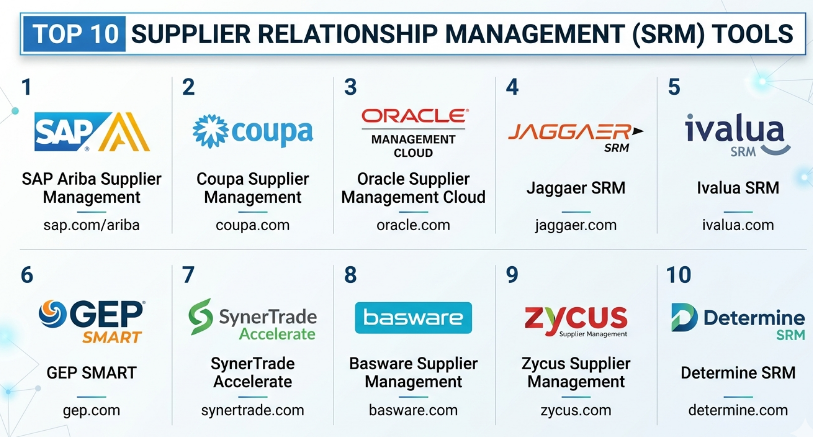
Top 10 Supplier Relationship Management (SRM) Tools
#1 — SAP Ariba Supplier Management
Short description:
A leading enterprise-grade SRM platform that helps organizations manage supplier information, performance, and risk. It is widely used by large enterprises and integrates deeply with SAP procurement solutions. It supports global supplier networks and compliance requirements. Ideal for organizations already using SAP systems.
Key Features
- Supplier lifecycle management
- Risk and compliance monitoring
- Supplier performance scorecards
- Integration with SAP Ariba Network
- Contract and document management
Pros
- Strong integration with SAP ecosystem
- Large global supplier network
Cons
- Complex implementation
- High cost for smaller organizations
Platforms / Deployment
- Web
- Cloud
Security & Compliance
- SSO, RBAC, encryption
- GDPR support
Integrations & Ecosystem
Deep integration with SAP ERP and procurement tools.
- SAP S/4HANA
- SAP Ariba Network
- APIs for external systems
Support & Community
Strong enterprise support with a large partner ecosystem.
#2 — Coupa Supplier Management
Short description:
A cloud-based SRM platform focused on improving supplier collaboration and spend visibility. It offers a user-friendly interface and strong analytics capabilities. Suitable for mid-market and enterprise organizations.
Key Features
- Supplier onboarding and management
- Spend analysis
- Risk management
- Collaboration tools
- Analytics dashboards
Pros
- Easy to use interface
- Strong analytics
Cons
- Limited customization
- Pricing can scale quickly
Platforms / Deployment
- Web
- Cloud
Security & Compliance
- MFA, RBAC, encryption
Integrations & Ecosystem
- ERP systems
- Financial tools
- APIs
Support & Community
Good support and active user community.
#3 — Oracle Supplier Management Cloud
Short description:
Part of Oracle’s cloud suite, this tool provides comprehensive supplier lifecycle management. It supports onboarding, qualification, and performance tracking. Best suited for organizations using Oracle ERP.
Key Features
- Supplier qualification and onboarding
- Risk management
- Performance tracking
- Supplier collaboration
- Workflow automation
Pros
- Strong ERP integration
- Scalable architecture
Cons
- Complex configuration
- Higher cost
Platforms / Deployment
- Web
- Cloud
Security & Compliance
- SSO, encryption, RBAC
Integrations & Ecosystem
- Oracle ERP
- Financial systems
- APIs
Support & Community
Enterprise-level support with strong documentation.
#4 — Jaggaer SRM
Short description:
A procurement-focused platform with strong SRM capabilities. It helps organizations manage supplier relationships, sourcing, and performance. Popular in manufacturing and public sector organizations.
Key Features
- Supplier lifecycle management
- Performance tracking
- Risk management
- Sourcing integration
- Analytics
Pros
- Strong procurement integration
- Good analytics
Cons
- UI can feel complex
- Implementation effort required
Platforms / Deployment
- Web
- Cloud
Security & Compliance
- Not publicly stated
Integrations & Ecosystem
- ERP systems
- Procurement tools
- APIs
Support & Community
Reliable support with enterprise focus.
#5 — Ivalua SRM
Short description:
A flexible SRM platform offering end-to-end supplier management. It is known for customization and scalability. Suitable for large enterprises with complex supplier ecosystems.
Key Features
- Supplier lifecycle management
- Risk and compliance tracking
- Performance management
- Workflow automation
- Custom dashboards
Pros
- Highly customizable
- Strong scalability
Cons
- Requires configuration expertise
- Longer deployment time
Platforms / Deployment
- Web
- Cloud
Security & Compliance
- Not publicly stated
Integrations & Ecosystem
- ERP systems
- Financial systems
- APIs
Support & Community
Strong enterprise support.
#6 — GEP SMART
Short description:
A unified procurement platform that includes SRM capabilities. It focuses on digital procurement transformation and supplier collaboration. Suitable for mid-market to enterprise organizations.
Key Features
- Supplier management
- Spend analysis
- Risk monitoring
- Collaboration tools
- Analytics
Pros
- Unified procurement platform
- Good user experience
Cons
- Limited niche features
- Customization may be needed
Platforms / Deployment
- Web
- Cloud
Security & Compliance
- Not publicly stated
Integrations & Ecosystem
- ERP systems
- Procurement tools
- APIs
Support & Community
Moderate support with growing ecosystem.
#7 — SynerTrade Accelerate
Short description:
A digital procurement suite with strong SRM features. It supports supplier onboarding, evaluation, and collaboration. Popular in European markets.
Key Features
- Supplier onboarding
- Performance evaluation
- Risk management
- Collaboration tools
- Workflow automation
Pros
- Strong compliance features
- Flexible workflows
Cons
- Less global presence
- Limited community
Platforms / Deployment
- Web
- Cloud
Security & Compliance
- Not publicly stated
Integrations & Ecosystem
- ERP systems
- APIs
Support & Community
Varies by region.
#8 — Basware Supplier Management
Short description:
A financial-focused platform with SRM capabilities. It helps manage suppliers along with invoicing and payments. Suitable for finance-driven organizations.
Key Features
- Supplier onboarding
- Invoice and payment management
- Risk tracking
- Compliance management
- Analytics
Pros
- Strong finance integration
- Good automation
Cons
- Limited SRM depth
- Not ideal for complex supply chains
Platforms / Deployment
- Web
- Cloud
Security & Compliance
- Not publicly stated
Integrations & Ecosystem
- ERP systems
- Financial tools
- APIs
Support & Community
Moderate support.
#9 — Zycus Supplier Management
Short description:
An AI-powered procurement platform with strong SRM capabilities. It focuses on automation and analytics. Suitable for enterprises seeking digital transformation.
Key Features
- AI-driven supplier insights
- Performance management
- Risk tracking
- Workflow automation
- Analytics dashboards
Pros
- Strong AI capabilities
- Good automation
Cons
- Requires training
- Implementation effort
Platforms / Deployment
- Web
- Cloud
Security & Compliance
- Not publicly stated
Integrations & Ecosystem
- ERP systems
- Procurement tools
- APIs
Support & Community
Growing ecosystem.
#10 — Determine (Corcentric)
Short description:
A procurement and SRM platform focused on supplier collaboration and sourcing. It supports supplier lifecycle and performance management.
Key Features
- Supplier lifecycle management
- Performance tracking
- Sourcing integration
- Analytics
- Collaboration tools
Pros
- Integrated procurement features
- Flexible workflows
Cons
- Smaller ecosystem
- Limited advanced AI
Platforms / Deployment
- Web
- Cloud
Security & Compliance
- Not publicly stated
Integrations & Ecosystem
- ERP systems
- APIs
Support & Community
Moderate support.
Comparison Table (Top 10)
| Tool Name | Best For | Platform(s) Supported | Deployment | Standout Feature | Public Rating |
|---|---|---|---|---|---|
| SAP Ariba | Enterprise | Web | Cloud | Global supplier network | N/A |
| Coupa | Mid-market/Enterprise | Web | Cloud | Spend visibility | N/A |
| Oracle Supplier Management | Enterprise | Web | Cloud | ERP integration | N/A |
| Jaggaer | Procurement-focused orgs | Web | Cloud | Sourcing integration | N/A |
| Ivalua | Large enterprises | Web | Cloud | Customization | N/A |
| GEP SMART | Digital procurement | Web | Cloud | Unified platform | N/A |
| SynerTrade | EU-focused orgs | Web | Cloud | Compliance features | N/A |
| Basware | Finance-driven orgs | Web | Cloud | Invoice integration | N/A |
| Zycus | AI-driven procurement | Web | Cloud | AI insights | N/A |
| Determine | Mid-market | Web | Cloud | Supplier collaboration | N/A |
Evaluation & Scoring of Supplier Relationship Management (SRM) Tools
| Tool Name | Core | Ease | Integrations | Security | Performance | Support | Value | Weighted Total |
|---|---|---|---|---|---|---|---|---|
| SAP Ariba | 9 | 7 | 9 | 8 | 9 | 8 | 7 | 8.4 |
| Coupa | 8 | 8 | 8 | 8 | 8 | 8 | 7 | 8.0 |
| Oracle | 9 | 7 | 9 | 8 | 9 | 8 | 7 | 8.4 |
| Jaggaer | 8 | 7 | 8 | 7 | 8 | 7 | 7 | 7.8 |
| Ivalua | 9 | 7 | 8 | 7 | 8 | 7 | 7 | 8.0 |
| GEP SMART | 8 | 8 | 8 | 7 | 8 | 7 | 7 | 7.9 |
| SynerTrade | 7 | 7 | 7 | 6 | 7 | 6 | 7 | 7.0 |
| Basware | 7 | 8 | 7 | 6 | 7 | 7 | 7 | 7.2 |
| Zycus | 8 | 7 | 8 | 7 | 8 | 7 | 7 | 7.8 |
| Determine | 7 | 7 | 7 | 6 | 7 | 7 | 7 | 7.0 |
Score interpretation:
These scores provide a relative comparison across tools based on key evaluation criteria. Higher scores indicate stronger overall capabilities, but the best choice depends on your specific business needs, budget, and existing systems.
Which Supplier Relationship Management (SRM) Software
Solo / Freelancer
SRM tools are generally unnecessary; simple vendor tracking tools or spreadsheets are sufficient.
SMB
Coupa and GEP SMART offer a balance of usability and functionality.
Mid-Market
Zycus, Ivalua, and Jaggaer provide strong capabilities without extreme complexity.
Enterprise
SAP Ariba and Oracle Supplier Management are the top choices for global operations.
Budget vs Premium
- Budget: Basware, Determine
- Premium: SAP Ariba, Oracle
Feature Depth vs Ease of Use
- Deep features: SAP, Oracle, Ivalua
- Easier to use: Coupa, GEP SMART
Integrations & Scalability
Choose SAP or Oracle if already using their ecosystems.
Security & Compliance Needs
Enterprise platforms provide better governance and compliance capabilities.
Frequently Asked Questions (FAQs)
1. What is SRM software used for?
SRM software helps manage supplier relationships, track performance, and improve collaboration across procurement processes.
2. How much does SRM software cost?
Pricing varies widely depending on features and organization size, often subscription-based.
3. How long does implementation take?
Implementation can take several weeks to months depending on complexity.
4. Can small businesses use SRM tools?
Yes, but simpler tools may be more suitable for smaller operations.
5. What integrations are required?
Common integrations include ERP, procurement, finance, and analytics systems.
6. Is AI important in SRM tools?
Yes, AI helps identify risks, optimize supplier selection, and improve decision-making.
7. What are common mistakes?
Poor supplier data management and lack of stakeholder alignment.
8. Can SRM tools scale globally?
Yes, most enterprise tools are designed for global supplier networks.
9. How secure are SRM platforms?
Most include encryption and access controls, but specifics vary.
10. Can you switch SRM tools easily?
Switching can be complex due to data migration and process changes.
Conclusion
Supplier Relationship Management tools are no longer optional for organizations dealing with complex supply chains. They provide visibility, control, and strategic insights into supplier ecosystems, helping businesses reduce risk, improve performance, and build stronger partnerships. However, the right tool depends heavily on your organization’s size, complexity, and existing technology stack.