Introduction
Reinsurance management tools are specialized software platforms that help insurers and reinsurers manage complex reinsurance contracts, track exposures, calculate premiums, and handle claims settlements. In simple terms, they act as the backbone for managing how insurance companies share and transfer risk with other insurers.
In today’s environment, where risks are becoming more dynamic and global, these tools are essential. Insurers must handle large volumes of data, comply with regulatory requirements, and maintain financial accuracy across multiple treaties and agreements. Modern reinsurance platforms automate calculations, improve transparency, and enable faster decision-making.
Real-world use cases include:
- Managing proportional and non-proportional treaties across multiple regions
- Automating premium and claims allocation across reinsurers
- Tracking risk exposure in real time for catastrophe events
- Financial reporting and compliance for regulatory bodies
- Supporting actuarial analysis and forecasting
What buyers should evaluate:
- Treaty management capabilities
- Financial accounting and reporting features
- Integration with policy, claims, and underwriting systems
- Scalability for global operations
- Data analytics and reporting tools
- Compliance and audit capabilities
- Automation of settlements and calculations
- Ease of use for actuarial and finance teams
- Deployment flexibility (cloud, hybrid)
Best for: Large insurers, reinsurers, MGAs, and actuarial teams managing complex reinsurance portfolios across multiple geographies.
Not ideal for: Small insurance firms with minimal or no reinsurance exposure, where basic financial tools or spreadsheets may suffice.
Key Trends in Reinsurance Management Tools
- AI-driven risk modeling: Advanced analytics and machine learning are used to predict risk exposure and optimize reinsurance structures
- Cloud-based reinsurance systems: SaaS platforms enable scalability and global access
- Real-time exposure tracking: Continuous monitoring of catastrophe and portfolio risks
- Automation of settlements: Reduces manual errors in premium and claims allocation
- API-first integrations: Seamless connectivity with underwriting, claims, and finance systems
- Regulatory compliance automation: Built-in reporting for IFRS and solvency regulations
- Data centralization: Unified platforms for actuarial, finance, and underwriting teams
- Scenario simulation: Stress testing and catastrophe modeling integration
- User-friendly dashboards: Improved visualization for decision-makers
How We Selected These Tools (Methodology)
- Reviewed market adoption and global presence among insurers and reinsurers
- Evaluated core reinsurance functionality, including treaty and facultative management
- Assessed financial and accounting capabilities
- Considered performance and scalability in large environments
- Analyzed integration capabilities with core insurance systems
- Looked at security and compliance readiness
- Evaluated user experience and configurability
- Ensured coverage across enterprise and mid-market solutions
- Focused on modern architecture and innovation
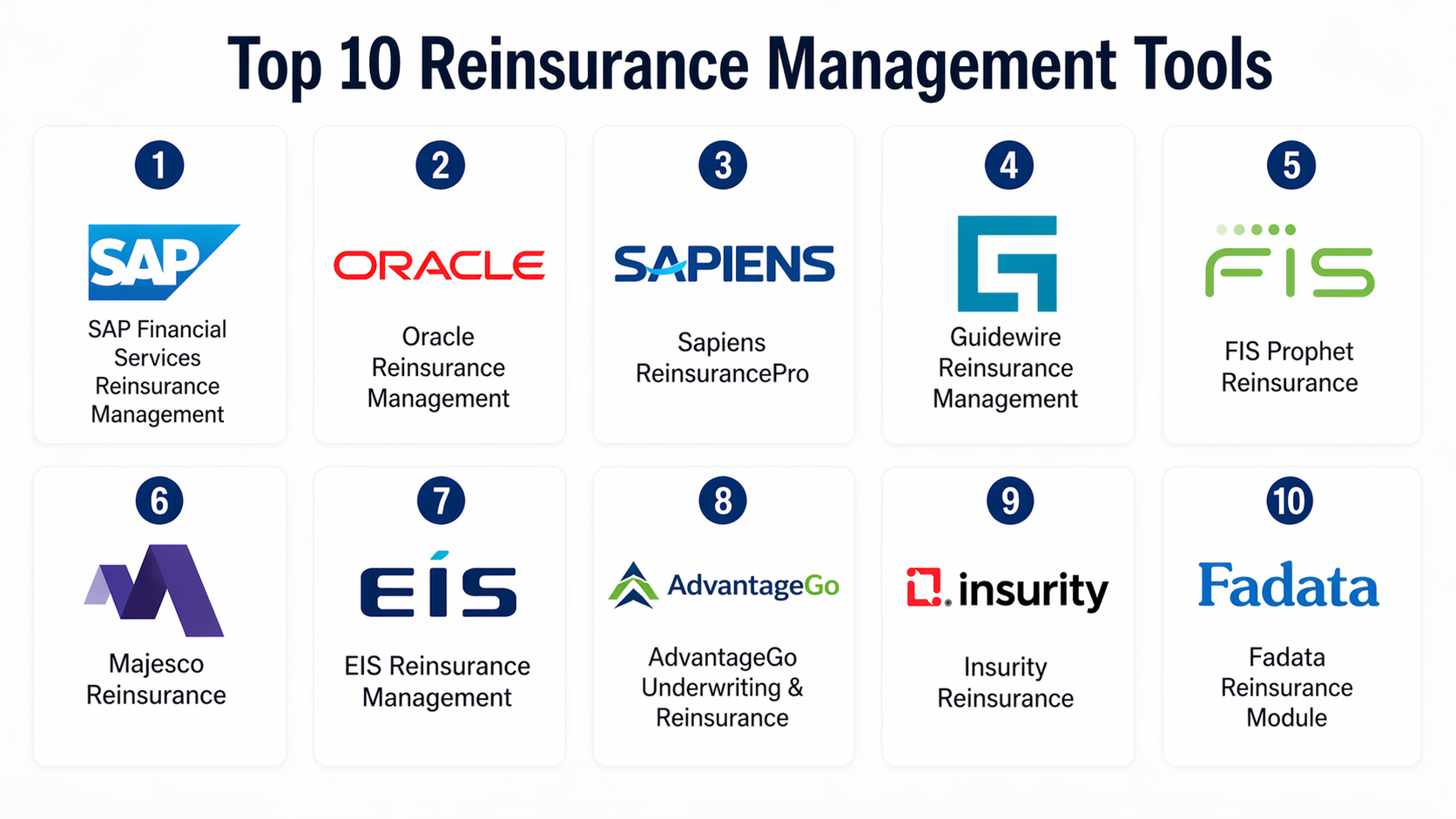
Top 10 Reinsurance Management Tools
#1 — SAP Financial Services Reinsurance Management
Short description :
SAP provides a comprehensive reinsurance management solution as part of its financial services suite. It supports end-to-end reinsurance lifecycle management including treaty administration, accounting, and reporting. The platform is designed for large insurers and reinsurers with complex operations. It integrates seamlessly with SAP’s financial and ERP systems. It is known for scalability and enterprise-grade capabilities.
Key Features
- End-to-end reinsurance lifecycle management
- Financial accounting integration
- Treaty and facultative management
- Automated settlement processing
- Advanced reporting and analytics
- Integration with SAP ecosystem
Pros
- Strong financial integration
- Highly scalable for large enterprises
Cons
- Complex implementation
- High cost and resource requirements
Platforms / Deployment
Cloud / Hybrid
Security & Compliance
SSO, RBAC, encryption (certifications not publicly stated)
Integrations & Ecosystem
SAP integrates deeply within its ecosystem and external enterprise tools.
- SAP ERP and finance modules
- Data warehouses
- APIs for third-party integration
Support & Community
Strong enterprise support with global partner ecosystem.
#2 — Oracle Reinsurance Management
Short description :
Oracle offers reinsurance management capabilities within its insurance and financial services platforms. It supports treaty management, accounting, and analytics. Designed for large organizations, it leverages Oracle Cloud infrastructure. It is widely used in enterprise environments with complex financial needs.
Key Features
- Treaty and facultative management
- Financial reporting and accounting
- Workflow automation
- Integration with Oracle Cloud
- Advanced analytics
- Scalable architecture
Pros
- Reliable enterprise performance
- Strong analytics capabilities
Cons
- Expensive for smaller firms
- Complex configuration
Platforms / Deployment
Cloud / Hybrid
Security & Compliance
SSO, encryption, RBAC (certifications not publicly stated)
Integrations & Ecosystem
- Oracle Cloud services
- Financial systems
- APIs and data integrations
Support & Community
Enterprise-grade support with extensive documentation.
#3 — Sapiens ReinsurancePro
Short description :
Sapiens provides a dedicated reinsurance management platform focused on automation and analytics. It supports both treaty and facultative reinsurance processes. The platform is widely used by insurers and reinsurers globally. It offers strong financial and regulatory reporting capabilities.
Key Features
- Treaty and facultative management
- Automated accounting and settlements
- Regulatory reporting tools
- Workflow automation
- Data analytics and dashboards
Pros
- Comprehensive reinsurance features
- Strong compliance support
Cons
- Requires onboarding effort
- UI may feel complex
Platforms / Deployment
Cloud / Hybrid
Security & Compliance
Not publicly stated
Integrations & Ecosystem
- Core insurance systems
- Data providers
- APIs for integration
Support & Community
Enterprise support with global presence.
#4 — Guidewire Reinsurance Management
Short description :
Guidewire offers reinsurance capabilities as part of its InsuranceSuite. It supports integration with underwriting and claims systems. Designed for large insurers, it provides automation and visibility across reinsurance processes. It is well-suited for property and casualty insurers.
Key Features
- Integration with PolicyCenter and ClaimCenter
- Automated reinsurance calculations
- Treaty management
- Reporting and analytics
- Workflow automation
Pros
- Seamless integration with core systems
- Strong ecosystem
Cons
- Requires full Guidewire stack for best value
- High implementation effort
Platforms / Deployment
Cloud / Hybrid
Security & Compliance
SSO, RBAC, audit logs
Integrations & Ecosystem
- Guidewire suite
- External data providers
- APIs
Support & Community
Strong enterprise community and partner network.
#5 — FIS Prophet Reinsurance
Short description :
FIS Prophet is primarily known for actuarial modeling but includes reinsurance capabilities. It supports financial modeling, risk analysis, and reinsurance calculations. It is widely used by actuarial teams.
Key Features
- Actuarial modeling
- Reinsurance calculations
- Risk analysis tools
- Financial forecasting
- Reporting capabilities
Pros
- Strong actuarial capabilities
- Accurate financial modeling
Cons
- Not a full reinsurance system
- Requires actuarial expertise
Platforms / Deployment
Varies / N/A
Security & Compliance
Not publicly stated
Integrations & Ecosystem
- Financial systems
- Data models
- APIs
Support & Community
Strong actuarial community.
#6 — Majesco Reinsurance
Short description :
Majesco provides reinsurance functionality as part of its digital insurance platform. It focuses on automation and cloud-native capabilities. The platform supports multi-line reinsurance operations.
Key Features
- Automated reinsurance workflows
- Cloud-native architecture
- Multi-line support
- Data integration
- Analytics tools
Pros
- Modern architecture
- Flexible configuration
Cons
- Limited documentation
- Requires customization
Platforms / Deployment
Cloud
Security & Compliance
Not publicly stated
Integrations & Ecosystem
- Core insurance platforms
- APIs
- Data integrations
Support & Community
Varies / Not publicly stated
#7 — EIS Reinsurance Management
Short description :
EIS offers reinsurance capabilities within its cloud-native insurance platform. It enables insurers to automate reinsurance processes and integrate with underwriting systems. It is suitable for digital insurers.
Key Features
- API-first design
- Real-time data processing
- Automated workflows
- Integration capabilities
- Cloud-native architecture
Pros
- Fast deployment
- Strong integrations
Cons
- Learning curve
- Pricing not transparent
Platforms / Deployment
Cloud
Security & Compliance
Not publicly stated
Integrations & Ecosystem
- APIs
- External systems
- Data providers
Support & Community
Varies / Not publicly stated
#8 — AdvantageGo Underwriting & Reinsurance
Short description :
AdvantageGo provides underwriting and exposure management tools with reinsurance support. It focuses on analytics and portfolio management. It is used by specialty insurers and reinsurers.
Key Features
- Exposure management
- Portfolio analytics
- Risk modeling
- Workflow automation
- Reporting tools
Pros
- Strong analytics
- Good for specialty insurers
Cons
- Not a full standalone reinsurance system
- Limited automation
Platforms / Deployment
Cloud
Security & Compliance
Not publicly stated
Integrations & Ecosystem
- Data providers
- APIs
- Analytics tools
Support & Community
Varies / Not publicly stated
#9 — Insurity Reinsurance
Short description :
Insurity offers reinsurance functionality within its platform for P&C insurers. It focuses on automation and usability. It is designed for mid-market insurers.
Key Features
- Automated workflows
- Reporting and analytics
- Multi-line support
- Integration capabilities
- Cloud deployment
Pros
- Easy to use
- Good for mid-market
Cons
- Limited advanced features
- Smaller ecosystem
Platforms / Deployment
Cloud
Security & Compliance
Not publicly stated
Integrations & Ecosystem
- APIs
- Core systems
- Data providers
Support & Community
Moderate support availability.
#10 — Fadata Reinsurance Module
Short description :
Fadata provides reinsurance capabilities within its insurance core platform. It supports automation and integration with policy systems. It is widely used in Europe.
Key Features
- Rule-based automation
- Integration with core systems
- Reporting tools
- Multi-line support
- Workflow management
Pros
- Reliable performance
- Strong integration
Cons
- Limited global reach
- Customization needed
Platforms / Deployment
Cloud / Hybrid
Security & Compliance
Not publicly stated
Integrations & Ecosystem
- Core insurance systems
- APIs
- Data integrations
Support & Community
Regional support focus.
Comparison Table (Top 10)
| Tool Name | Best For | Platform(s) Supported | Deployment | Standout Feature | Public Rating |
|---|---|---|---|---|---|
| SAP Reinsurance | Enterprise insurers | Web | Cloud/Hybrid | Deep financial integration | N/A |
| Oracle Reinsurance | Large enterprises | Web | Cloud/Hybrid | Advanced analytics | N/A |
| Sapiens ReinsurancePro | Global reinsurers | Web | Cloud/Hybrid | Compliance tools | N/A |
| Guidewire Reinsurance | P&C insurers | Web | Cloud/Hybrid | Core system integration | N/A |
| FIS Prophet | Actuarial teams | Varies | Varies | Risk modeling | N/A |
| Majesco Reinsurance | Digital insurers | Web | Cloud | Cloud-native design | N/A |
| EIS Reinsurance | Insurtech firms | Web | Cloud | API-first architecture | N/A |
| AdvantageGo | Specialty insurers | Web | Cloud | Exposure analytics | N/A |
| Insurity Reinsurance | Mid-market insurers | Web | Cloud | Ease of use | N/A |
| Fadata Reinsurance | European insurers | Web | Cloud/Hybrid | Core integration | N/A |
Evaluation & Reinsurance Management Tools
| Tool Name | Core | Ease | Integrations | Security | Performance | Support | Value | Weighted Total |
|---|---|---|---|---|---|---|---|---|
| SAP | 9 | 6 | 9 | 8 | 9 | 9 | 6 | 8.1 |
| Oracle | 9 | 6 | 9 | 8 | 9 | 9 | 6 | 8.1 |
| Sapiens | 8 | 7 | 8 | 7 | 8 | 8 | 7 | 7.8 |
| Guidewire | 9 | 7 | 9 | 8 | 9 | 9 | 7 | 8.5 |
| FIS Prophet | 7 | 6 | 7 | 7 | 8 | 8 | 7 | 7.2 |
| Majesco | 8 | 7 | 8 | 7 | 8 | 7 | 8 | 7.7 |
| EIS | 8 | 7 | 9 | 7 | 8 | 7 | 8 | 7.9 |
| AdvantageGo | 7 | 7 | 7 | 7 | 7 | 7 | 7 | 7.0 |
| Insurity | 7 | 8 | 7 | 7 | 7 | 7 | 8 | 7.5 |
| Fadata | 7 | 6 | 7 | 7 | 7 | 7 | 7 | 6.9 |
Interpretation: These scores are comparative and reflect how tools perform relative to each other. Higher scores indicate better enterprise readiness, while lower scores may still be suitable for niche or smaller use cases.
Which Reinsurance Management Tools
Solo / Freelancer
Not applicable—reinsurance tools are too complex for individual use.
SMB
Insurity or AdvantageGo may be suitable due to simpler workflows.
Mid-Market
Majesco and EIS provide a good balance of scalability and cost.
Enterprise
Guidewire, SAP, and Oracle are ideal for large-scale operations.
Budget vs Premium
- Budget: Insurity, AdvantageGo
- Premium: SAP, Oracle, Guidewire
Feature Depth vs Ease of Use
- Feature-heavy: SAP, Guidewire
- Easier tools: Insurity
Integrations & Scalability
- Best: SAP, Oracle, Guidewire
Security & Compliance Needs
- Enterprise-grade: SAP, Oracle
Frequently Asked Questions (FAQs)
1. What is a reinsurance management tool?
It is software used to manage risk-sharing agreements between insurers and reinsurers.
2. How much do these tools cost?
Pricing varies widely and is usually custom-based for enterprise deployments.
3. How long does implementation take?
Implementation can take several months depending on complexity.
4. Do these tools support automation?
Yes, most modern tools automate calculations and settlements.
5. Are they cloud-based?
Most modern platforms offer cloud deployment options.
6. Can they integrate with other systems?
Yes, APIs enable integration with underwriting and claims systems.
7. Who uses these tools?
Insurance companies, reinsurers, and actuarial teams.
8. Are they secure?
Most platforms include encryption and access controls, but certifications vary.
9. What are common mistakes?
Choosing a tool without considering integration needs and scalability.
10. Can I switch tools easily?
Switching is complex and requires significant planning.
Conclusion
Reinsurance management tools are critical for insurers operating in complex, risk-sharing environments. They enable accurate financial tracking, efficient treaty management, and better decision-making through analytics and automation. While enterprise platforms like SAP, Oracle, and Guidewire dominate large-scale deployments, mid-market and niche solutions offer flexibility and ease of use. The right choice depends on your operational complexity, budget, and integration requirements. Instead of searching for a single “best” tool, organizations should shortlist a few options, evaluate them through pilot programs, and ensure they align with business goals, regulatory requirements, and long-term scalability needs.
