Introduction
Search Relevance Tuning Tools are platforms and systems that help organizations improve the quality of search results by adjusting how content is ranked, filtered, and presented to users. Instead of relying on default search behavior, these tools allow teams to fine-tune relevance using signals like user intent, click behavior, semantic understanding, and AI-driven ranking models.
In the search is no longer just keyword matching—it is context-aware, AI-powered, and deeply personalized. Whether it’s e-commerce search, enterprise knowledge search, or AI copilots, relevance tuning directly impacts user experience, conversion rates, and productivity.
Real-world use cases:
- E-commerce product search optimization (boosting conversions)
- Enterprise search across documents and knowledge bases
- Customer support portals and self-service systems
- AI assistants and RAG-based applications
- Content discovery platforms and recommendation engines
What buyers should evaluate:
- Ranking algorithm flexibility (rules vs ML vs hybrid)
- Query understanding (semantic search, NLP support)
- A/B testing and experimentation capabilities
- Personalization features
- Data ingestion and indexing speed
- Analytics and feedback loops
- Integration with existing data pipelines
- Scalability and latency performance
- Security and compliance features
Best for: Product managers, search engineers, data teams, e-commerce platforms, SaaS companies, and enterprises managing large-scale search experiences.
Not ideal for: Small websites with basic search needs or static datasets where default search engines (like simple database queries) are sufficient.
Key Trends in Search Relevance Tuning Tools
- AI-powered ranking models: Increasing use of LLMs and ML models for relevance scoring.
- Hybrid search (keyword + vector): Combining lexical search with semantic embeddings.
- Real-time personalization: Adjusting results dynamically based on user behavior.
- RAG optimization: Enhancing retrieval layers for AI assistants and chatbots.
- Low-code tuning interfaces: Non-technical users can manage relevance rules.
- Feedback-driven learning: Systems improve based on clickstream and user signals.
- Explainable ranking: Transparency into why results are ranked a certain way.
- Privacy-first search: Compliance with GDPR and data protection standards.
- Cloud-native architectures: Managed search services dominating adoption.
- Multi-modal search: Supporting text, image, and voice queries.
How We Selected These Tools (Methodology)
- Evaluated market adoption and developer mindshare
- Assessed depth of relevance tuning capabilities
- Reviewed performance and scalability benchmarks
- Considered security and enterprise readiness
- Analyzed integration with AI, analytics, and data platforms
- Included a mix of open-source and enterprise tools
- Focused on real-world usability and documentation quality
- Examined support for modern search paradigms (vector, hybrid, AI)
- Ensured coverage across different company sizes and use cases
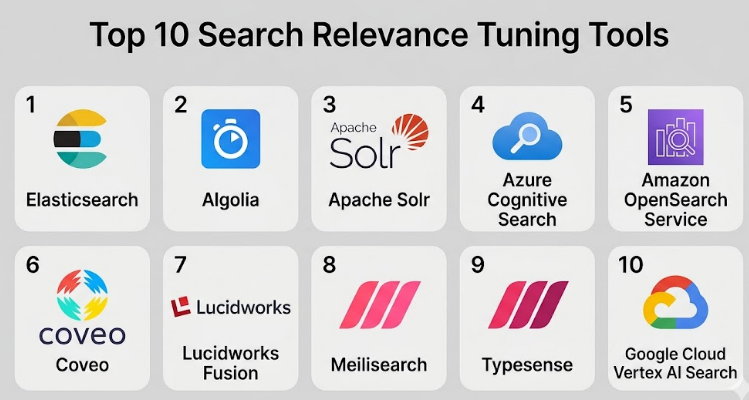
Top 10 Search Relevance Tuning Tools
#1 — Elasticsearch
Short description (2–3 lines): A widely used open-source search engine with powerful relevance tuning capabilities, suitable for developers and enterprises building custom search solutions.
Key Features
- BM25-based ranking with customization
- Query DSL for advanced tuning
- Vector search support
- Aggregations and analytics
- Real-time indexing
- A/B testing via external tools
Pros
- Highly flexible and customizable
- Large ecosystem and community
Cons
- Requires expertise to tune effectively
- Operational complexity at scale
Platforms / Deployment
Web / Windows / macOS / Linux
Cloud / Self-hosted / Hybrid
Security & Compliance
RBAC, encryption, audit logging; certifications vary by deployment
Integrations & Ecosystem
Elasticsearch integrates deeply into modern data stacks.
- Logstash
- Kibana
- Beats
- REST APIs
- Data pipelines
Support & Community
Very strong open-source community and enterprise support options
#2 — Algolia
Short description (2–3 lines): A hosted search platform focused on speed, relevance, and developer-friendly APIs, widely used in e-commerce and SaaS applications.
Key Features
- AI-powered ranking
- Typo tolerance and synonyms
- Personalization features
- Real-time indexing
- Analytics dashboard
- A/B testing tools
Pros
- Extremely fast search responses
- Easy to implement and tune
Cons
- Pricing can scale quickly
- Limited deep customization vs open-source
Platforms / Deployment
Web
Cloud
Security & Compliance
Encryption, API key controls; certifications not publicly stated
Integrations & Ecosystem
- Frontend frameworks
- E-commerce platforms
- APIs
- Analytics tools
Support & Community
Strong documentation, developer-friendly onboarding
#3 — Apache Solr
Short description (2–3 lines): Open-source search platform built on Lucene, offering advanced relevance tuning and enterprise-grade search capabilities.
Key Features
- Flexible ranking algorithms
- Faceted search
- Query boosting
- Distributed search
- Plugin architecture
Pros
- Highly customizable
- Mature and stable platform
Cons
- Complex setup
- UI less modern compared to SaaS tools
Platforms / Deployment
Web / Windows / macOS / Linux
Self-hosted / Cloud
Security & Compliance
RBAC, SSL; certifications not publicly stated
Integrations & Ecosystem
- Hadoop
- Spark
- APIs
- Enterprise systems
Support & Community
Strong open-source community
#4 — Azure Cognitive Search
Short description (2–3 lines): Microsoft’s cloud-based search service with AI enrichment and relevance tuning capabilities.
Key Features
- AI enrichment pipelines
- Semantic search
- Scoring profiles
- Integration with Azure AI
- Built-in indexing
Pros
- Strong AI integration
- Easy Azure ecosystem integration
Cons
- Azure dependency
- Limited customization compared to open-source
Platforms / Deployment
Cloud
Security & Compliance
Azure security framework, RBAC, encryption
Integrations & Ecosystem
- Azure AI services
- Data storage systems
- APIs
Support & Community
Enterprise-grade Microsoft support
#5 — Amazon OpenSearch Service
Short description (2–3 lines): Managed search service based on Elasticsearch/OpenSearch with built-in tuning and scaling capabilities.
Key Features
- Managed clusters
- Query tuning tools
- ML-based ranking
- Dashboards
- Real-time analytics
Pros
- Scalable and managed
- Strong AWS integration
Cons
- AWS lock-in
- Complexity for advanced tuning
Platforms / Deployment
Cloud
Security & Compliance
IAM, encryption, VPC; certifications vary
Integrations & Ecosystem
- AWS services
- APIs
- Data pipelines
Support & Community
AWS enterprise support
#6 — Coveo
Short description (2–3 lines): AI-powered relevance platform focused on personalization and enterprise search optimization.
Key Features
- AI relevance models
- Personalization engine
- A/B testing
- Analytics dashboards
- Recommendation engine
Pros
- Strong AI-driven personalization
- Enterprise-ready features
Cons
- Premium pricing
- Complex onboarding
Platforms / Deployment
Cloud
Security & Compliance
Not publicly stated
Integrations & Ecosystem
- CRM systems
- CMS platforms
- APIs
Support & Community
Enterprise support, smaller community
#7 — Lucidworks Fusion
Short description (2–3 lines): Enterprise search platform built on Solr, focused on relevance tuning, AI, and analytics.
Key Features
- AI ranking models
- Data pipelines
- Query tuning
- Analytics dashboards
- NLP support
Pros
- Advanced enterprise capabilities
- Strong analytics
Cons
- Complex setup
- Costly for smaller teams
Platforms / Deployment
Cloud / Self-hosted
Security & Compliance
RBAC, encryption; certifications not publicly stated
Integrations & Ecosystem
- Data lakes
- APIs
- Enterprise systems
Support & Community
Enterprise support
#8 — Meilisearch
Short description (2–3 lines): Lightweight, developer-friendly search engine focused on simplicity and speed.
Key Features
- Instant search
- Typo tolerance
- Simple relevance tuning
- REST API
- Easy setup
Pros
- Easy to use
- Fast performance
Cons
- Limited advanced tuning
- Smaller ecosystem
Platforms / Deployment
Web / Windows / macOS / Linux
Self-hosted / Cloud
Security & Compliance
Not publicly stated
Integrations & Ecosystem
- APIs
- Frontend frameworks
Support & Community
Growing community
#9 — Typesense
Short description (2–3 lines): Open-source search engine with focus on fast, typo-tolerant search and easy relevance tuning.
Key Features
- Typo tolerance
- Ranking rules
- Real-time indexing
- API-first design
- Lightweight deployment
Pros
- Easy to deploy
- Good performance
Cons
- Limited enterprise features
- Smaller ecosystem
Platforms / Deployment
Web / Windows / macOS / Linux
Self-hosted / Cloud
Security & Compliance
Not publicly stated
Integrations & Ecosystem
- APIs
- SaaS platforms
Support & Community
Active open-source community
#10 — Google Cloud Vertex AI Search
Short description (2–3 lines): AI-powered search platform with semantic understanding and relevance tuning capabilities.
Key Features
- Semantic search
- AI ranking models
- Personalization
- Integration with Google AI
- Real-time indexing
Pros
- Strong AI capabilities
- Scalable infrastructure
Cons
- Google Cloud dependency
- Limited control vs open-source
Platforms / Deployment
Cloud
Security & Compliance
Google Cloud security framework
Integrations & Ecosystem
- Google Cloud services
- APIs
- Data platforms
Support & Community
Enterprise support
Comparison Table (Top 10)
| Tool Name | Best For | Platform(s) Supported | Deployment | Standout Feature | Public Rating |
|---|---|---|---|---|---|
| Elasticsearch | Custom search systems | Web, OS | Hybrid | Query DSL | N/A |
| Algolia | SaaS/e-commerce | Web | Cloud | Speed & UX | N/A |
| Apache Solr | Enterprise search | Web, OS | Hybrid | Flexibility | N/A |
| Azure Cognitive Search | Microsoft ecosystem | Web | Cloud | AI enrichment | N/A |
| Amazon OpenSearch | AWS users | Web | Cloud | Managed search | N/A |
| Coveo | Personalization | Web | Cloud | AI recommendations | N/A |
| Lucidworks Fusion | Enterprise AI search | Web | Hybrid | NLP + analytics | N/A |
| Meilisearch | Lightweight apps | Web, OS | Hybrid | Simplicity | N/A |
| Typesense | Developer projects | Web, OS | Hybrid | Fast search | N/A |
| Vertex AI Search | AI-driven search | Web | Cloud | Semantic AI | N/A |
Evaluation & Scoring of Search Relevance Tuning Tools
| Tool Name | Core (25%) | Ease (15%) | Integrations (15%) | Security (10%) | Performance (10%) | Support (10%) | Value (15%) | Weighted Total |
|---|---|---|---|---|---|---|---|---|
| Elasticsearch | 9 | 7 | 9 | 8 | 9 | 9 | 8 | 8.5 |
| Algolia | 8 | 9 | 8 | 7 | 10 | 8 | 7 | 8.4 |
| Solr | 9 | 6 | 8 | 7 | 9 | 8 | 8 | 8.1 |
| Azure Search | 8 | 8 | 9 | 9 | 9 | 9 | 7 | 8.5 |
| OpenSearch | 8 | 7 | 9 | 9 | 9 | 9 | 8 | 8.6 |
| Coveo | 9 | 7 | 8 | 8 | 8 | 8 | 6 | 8.0 |
| Lucidworks | 9 | 6 | 8 | 8 | 8 | 8 | 6 | 7.9 |
| Meilisearch | 7 | 9 | 7 | 6 | 8 | 7 | 9 | 7.9 |
| Typesense | 7 | 9 | 7 | 6 | 8 | 7 | 9 | 7.9 |
| Vertex AI | 9 | 8 | 9 | 9 | 9 | 9 | 7 | 8.7 |
How to interpret:
- Scores are relative comparisons within this category.
- Higher total indicates better balance across criteria.
- Core features have the highest weight.
- Value considers cost vs capability.
- Choose based on use case, not just score.
Which Search Relevance Tuning Tools
Solo / Freelancer
- Best: Meilisearch, Typesense
Simple, fast, easy to deploy.
SMB
- Best: Algolia, Typesense
Balance between ease and performance.
Mid-Market
- Best: Elasticsearch, Azure Search
Scalable with good feature sets.
Enterprise
- Best: Coveo, OpenSearch, Vertex AI
Advanced AI and scalability.
Budget vs Premium
- Budget: Meilisearch, Typesense
- Premium: Coveo, Lucidworks
Feature Depth vs Ease of Use
- Deep: Elasticsearch, Solr
- Easy: Algolia, Meilisearch
Integrations & Scalability
- Strong: OpenSearch, Vertex AI
- Moderate: Typesense
Security & Compliance Needs
- Best: Azure Search, OpenSearch, Vertex AI
Frequently Asked Questions (FAQs)
What is search relevance tuning?
It is the process of improving how search results are ranked and displayed.
Do I need AI for relevance tuning?
Not always, but AI improves accuracy significantly.
Are these tools expensive?
Varies; open-source tools are cheaper, SaaS tools cost more.
Can I use multiple tools together?
Yes, especially in hybrid architectures.
Is it hard to implement?
Depends on the tool; SaaS options are easier.
What industries benefit most?
E-commerce, SaaS, enterprise IT.
Can it scale to millions of users?
Yes, most tools support large-scale deployments.
How long does tuning take?
Initial setup can take weeks; ongoing optimization is continuous.
What are common mistakes?
Ignoring user behavior data and over-tuning rules.
Can I switch tools later?
Yes, but requires re-indexing and migration.
Conclusion
Search relevance tuning tools are essential for delivering high-quality search experiences in modern applications. From simple keyword adjustments to AI-powered ranking models, these tools help businesses improve user engagement, conversions, and efficiency. There is no single best tool for every scenario. The right choice depends on your scale, technical expertise, budget, and integration requirements. Start by identifying your core needs, shortlist 2–3 tools, and run a pilot to evaluate performance, relevance quality, and ease of integration before making a final decision.
