Introduction
Recommendation System Toolkits are software frameworks and platforms that help businesses suggest relevant products, content, or services to users based on behavior, preferences, and data patterns. In simple terms, these tools power the “You may also like” or “Recommended for you” features you see on e-commerce sites, streaming platforms, and apps.
In today’s AI-driven landscape, recommendation systems have become a core business engine rather than an optional feature. With the rise of personalization, real-time analytics, and generative AI, companies are expected to deliver hyper-relevant experiences across channels.
Real-world use cases include:
- E-commerce product recommendations (cross-sell, upsell)
- Streaming content personalization
- News and content feed ranking
- Job and talent matching platforms
- Personalized marketing campaigns
What buyers should evaluate:
- Algorithm flexibility (collaborative, content-based, hybrid)
- Real-time vs batch processing capability
- Scalability and performance
- Ease of integration with data pipelines
- Model explainability and transparency
- Security and compliance support
- Cost and operational overhead
- Support for AI/ML frameworks
- Customization vs out-of-the-box readiness
Best for: Data-driven companies, e-commerce platforms, SaaS businesses, media platforms, and AI/ML teams looking to improve engagement and conversions.
Not ideal for: Small businesses with minimal data, static websites, or teams without data engineering/ML capabilities—simpler rule-based systems may be sufficient.
Key Trends in Recommendation System Toolkits
- AI-first recommendation engines: Increasing use of deep learning and transformer-based models.
- Real-time personalization: Streaming data pipelines enabling instant recommendations.
- Hybrid recommendation models: Combining collaborative filtering, content-based, and contextual signals.
- Privacy-first design: Compliance with GDPR and data localization requirements.
- AutoML integration: Reducing the need for deep ML expertise.
- Composable architectures: APIs and microservices for flexible deployment.
- Edge personalization: Recommendations happening closer to the user for faster response.
- Explainable AI: Growing demand for transparency in recommendations.
- Integration with CDPs: Customer data platforms driving richer personalization.
- Cost optimization models: Usage-based pricing replacing fixed licensing.
How We Selected These Tools (Methodology)
- Evaluated market adoption and industry presence
- Assessed feature completeness across recommendation types
- Reviewed performance and scalability indicators
- Considered security posture and enterprise readiness
- Analyzed integration capabilities with modern data stacks
- Checked community support and ecosystem maturity
- Balanced open-source vs enterprise tools
- Ensured coverage across different business sizes
- Focused on real-world usability and flexibility
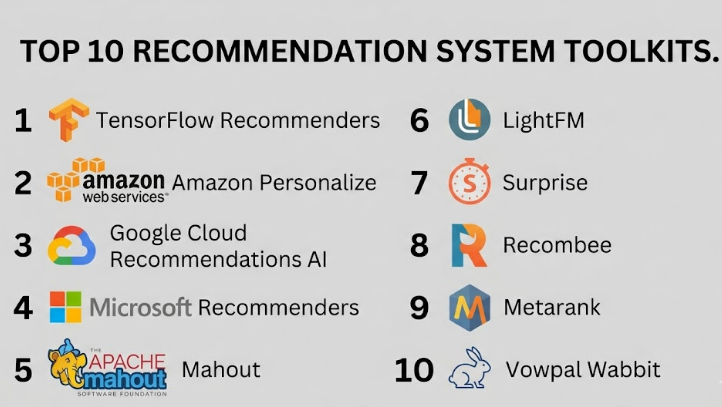
Top 10 Recommendation System Toolkits
#1 — TensorFlow Recommenders
Short description: A library built on TensorFlow for building scalable recommendation systems, ideal for ML engineers.
Key Features
- Deep learning-based recommendation models
- Ranking and retrieval pipelines
- Integration with TensorFlow ecosystem
- Scalable training workflows
- Flexible model architecture
- Support for large datasets
Pros
- Highly customizable
- Strong performance at scale
Cons
- Requires ML expertise
- Setup complexity
Platforms / Deployment
Linux / Cloud / Self-hosted
Security & Compliance
Not publicly stated
Integrations & Ecosystem
Works seamlessly with TensorFlow tools and ML pipelines.
- TensorFlow Extended (TFX)
- Kubernetes
- Big data tools
Support & Community
Strong open-source community and documentation.
#2 — Amazon Personalize
Short description: Fully managed AWS service for building recommendation systems without deep ML knowledge.
Key Features
- Pre-built recommendation algorithms
- Real-time personalization
- Auto-scaling infrastructure
- Batch and streaming support
- Event tracking integration
- Managed training pipelines
Pros
- Easy to deploy
- Scales automatically
Cons
- Vendor lock-in
- Cost can increase with usage
Platforms / Deployment
Cloud
Security & Compliance
IAM, encryption, compliance support (details vary)
Integrations & Ecosystem
Integrates deeply with AWS services.
- S3
- Lambda
- Redshift
Support & Community
Enterprise-level support with AWS ecosystem.
#3 — Google Cloud Recommendations AI
Short description: Managed recommendation platform focused on retail and e-commerce personalization.
Key Features
- Retail-focused recommendation models
- Real-time inference
- AutoML capabilities
- A/B testing support
- High scalability
- Pre-trained models
Pros
- Strong performance
- Minimal setup
Cons
- Limited customization
- GCP dependency
Platforms / Deployment
Cloud
Security & Compliance
Encryption, IAM, compliance support (Not fully detailed)
Integrations & Ecosystem
Works within Google Cloud ecosystem.
- BigQuery
- Dataflow
- Vertex AI
Support & Community
Enterprise support with GCP documentation.
#4 — Microsoft Recommenders
Short description: Open-source toolkit with multiple algorithms for experimentation and production use.
Key Features
- Wide range of algorithms
- Notebook-based experimentation
- Azure integration
- Benchmark datasets
- Evaluation tools
- Modular design
Pros
- Flexible
- Open-source
Cons
- Requires setup effort
- Not fully managed
Platforms / Deployment
Windows / Linux / Cloud / Self-hosted
Security & Compliance
Not publicly stated
Integrations & Ecosystem
- Azure ML
- Python ecosystem
- Data science tools
Support & Community
Active GitHub community.
#5 — Apache Mahout
Short description: Scalable machine learning library with recommendation algorithms.
Key Features
- Collaborative filtering
- Distributed processing
- Integration with Hadoop ecosystem
- Matrix factorization
- Scalable architecture
Pros
- Good for big data
- Open-source
Cons
- Limited modern ML features
- Steeper learning curve
Platforms / Deployment
Linux / Self-hosted
Security & Compliance
Not publicly stated
Integrations & Ecosystem
- Hadoop
- Spark
- Big data pipelines
Support & Community
Moderate community support.
#6 — LightFM
Short description: Hybrid recommendation library combining collaborative and content-based filtering.
Key Features
- Hybrid recommendation models
- Fast training
- Easy implementation
- Support for sparse data
- Python-based
Pros
- Easy to use
- Good performance
Cons
- Limited scalability
- Fewer enterprise features
Platforms / Deployment
Linux / Self-hosted
Security & Compliance
Not publicly stated
Integrations & Ecosystem
- Python libraries
- Data science tools
Support & Community
Active open-source contributors.
#7 — Surprise
Short description: Python library focused on collaborative filtering techniques.
Key Features
- Easy experimentation
- Built-in datasets
- Algorithm comparison
- Evaluation tools
- Simple API
Pros
- Beginner-friendly
- Quick setup
Cons
- Limited scalability
- Not production-focused
Platforms / Deployment
Linux / Self-hosted
Security & Compliance
Not publicly stated
Integrations & Ecosystem
- Python ecosystem
Support & Community
Good documentation for beginners.
#8 — Recombee
Short description: SaaS-based recommendation engine focused on real-time personalization.
Key Features
- Real-time recommendations
- API-first design
- Personalization models
- A/B testing
- Scalability
Pros
- Easy integration
- Real-time capabilities
Cons
- Paid service
- Limited offline control
Platforms / Deployment
Cloud
Security & Compliance
Not publicly stated
Integrations & Ecosystem
- REST APIs
- E-commerce platforms
Support & Community
Commercial support available.
#9 — Metarank
Short description: Open-source ranking and recommendation system focused on real-time use cases.
Key Features
- Real-time ranking
- Feature store integration
- Event-driven architecture
- Streaming support
- Custom ranking logic
Pros
- Real-time processing
- Developer-friendly
Cons
- Setup complexity
- Smaller community
Platforms / Deployment
Cloud / Self-hosted
Security & Compliance
Not publicly stated
Integrations & Ecosystem
- Kafka
- Data pipelines
- APIs
Support & Community
Growing open-source community.
#10 — Vowpal Wabbit
Short description: Fast machine learning system suitable for large-scale recommendation tasks.
Key Features
- Online learning
- High performance
- Large-scale support
- Feature engineering flexibility
- Low latency
Pros
- Extremely fast
- Efficient for big data
Cons
- Complex setup
- Limited UI
Platforms / Deployment
Linux / Self-hosted
Security & Compliance
Not publicly stated
Integrations & Ecosystem
- ML pipelines
- Data processing systems
Support & Community
Strong academic and open-source support.
Comparison Table (Top 10)
| Tool Name | Best For | Platform(s) Supported | Deployment | Standout Feature | Public Rating |
|---|---|---|---|---|---|
| TensorFlow Recommenders | ML engineers | Linux | Self-hosted | Deep learning models | N/A |
| Amazon Personalize | Enterprises | Cloud | Cloud | Managed service | N/A |
| Google Recommendations AI | Retail | Cloud | Cloud | Retail-specific models | N/A |
| Microsoft Recommenders | Developers | Windows/Linux | Hybrid | Algorithm variety | N/A |
| Apache Mahout | Big data | Linux | Self-hosted | Hadoop integration | N/A |
| LightFM | SMB developers | Linux | Self-hosted | Hybrid models | N/A |
| Surprise | Beginners | Linux | Self-hosted | Easy experimentation | N/A |
| Recombee | SaaS teams | Cloud | Cloud | Real-time API | N/A |
| Metarank | Real-time systems | Cloud/Linux | Hybrid | Event-driven ranking | N/A |
| Vowpal Wabbit | Large-scale ML | Linux | Self-hosted | Online learning | N/A |
Evaluation & Scoring of Recommendation System Toolkits
| Tool Name | Core | Ease | Integrations | Security | Performance | Support | Value | Weighted Total |
|---|---|---|---|---|---|---|---|---|
| TensorFlow Recommenders | 9 | 6 | 8 | 6 | 9 | 8 | 7 | 7.9 |
| Amazon Personalize | 8 | 9 | 9 | 8 | 9 | 9 | 7 | 8.5 |
| Google Recommendations AI | 8 | 9 | 8 | 8 | 9 | 8 | 7 | 8.3 |
| Microsoft Recommenders | 7 | 7 | 8 | 6 | 7 | 7 | 8 | 7.3 |
| Apache Mahout | 7 | 5 | 7 | 6 | 8 | 6 | 7 | 6.7 |
| LightFM | 7 | 8 | 6 | 5 | 7 | 7 | 8 | 7.2 |
| Surprise | 6 | 9 | 5 | 5 | 6 | 7 | 9 | 6.9 |
| Recombee | 8 | 9 | 8 | 7 | 9 | 8 | 7 | 8.3 |
| Metarank | 8 | 7 | 7 | 6 | 8 | 6 | 7 | 7.3 |
| Vowpal Wabbit | 8 | 5 | 7 | 6 | 9 | 7 | 8 | 7.5 |
How to interpret scores:
- Scores are comparative, not absolute.
- A higher score means better balance across categories.
- Enterprise tools score higher in scalability and support.
- Open-source tools score higher in value but lower in ease.
- Choose based on your context, not just total score.
Which Recommendation System Toolkits
Solo / Freelancer
- Best: Surprise, LightFM
- Reason: Easy to learn, minimal setup
SMB
- Best: Recombee, LightFM
- Reason: Balance between ease and performance
Mid-Market
- Best: Metarank, Microsoft Recommenders
- Reason: Flexibility and customization
Enterprise
- Best: Amazon Personalize, Google Recommendations AI
- Reason: Scalability, reliability, support
Budget vs Premium
- Budget: Open-source tools
- Premium: Managed cloud services
Feature Depth vs Ease of Use
- Depth: TensorFlow Recommenders
- Ease: Amazon Personalize
Integrations & Scalability
- Strongest: AWS, Google Cloud tools
Security & Compliance Needs
- Enterprise tools offer better compliance features
Frequently Asked Questions (FAQs)
What is a recommendation system toolkit?
A toolkit provides tools and frameworks to build systems that suggest items based on user behavior and data.
Do I need ML expertise to use these tools?
Not always. Managed services reduce complexity, but open-source tools require ML knowledge.
Are these tools expensive?
Costs vary. Open-source is free, while cloud tools use usage-based pricing.
Can I build real-time recommendations?
Yes, many tools support real-time or near real-time processing.
What data is required?
User behavior, item metadata, and interaction history.
How scalable are these systems?
Enterprise tools are highly scalable; open-source depends on infrastructure.
Are they secure?
Security depends on deployment and vendor capabilities.
Can I integrate with existing systems?
Yes, most tools provide APIs and integration options.
What are common mistakes?
Poor data quality and ignoring evaluation metrics.
Can I switch tools later?
Yes, but migration requires effort and data alignment.
Conclusion
Recommendation system toolkits are no longer optional—they are a core part of modern digital experiences. Whether you are running an e-commerce platform, a content site, or a SaaS product, the ability to deliver personalized recommendations directly impacts engagement, retention, and revenue. The right choice depends on your scale, technical expertise, and business goals. Open-source tools offer flexibility and cost advantages, while managed services provide speed, reliability, and scalability. There is no single “best” solution—only the one that fits your use case.
