Introduction
Robotics Simulation Tools are software platforms that allow engineers, developers, and researchers to design, test, and validate robotic systems in a virtual environment before deploying them in the real world. In simple terms, these tools create a digital version of robots, environments, and physics so teams can experiment safely and efficiently.
In today’s robotics and AI-driven landscape, simulation has become a critical step in development. With increasing complexity in autonomous systems, AI-based perception, and real-world variability, testing everything physically is expensive and risky. Simulation bridges that gap by enabling rapid prototyping, AI training, and system validation at scale.
Real-world use cases include:
- Autonomous vehicle testing in virtual environments
- Industrial robot path planning and optimization
- Warehouse robotics simulation and logistics modeling
- AI model training for perception (vision, sensors)
- Drone navigation and control system validation
What buyers should evaluate:
- Physics accuracy and realism
- Support for sensors (LiDAR, camera, IMU)
- Integration with AI/ML frameworks
- Real-time vs offline simulation capability
- Scalability (single robot vs swarm simulation)
- Ease of setup and usability
- Compatibility with ROS (Robot Operating System)
- Visualization and debugging tools
- Hardware-in-the-loop support
- Licensing and cost model
Best for: Robotics engineers, AI/ML developers, research institutions, automotive companies, manufacturing firms, and startups building autonomous systems.
Not ideal for: Teams with simple automation needs, non-robotic software development, or businesses without simulation requirements—basic modeling tools or direct hardware testing may be sufficient.
Key Trends in Robotics Simulation Tools
- AI-integrated simulation: Deep learning models are trained directly inside simulation environments.
- Digital twin adoption: Real-world systems mirrored in simulation for predictive analysis.
- Cloud-based simulation: Distributed simulation workloads running at scale.
- Photorealistic rendering: Improved visual realism for perception training.
- Sensor simulation advancements: Accurate modeling of LiDAR, radar, and camera data.
- ROS-native ecosystems: Strong alignment with ROS and ROS2 frameworks.
- Reinforcement learning environments: Simulation-first training pipelines for robots.
- Edge-to-cloud workflows: Simulation integrated with deployment pipelines.
- Open-source growth: Increased adoption of flexible, community-driven platforms.
- Interoperability standards: Support for URDF, SDF, and other robotics formats.
How We Selected These Tools (Methodology)
- Evaluated market adoption and industry relevance
- Assessed breadth of simulation capabilities (physics, sensors, AI)
- Reviewed performance and scalability indicators
- Considered ease of integration with robotics stacks (ROS, AI frameworks)
- Analyzed ecosystem maturity and community support
- Checked enterprise readiness and deployment flexibility
- Balanced open-source vs commercial offerings
- Focused on real-world usability across industries
- Considered learning curve and onboarding experience
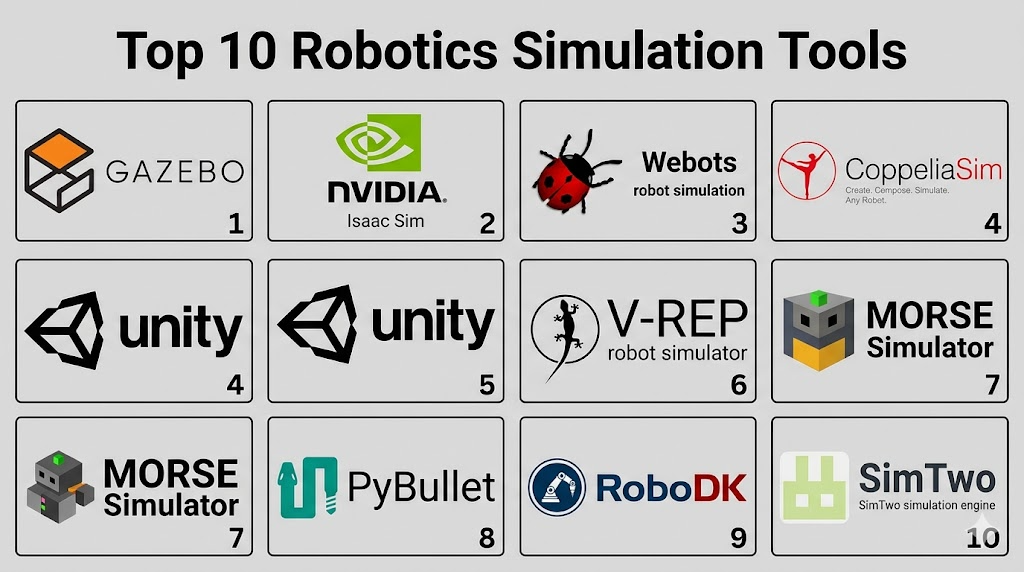
Top 10 Robotics Simulation Tools
#1 — Gazebo
Short description: Open-source robotics simulator widely used with ROS, suitable for research and industrial robotics testing.
Key Features
- Advanced physics engine
- Sensor simulation (camera, LiDAR)
- ROS/ROS2 integration
- Multi-robot simulation
- Plugin-based architecture
- Realistic environment modeling
Pros
- Strong ROS ecosystem support
- Highly customizable
Cons
- Steeper learning curve
- UI can feel outdated
Platforms / Deployment
Linux / Self-hosted
Security & Compliance
Not publicly stated
Integrations & Ecosystem
Deep integration with ROS ecosystem and robotics workflows.
- ROS / ROS2
- URDF/SDF formats
- Robotics middleware
Support & Community
Large open-source community and extensive documentation.
#2 — NVIDIA Isaac Sim
Short description: High-performance simulation platform built on Omniverse for AI-driven robotics and digital twin applications.
Key Features
- Photorealistic rendering
- AI and deep learning integration
- Synthetic data generation
- Digital twin capabilities
- GPU-accelerated simulation
- Sensor simulation
Pros
- High realism
- Strong AI integration
Cons
- Hardware requirements (GPU-heavy)
- Complexity
Platforms / Deployment
Windows / Linux / Cloud
Security & Compliance
Not publicly stated
Integrations & Ecosystem
- NVIDIA Omniverse
- AI frameworks
- Robotics SDKs
Support & Community
Enterprise-level support with growing ecosystem.
#3 — Webots
Short description: User-friendly open-source simulator for education, research, and industrial robotics.
Key Features
- Cross-platform support
- Built-in robot models
- Real-time simulation
- Multiple programming languages
- Visualization tools
- Physics-based simulation
Pros
- Easy to use
- Good for beginners
Cons
- Limited scalability
- Less advanced physics
Platforms / Deployment
Windows / macOS / Linux
Security & Compliance
Not publicly stated
Integrations & Ecosystem
- ROS integration
- Python, C++, Java
- Robotics frameworks
Support & Community
Active community with good documentation.
#4 — CoppeliaSim
Short description: Flexible robot simulation platform (formerly V-REP) for research and prototyping.
Key Features
- Multiple physics engines
- Script-based control
- Modular architecture
- Real-time simulation
- Extensive API support
- Multi-robot support
Pros
- Highly flexible
- Multiple simulation modes
Cons
- UI complexity
- Learning curve
Platforms / Deployment
Windows / macOS / Linux
Security & Compliance
Not publicly stated
Integrations & Ecosystem
- ROS
- Python / Lua APIs
- External tools
Support & Community
Strong academic and research usage.
#5 — Unity Robotics Simulation
Short description: Simulation toolkit built on Unity for robotics visualization and AI training.
Key Features
- High-quality graphics
- Digital twin support
- Simulation pipelines
- AI training environments
- Physics-based modeling
- Cross-platform support
Pros
- Excellent visualization
- Flexible environment creation
Cons
- Requires Unity knowledge
- Not robotics-first
Platforms / Deployment
Windows / macOS / Linux
Security & Compliance
Not publicly stated
Integrations & Ecosystem
- Unity ecosystem
- ROS integration
- AI tools
Support & Community
Large Unity developer community.
#6 — V-REP (Legacy CoppeliaSim)
Short description: Earlier version of CoppeliaSim, still used in legacy robotics projects.
Key Features
- Multi-physics engines
- Scripting support
- Simulation environments
- Robot modeling
- Flexible architecture
Pros
- Proven platform
- Rich feature set
Cons
- Legacy status
- Limited updates
Platforms / Deployment
Windows / Linux
Security & Compliance
Not publicly stated
Integrations & Ecosystem
- Robotics frameworks
- APIs
Support & Community
Limited ongoing support.
#7 — MORSE Simulator
Short description: Open-source robotics simulator focused on academic research.
Key Features
- Blender-based simulation
- Realistic environments
- ROS integration
- Sensor simulation
- Modular design
Pros
- Good for research
- Flexible
Cons
- Limited updates
- Smaller community
Platforms / Deployment
Linux
Security & Compliance
Not publicly stated
Integrations & Ecosystem
- ROS
- Blender
Support & Community
Moderate community activity.
#8 — PyBullet
Short description: Python-based physics simulation library widely used for robotics and reinforcement learning.
Key Features
- Real-time physics simulation
- Reinforcement learning support
- Lightweight setup
- Robotics modeling
- Fast prototyping
Pros
- Easy to use
- Strong RL integration
Cons
- Limited visualization
- Less realistic graphics
Platforms / Deployment
Windows / Linux / macOS
Security & Compliance
Not publicly stated
Integrations & Ecosystem
- Python ML ecosystem
- RL frameworks
- OpenAI Gym
Support & Community
Active developer community.
#9 — RoboDK
Short description: Industrial robot simulation software focused on manufacturing and automation.
Key Features
- Offline programming
- Robot calibration
- Industrial robot support
- Path optimization
- CAD integration
Pros
- Industry-focused
- Easy deployment
Cons
- Commercial licensing
- Limited AI features
Platforms / Deployment
Windows / macOS / Linux
Security & Compliance
Not publicly stated
Integrations & Ecosystem
- CAD tools
- Industrial robots
- APIs
Support & Community
Commercial support available.
#10 — SimTwo
Short description: Simulation platform for robotics and control systems research.
Key Features
- Multi-robot simulation
- Physics engine
- Control system testing
- Real-time simulation
- Visualization tools
Pros
- Good for research
- Lightweight
Cons
- Limited adoption
- Smaller ecosystem
Platforms / Deployment
Windows
Security & Compliance
Not publicly stated
Integrations & Ecosystem
- Robotics frameworks
- APIs
Support & Community
Limited community support.
Comparison Table (Top 10)
| Tool Name | Best For | Platform(s) Supported | Deployment | Standout Feature | Public Rating |
|---|---|---|---|---|---|
| Gazebo | ROS users | Linux | Self-hosted | ROS integration | N/A |
| NVIDIA Isaac Sim | AI robotics | Windows/Linux | Cloud | Photorealism | N/A |
| Webots | Beginners | Cross-platform | Self-hosted | Ease of use | N/A |
| CoppeliaSim | Research | Cross-platform | Self-hosted | Multi-physics | N/A |
| Unity Robotics | Visualization | Cross-platform | Hybrid | Graphics engine | N/A |
| V-REP | Legacy users | Windows/Linux | Self-hosted | Flexibility | N/A |
| MORSE | Academic | Linux | Self-hosted | Blender integration | N/A |
| PyBullet | RL training | Cross-platform | Self-hosted | RL support | N/A |
| RoboDK | Manufacturing | Cross-platform | Self-hosted | Industrial focus | N/A |
| SimTwo | Research | Windows | Self-hosted | Control testing | N/A |
Evaluation & Scoring of Robotics Simulation Tools
| Tool Name | Core | Ease | Integrations | Security | Performance | Support | Value | Weighted Total |
|---|---|---|---|---|---|---|---|---|
| Gazebo | 9 | 6 | 9 | 6 | 8 | 9 | 8 | 8.1 |
| NVIDIA Isaac Sim | 9 | 7 | 9 | 7 | 9 | 8 | 7 | 8.4 |
| Webots | 7 | 9 | 7 | 5 | 7 | 8 | 9 | 7.7 |
| CoppeliaSim | 8 | 7 | 8 | 6 | 8 | 7 | 8 | 7.8 |
| Unity Robotics | 8 | 7 | 8 | 6 | 8 | 8 | 7 | 7.8 |
| V-REP | 7 | 6 | 7 | 5 | 7 | 6 | 7 | 6.7 |
| MORSE | 6 | 6 | 6 | 5 | 6 | 6 | 7 | 6.2 |
| PyBullet | 8 | 9 | 7 | 5 | 8 | 8 | 9 | 8.0 |
| RoboDK | 8 | 8 | 7 | 6 | 8 | 8 | 7 | 7.8 |
| SimTwo | 6 | 6 | 5 | 5 | 6 | 5 | 7 | 5.9 |
How to interpret scores:
- Scores are relative comparisons across tools.
- Enterprise-grade tools score higher in performance and integration.
- Open-source tools often score higher in value.
- Ease scores reflect onboarding complexity.
- Choose based on use case, not just total score.
Which Robotics Simulation Tools
Solo / Freelancer
- Best: Webots, PyBullet
- Reason: Easy setup, minimal infrastructure
SMB
- Best: CoppeliaSim, RoboDK
- Reason: Balance of features and usability
Mid-Market
- Best: Gazebo, Unity Robotics
- Reason: Flexibility and scalability
Enterprise
- Best: NVIDIA Isaac Sim
- Reason: AI integration and performance
Budget vs Premium
- Budget: Open-source tools (Gazebo, PyBullet)
- Premium: NVIDIA Isaac Sim, RoboDK
Feature Depth vs Ease of Use
- Depth: Gazebo, Isaac Sim
- Ease: Webots
Integrations & Scalability
- Strongest: Gazebo, Isaac Sim
Security & Compliance Needs
- Enterprise platforms provide better control
Frequently Asked Questions (FAQs)
What is a robotics simulation tool?
It is software that allows virtual testing of robots before real-world deployment.
Do I need coding skills?
Most tools require basic programming knowledge, especially Python or C++.
Are these tools free?
Some are open-source, while others require paid licenses.
Can I simulate real-world sensors?
Yes, many tools simulate cameras, LiDAR, and other sensors.
Is simulation accurate?
Accuracy depends on the physics engine and configuration.
Can I train AI models in simulation?
Yes, many tools support reinforcement learning and AI training.
What industries use these tools?
Automotive, manufacturing, logistics, and research sectors.
Can I integrate with ROS?
Most major tools support ROS integration.
What are common mistakes?
Ignoring simulation realism and poor data modeling.
Can I switch tools later?
Yes, but it requires adapting models and workflows.
Conclusion
Robotics simulation tools are essential for modern robotics development, enabling safe, scalable, and cost-effective experimentation. From open-source platforms like Gazebo and PyBullet to enterprise-grade solutions like NVIDIA Isaac Sim, the ecosystem offers a wide range of options tailored to different needs. The right choice depends on your project complexity, budget, and technical expertise. Beginners and small teams may prefer lightweight tools, while enterprises benefit from advanced AI-integrated platforms.
