Introduction
Robotics Fleet Management Tools are software platforms designed to monitor, control, and optimize multiple robots operating across warehouses, factories, hospitals, or outdoor environments. Instead of managing robots individually, these tools provide a centralized system to coordinate tasks, track performance, and ensure efficient operations at scale.
As automation adoption accelerates globally, especially in logistics, manufacturing, and last-mile delivery, managing fleets of robots has become a complex challenge. Modern fleet management platforms now include AI-driven orchestration, predictive maintenance, real-time analytics, and integration with enterprise systems like ERP and WMS.
Common real-world use cases include:
- Warehouse automation with autonomous mobile robots (AMRs)
- Industrial automation in manufacturing plants
- Hospital logistics robots for delivery and sanitation
- Autonomous delivery robots in urban environments
- Agriculture robots for precision farming
What buyers should evaluate:
- Scalability and multi-robot coordination
- Real-time monitoring and analytics
- Integration with existing systems (ERP, WMS, IoT)
- AI-based optimization capabilities
- Deployment flexibility (cloud vs edge)
- Security and compliance readiness
- Vendor support and ecosystem maturity
- Ease of configuration and onboarding
Best for: logistics operators, manufacturing teams, robotics engineers, IT leaders, and enterprises scaling robotic operations across multiple locations.
Not ideal for: small teams managing a single robot or early-stage robotics projects where simple control software or SDKs may be sufficient.
Key Trends in Robotics Fleet Management Tools
- AI-driven orchestration: Platforms increasingly use machine learning to optimize routes, workloads, and robot coordination.
- Edge computing adoption: Real-time decision-making is shifting closer to robots for low latency operations.
- Interoperability standards: Growing support for ROS-based systems and multi-vendor robot environments.
- Digital twins: Simulation environments are used for planning and testing fleet behavior before deployment.
- Predictive maintenance: Tools analyze sensor data to reduce downtime and extend robot lifespan.
- Cloud-native architectures: SaaS-based fleet management is becoming common for scalability and remote access.
- Security-first design: Encryption, identity management, and role-based access control are now baseline expectations.
- Integration ecosystems: Strong APIs and connectors with warehouse, supply chain, and analytics platforms.
- Usage-based pricing models: Some vendors are moving toward per-robot or per-operation pricing.
- Autonomy levels increasing: Fleet systems now support higher autonomy with minimal human intervention.
How We Selected These Tools (Methodology)
- Evaluated market adoption and industry recognition
- Assessed feature completeness across fleet orchestration, monitoring, and analytics
- Considered performance reliability in real-world deployments
- Reviewed security capabilities and enterprise readiness signals
- Checked integration support with robotics frameworks and enterprise systems
- Balanced enterprise-grade platforms and developer-friendly tools
- Included tools supporting multi-vendor and heterogeneous fleets
- Considered ease of deployment and scalability
- Evaluated community and support ecosystem strength
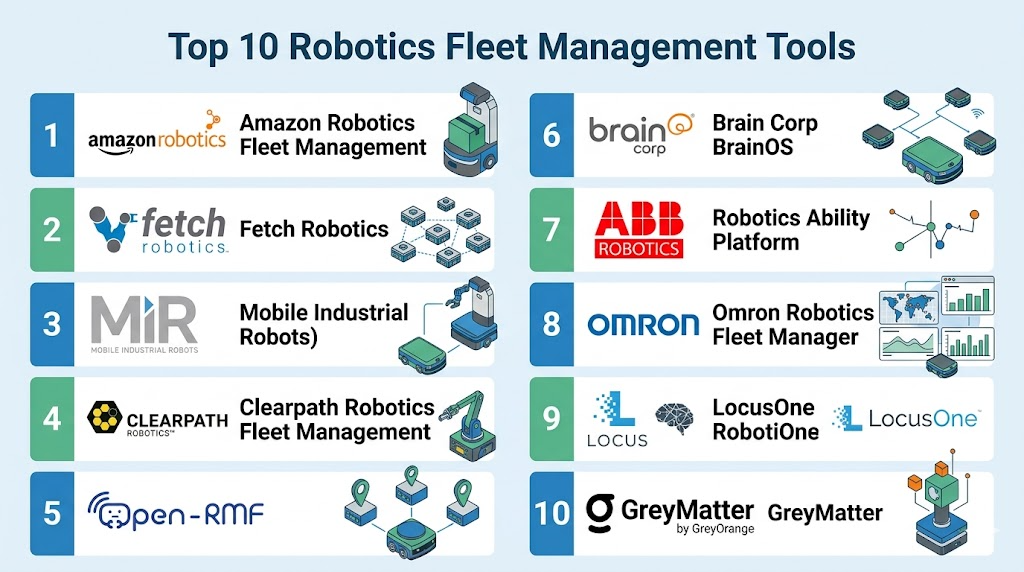
Top 10 Robotics Fleet Management Tools
#1 — Amazon Robotics Fleet Management
Short description (2–3 lines): A highly scalable fleet management system designed for warehouse robotics operations. Best suited for large-scale logistics and fulfillment environments.
Key Features
- Centralized robot orchestration
- Real-time fleet monitoring
- AI-driven task allocation
- Warehouse optimization algorithms
- High-throughput operations support
- Integration with logistics systems
Pros
- Proven at massive scale
- Strong reliability in logistics environments
Cons
- Limited availability outside Amazon ecosystem
- Not flexible for non-warehouse use cases
Platforms / Deployment
- Cloud / Hybrid
Security & Compliance
- Not publicly stated
Integrations & Ecosystem
Primarily integrates within internal logistics ecosystems.
- Warehouse management systems
- Inventory platforms
- Internal APIs
Support & Community
Enterprise-level internal support; limited public documentation.
#2 — Fetch Robotics (Zebra)
Short description: Cloud-based fleet management platform for AMRs used in warehouses and manufacturing.
Key Features
- Cloud fleet orchestration
- Robot health monitoring
- Task scheduling and optimization
- Analytics dashboards
- Multi-site management
- OTA updates
Pros
- Easy cloud deployment
- Strong warehouse use cases
Cons
- Limited customization
- Vendor lock-in risk
Platforms / Deployment
- Web / Cloud
Security & Compliance
- Not publicly stated
Integrations & Ecosystem
Supports integration with logistics platforms.
- REST APIs
- WMS integration
- IoT devices
Support & Community
Strong enterprise support via Zebra.
#3 — MiR (Mobile Industrial Robots) Fleet
Short description: Fleet management solution designed for industrial AMRs in manufacturing and logistics.
Key Features
- Multi-robot coordination
- Dynamic route planning
- Traffic management
- Centralized control
- Task automation
- Real-time monitoring
Pros
- Reliable industrial performance
- Easy integration with MiR robots
Cons
- Limited third-party robot support
- Mostly hardware-centric
Platforms / Deployment
- Web / On-premise
Security & Compliance
- Not publicly stated
Integrations & Ecosystem
- ERP systems
- Manufacturing systems
- APIs
Support & Community
Vendor-driven support, moderate documentation.
#4 — Clearpath Robotics Fleet Management
Short description: A flexible platform supporting research and industrial robotics fleets, especially ROS-based systems.
Key Features
- ROS-native integration
- Fleet orchestration tools
- Remote monitoring
- Data collection and analytics
- Customizable workflows
- Simulation support
Pros
- Highly flexible
- Strong for research environments
Cons
- Requires technical expertise
- Not plug-and-play
Platforms / Deployment
- Linux / On-premise / Cloud
Security & Compliance
- Not publicly stated
Integrations & Ecosystem
- ROS ecosystem
- Custom APIs
- Simulation tools
Support & Community
Strong developer community.
#5 — Open-RMF (Open Robotics)
Short description: Open-source robotics fleet management framework enabling interoperability between heterogeneous robots.
Key Features
- Multi-vendor fleet coordination
- Traffic management
- Task scheduling
- Open-source extensibility
- ROS integration
- Simulation support
Pros
- Vendor-neutral
- Highly customizable
Cons
- Requires engineering effort
- No enterprise support by default
Platforms / Deployment
- Linux / Self-hosted
Security & Compliance
- Not publicly stated
Integrations & Ecosystem
- ROS 2 ecosystem
- Custom integrations
- Simulation platforms
Support & Community
Strong open-source community.
#6 — Brain Corp BrainOS
Short description: AI-driven platform for managing fleets of autonomous cleaning and service robots.
Key Features
- AI navigation
- Fleet analytics
- Remote monitoring
- Performance tracking
- Task automation
- Cloud-based management
Pros
- Strong AI capabilities
- Scalable cloud platform
Cons
- Focused on specific industries
- Limited customization
Platforms / Deployment
- Cloud
Security & Compliance
- Not publicly stated
Integrations & Ecosystem
- IoT systems
- APIs
- Enterprise dashboards
Support & Community
Enterprise support with vendor ecosystem.
#7 — ABB Robotics Ability Platform
Short description: Industrial IoT and robotics management platform for large-scale manufacturing environments.
Key Features
- Fleet monitoring
- Predictive maintenance
- Industrial analytics
- Remote diagnostics
- Integration with factory systems
- Digital twin capabilities
Pros
- Enterprise-grade reliability
- Strong industrial integration
Cons
- Complex setup
- Higher cost
Platforms / Deployment
- Cloud / Hybrid
Security & Compliance
- Not publicly stated
Integrations & Ecosystem
- ERP systems
- Industrial IoT platforms
- APIs
Support & Community
Global enterprise support.
#8 — Omron Robotics Fleet Manager
Short description: Fleet management solution for Omron mobile robots in manufacturing and logistics.
Key Features
- Centralized fleet control
- Traffic management
- Dynamic routing
- Task prioritization
- Real-time monitoring
Pros
- Strong reliability
- Good industrial integration
Cons
- Vendor-specific
- Limited flexibility
Platforms / Deployment
- On-premise
Security & Compliance
- Not publicly stated
Integrations & Ecosystem
- Manufacturing systems
- APIs
- ERP
Support & Community
Vendor-driven support.
#9 — Locus Robotics LocusOne
Short description: Warehouse-focused fleet orchestration platform for optimizing picking and logistics operations.
Key Features
- Real-time task allocation
- Performance analytics
- Workforce coordination
- AI optimization
- Cloud dashboards
Pros
- High efficiency gains
- Easy deployment in warehouses
Cons
- Limited outside logistics
- SaaS dependency
Platforms / Deployment
- Cloud
Security & Compliance
- Not publicly stated
Integrations & Ecosystem
- WMS integration
- APIs
- Analytics tools
Support & Community
Strong enterprise support.
#10 — GreyOrange GreyMatter
Short description: AI-powered orchestration platform for warehouse robotics and automation systems.
Key Features
- AI-based decision engine
- Real-time orchestration
- Inventory optimization
- Multi-robot coordination
- Predictive analytics
Pros
- Strong AI capabilities
- End-to-end automation
Cons
- Enterprise-focused pricing
- Complex onboarding
Platforms / Deployment
- Cloud / Hybrid
Security & Compliance
- Not publicly stated
Integrations & Ecosystem
- WMS
- ERP systems
- APIs
Support & Community
Enterprise-grade support.
Comparison Table (Top 10)
| Tool Name | Best For | Platform(s) Supported | Deployment | Standout Feature | Public Rating |
|---|---|---|---|---|---|
| Amazon Robotics | Large warehouses | Web | Cloud/Hybrid | Massive scale automation | N/A |
| Fetch Robotics | AMR fleets | Web | Cloud | Easy cloud orchestration | N/A |
| MiR Fleet | Industrial AMRs | Web | On-premise | Traffic management | N/A |
| Clearpath Robotics | Research & custom fleets | Linux | Hybrid | ROS-native flexibility | N/A |
| Open-RMF | Multi-vendor fleets | Linux | Self-hosted | Open-source interoperability | N/A |
| BrainOS | Service robots | Web | Cloud | AI-driven navigation | N/A |
| ABB Ability | Manufacturing | Web | Hybrid | Predictive maintenance | N/A |
| Omron Fleet Manager | Industrial robots | Web | On-premise | Reliable routing | N/A |
| LocusOne | Warehouse ops | Web | Cloud | Picking optimization | N/A |
| GreyMatter | Warehouse AI | Web | Hybrid | AI orchestration engine | N/A |
Evaluation & Scoring of Robotics Fleet Management Tools
| Tool Name | Core (25%) | Ease (15%) | Integrations (15%) | Security (10%) | Performance (10%) | Support (10%) | Value (15%) | Weighted Total |
|---|---|---|---|---|---|---|---|---|
| Amazon Robotics | 9 | 6 | 7 | 7 | 10 | 8 | 6 | 8.0 |
| Fetch Robotics | 8 | 8 | 7 | 7 | 8 | 8 | 7 | 7.8 |
| MiR Fleet | 8 | 7 | 6 | 6 | 8 | 7 | 7 | 7.3 |
| Clearpath | 7 | 5 | 8 | 6 | 7 | 7 | 8 | 6.9 |
| Open-RMF | 7 | 4 | 9 | 5 | 7 | 6 | 9 | 6.8 |
| BrainOS | 8 | 7 | 6 | 6 | 8 | 7 | 7 | 7.3 |
| ABB Ability | 9 | 6 | 8 | 7 | 9 | 8 | 6 | 8.1 |
| Omron Fleet | 7 | 7 | 6 | 6 | 8 | 7 | 7 | 7.1 |
| LocusOne | 8 | 8 | 7 | 6 | 8 | 8 | 7 | 7.7 |
| GreyMatter | 9 | 7 | 8 | 7 | 9 | 8 | 6 | 8.2 |
How to interpret scores:
- Scores are comparative across tools in this category.
- Higher scores indicate stronger overall capability, not universal superiority.
- Enterprise tools often score higher in performance but lower in ease or cost.
- Open-source tools score well in value but lower in ease and support.
- Always validate with real-world pilots before selection.
Which Robotics Fleet Management Tools
Solo / Freelancer
- Open-RMF or Clearpath tools are suitable for experimentation and research.
SMB
- Fetch Robotics or LocusOne offer easy onboarding and cloud deployment.
Mid-Market
- MiR Fleet or BrainOS provide balance between control and usability.
Enterprise
- ABB Ability, GreyMatter, or Amazon Robotics for large-scale operations.
Budget vs Premium
- Budget: Open-RMF (open-source)
- Premium: ABB, GreyOrange, Amazon Robotics
Feature Depth vs Ease of Use
- Deep features: ABB, GreyMatter
- Easy to use: Fetch Robotics, LocusOne
Integrations & Scalability
- Strong: GreyMatter, ABB, Fetch Robotics
Security & Compliance Needs
- Enterprise tools provide better compliance readiness; verify per deployment.
Frequently Asked Questions (FAQs)
What is robotics fleet management software?
It is software used to control and monitor multiple robots from a central system.
How is pricing typically structured?
Usually per robot, subscription-based, or enterprise licensing models.
Is cloud or on-premise better?
Cloud offers scalability; on-premise offers control and security.
Can I manage multi-vendor robots?
Yes, with tools like Open-RMF and some enterprise platforms.
What integrations are required?
Typically ERP, WMS, IoT systems, and analytics platforms.
How long does implementation take?
From weeks to months depending on scale and complexity.
What are common mistakes?
Ignoring scalability, underestimating integration effort, and poor planning.
Are these tools secure?
Most include basic security features; enterprise tools offer stronger controls.
Can I switch tools later?
Possible but complex due to integration dependencies.
What alternatives exist?
Custom-built systems or basic robot control software.
Conclusion
Robotics fleet management tools are no longer optional for organizations scaling automation—they are essential. As robots become more intelligent and widely deployed, the complexity of managing them increases significantly. The right platform helps improve efficiency, reduce downtime, and unlock the full value of robotics investments. There is no one-size-fits-all solution. Enterprises may prioritize scalability and performance, while smaller teams may focus on ease of use and cost. Open-source platforms offer flexibility but require expertise, while enterprise solutions deliver reliability at a higher investment.
