Introduction
Knowledge Graph Construction Tools help organizations collect, connect, and structure data into a graph format where relationships between entities (people, places, products, events, etc.) are clearly defined. Instead of storing isolated data points, these tools enable systems to understand context and relationships—making data far more valuable.
In the modern AI-driven landscape, especially in knowledge graphs are becoming critical for powering LLMs, search engines, recommendation systems, fraud detection, and enterprise data platforms. As businesses shift toward semantic data and AI-ready architectures, knowledge graph tools are no longer optional—they are strategic infrastructure.
Real-world use cases:
- Semantic search and intelligent enterprise search
- Fraud detection and risk modeling
- Customer 360 and personalization
- AI copilots and LLM grounding (RAG pipelines)
- Data integration across silos
What buyers should evaluate:
- Data modeling flexibility (RDF, property graph support)
- Scalability and performance
- Ease of ingestion and ETL capabilities
- Query language support (SPARQL, Cypher, GraphQL)
- Integration with AI/ML pipelines
- Security and compliance features
- Visualization and exploration tools
- Deployment flexibility (cloud vs self-hosted)
- Cost and licensing model
Best for: Data engineers, AI/ML teams, enterprise architects, and organizations managing large, complex, interconnected datasets (finance, healthcare, e-commerce, telecom).
Not ideal for: Small teams with simple relational data needs, or organizations without a clear use case for graph relationships—traditional databases or BI tools may be sufficient.
Key Trends in Knowledge Graph Construction Tools
- AI-native graph building: Tools now use LLMs to auto-extract entities and relationships from unstructured data.
- RAG integration: Knowledge graphs are increasingly used to improve Retrieval-Augmented Generation pipelines.
- Hybrid graph models: Support for both RDF and property graphs in a single platform.
- Cloud-first deployment: Managed graph databases and SaaS platforms dominate new adoption.
- Graph + vector convergence: Combining knowledge graphs with vector databases for semantic search.
- Automation of ontology creation: AI-assisted schema and ontology generation.
- Data governance focus: Increased emphasis on lineage, compliance, and explainability.
- Real-time graph updates: Streaming pipelines for dynamic graph updates.
- Low-code interfaces: Business users can explore and build graphs without deep technical expertise.
- API-first ecosystems: Strong developer tooling and integrations with modern data stacks.
How We Selected These Tools (Methodology)
- Evaluated market adoption and industry usage
- Assessed feature completeness across graph modeling, querying, and visualization
- Reviewed performance and scalability indicators
- Considered security posture and enterprise readiness
- Analyzed integration capabilities with modern data and AI stacks
- Included a mix of enterprise, developer-first, and open-source tools
- Focused on real-world usability and documentation quality
- Ensured relevance for modern AI and data architectures
- Compared deployment flexibility and pricing models
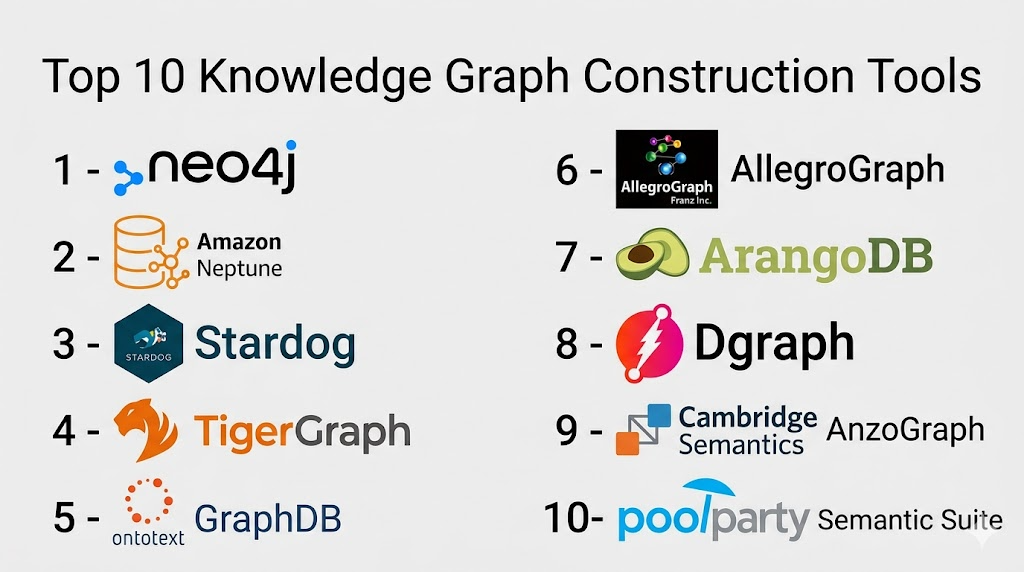
Top 10 Knowledge Graph Construction Tools
#1 — Neo4j
Short description (2–3 lines): A leading graph database platform designed for building and querying knowledge graphs using property graph models. Widely used by enterprises and developers.
Key Features
- Cypher query language
- Graph data modeling
- Built-in visualization tools
- High-performance graph traversal
- Graph Data Science library
- Cloud and self-hosted options
Pros
- Strong ecosystem and community
- Excellent performance for graph queries
Cons
- Learning curve for Cypher
- Enterprise features can be costly
Platforms / Deployment
Web / Windows / macOS / Linux
Cloud / Self-hosted / Hybrid
Security & Compliance
RBAC, encryption, SSO support; compliance certifications not publicly stated
Integrations & Ecosystem
Neo4j integrates with modern data pipelines and analytics tools.
- Apache Spark
- Kafka
- GraphQL APIs
- BI tools
Support & Community
Strong documentation, active community, enterprise support available
#2 — Amazon Neptune
Short description (2–3 lines): Fully managed graph database service supporting RDF and property graph models, designed for scalable cloud deployments.
Key Features
- SPARQL and Gremlin support
- Fully managed AWS service
- High availability and replication
- Integration with AWS ecosystem
- Automated backups
Pros
- Scalable and reliable
- Tight AWS integration
Cons
- AWS lock-in
- Limited customization compared to self-hosted tools
Platforms / Deployment
Cloud
Security & Compliance
IAM, encryption, VPC support; certifications vary
Integrations & Ecosystem
- AWS Lambda
- S3
- Glue
- IAM
Support & Community
Enterprise-grade AWS support
#3 — Stardog
Short description (2–3 lines): Enterprise knowledge graph platform focused on semantic data, reasoning, and AI integration.
Key Features
- RDF and OWL support
- Reasoning engine
- Virtual graph capabilities
- Data unification
- AI/ML integration
Pros
- Strong semantic capabilities
- Enterprise-grade features
Cons
- Complex setup
- Pricing not transparent
Platforms / Deployment
Cloud / Self-hosted
Security & Compliance
RBAC, encryption; certifications not publicly stated
Integrations & Ecosystem
- SQL databases
- APIs
- BI tools
Support & Community
Enterprise support, smaller community than Neo4j
#4 — TigerGraph
Short description (2–3 lines): High-performance graph analytics platform optimized for real-time insights and large-scale data.
Key Features
- Parallel graph processing
- Real-time analytics
- GraphStudio UI
- Distributed architecture
- Machine learning integration
Pros
- High scalability
- Fast query performance
Cons
- Complex deployment
- Learning curve
Platforms / Deployment
Cloud / Self-hosted
Security & Compliance
RBAC, encryption; certifications not publicly stated
Integrations & Ecosystem
- Kafka
- Spark
- REST APIs
Support & Community
Enterprise support, growing community
#5 — Ontotext GraphDB
Short description (2–3 lines): RDF-based graph database focused on semantic data and enterprise knowledge graphs.
Key Features
- SPARQL support
- Semantic reasoning
- RDF data management
- Data linking capabilities
- Visualization tools
Pros
- Strong semantic standards support
- Reliable for RDF workloads
Cons
- Less intuitive UI
- Limited property graph support
Platforms / Deployment
Cloud / Self-hosted
Security & Compliance
Not publicly stated
Integrations & Ecosystem
- ETL tools
- APIs
- Linked data platforms
Support & Community
Moderate community, enterprise support available
#6 — AllegroGraph
Short description (2–3 lines): Graph database designed for semantic web and AI applications.
Key Features
- RDF triple store
- Reasoning engine
- Geospatial capabilities
- Temporal data support
- High scalability
Pros
- Strong semantic features
- Handles complex queries well
Cons
- Limited modern UI
- Smaller ecosystem
Platforms / Deployment
Self-hosted / Cloud
Security & Compliance
Not publicly stated
Integrations & Ecosystem
- APIs
- Python libraries
Support & Community
Smaller but specialized community
#7 — ArangoDB
Short description (2–3 lines): Multi-model database supporting graph, document, and key-value data models.
Key Features
- Multi-model support
- AQL query language
- Graph analytics
- Distributed architecture
- Flexible schema
Pros
- Versatile data model
- Good performance
Cons
- Less specialized for knowledge graphs
- Smaller ecosystem than Neo4j
Platforms / Deployment
Cloud / Self-hosted
Security & Compliance
RBAC, encryption; certifications not publicly stated
Integrations & Ecosystem
- APIs
- Microservices
- DevOps tools
Support & Community
Active open-source community
#8 — Dgraph
Short description (2–3 lines): Distributed graph database designed for real-time applications and scalability.
Key Features
- GraphQL support
- Distributed architecture
- Real-time queries
- ACID transactions
- Horizontal scaling
Pros
- Fast and scalable
- Developer-friendly
Cons
- Limited enterprise features
- Smaller ecosystem
Platforms / Deployment
Cloud / Self-hosted
Security & Compliance
Not publicly stated
Integrations & Ecosystem
- GraphQL APIs
- Microservices
Support & Community
Growing community
#9 — Cambridge Semantics AnzoGraph
Short description (2–3 lines): Enterprise graph analytics platform focused on large-scale semantic data processing.
Key Features
- High-performance analytics
- RDF support
- Data virtualization
- Parallel processing
- Visualization tools
Pros
- Strong analytics capabilities
- Scales well
Cons
- Enterprise-focused (costly)
- Complex setup
Platforms / Deployment
Cloud / Self-hosted
Security & Compliance
Not publicly stated
Integrations & Ecosystem
- BI tools
- Data warehouses
Support & Community
Enterprise support
#10 — PoolParty Semantic Suite
Short description (2–3 lines): Semantic platform for taxonomy management and knowledge graph construction.
Key Features
- Taxonomy management
- Linked data support
- Semantic enrichment
- NLP integration
- Data governance tools
Pros
- Strong taxonomy tools
- Business-friendly UI
Cons
- Less focus on large-scale graph analytics
- Limited developer features
Platforms / Deployment
Cloud / Self-hosted
Security & Compliance
Not publicly stated
Integrations & Ecosystem
- CMS systems
- NLP tools
Support & Community
Enterprise support, niche community
Comparison Table (Top 10)
| Tool Name | Best For | Platform(s) Supported | Deployment | Standout Feature | Public Rating |
|---|---|---|---|---|---|
| Neo4j | General graph use | Web, OS platforms | Hybrid | Cypher language | N/A |
| Amazon Neptune | AWS users | Web | Cloud | Managed service | N/A |
| Stardog | Semantic graphs | Web | Hybrid | Reasoning engine | N/A |
| TigerGraph | Large-scale analytics | Web | Hybrid | Parallel processing | N/A |
| Ontotext GraphDB | RDF workloads | Web | Hybrid | SPARQL support | N/A |
| AllegroGraph | Semantic AI | Web | Hybrid | Temporal data | N/A |
| ArangoDB | Multi-model | Web, OS | Hybrid | Multi-model DB | N/A |
| Dgraph | Real-time apps | Web | Hybrid | GraphQL support | N/A |
| AnzoGraph | Enterprise analytics | Web | Hybrid | Data virtualization | N/A |
| PoolParty | Taxonomy & semantics | Web | Hybrid | NLP enrichment | N/A |
Evaluation & Scoring of Knowledge Graph Construction Tools
| Tool Name | Core (25%) | Ease (15%) | Integrations (15%) | Security (10%) | Performance (10%) | Support (10%) | Value (15%) | Weighted Total |
|---|---|---|---|---|---|---|---|---|
| Neo4j | 9 | 8 | 9 | 8 | 9 | 9 | 7 | 8.5 |
| Amazon Neptune | 8 | 8 | 9 | 9 | 9 | 9 | 7 | 8.4 |
| Stardog | 9 | 7 | 8 | 8 | 8 | 8 | 6 | 7.9 |
| TigerGraph | 9 | 7 | 8 | 8 | 9 | 8 | 6 | 8.0 |
| GraphDB | 8 | 7 | 7 | 7 | 8 | 7 | 7 | 7.5 |
| AllegroGraph | 8 | 6 | 6 | 7 | 8 | 6 | 7 | 7.1 |
| ArangoDB | 8 | 8 | 8 | 7 | 8 | 8 | 8 | 8.0 |
| Dgraph | 7 | 8 | 7 | 6 | 8 | 7 | 8 | 7.6 |
| AnzoGraph | 9 | 6 | 7 | 7 | 9 | 7 | 6 | 7.8 |
| PoolParty | 7 | 8 | 7 | 7 | 7 | 7 | 7 | 7.3 |
How to interpret:
- Scores are comparative across this category, not absolute.
- Higher scores indicate better balance across enterprise needs.
- Core features carry the highest weight (25%).
- Value reflects cost vs capability trade-offs.
- Choose based on your use case, not just total score.
Which Knowledge Graph Construction Tools
Solo / Freelancer
- Best: ArangoDB, Dgraph
Simple setup, flexible usage, lower cost.
SMB
- Best: Neo4j, ArangoDB
Balance of usability and power.
Mid-Market
- Best: Neo4j, TigerGraph, Stardog
Scalable with strong feature sets.
Enterprise
- Best: Amazon Neptune, Stardog, AnzoGraph
High scalability, security, and integrations.
Budget vs Premium
- Budget: Dgraph, ArangoDB
- Premium: Stardog, TigerGraph, AnzoGraph
Feature Depth vs Ease of Use
- Deep features: Stardog, TigerGraph
- Easy to use: Neo4j, ArangoDB
Integrations & Scalability
- Strong integrations: Neptune, Neo4j
- Scalable: TigerGraph, AnzoGraph
Security & Compliance Needs
- Best: Amazon Neptune, Neo4j
Focus on enterprise security
Frequently Asked Questions (FAQs)
What is a knowledge graph?
A structured representation of data where entities are connected through relationships.
How is it different from a database?
Graphs focus on relationships, unlike traditional relational databases.
Are knowledge graph tools expensive?
Pricing varies; open-source options exist.
Do I need coding skills?
Yes, for advanced use; some tools offer low-code options.
Can it integrate with AI models?
Yes, especially for RAG and LLM applications.
What industries use it most?
Finance, healthcare, e-commerce, telecom.
Is it scalable?
Yes, most enterprise tools are highly scalable.
What are common mistakes?
Poor data modeling and unclear use cases.
Can I migrate from SQL databases?
Yes, but requires data transformation.
Are open-source tools reliable?
Yes, but may lack enterprise support.
Conclusion
Knowledge graph construction tools are becoming foundational for modern data and AI architectures. Whether you’re building intelligent search, powering AI copilots, or connecting enterprise data, the right tool can significantly improve your outcomes. There is no single “best” tool—your choice depends on scale, budget, technical expertise, and use case. Start by shortlisting 2–3 tools that align with your requirements, run a pilot project, and validate integrations, performance, and security before full adoption.
