Introduction
Sales Tax Automation Tools help businesses automatically calculate, collect, report, and file sales tax across different jurisdictions. Instead of manually tracking tax rates, exemptions, and compliance rules, these tools handle everything in real time—reducing errors and saving time.
With increasing digital commerce, multi-state operations, and evolving tax regulations, managing sales tax manually has become risky and inefficient. Governments are tightening compliance requirements, and businesses need accurate, automated solutions to stay compliant.
Real-world use cases:
- Calculating sales tax for eCommerce orders across states
- Managing tax compliance for SaaS subscriptions
- Automating filings for multi-location retail chains
- Handling marketplace tax obligations
- Supporting finance teams during audits
What buyers should evaluate:
- Accuracy of tax calculations
- Jurisdiction coverage
- Automation of filing and remittance
- Integration with billing, ERP, and eCommerce tools
- Reporting and audit readiness
- Ease of implementation
- Scalability for business growth
- Pricing model
- Security and compliance features
Best for: eCommerce companies, SaaS businesses, finance teams, accountants, and enterprises operating in multiple tax jurisdictions.
Not ideal for: Freelancers or very small businesses with minimal tax complexity who can rely on basic accounting tools.
Key Trends in Sales Tax Automation Tools
- AI-powered tax classification: Automatically categorizing products and services
- Real-time tax calculation APIs: Used in checkout and billing systems
- Continuous compliance updates: Automatic updates for changing tax laws
- Marketplace compliance support: Handling platform-based sales tax obligations
- Cloud-native platforms: Scalable and accessible from anywhere
- Global tax expansion: Tools expanding beyond US sales tax to VAT/GST
- API-first integration models: Developer-friendly automation
- Audit-ready reporting: Detailed logs and compliance tracking
- Subscription-based pricing: Flexible SaaS pricing models
- Embedded finance integrations: Direct integration into payment and billing platforms
How We Selected These Tools (Methodology)
- Market adoption across SMB and enterprise segments
- Strong automation features for tax calculation and filing
- Proven reliability in production environments
- Integration support with popular ERP, CRM, and eCommerce platforms
- Scalability for growing businesses
- Security posture aligned with compliance needs
- Ease of use and onboarding experience
- Vendor ecosystem and support quality
- Coverage of tax jurisdictions and compliance rules
- Balanced mix of enterprise and SMB-friendly tools
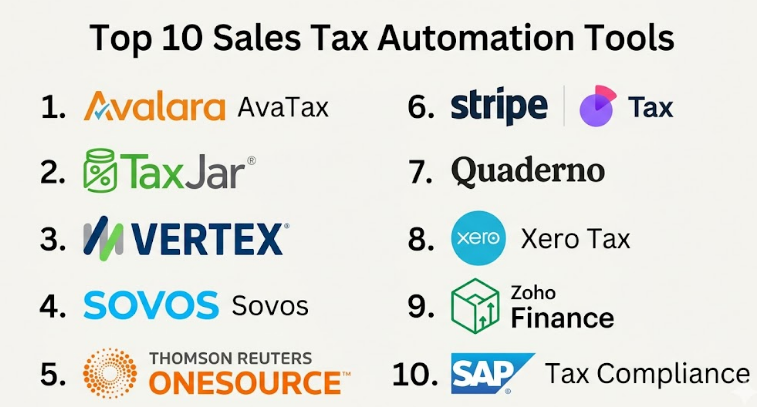
Top 10 Sales Tax Automation Tools
#1 — Avalara AvaTax
Short description: A widely used cloud-based platform for automating sales tax calculations, filings, and compliance across multiple regions.
Key Features
- Real-time tax calculation
- Automated filing and remittance
- Global tax coverage
- Exemption certificate management
- API-based integrations
- Audit reporting tools
Pros
- Scalable for large businesses
- Strong integration ecosystem
Cons
- Pricing can be complex
- Initial setup may require effort
Platforms / Deployment
Cloud
Security & Compliance
SSO, MFA, encryption (details not publicly stated)
Integrations & Ecosystem
Avalara integrates with major business platforms and eCommerce systems.
- Shopify
- Salesforce
- NetSuite
- Magento
Support & Community
Strong enterprise support with onboarding resources and documentation.
#2 — TaxJar
Short description: A simple and developer-friendly sales tax automation tool designed primarily for eCommerce businesses.
Key Features
- Automated tax calculations
- Sales tax filing automation
- Nexus tracking
- Reporting dashboard
- API access
- Transaction categorization
Pros
- Easy to use
- Ideal for online sellers
Cons
- Limited global coverage
- Not suitable for complex enterprise needs
Platforms / Deployment
Cloud
Security & Compliance
Not publicly stated
Integrations & Ecosystem
- Amazon
- Shopify
- Stripe
- WooCommerce
Support & Community
Good documentation and responsive support.
#3 — Vertex
Short description: Enterprise-grade tax automation solution for managing complex sales tax and compliance requirements.
Key Features
- Advanced tax calculation engine
- Multi-jurisdiction support
- Compliance reporting
- ERP integration
- Custom tax rules
Pros
- Highly customizable
- Suitable for large enterprises
Cons
- High cost
- Requires technical expertise
Platforms / Deployment
Cloud / Hybrid
Security & Compliance
Not publicly stated
Integrations & Ecosystem
- SAP
- Oracle
- Microsoft Dynamics
Support & Community
Enterprise-level support services.
#4 — Sovos
Short description: A compliance-focused platform offering sales tax automation along with regulatory reporting capabilities.
Key Features
- Sales tax calculation
- Continuous compliance updates
- Reporting and filing
- Data validation
- Regulatory support
Pros
- Strong compliance capabilities
- Global reach
Cons
- Complex implementation
- Higher pricing
Platforms / Deployment
Cloud
Security & Compliance
Not publicly stated
Integrations & Ecosystem
- ERP systems
- Government reporting platforms
Support & Community
Enterprise-grade support.
#5 — Thomson Reuters ONESOURCE
Short description: Comprehensive tax compliance platform designed for enterprises managing global tax operations.
Key Features
- Sales tax automation
- Reporting and analytics
- Audit support
- Workflow automation
- Data integration
Pros
- Robust feature set
- Strong reporting tools
Cons
- Expensive
- Steep learning curve
Platforms / Deployment
Cloud / Hybrid
Security & Compliance
Not publicly stated
Integrations & Ecosystem
- SAP
- Oracle
- Custom APIs
Support & Community
Strong enterprise support and training.
#6 — Stripe Tax
Short description: Built-in tax automation for businesses using Stripe for payments and billing.
Key Features
- Automatic tax calculation at checkout
- Global tax support
- Integration with Stripe billing
- Real-time updates
- Transaction-based reporting
Pros
- Seamless integration with Stripe
- Easy to implement
Cons
- Limited outside Stripe ecosystem
- Not ideal for complex tax scenarios
Platforms / Deployment
Cloud
Security & Compliance
Not publicly stated
Integrations & Ecosystem
- Stripe payments
- Billing systems
Support & Community
Good documentation and developer support.
#7 — Quaderno
Short description: A tax automation tool focused on SaaS and digital businesses managing global sales tax and VAT.
Key Features
- Real-time tax calculation
- Automated invoicing
- VAT/GST compliance
- Reporting tools
- API integration
Pros
- Great for SaaS businesses
- Supports global tax types
Cons
- Smaller ecosystem
- Limited enterprise features
Platforms / Deployment
Cloud
Security & Compliance
Not publicly stated
Integrations & Ecosystem
- Stripe
- PayPal
- eCommerce platforms
Support & Community
Moderate support with helpful documentation.
#8 — Xero Tax
Short description: Sales tax and compliance features integrated into the Xero accounting platform.
Key Features
- Tax calculations
- Reporting tools
- Accounting integration
- Filing support
- Dashboard insights
Pros
- Easy to use
- Good for SMBs
Cons
- Limited advanced automation
- Regional limitations
Platforms / Deployment
Cloud
Security & Compliance
Not publicly stated
Integrations & Ecosystem
- Xero app ecosystem
Support & Community
Strong community and documentation.
#9 — Zoho Finance (Zoho Tax)
Short description: Tax and finance solution within the Zoho ecosystem for SMBs and growing businesses.
Key Features
- Tax calculations
- Invoice-based tax automation
- Reporting
- Compliance tracking
- Integration with Zoho apps
Pros
- Affordable
- Strong ecosystem
Cons
- Limited enterprise capabilities
- Less global coverage
Platforms / Deployment
Cloud
Security & Compliance
Not publicly stated
Integrations & Ecosystem
- Zoho Books
- Zoho CRM
Support & Community
Good support and onboarding resources.
#10 — SAP Tax Compliance
Short description: Enterprise tax compliance solution integrated with SAP systems for large organizations.
Key Features
- Real-time compliance monitoring
- Integration with SAP ERP
- Reporting and analytics
- Audit trails
- Automation workflows
Pros
- Deep SAP integration
- Highly scalable
Cons
- Requires SAP environment
- High implementation cost
Platforms / Deployment
Cloud / Hybrid
Security & Compliance
Not publicly stated
Integrations & Ecosystem
- SAP ecosystem
Support & Community
Enterprise-level support services.
Comparison Table (Top 10)
| Tool Name | Best For | Platform(s) Supported | Deployment | Standout Feature | Public Rating |
|---|---|---|---|---|---|
| Avalara | Large businesses | Web | Cloud | Real-time automation | N/A |
| TaxJar | eCommerce | Web | Cloud | Easy API usage | N/A |
| Vertex | Enterprises | Web | Hybrid | Advanced tax engine | N/A |
| Sovos | Compliance-heavy orgs | Web | Cloud | Continuous compliance | N/A |
| ONESOURCE | Enterprises | Web | Hybrid | Deep reporting | N/A |
| Stripe Tax | SaaS/payments | Web | Cloud | Built-in billing tax | N/A |
| Quaderno | SaaS startups | Web | Cloud | VAT/GST support | N/A |
| Xero Tax | SMBs | Web | Cloud | Accounting integration | N/A |
| Zoho Tax | SMBs | Web | Cloud | Affordable ecosystem | N/A |
| SAP Tax | Enterprises | Web | Hybrid | ERP integration | N/A |
Evaluation & Scoring of Sales Tax Automation Tools
| Tool Name | Core | Ease | Integrations | Security | Performance | Support | Value | Weighted Total |
|---|---|---|---|---|---|---|---|---|
| Avalara | 9 | 8 | 9 | 8 | 9 | 8 | 7 | 8.4 |
| TaxJar | 7 | 9 | 8 | 7 | 8 | 7 | 8 | 7.9 |
| Vertex | 9 | 7 | 9 | 9 | 9 | 8 | 6 | 8.3 |
| Sovos | 9 | 7 | 8 | 9 | 9 | 8 | 6 | 8.2 |
| ONESOURCE | 9 | 7 | 9 | 9 | 9 | 8 | 6 | 8.3 |
| Stripe Tax | 8 | 9 | 7 | 7 | 8 | 7 | 8 | 7.9 |
| Quaderno | 7 | 8 | 7 | 7 | 8 | 7 | 8 | 7.6 |
| Xero Tax | 7 | 8 | 7 | 7 | 8 | 7 | 8 | 7.6 |
| Zoho Tax | 7 | 8 | 7 | 7 | 8 | 7 | 9 | 7.8 |
| SAP Tax | 9 | 6 | 9 | 9 | 9 | 8 | 6 | 8.1 |
How to interpret scores:
- Enterprise tools score higher in features and integrations
- SMB tools perform better in ease and affordability
- Scores are comparative, not absolute
- Choose based on use case, not just total score
- Evaluate integration and scalability needs carefully
Which Sales Tax Automation Tool
Solo / Freelancer
Simple tools like Zoho Tax or Xero Tax are enough. Focus on cost and simplicity.
SMB
TaxJar, Zoho Tax, or Quaderno are strong choices with good automation and ease of use.
Mid-Market
Avalara or Stripe Tax offers scalability with moderate complexity.
Enterprise
Vertex, ONESOURCE, Sovos, or SAP Tax are best for complex, global operations.
Budget vs Premium
- Budget: Zoho Tax, Xero Tax
- Premium: Vertex, ONESOURCE, SAP
Feature Depth vs Ease of Use
- Feature-rich: Vertex, ONESOURCE
- Easy-to-use: TaxJar, Stripe Tax
Integrations & Scalability
Avalara and SAP are strong for integration-heavy environments.
Security & Compliance Needs
Enterprises should prioritize Sovos, Vertex, or SAP.
Frequently Asked Questions (FAQs)
1. What is a sales tax automation tool?
It automates tax calculation, collection, and filing to ensure compliance with tax regulations.
2. How much does it cost?
Pricing varies by transaction volume and features, usually subscription-based.
3. Is it hard to implement?
Most cloud tools are easy to set up, but enterprise tools may need integration work.
4. Can it handle multiple states or countries?
Yes, many tools support multi-jurisdiction compliance.
5. Does it integrate with eCommerce platforms?
Yes, most tools integrate with Shopify, Amazon, and others.
6. Are these tools secure?
Most follow strong security practices, but details vary.
7. Can I automate tax filing?
Yes, many tools support automated filing and remittance.
8. What mistakes should I avoid?
Choosing a tool without checking integration and scalability.
9. Can I switch tools later?
Yes, but migration and integration can take effort.
10. Are there alternatives?
Basic accounting tools can help but lack full automation.
Conclusion
Sales tax automation tools have become essential for businesses operating in today’s digital and multi-jurisdictional economy. Manual tax handling is not only time-consuming but also prone to costly errors. Modern tools offer automation, real-time accuracy, and compliance assurance, helping organizations reduce risk and focus on growth. However, the “best” tool depends on your specific needs—whether you are a small business looking for simplicity or an enterprise requiring deep integrations and global compliance. Instead of choosing based on popularity alone, shortlist two or three tools that align with your business model, run a pilot, and validate how well they integrate with your systems. This approach ensures a long-term, scalable solution that supports both compliance and operational efficiency.
