Introduction
Tax Compliance Software helps businesses calculate, manage, and file taxes accurately across different jurisdictions. It automates tax calculations, reporting, and regulatory compliance so companies can avoid errors, penalties, and manual overhead.
In today’s environment—where tax laws change frequently, digital tax reporting is becoming mandatory, and cross-border commerce is growing—these tools are no longer optional. Organizations dealing with GST, VAT, sales tax, or international taxation need reliable systems that ensure compliance at scale.
Real-world use cases:
- Automating GST/VAT filings for multi-state or multi-country businesses
- Managing indirect taxes for eCommerce platforms
- Ensuring compliance in SaaS billing systems
- Supporting finance teams during audits and reconciliations
- Handling tax calculation in real-time transactions
What buyers should evaluate:
- Accuracy of tax calculations
- Jurisdiction coverage (global vs regional)
- Automation and filing capabilities
- Integration with ERP/accounting tools
- Reporting and audit support
- Scalability for business growth
- Security and compliance standards
- Ease of implementation and use
- Pricing and total cost of ownership
Best for: Finance teams, CFOs, accountants, eCommerce businesses, SaaS companies, enterprises operating across regions, and compliance-heavy industries.
Not ideal for: Very small businesses with simple tax needs or freelancers who can manage taxes using basic accounting tools.
Key Trends in Tax Compliance Software
- AI-driven tax automation: AI is being used to detect anomalies, classify transactions, and reduce manual errors.
- Real-time tax calculation: Especially for eCommerce and SaaS billing systems.
- Cloud-first platforms: Most modern tools are cloud-native for scalability and remote access.
- Continuous compliance: Automated updates to reflect changing tax regulations globally.
- Integration with ERP ecosystems: Seamless integration with platforms like SAP, Oracle, and QuickBooks.
- Digital tax reporting mandates: Governments are pushing real-time reporting systems.
- Global tax management: Increasing demand for multi-country tax compliance support.
- API-first architecture: Developer-friendly integrations for custom workflows.
- Data analytics and audit readiness: Enhanced reporting and audit trails.
- Subscription-based pricing: Shift from license-based to SaaS models.
How We Selected These Tools (Methodology)
- Widely adopted in enterprise and SMB markets
- Strong feature coverage across tax calculation, reporting, and filing
- Proven reliability in high-volume environments
- Security capabilities aligned with enterprise expectations
- Integration capabilities with major accounting and ERP systems
- Support for multiple jurisdictions and tax types
- Ease of onboarding and usability
- Vendor reputation and ecosystem strength
- Scalability across business sizes
- Balanced representation of enterprise and SMB solutions
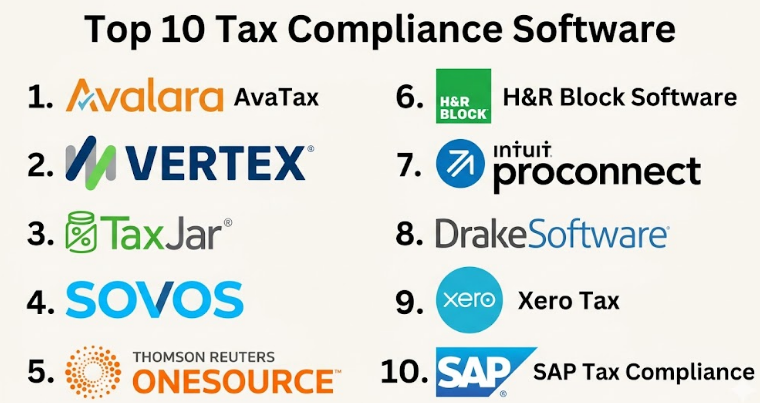
Top 10 Tax Compliance Software
#1 — Avalara AvaTax
Short description: A leading cloud-based tax compliance platform designed for businesses needing automated sales tax and VAT calculations globally.
Key Features
- Real-time tax calculation
- Automated filing and remittance
- Global tax coverage
- Exemption certificate management
- Audit-ready reporting
- API integration support
Pros
- Strong global coverage
- Highly scalable
Cons
- Complex pricing structure
- Can require setup effort
Platforms / Deployment
Cloud
Security & Compliance
SSO, MFA, encryption (details not publicly stated)
Integrations & Ecosystem
Avalara integrates with ERP, CRM, and eCommerce platforms.
- SAP
- Salesforce
- Shopify
- NetSuite
Support & Community
Strong enterprise support with documentation and onboarding assistance.
#2 — Vertex
Short description: Enterprise-grade tax compliance software focused on large organizations with complex tax requirements.
Key Features
- Advanced tax calculation engine
- Global compliance support
- Audit and reporting tools
- ERP integrations
- Industry-specific tax rules
Pros
- Highly customizable
- Strong enterprise capabilities
Cons
- Expensive
- Requires technical expertise
Platforms / Deployment
Cloud / Hybrid
Security & Compliance
Not publicly stated
Integrations & Ecosystem
- SAP
- Oracle
- Microsoft Dynamics
Support & Community
Enterprise-level support with dedicated teams.
#3 — TaxJar
Short description: Simplified sales tax automation tool ideal for eCommerce businesses.
Key Features
- Automated sales tax calculations
- Filing automation
- Tax nexus tracking
- Reporting dashboards
- API support
Pros
- Easy to use
- Great for eCommerce
Cons
- Limited enterprise features
- Mostly US-focused
Platforms / Deployment
Cloud
Security & Compliance
Not publicly stated
Integrations & Ecosystem
- Shopify
- Amazon
- Stripe
Support & Community
Good documentation and customer support.
#4 — Sovos
Short description: Comprehensive tax compliance solution for global businesses managing complex regulatory requirements.
Key Features
- Global tax compliance
- Continuous transaction controls
- Reporting and filing
- Regulatory updates
- Data management
Pros
- Strong global presence
- Compliance-focused
Cons
- Complex implementation
- Higher cost
Platforms / Deployment
Cloud
Security & Compliance
Not publicly stated
Integrations & Ecosystem
- ERP integrations
- Government reporting systems
Support & Community
Enterprise-grade support.
#5 — Thomson Reuters ONESOURCE
Short description: Advanced tax and accounting platform for large enterprises and multinational corporations.
Key Features
- Global tax compliance
- Financial reporting
- Workflow automation
- Audit support
- Data analytics
Pros
- Comprehensive features
- Strong reporting
Cons
- Expensive
- Learning curve
Platforms / Deployment
Cloud / Hybrid
Security & Compliance
Not publicly stated
Integrations & Ecosystem
- SAP
- Oracle
- Custom APIs
Support & Community
Strong enterprise support and training.
#6 — H&R Block Software
Short description: Tax software primarily for individuals and small businesses.
Key Features
- Tax filing
- Deduction optimization
- Step-by-step guidance
- Error checking
Pros
- Easy to use
- Affordable
Cons
- Limited enterprise features
- Not suitable for complex taxes
Platforms / Deployment
Web / Desktop
Security & Compliance
Not publicly stated
Integrations & Ecosystem
Limited integrations.
Support & Community
Basic support and help resources.
#7 — Intuit ProConnect
Short description: Cloud-based tax software for professional accountants and firms.
Key Features
- Tax return preparation
- Cloud-based workflow
- Client collaboration
- Data import/export
Pros
- Strong accounting integration
- Cloud flexibility
Cons
- Pricing may scale quickly
- Limited enterprise features
Platforms / Deployment
Cloud
Security & Compliance
Not publicly stated
Integrations & Ecosystem
- QuickBooks
- Accounting tools
Support & Community
Good support and documentation.
#8 — Drake Tax
Short description: Tax preparation software for professionals handling multiple client filings.
Key Features
- Bulk tax filing
- Client management
- Reporting tools
- Workflow automation
Pros
- Cost-effective
- Good for tax professionals
Cons
- UI can feel outdated
- Limited global support
Platforms / Deployment
Windows
Security & Compliance
Not publicly stated
Integrations & Ecosystem
Limited integrations.
Support & Community
Moderate support with documentation.
#9 — Xero Tax
Short description: Tax solution integrated into Xero accounting platform for SMBs.
Key Features
- Tax calculations
- Filing support
- Accounting integration
- Reporting
Pros
- Easy integration with Xero
- Simple interface
Cons
- Limited advanced features
- Regional limitations
Platforms / Deployment
Cloud
Security & Compliance
Not publicly stated
Integrations & Ecosystem
- Xero ecosystem apps
Support & Community
Good community and documentation.
#10 — SAP Tax Compliance
Short description: Enterprise tax compliance solution integrated into SAP ecosystem.
Key Features
- Real-time compliance
- Integration with SAP ERP
- Reporting and analytics
- Audit trails
Pros
- Strong enterprise integration
- Scalable
Cons
- Requires SAP ecosystem
- High cost
Platforms / Deployment
Cloud / Hybrid
Security & Compliance
Not publicly stated
Integrations & Ecosystem
- SAP ecosystem
Support & Community
Enterprise support available.
Comparison Table (Top 10)
| Tool Name | Best For | Platform(s) Supported | Deployment | Standout Feature | Public Rating |
|---|---|---|---|---|---|
| Avalara AvaTax | Global businesses | Web | Cloud | Real-time tax automation | N/A |
| Vertex | Enterprises | Web | Hybrid | Advanced tax engine | N/A |
| TaxJar | eCommerce | Web | Cloud | Easy sales tax automation | N/A |
| Sovos | Global compliance | Web | Cloud | Continuous compliance | N/A |
| ONESOURCE | Enterprises | Web | Hybrid | Comprehensive reporting | N/A |
| H&R Block | Individuals/SMB | Web/Desktop | Local/Cloud | Simple filing | N/A |
| ProConnect | Accountants | Web | Cloud | Cloud workflow | N/A |
| Drake Tax | Tax professionals | Windows | Local | Bulk filing | N/A |
| Xero Tax | SMBs | Web | Cloud | Accounting integration | N/A |
| SAP Tax | Enterprises | Web | Hybrid | ERP integration | N/A |
Evaluation & Scoring of Tax Compliance Software
| Tool Name | Core | Ease | Integrations | Security | Performance | Support | Value | Weighted Total |
|---|---|---|---|---|---|---|---|---|
| Avalara | 9 | 8 | 9 | 8 | 9 | 8 | 7 | 8.4 |
| Vertex | 9 | 7 | 9 | 9 | 9 | 8 | 6 | 8.3 |
| TaxJar | 7 | 9 | 8 | 7 | 8 | 7 | 8 | 7.9 |
| Sovos | 9 | 7 | 8 | 9 | 9 | 8 | 6 | 8.2 |
| ONESOURCE | 9 | 7 | 9 | 9 | 9 | 8 | 6 | 8.3 |
| H&R Block | 6 | 9 | 5 | 6 | 7 | 7 | 9 | 7.2 |
| ProConnect | 7 | 8 | 7 | 7 | 8 | 7 | 7 | 7.5 |
| Drake Tax | 7 | 7 | 5 | 6 | 7 | 6 | 8 | 7.0 |
| Xero Tax | 7 | 8 | 7 | 7 | 8 | 7 | 8 | 7.6 |
| SAP Tax | 9 | 6 | 9 | 9 | 9 | 8 | 6 | 8.1 |
How to interpret scores:
- Scores are comparative, not absolute.
- Enterprise tools score higher in core features and integrations.
- SMB tools score higher in ease of use and value.
- Weighted totals reflect balanced performance across all criteria.
- Choose based on your specific needs, not just total score.
Which Tax Compliance Software
Solo / Freelancer
Simple tools like H&R Block or Xero Tax are sufficient. Focus on ease of use and cost.
SMB
TaxJar or Xero Tax works well. They offer automation without complexity.
Mid-Market
Avalara or ProConnect are ideal for growing businesses needing scalability.
Enterprise
Vertex, SAP Tax, ONESOURCE, or Sovos are best for complex, global operations.
Budget vs Premium
- Budget: H&R Block, Drake Tax
- Premium: Vertex, ONESOURCE, SAP
Feature Depth vs Ease of Use
- Feature-rich: Vertex, ONESOURCE
- Easy-to-use: TaxJar, Xero
Integrations & Scalability
Choose Avalara or SAP if you need strong ERP integrations.
Security & Compliance Needs
Enterprises should prioritize tools like Sovos, Vertex, or SAP.
Frequently Asked Questions (FAQs)
1. What is tax compliance software?
It automates tax calculation, reporting, and filing to ensure businesses meet regulatory requirements.
2. How much does tax compliance software cost?
Pricing varies widely depending on features and scale. Most tools follow subscription models.
3. Is implementation difficult?
Enterprise tools may require setup and integration, while SMB tools are easier to deploy.
4. Can these tools handle global taxes?
Yes, some tools like Avalara, Vertex, and Sovos support global compliance.
5. Are these tools secure?
Most provide enterprise-grade security, but specifics may vary.
6. Can I integrate with accounting software?
Yes, most tools support integrations with ERP and accounting platforms.
7. Do they support real-time tax calculation?
Many modern tools offer real-time calculations.
8. What are common mistakes when choosing software?
Ignoring integration needs and underestimating scalability requirements.
9. Can I switch tools later?
Yes, but data migration and integration changes can be complex.
10. Are there alternatives?
Basic accounting software can handle simple tax needs but lacks advanced compliance features.
Conclusion
Tax compliance software is no longer just a convenience—it’s a critical part of modern financial operations. As regulations become more complex and digital reporting becomes mandatory, businesses need tools that ensure accuracy, automation, and audit readiness. Enterprise solutions provide deep capabilities but require investment, while SMB-focused tools prioritize simplicity and affordability. There is no single “best” tool for everyone. The right choice depends on your business size, geographic presence, compliance complexity, and integration requirements. A practical approach is to shortlist two or three tools, run a pilot implementation, and validate how well they integrate with your existing systems. This ensures you select a solution that not only meets today’s needs but can scale with your business in the future.
