Introduction
Media Mix Modeling Tools help marketing teams understand how different channels, campaigns, promotions, pricing, seasonality, and external market factors influence business outcomes. In simple English, these tools help answer: Which marketing activities are really driving sales, revenue, leads, or customer growth?
Unlike last-click attribution, Media Mix Modeling uses aggregated business and marketing data. This makes it useful when cookies, device-level tracking, and user-level attribution are limited. MMM can evaluate online and offline channels together, including paid search, paid social, TV, radio, print, retail media, influencers, promotions, and organic demand signals. Google’s Meridian documentation describes MMM as a statistical technique used to measure marketing impact while using aggregated data rather than user-level or cookie-based tracking.
Real-world use cases include budget planning, channel ROI analysis, campaign effectiveness, sales forecasting, incrementality validation, and media optimization. Buyers should evaluate modeling quality, data requirements, explainability, refresh frequency, forecasting, scenario planning, integrations, privacy approach, support, and pricing model.
Best for: Marketing leaders, growth teams, performance marketers, finance teams, agencies, retail brands, ecommerce teams, and enterprise advertisers managing multiple paid and offline channels.
Not ideal for: Very small advertisers with limited spend, teams without clean historical data, companies needing only basic web analytics, or teams that expect MMM to replace all campaign-level experimentation.
Key Trends in Media Mix Modeling Tools
- Privacy-safe measurement is becoming a core reason to adopt MMM: Since MMM works with aggregated data, it is useful for teams reducing dependence on cookies, device identifiers, and user-level tracking.
- Open-source MMM is growing: Google Meridian, Meta Robyn, and PyMC-Marketing give technical teams more control over modeling logic, assumptions, validation, and customization. Meridian is an open-source MMM built by Google, while Robyn is an experimental AI/ML-powered open-source MMM package from Meta Marketing Science.
- Bayesian modeling is becoming more common: Many modern MMM tools use Bayesian methods to handle uncertainty, priors, saturation, carryover effects, and scenario planning.
- Incrementality testing and MMM are being combined: Vendors are increasingly connecting experiments, lift tests, and MMM so teams can validate model outputs with real-world causal signals.
- Faster refresh cycles are expected: Traditional MMM was often quarterly or annual. Modern platforms increasingly support weekly, daily, or always-on measurement workflows.
- Finance-friendly reporting is becoming important: Marketing teams need MMM outputs that finance leaders can understand, such as marginal ROI, saturation curves, confidence intervals, and budget reallocation scenarios.
- Retail media and marketplace measurement are rising: Ecommerce and retail brands need MMM tools that account for marketplaces, DTC stores, TikTok Shop, Amazon, offline retail, and promotions.
- AI-assisted planning is becoming practical: Some tools now help with forecasting, budget simulation, spend optimization, and scenario comparison.
- Integration quality matters more: MMM platforms need reliable data pipelines from ad platforms, ecommerce systems, CRM, BI tools, offline sales, and financial systems.
- Model transparency is a key buying criterion: Teams increasingly want explainable models instead of black-box recommendations.
How We Selected These Tools
The tools below were selected using practical evaluation logic for modern marketing measurement teams.
- Market adoption and mindshare: Tools with strong recognition among marketers, data scientists, agencies, ecommerce teams, and enterprise advertisers were prioritized.
- Feature completeness: We looked for tools that support channel contribution, ROI, saturation curves, forecasting, scenario planning, and budget optimization.
- Modeling approach: Tools with transparent statistical, Bayesian, causal, or incrementality-aware approaches were considered stronger.
- Data flexibility: Tools that can work with paid media, offline media, ecommerce, retail, promotions, and external factors were prioritized.
- Reliability and performance signals: Preference was given to tools designed for recurring measurement, not one-time static reports only.
- Security posture signals: Enterprise security, access controls, data handling, and compliance visibility were considered, but not guessed.
- Integration ecosystem: Tools with ad platform, ecommerce, BI, analytics, and data warehouse integration potential were rated higher.
- Customer fit across segments: The list balances open-source frameworks, enterprise platforms, ecommerce-focused systems, and consulting-led solutions.
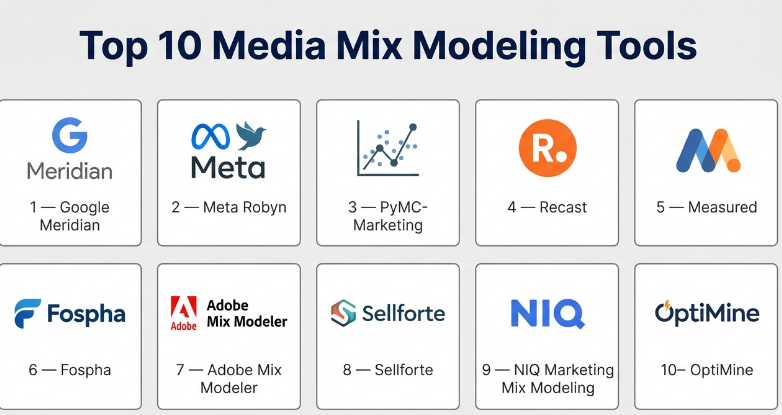
Top 10 Media Mix Modeling Tools
#1 — Google Meridian
Short description :
Google Meridian is an open-source Media Mix Modeling framework built for advanced marketing measurement. It is designed for teams that want a privacy-conscious and customizable MMM approach. Meridian is suitable for data science teams, analytics teams, and advertisers that want control over model inputs, assumptions, and outputs. It supports modern MMM needs such as Bayesian modeling, geo-level data, budget optimization, and scenario planning. It is best for organizations with strong technical skills and clean marketing data.
Key Features
- Open-source MMM framework
- Bayesian causal inference approach
- Support for geo-level and national-level modeling
- Budget optimization and planning insights
- Visualization support for business decisions
- Designed for privacy-durable measurement
- Customizable modeling workflow
Pros
- Strong option for technical teams that want transparency.
- No vendor lock-in around the modeling framework.
- Good fit for advertisers with mature analytics teams.
Cons
- Requires data science and statistical modeling knowledge.
- Not a plug-and-play business dashboard for non-technical users.
- Implementation quality depends heavily on data readiness.
Platforms / Deployment
Python-based framework.
Cloud / Self-hosted / Hybrid depending on implementation.
Security & Compliance
Security depends on the user’s deployment environment.
SOC 2, ISO 27001, HIPAA: Not publicly stated for the framework itself.
Integrations & Ecosystem
Meridian is developer-focused and can be integrated into a company’s internal analytics stack. Teams can connect it with data warehouses, BI tools, and ad platform exports depending on their engineering setup.
- Data warehouse workflows
- Google marketing data
- Python analytics environment
- BI dashboards
- Internal modeling pipelines
- Custom reporting layers
Support & Community
Meridian has official documentation and an open-source ecosystem. Support depends on internal technical capability, implementation partners, and community resources.
#2 — Meta Robyn
Short description :
Meta Robyn is an open-source Marketing Mix Modeling package from Meta Marketing Science. It is built for teams that want an automated and data-science-driven MMM framework. Robyn is especially useful for analysts who want to model adstock, saturation, channel contribution, and budget allocation using an open-source approach. It is commonly associated with R-based workflows, though technical usage may vary by implementation. Robyn is best for data teams comfortable with modeling, validation, and experimentation.
Key Features
- Open-source MMM package
- AI/ML-powered modeling workflow
- Adstock and saturation modeling
- Channel contribution analysis
- Budget allocation support
- Model validation workflows
- Community-driven resources
Pros
- Strong open-source option for MMM experimentation.
- Useful for teams wanting more modeling transparency.
- Good learning resource for marketing science teams.
Cons
- Requires technical skills and statistical understanding.
- Not ideal for teams wanting fully managed consulting.
- Setup and validation can take time.
Platforms / Deployment
R-based / technical analytics environment.
Cloud / Self-hosted / Hybrid depending on implementation.
Security & Compliance
Security depends on where and how it is deployed.
SOC 2, ISO 27001, HIPAA: Not publicly stated for the open-source package.
Integrations & Ecosystem
Robyn fits well into internal analytics workflows where teams can prepare data, run models, validate results, and export outputs into business dashboards.
- R analytics workflows
- Data warehouses
- BI tools
- Ad platform exports
- Internal data pipelines
- Experimentation workflows
Support & Community
Robyn has documentation, open-source resources, and community discussion. Enterprise support is not the same as a commercial SaaS tool, so companies should plan for internal ownership.
#3 — PyMC-Marketing
Short description :
PyMC-Marketing is an open-source Bayesian marketing analytics toolkit that supports Media Mix Modeling, Customer Lifetime Value analysis, and other marketing science use cases. It is suitable for data scientists who want flexible Bayesian modeling instead of a fixed vendor platform. PyMC-Marketing is especially useful when teams need transparency, experimentation, uncertainty estimation, and custom modeling. It is not a simple dashboard tool, but it can be powerful for advanced analytics teams. PyMC-Marketing positions itself around Bayesian modeling techniques for MMM and CLV.
Key Features
- Open-source Bayesian marketing analytics
- Media Mix Modeling support
- Customer Lifetime Value modeling support
- Flexible model customization
- Uncertainty-aware outputs
- Python-based analytics workflow
- Strong fit for technical research teams
Pros
- Highly flexible for advanced data science teams.
- Useful when standard MMM templates are not enough.
- Strong Bayesian modeling foundation.
Cons
- Requires technical and statistical expertise.
- Not designed as a ready-made executive SaaS dashboard.
- Implementation speed depends on team capability.
Platforms / Deployment
Python-based framework.
Cloud / Self-hosted / Hybrid depending on implementation.
Security & Compliance
Security depends on deployment, data storage, and internal governance.
SOC 2, ISO 27001, HIPAA: Not publicly stated for the open-source toolkit.
Integrations & Ecosystem
PyMC-Marketing can be used with modern Python data stacks and internal analytics infrastructure. It is best for companies that can build their own data pipelines and reporting layers.
- Python ecosystem
- Data warehouses
- Notebooks
- BI dashboards
- Custom APIs
- Internal experimentation platforms
Support & Community
Support comes from documentation, open-source community, and professional services from related experts where available. Internal data science ownership is important.
#4 — Recast
Short description :
Recast is a modern MMM platform focused on helping marketers measure true channel impact, optimize spend, and forecast future performance. It is designed for teams that want a managed MMM platform rather than building models fully in-house. Recast emphasizes real-time performance, confidence intervals, ROI estimates, saturation curves, and time-shift estimates. It is a strong fit for growth teams, ecommerce brands, and marketing leaders who want MMM outputs that support budget decisions. Recast states that it is SOC 2 compliant and a badged Meta Measurement Partner.
Key Features
- Modern MMM platform
- ROI and channel contribution analysis
- Saturation curve estimation
- Confidence intervals
- Forecasting and planning
- Budget optimization
- Real-time performance orientation
Pros
- Strong fit for marketers who want actionable MMM.
- Provides uncertainty ranges, not only single-point estimates.
- Useful for budget planning and channel mix decisions.
Cons
- May not be ideal for teams wanting fully open-source control.
- Pricing may be better suited for serious marketing spend levels.
- Requires quality historical data for strong outputs.
Platforms / Deployment
Web-based platform.
Cloud deployment.
Security & Compliance
SOC 2 compliant according to public Recast information.
Other certifications: Not publicly stated.
Integrations & Ecosystem
Recast is built to connect marketing data with measurement and forecasting workflows. It is commonly used alongside performance marketing, finance planning, and growth reporting.
- Paid media data
- Ecommerce data
- Revenue and sales data
- Forecasting workflows
- Executive reporting
- Budget planning workflows
Support & Community
Recast provides customer support, onboarding, and educational content around MMM. Community strength is stronger among modern marketing analytics and growth marketing professionals.
#5 — Measured
Short description :
Measured is a media effectiveness platform that combines causal experiments, incrementality testing, and Media Mix Modeling. It is designed for enterprise marketers who want to connect MMM outputs with real experiments and full-funnel media measurement. Measured is especially relevant for brands that need more confidence in budget decisions across online and offline channels. It is useful for teams that want MMM to be informed by incrementality rather than relying only on correlation. Measured publicly describes its platform as combining causal experiments with MMM.
Key Features
- Causal MMM
- Incrementality testing
- Full-funnel media measurement
- Online and offline channel analysis
- Budget decision support
- Enterprise measurement workflows
- Experiment-informed modeling
Pros
- Strong for teams that value causal validation.
- Useful for enterprise-level media measurement.
- Helps connect marketing and finance discussions.
Cons
- May be too advanced for small advertisers.
- Requires mature testing and data practices.
- Pricing details may not be fully public.
Platforms / Deployment
Web-based platform.
Cloud deployment.
Security & Compliance
Enterprise security controls may be available.
SOC 2, ISO 27001, HIPAA: Not publicly stated.
Integrations & Ecosystem
Measured fits into enterprise media measurement systems where MMM, incrementality, and financial impact need to work together.
- Paid media platforms
- Ecommerce and sales systems
- Experimentation workflows
- BI and reporting tools
- Offline channel data
- Finance reporting workflows
Support & Community
Measured provides enterprise-style support, onboarding, and education. It is best suited for organizations ready to operationalize incrementality and MMM together.
#6 — Fospha
Short description :
Fospha is a measurement operating system focused on retail commerce, ecommerce, and performance marketing measurement. It offers always-on measurement and daily MMM-style insights for brands that need frequent decision support. Fospha is especially useful for retail, DTC, marketplace, and commerce teams working across channels such as DTC stores, Amazon, paid social, and TikTok Shop. It focuses on making MMM more operational and useful for day-to-day optimization. Fospha publicly describes its platform around daily, ad-level measurement for retail commerce.
Key Features
- Daily MMM-style measurement
- Retail and ecommerce focus
- Ad-level and campaign-level insights
- Cross-channel sales measurement
- Marketplace and DTC support
- Strategic and tactical reporting
- Optimization recommendations
Pros
- Strong fit for retail and ecommerce brands.
- More operational than traditional slow MMM cycles.
- Useful for teams managing multiple sales channels.
Cons
- May be less relevant for non-commerce businesses.
- Details may vary by brand size and data access.
- Pricing and security details may require vendor discussion.
Platforms / Deployment
Web-based platform.
Cloud deployment.
Security & Compliance
Specific certifications are not clearly known.
SOC 2, ISO 27001, HIPAA: Not publicly stated.
Integrations & Ecosystem
Fospha is designed for commerce-focused measurement, so integrations usually matter across sales channels, ad platforms, and reporting systems.
- Ecommerce platforms
- Retail media data
- Paid social platforms
- Marketplace data
- BI reporting
- Campaign optimization workflows
Support & Community
Fospha provides customer support and measurement guidance. Community visibility is strongest in retail commerce and performance marketing measurement spaces.
#7 — Adobe Mix Modeler
Short description :
Adobe Mix Modeler is a marketing measurement and planning solution designed to help teams understand media ROI, optimize budgets, and make planning decisions across channels. It is part of the Adobe business ecosystem and is suitable for larger marketing organizations already using Adobe’s marketing and data products. Adobe describes Mix Modeler as combining media planning and data insights to help marketers decide where to invest. It is best for enterprises that need MMM connected to broader marketing operations and planning.
Key Features
- Media mix modeling
- Media planning support
- AI-powered measurement capabilities
- Cross-channel campaign analysis
- Budget optimization
- Planning and forecasting
- Adobe ecosystem alignment
Pros
- Strong fit for Adobe enterprise customers.
- Useful for connecting measurement with media planning.
- Designed for cross-channel marketing decisions.
Cons
- May be too enterprise-focused for smaller teams.
- Best value may depend on Adobe ecosystem usage.
- Implementation may require data and platform readiness.
Platforms / Deployment
Web-based platform.
Cloud deployment.
Security & Compliance
Adobe enterprise products commonly support strong security and governance capabilities, but buyers should validate the exact controls for Mix Modeler.
SOC 2, ISO 27001, HIPAA: Not publicly stated here.
Integrations & Ecosystem
Adobe Mix Modeler is strongest when used inside a broader Adobe marketing and analytics environment. It can support unified measurement, planning, and optimization workflows.
- Adobe ecosystem
- Marketing data workflows
- Planning systems
- Campaign reporting
- Data harmonization
- Executive dashboards
Support & Community
Adobe provides enterprise documentation, training, partner support, and customer success resources. Support depth depends on contract and Adobe product adoption.
#8 — Sellforte
Short description :
Sellforte is a measurement and optimization platform focused on retail and ecommerce brands. It combines Marketing Mix Modeling, incrementality testing, and attribution into a unified operating system for marketing decisions. Sellforte is especially suitable for brands that want campaign-level and ad-set-level optimization rather than only high-level channel analysis. It is built for teams that need frequent recommendations for media investment, bidding, and growth planning. Sellforte publicly positions itself around MMM, incrementality testing, and attribution for retail and ecommerce.
Key Features
- MMM for ecommerce and retail
- Incrementality testing
- Attribution comparison
- Campaign and ad-set-level insights
- Media spend optimization
- Full-funnel media measurement
- Growth and ROI recommendations
Pros
- Strong for ecommerce and retail advertisers.
- Combines MMM with incrementality and attribution.
- Useful for campaign-level decision-making.
Cons
- May be less relevant for non-retail businesses.
- Pricing and implementation details may require discussion.
- Best results depend on strong commerce and media data.
Platforms / Deployment
Web-based platform.
Cloud deployment.
Security & Compliance
Specific security certifications are not clearly known.
SOC 2, ISO 27001, HIPAA: Not publicly stated.
Integrations & Ecosystem
Sellforte is designed to connect commerce data, media data, and performance outcomes. It is useful for teams that need media optimization across multiple digital and retail channels.
- Ad platforms
- Ecommerce data
- Retail sales data
- Campaign reporting
- Incrementality workflows
- Budget optimization processes
Support & Community
Sellforte provides customer support and measurement expertise. Its community visibility is strongest among ecommerce, retail, and performance marketing teams.
#9 — NIQ Marketing Mix Modeling
Short description :
NIQ Marketing Mix Modeling helps brands measure and optimize commercial impact using marketing, sales, and retail data. It is especially relevant for consumer goods, retail, and large brands that need store-level or market-level performance measurement. NIQ emphasizes marketing investment optimization grounded in retail and commercial data. This makes it useful for teams that need to evaluate media, promotions, pricing, and distribution effects together. NIQ publicly describes its MMM solution as helping brands measure and optimize marketing impact using proprietary store-level data.
Key Features
- Marketing mix modeling for commercial impact
- Retail and store-level data orientation
- ROI measurement
- Marketing investment optimization
- Promotion and sales impact analysis
- Category and market-level insights
- Consulting-led measurement support
Pros
- Strong fit for retail and consumer goods brands.
- Useful when sales and store-level signals matter.
- Can support broader commercial decision-making.
Cons
- May be more consulting-led than self-serve SaaS.
- May not be ideal for small digital-only advertisers.
- Pricing and implementation details are not fully public.
Platforms / Deployment
Varies / N/A.
Cloud / managed service / consulting-led delivery may vary.
Security & Compliance
Specific controls should be validated during enterprise procurement.
SOC 2, ISO 27001, HIPAA: Not publicly stated.
Integrations & Ecosystem
NIQ MMM is commonly relevant where retail data, category performance, and commercial analytics need to connect with media planning.
- Retail sales data
- Store-level data
- Category analytics
- Media spend data
- Commercial planning
- Executive reporting
Support & Community
Support is likely service-led and enterprise-oriented. NIQ has strong market recognition in retail and consumer intelligence.
#10 — OptiMine
Short description :
OptiMine is a marketing measurement and optimization platform that supports Marketing Mix Modeling, attribution, media planning, and budget optimization. It is designed for brands that want actionable recommendations across digital and traditional marketing channels. OptiMine focuses on detailed guidance and scenario planning for media investment decisions. It can be useful for teams that need both strategic budget optimization and tactical planning support. OptiMine publicly describes its platform around MMM, attribution, and media plan optimization.
Key Features
- Marketing Mix Modeling
- Marketing attribution
- Budget optimization
- Scenario planning
- Digital and traditional channel analysis
- Media plan recommendations
- Predictive modeling
Pros
- Useful for media planning and optimization.
- Covers both digital and traditional marketing channels.
- Supports budget scenario analysis.
Cons
- Public technical details may be limited.
- May require vendor-led implementation.
- Not ideal for teams wanting open-source modeling control.
Platforms / Deployment
Web-based platform.
Cloud deployment.
Security & Compliance
Specific security certifications are not clearly known.
SOC 2, ISO 27001, HIPAA: Not publicly stated.
Integrations & Ecosystem
OptiMine fits into media planning and marketing performance workflows where teams need recommendations, modeling, and budget guidance.
- Media data
- Attribution workflows
- Planning systems
- Reporting dashboards
- Budget optimization
- Marketing analytics processes
Support & Community
OptiMine provides vendor support and measurement expertise. Public community visibility is more limited than open-source frameworks, but it is known in marketing measurement circles.
Comparison Table (Top 10)
| Tool Name | Best For | Platform(s) Supported | Deployment | Standout Feature | Public Rating |
|---|---|---|---|---|---|
| Google Meridian | Technical teams needing open-source MMM | Python / Web workflows via custom setup | Cloud / Self-hosted / Hybrid | Bayesian open-source MMM framework | N/A |
| Meta Robyn | Data science teams using open-source MMM | R-based technical environment | Cloud / Self-hosted / Hybrid | AI/ML-powered open-source MMM package | N/A |
| PyMC-Marketing | Advanced Bayesian marketing analytics | Python | Cloud / Self-hosted / Hybrid | Flexible Bayesian MMM modeling | N/A |
| Recast | Growth teams needing modern MMM dashboards | Web | Cloud | Confidence intervals and forecasting | N/A |
| Measured | Enterprise incrementality and MMM | Web | Cloud | Causal experiments plus MMM | N/A |
| Fospha | Retail commerce and ecommerce measurement | Web | Cloud | Daily MMM and ad-level commerce insights | N/A |
| Adobe Mix Modeler | Adobe enterprise marketing teams | Web | Cloud | MMM connected with media planning | N/A |
| Sellforte | Retail and ecommerce media optimization | Web | Cloud | MMM, incrementality, and attribution combined | N/A |
| NIQ Marketing Mix Modeling | Retail and consumer goods brands | Varies / N/A | Varies / Managed | Store-level commercial impact measurement | N/A |
| OptiMine | Media planning and budget optimization | Web | Cloud | MMM plus attribution and scenario planning | N/A |
Evaluation & Media Mix Modeling Tools
| Tool Name | Core (25%) | Ease (15%) | Integrations (15%) | Security (10%) | Performance (10%) | Support (10%) | Value (15%) | Weighted Total (0–10) |
|---|---|---|---|---|---|---|---|---|
| Google Meridian | 9 | 6 | 8 | 7 | 8 | 7 | 9 | 7.85 |
| Meta Robyn | 8 | 6 | 7 | 7 | 7 | 7 | 9 | 7.35 |
| PyMC-Marketing | 8 | 5 | 8 | 7 | 8 | 7 | 9 | 7.45 |
| Recast | 9 | 8 | 7 | 8 | 8 | 8 | 7 | 8.05 |
| Measured | 9 | 7 | 8 | 7 | 8 | 8 | 7 | 7.90 |
| Fospha | 8 | 8 | 8 | 7 | 8 | 7 | 8 | 7.85 |
| Adobe Mix Modeler | 9 | 7 | 9 | 8 | 8 | 8 | 7 | 8.10 |
| Sellforte | 8 | 8 | 8 | 7 | 8 | 7 | 8 | 7.85 |
| NIQ Marketing Mix Modeling | 8 | 7 | 7 | 7 | 8 | 8 | 7 | 7.55 |
| OptiMine | 8 | 7 | 7 | 7 | 8 | 7 | 7 | 7.40 |
These scores are comparative and should be treated as a starting point, not a final buying decision. A technical team may rate Meridian, Robyn, or PyMC-Marketing higher because of flexibility and transparency. A marketing leadership team may value Recast, Measured, Fospha, Adobe Mix Modeler, or Sellforte more because they provide managed workflows and decision-ready outputs. Security, pricing, and integration scores should always be validated directly with the vendor.
Which Media Mix Modeling Tools
Solo / Freelancer
Solo marketers and freelancers usually do not need a heavy MMM platform. If they are learning MMM or advising clients, Meta Robyn, Google Meridian, and PyMC-Marketing can be useful for education and experimentation.
For practical client reporting, a freelancer may also use simpler analytics, spreadsheet modeling, or vendor dashboards before moving into a full MMM platform. The main requirement is clean historical data, not just a tool subscription.
SMB
Small and mid-sized businesses should be careful not to buy more complexity than they can manage. MMM needs enough historical data, consistent spend, and clear business outcomes.
For SMBs with technical talent, Meridian or Robyn can be cost-effective but require strong analytics ownership. For ecommerce SMBs with meaningful ad spend, tools like Recast, Fospha, Sellforte, or OptiMine may be more practical if the budget allows.
Mid-Market
Mid-market companies usually benefit most from MMM because they have enough media spend and enough channel complexity to justify better measurement. They may be active across paid search, paid social, retail media, email, marketplaces, offline campaigns, and promotions.
Recast, Measured, Fospha, Sellforte, Adobe Mix Modeler, and OptiMine can be useful depending on business model. Technical teams may still prefer Meridian or PyMC-Marketing if they want internal control.
Enterprise
Enterprise companies need governance, scalability, auditability, multi-market support, security review, and executive-ready reporting. They may also need to connect MMM with finance, planning, campaign operations, and customer analytics.
Adobe Mix Modeler, Measured, NIQ Marketing Mix Modeling, Recast, Fospha, Sellforte, and OptiMine can fit enterprise needs depending on industry. Large data science teams may also build internal MMM systems using Meridian, Robyn, or PyMC-Marketing.
Budget vs Premium
Budget-focused teams should consider open-source tools first, but they must account for internal labor, data engineering, model validation, and maintenance. Open-source is not automatically cheap if the team lacks the skills to operate it.
Premium platforms are more useful when teams need faster deployment, support, dashboards, scenario planning, and executive reporting. The best premium choice is the one that helps teams make better budget decisions, not simply the one with the most features.
Feature Depth vs Ease of Use
Google Meridian, Meta Robyn, and PyMC-Marketing offer strong modeling depth but require technical knowledge. They are better for teams that want transparency and customization.
Recast, Measured, Fospha, Adobe Mix Modeler, Sellforte, NIQ, and OptiMine are generally easier for business teams because they offer more managed workflows. However, buyers should still understand the model assumptions behind the outputs.
Integrations & Scalability-
MMM tools become more valuable when they connect with real business data. Important integrations include ad platforms, ecommerce systems, offline sales, CRM, data warehouses, BI dashboards, finance systems, and experimentation platforms.
For scalability, buyers should check whether the tool can support multiple countries, brands, products, channels, currencies, business units, and reporting calendars. A tool that works for one market may not automatically work for a global organization.
Security & Compliance Needs
Security is important because MMM tools often process spend data, revenue data, sales data, campaign performance, and business planning information. Buyers should ask about SSO, SAML, MFA, RBAC, encryption, audit logs, data retention, access controls, and vendor security documentation.
If a vendor does not clearly publish certifications, do not assume them. Ask for formal documentation during procurement and involve IT, legal, privacy, and security teams before sharing sensitive business data.
Frequently Asked Questions (FAQs)
1. What are Media Mix Modeling Tools?
Media Mix Modeling Tools help businesses understand how different marketing channels and external factors affect sales, revenue, leads, or other business outcomes. They use aggregated data rather than individual user tracking. This makes them useful for privacy-conscious marketing measurement.
2. How is Media Mix Modeling different from attribution?
Attribution usually tries to assign credit to user-level touchpoints, often using clicks, impressions, or tracked journeys. Media Mix Modeling works at an aggregated level and evaluates broader patterns across spend, sales, seasonality, pricing, promotions, and external factors. MMM is better for strategic budget planning, while attribution is often used for tactical channel reporting.
3. How much do Media Mix Modeling Tools cost?
Pricing varies widely. Open-source tools may not have license fees, but they require technical labor. Commercial platforms may use custom pricing based on spend, data volume, markets, users, support, and modeling scope. Buyers should ask about setup fees, refresh frequency, support, data connectors, and add-on costs.
4. What data is needed for MMM?
Most MMM programs need historical marketing spend, impressions, clicks, sales, revenue, conversions, pricing, promotions, seasonality, holidays, distribution changes, and external market factors. The exact data depends on the model and business type. Clean, consistent historical data is more important than simply having many data sources.
5. How long does MMM implementation take?
Implementation can be quick for focused use cases with clean data, but complex enterprise programs may take longer because of data preparation, stakeholder alignment, model validation, and reporting setup. Open-source implementations depend heavily on internal technical skills. Managed platforms usually reduce setup burden but still require data readiness.
6. What are common mistakes in Media Mix Modeling?
Common mistakes include using poor-quality data, ignoring promotions and seasonality, over-trusting model outputs without validation, comparing MMM directly with last-click attribution, and expecting exact campaign-level truth from high-level models. Another mistake is not involving finance and business stakeholders early.
7. Can MMM measure digital and offline channels together?
Yes. One of MMM’s strengths is that it can evaluate digital and offline channels together, including paid search, paid social, TV, radio, print, retail media, out-of-home, influencer activity, and promotions. The quality of results depends on data granularity, spend variation, business outcomes, and model design.
8. Are open-source MMM tools good enough?
Open-source MMM tools can be powerful, especially for skilled data science teams. Google Meridian, Meta Robyn, and PyMC-Marketing offer transparency and flexibility. However, they require technical ownership, validation, maintenance, and business translation. Non-technical teams may prefer managed SaaS platforms.
9. How should MMM results be validated?
MMM results can be validated using holdout tests, geo experiments, incrementality tests, back-testing, forecast accuracy, business logic, and comparison with known campaign events. Good validation helps prevent false confidence. Teams should treat MMM as decision support, not as an unquestionable truth machine.
10. Can MMM help with budget optimization?
Yes. MMM can help estimate marginal ROI, saturation, diminishing returns, and better budget allocation across channels. Some tools also provide scenario planning and forecasting. However, budget recommendations should be reviewed with business context, channel constraints, creative plans, inventory limits, and sales goals.
Conclusion
Media Mix Modeling Tools are becoming more important because marketing measurement is no longer simple. Teams cannot rely only on last-click attribution, platform-reported ROAS, or disconnected dashboards when customer journeys cross many channels and privacy rules limit user-level tracking. MMM gives businesses a broader way to understand what is really driving growth, how channels work together, where spend is wasted, and how budgets can be planned more confidently.
