Introduction
Stadium Operations Software, often used as a Venue Management System (VMS), helps stadiums, arenas, sports complexes, and live-event venues manage daily operations from one connected platform. In simple terms, it supports event planning, booking, incident reporting, staff coordination, facility maintenance, concessions, ticketing workflows, access control, vendor coordination, and real-time communication.
It matters more in the 2026+ environment because stadiums are becoming more digital, data-driven, and experience-focused. Fans expect faster entry, smoother payments, safer venues, and real-time support. At the same time, operations teams must manage security, staffing, compliance, crowd movement, facility readiness, and multiple event types with fewer manual gaps.
Common real-world use cases include matchday operations, incident management, event booking, staff task assignment, facility maintenance, concession coordination, VIP area management, and post-event reporting.
Buyers should evaluate:
- Event booking and scheduling depth
- Incident and risk management features
- Staff communication and task workflows
- Mobile access for field teams
- Integrations with ticketing, POS, CRM, and access systems
- Reporting and analytics
- Security controls and audit logs
- Ease of onboarding
- Scalability across multiple venues
- Vendor support and implementation quality
Best for: Stadium operators, arena managers, event operations teams, facilities teams, sports franchises, universities, entertainment venues, convention centers, and large multi-use venues that need centralized control over complex event operations.
Not ideal for: Very small venues with simple calendars, small clubs using basic booking tools, or organizations that only need single-function software such as basic ticketing, simple POS, or standalone maintenance tracking.
Key Trends in Stadium Operations Software
- AI-assisted operations planning: More platforms are adding AI-based reporting, forecasting, task suggestions, and incident pattern analysis to help teams make faster decisions.
- Real-time incident response: Stadiums increasingly need live dashboards, mobile incident logging, escalation rules, and digital documentation for safety and compliance.
- Mobile-first workforce tools: Event staff, security teams, cleaning crews, maintenance teams, and supervisors need mobile apps for task updates, photos, alerts, and approvals.
- Integrated fan experience workflows: Operations software is becoming more connected with ticketing, concessions, parking, wayfinding, loyalty, and guest service systems.
- Cloud-based deployment: Most modern platforms are moving toward cloud or hybrid models to support multi-venue visibility, faster updates, and easier remote management.
- Compliance and audit readiness: Venues want better records for incidents, inspections, safety checks, risk assessments, and vendor performance.
- Interoperability through APIs: Buyers now expect integrations with CRM, POS, access control, ERP, finance, ticketing, workforce scheduling, and analytics platforms.
- Sustainability tracking: Large venues are paying more attention to waste, energy, resource usage, and operational sustainability reporting.
- Data-driven revenue operations: Stadiums are using software to connect booking, inventory, concessions, premium spaces, and financial reporting.
- Flexible pricing and modular buying: Many vendors now offer modular packages so venues can choose booking, operations, incident, POS, or facility modules based on need.
How We Selected These Tools
The tools below were selected using practical evaluation logic for stadium and venue operations teams:
- Strong relevance to stadiums, arenas, sports venues, entertainment venues, or large event operations
- Recognized market presence or visible adoption in venue, event, hospitality, sports, or facility operations
- Coverage of core operational workflows such as bookings, incident management, POS, facilities, workforce, and event coordination
- Fit for different buyer segments, including enterprise venues, mid-market stadiums, universities, and multi-location operators
- Integration potential with ticketing, payments, CRM, ERP, access control, and reporting systems
- Practical value for live-event environments where speed, reliability, and visibility matter
- Vendor ecosystem, implementation support, and product maturity
- Security posture signals where publicly available, without assuming unsupported certifications
- Ability to support modern cloud, mobile, and analytics-led operations
- Balance across all-in-one platforms and specialist tools used in stadium environments
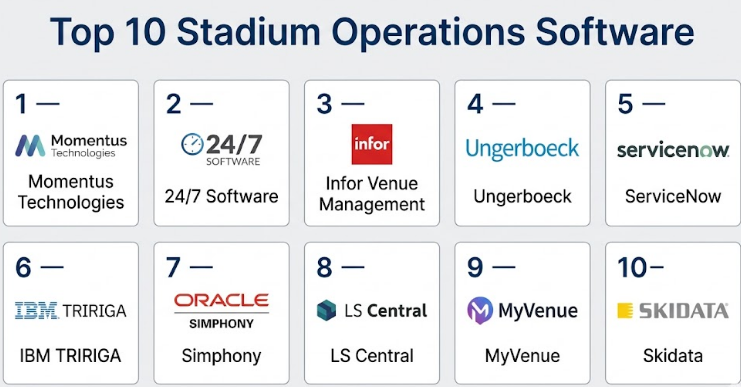
Top 10 Stadium Operations Software
#1 — Momentus Technologies
Short description :
Momentus Technologies is a venue and event management platform used by stadiums, arenas, convention centers, campuses, and performing arts venues.It supports event booking, operations planning, resource coordination, communication, and financial workflows.
For stadium operators, it is useful when multiple teams need to coordinate bookings, spaces, services, staff, and event requirements from one platform.It is best suited for large and mid-sized venues with complex event calendars.The platform is especially strong for venues that want connected booking and operational workflows rather than isolated spreadsheets.
Key Features
- Venue booking and event management
- Resource and space planning
- Event operations coordination
- CRM and client management workflows
- Financial and invoicing support
- Reporting and operational visibility
- Multi-venue support for larger organizations
Pros
- Strong fit for large venues, stadiums, arenas, and event centers
- Helps connect sales, booking, operations, and finance teams
- Useful for venues managing high event volume and complex requirements
Cons
- May be more than small venues need
- Implementation can require process mapping and staff training
- Pricing details are typically not simple to compare publicly
Platforms / Deployment
Web / Cloud
Mobile access: Varies / N/A
Security & Compliance
Not publicly stated for specific certifications in this context.
Expected enterprise controls may vary by contract and deployment.
Integrations & Ecosystem
Momentus is designed for venue and event ecosystems where booking, operations, finance, and communication need to connect. Integration depth may depend on package, implementation scope, and venue requirements.
- CRM and sales workflows
- Accounting and finance workflows
- Event planning systems
- Reporting tools
- Operational communication processes
- Venue resource management workflows
Support & Community
Momentus generally serves professional venue teams, so onboarding and implementation support are important parts of the buyer experience. Documentation, support tiers, and customer success options may vary by contract.
#2 — 24/7 Software
Short description :
24/7 Software focuses on operations management for sports venues, entertainment venues, and large event organizations.It is useful for incident management, task tracking, inspections, communication, documentation, and real-time operational awareness.The platform is especially relevant for stadium teams that need strong matchday visibility and rapid issue resolution.It helps operations, safety, guest services, and security teams work from shared information.It is best suited for venues where live operational control and incident response are top priorities.
Key Features
- Incident management
- Real-time operational dashboards
- Digital documentation
- Task and workflow management
- Communication tools
- Inspection and issue tracking
- Analytics for venue operations
Pros
- Strong focus on live event operations and incident response
- Useful for safety, security, guest services, and operations teams
- Helps reduce manual paperwork during high-pressure events
Cons
- Less focused on full venue booking compared with some VMS platforms
- May require integration with ticketing, POS, and finance systems
- Best value appears when teams fully adopt digital workflows
Platforms / Deployment
Web / Cloud
Mobile access: Varies / N/A
Security & Compliance
Not publicly stated.
Integrations & Ecosystem
24/7 Software fits into stadium operations environments where incident, communication, and task data need to connect with broader venue systems.
- Incident reporting workflows
- Guest services processes
- Security operations
- Facility operations
- Analytics and reporting
- Possible integrations depend on implementation scope
Support & Community
Support appears oriented toward professional venue and sports operations customers. Support tiers, onboarding models, and documentation depth may vary by contract.
#3 — Infor Venue Management
Short description :
Infor Venue Management is designed for stadiums, event spaces, entertainment venues, and hospitality-driven operations.It supports planning and operational workflows across venue events, service delivery, and guest experience needs.Infor’s broader enterprise software background makes it relevant for organizations that also need finance, hospitality, ERP, or operational integrations.It is best for larger venues that want enterprise-grade structure and system connectivity.It may be a good fit where venue operations must connect with wider business systems.
Key Features
- Venue and event operations support
- Cloud-based operational workflows
- Planning and orchestration features
- Enterprise system connectivity
- Guest experience support
- Reporting and operational visibility
- Hospitality and event venue alignment
Pros
- Strong enterprise software background
- Good fit for venues needing broader system integration
- Useful for organizations with complex operational and finance needs
Cons
- May feel heavy for smaller venues
- Implementation planning can be more involved
- Public product-level details may require vendor consultation
Platforms / Deployment
Web / Cloud
Hybrid: Varies / N/A
Security & Compliance
Not publicly stated for this specific venue solution context.
Integrations & Ecosystem
Infor products are often used in enterprise environments where venue operations may need to connect with financial, hospitality, analytics, and back-office systems.
- ERP ecosystem alignment
- Hospitality workflows
- Finance and reporting systems
- Event planning processes
- Operational analytics
- Enterprise data workflows
Support & Community
Infor generally supports enterprise customers through professional services, documentation, and support programs. Exact onboarding and service models vary by contract.
#4 — Ungerboeck
Short description :
Ungerboeck is an event and venue management platform used by convention centers, exhibition venues, arenas, and event organizations.It supports sales, booking, event planning, operations, CRM, and financial workflows.For stadium-style operations, it can help teams manage event pipelines, spaces, resources, contracts, and service delivery.It is best suited for venues with many event types and detailed planning requirements.It is especially relevant for organizations that need structured event lifecycle management.
Key Features
- Event booking and scheduling
- CRM and sales pipeline management
- Venue resource planning
- Event operations support
- Contract and financial workflows
- Reporting and dashboards
- Multi-department collaboration
Pros
- Mature event and venue management capabilities
- Useful for venues with complex sales-to-operations workflows
- Helps reduce disconnected planning across teams
Cons
- May require careful configuration
- Learning curve can be higher for new teams
- Smaller venues may not need its full depth
Platforms / Deployment
Web / Cloud
Other deployment options: Varies / N/A
Security & Compliance
Not publicly stated in this context.
Integrations & Ecosystem
Ungerboeck is commonly positioned around venue and event lifecycle workflows, where CRM, bookings, planning, finance, and reporting need to work together.
- CRM workflows
- Event booking systems
- Finance and invoicing processes
- Reporting tools
- Space and resource planning
- Third-party integrations may vary
Support & Community
Support and onboarding are typically important for this type of platform. Documentation, training, and service levels may vary based on package and contract.
#5 — ServiceNow
Short description :
ServiceNow is not a stadium-only platform, but it can be used by large stadiums and venue groups for facilities workflows, service management, incident response, asset management, and operational automation.It is best for enterprise organizations that already use ServiceNow or want standardized workflows across IT, facilities, security, HR, and operations.For stadium operations, it can support ticketing-style internal requests, maintenance workflows, approvals, and operational dashboards.
It is especially valuable when venues need governance and workflow control at scale.
It is less suitable for venues looking only for event booking software.
Key Features
- Workflow automation
- Incident and request management
- Asset and facilities workflows
- Dashboards and reporting
- Approval processes
- Enterprise integrations
- Configurable service portals
Pros
- Highly scalable for enterprise workflows
- Strong automation and process control
- Good fit for organizations already using ServiceNow
Cons
- Not purpose-built only for stadium event operations
- Can require configuration and specialist administration
- May be costly for smaller venues
Platforms / Deployment
Web / Cloud
Mobile access: iOS / Android availability may vary by product setup
Security & Compliance
Enterprise security capabilities are available, but specific controls and certifications should be validated directly during procurement. Do not assume all features are included in every package.
Integrations & Ecosystem
ServiceNow has a broad enterprise ecosystem and can connect stadium operations with IT, facilities, security, HR, finance, and vendor workflows.
- IT service management
- Facilities management
- Asset systems
- Identity and access systems
- Reporting and analytics
- API-based workflow integrations
Support & Community
ServiceNow has a large enterprise support ecosystem, implementation partner network, documentation base, and administrator community. Support depends heavily on contract and partner setup.
#6 — IBM TRIRIGA
Short description :
IBM TRIRIGA is an enterprise facilities and workplace management platform that can support large stadiums, campuses, arenas, and complex real estate operations.It is useful for asset management, space planning, maintenance, lease administration, capital projects, and facility lifecycle workflows.
For stadium operators, it is most relevant when physical assets, facility maintenance, sustainability, and long-term infrastructure planning are major needs.It is not a pure event booking tool, but it can support the facility side of stadium operations.It is best for enterprise venues with complex assets and property portfolios.
Key Features
- Facility and asset management
- Space and workplace planning
- Maintenance workflows
- Capital project support
- Real estate and lease workflows
- Sustainability and operational reporting
- Enterprise portfolio visibility
Pros
- Strong fit for large facilities and asset-heavy environments
- Useful for long-term stadium infrastructure management
- Supports enterprise-level planning and reporting
Cons
- Not focused on live event booking as a primary use case
- Implementation may be complex
- Better suited to enterprise teams than small venues
Platforms / Deployment
Web / Cloud / Hybrid options may vary
Security & Compliance
Security and compliance details depend on IBM product configuration, contract, and deployment model. Specific certifications should be validated during procurement.
Integrations & Ecosystem
IBM TRIRIGA is often used in enterprise facility ecosystems where assets, maintenance, space, sustainability, and financial data need to connect.
- Enterprise asset systems
- Facility maintenance workflows
- Real estate systems
- Reporting and analytics
- Capital planning tools
- ERP and finance integrations
Support & Community
IBM provides enterprise support, documentation, partner services, and implementation resources. Support experience depends on license, contract, and partner involvement.
#7 — Oracle Simphony
Short description :
Oracle Simphony is a cloud POS platform used in hospitality, food service, stadiums, arenas, and entertainment venues.It is focused on concessions, food and beverage operations, transactions, menu management, reporting, and service workflows.For stadium operations, it helps manage high-volume concession environments where speed, reliability, and integrated payment workflows matter.
It is not a full stadium operations suite, but it is highly relevant to fan experience and revenue operations.
It is best for venues where food, beverage, and retail operations are a major priority.
Key Features
- Cloud POS functionality
- Concession and food service workflows
- Menu and item management
- Payment support
- Reporting and sales visibility
- Offline functionality may be available depending on setup
- Hospitality-focused operations
Pros
- Strong fit for high-volume concession environments
- Useful for stadium food and beverage operations
- Enterprise hospitality ecosystem support
Cons
- Not a complete venue operations platform
- Requires integration with other event, ticketing, or facility systems
- Setup can be more complex for large venue environments
Platforms / Deployment
Web / Cloud
Hardware and device support: Varies / N/A
Security & Compliance
Payment and enterprise security details should be validated directly based on deployment, region, payment processor, and contract.
Integrations & Ecosystem
Oracle Simphony fits into stadium ecosystems where POS, payments, kitchen operations, reporting, and hospitality systems need to connect.
- Payment systems
- Kitchen and concession workflows
- Reporting tools
- Hospitality systems
- Inventory workflows
- Third-party integrations may vary
Support & Community
Oracle provides enterprise support and implementation resources. Support tiers, onboarding, and partner involvement vary by contract.
#8 — LS Central
Short description :
LS Central is a unified commerce and business management platform built on Microsoft Dynamics 365 Business Central.For stadiums, arenas, and event centers, it can support retail, concessions, table service, reservations, inventory, finance, and operational workflows.It is useful when venues want POS, ERP, inventory, and commercial operations connected more tightly.It is not only for stadiums, but it is relevant for venues with food, merchandise, and hospitality operations.It is best for organizations that value Microsoft ecosystem alignment.
Key Features
- POS and retail operations
- Inventory management
- Concession and hospitality workflows
- Reservations and table management
- Finance and ERP alignment
- Reporting and operational visibility
- Microsoft Dynamics ecosystem support
Pros
- Strong fit for venues with retail and concession complexity
- Useful for connecting commerce with finance and inventory
- Good option for Microsoft-oriented organizations
Cons
- Not a pure event operations or incident management platform
- May require Microsoft ecosystem knowledge
- Implementation scope can grow if many workflows are included
Platforms / Deployment
Web / Cloud / Hybrid options may vary
Microsoft Dynamics ecosystem
Security & Compliance
Security and compliance details depend on Microsoft, LS Central configuration, region, and implementation model. Specific certifications should be validated during procurement.
Integrations & Ecosystem
LS Central benefits from the Microsoft Dynamics ecosystem and is suitable for venues wanting commerce, inventory, and finance alignment.
- Microsoft Dynamics 365 Business Central
- POS systems
- Inventory workflows
- Finance and accounting
- Reporting tools
- Hospitality and retail systems
Support & Community
Support usually depends on LS Retail and implementation partners. Documentation, onboarding, and service quality can vary by region and partner.
#9 — MyVenue
Short description :
MyVenue is a POS and mobile commerce platform designed for stadiums, arenas, and entertainment venues.It supports high-volume transactions, mobile ordering, self-service, dashboards, and venue food and beverage workflows.For stadium operators, it is useful when fan spending, concession speed, and operational visibility are important.It is not a full venue management system, but it plays a key role in stadium revenue operations.It is best for venues that want modern concession and point-of-sale experiences.
Key Features
- Stadium and venue POS
- Mobile ordering workflows
- Self-service kiosk support
- Real-time sales dashboards
- Concession operations support
- Payment and transaction workflows
- Venue revenue visibility
Pros
- Strong focus on sports and entertainment venues
- Useful for improving concession speed and sales visibility
- Supports modern fan commerce experiences
Cons
- Not a full event booking or facility operations platform
- Integration planning is important
- Best suited for venues with significant food and beverage activity
Platforms / Deployment
Web / Cloud
Mobile and hardware support: Varies / N/A
Security & Compliance
Payment-related security should be validated based on processor, region, and implementation. Other compliance details are not publicly stated in this context.
Integrations & Ecosystem
MyVenue fits into stadium technology stacks focused on POS, concessions, mobile ordering, kiosks, and revenue reporting.
- POS hardware
- Payment systems
- Mobile ordering
- Kiosks
- Sales dashboards
- Venue commerce workflows
Support & Community
Support appears focused on venue commerce customers. Documentation, onboarding, and technical support details may vary by contract.
#10 — Skidata
Short description :
Skidata provides access, parking, and visitor management technology used in venues, stadiums, leisure facilities, and transport environments.For stadium operations, it is relevant for entry control, parking flows, ticket validation, and access-related visitor movement.It helps venues manage controlled entry points and improve operational flow around arrival and departure.It is not a full stadium operations suite, but it is important for physical access and movement workflows.It is best for stadiums where parking, access control, and entrance management are major operational needs.
Key Features
- Access control solutions
- Parking management
- Ticket validation support
- Entry and exit workflows
- Visitor movement support
- Hardware and software ecosystem
- Operational control for controlled access points
Pros
- Strong relevance for physical access and parking operations
- Useful for large venues with heavy arrival and exit flows
- Can support smoother visitor movement and entry management
Cons
- Not a full event planning or incident management platform
- Hardware and system integration can be project-heavy
- Best value depends on venue infrastructure needs
Platforms / Deployment
Hardware + Software ecosystem
Cloud / Hybrid / On-premises options may vary
Security & Compliance
Not publicly stated in this context. Security details should be validated based on access control architecture, data handling, and regional requirements.
Integrations & Ecosystem
Skidata is often part of the physical venue operations ecosystem where access, parking, ticket validation, and controlled entry must connect.
- Access control systems
- Parking systems
- Ticketing validation
- Visitor flow systems
- Hardware devices
- Venue infrastructure integrations
Support & Community
Support is typically project and implementation-driven. Service quality, local partner availability, and hardware support should be checked during procurement.
Comparison Table
| Tool Name | Best For | Platform(s) Supported | Deployment (Cloud/Self-hosted/Hybrid) | Standout Feature | Public Rating |
|---|---|---|---|---|---|
| Momentus Technologies | Large stadiums, arenas, event venues | Web | Cloud | Venue booking and event operations management | N/A |
| 24/7 Software | Live event operations and incident response | Web, mobile availability varies | Cloud | Real-time incident and operations management | N/A |
| Infor Venue Management | Enterprise stadium and event operations | Web | Cloud | Enterprise venue operations and system connectivity | N/A |
| Ungerboeck | Event-heavy venues and convention-style operations | Web | Cloud / Varies | Event lifecycle and venue management | N/A |
| ServiceNow | Enterprise workflow and facilities operations | Web, mobile availability varies | Cloud | Configurable workflow automation | N/A |
| IBM TRIRIGA | Facility, asset, and infrastructure management | Web | Cloud / Hybrid varies | Enterprise facility lifecycle management | N/A |
| Oracle Simphony | Stadium concessions and food service | Web, hardware varies | Cloud | Enterprise POS for food and beverage operations | N/A |
| LS Central | Venue commerce, retail, and concessions | Web, Microsoft ecosystem | Cloud / Hybrid varies | POS, inventory, and ERP alignment | N/A |
| MyVenue | Stadium POS and mobile commerce | Web, hardware varies | Cloud | Mobile ordering and concession dashboards | N/A |
| Skidata | Access control and parking operations | Hardware + software | Cloud / Hybrid / On-premises varies | Parking and access management | N/A |
Evaluation & Stadium Operations Software
| Tool Name | Core (25%) | Ease (15%) | Integrations (15%) | Security (10%) | Performance (10%) | Support (10%) | Value (15%) | Weighted Total (0–10) |
|---|---|---|---|---|---|---|---|---|
| Momentus Technologies | 9 | 7 | 8 | 7 | 8 | 8 | 7 | 7.95 |
| 24/7 Software | 8 | 8 | 7 | 7 | 8 | 8 | 8 | 7.75 |
| Infor Venue Management | 8 | 7 | 8 | 8 | 8 | 8 | 7 | 7.70 |
| Ungerboeck | 8 | 7 | 8 | 7 | 8 | 8 | 7 | 7.60 |
| ServiceNow | 8 | 6 | 9 | 9 | 9 | 9 | 6 | 7.95 |
| IBM TRIRIGA | 8 | 6 | 8 | 8 | 8 | 8 | 6 | 7.40 |
| Oracle Simphony | 8 | 7 | 8 | 8 | 9 | 8 | 7 | 7.80 |
| LS Central | 8 | 7 | 8 | 8 | 8 | 7 | 7 | 7.60 |
| MyVenue | 8 | 8 | 7 | 7 | 8 | 7 | 8 | 7.65 |
| Skidata | 7 | 6 | 7 | 7 | 8 | 7 | 7 | 6.95 |
These scores are comparative, not absolute. A higher total does not automatically mean the tool is the best choice for every stadium. For example, Oracle Simphony may score highly for concessions, while 24/7 Software may be better for live incident response. Buyers should interpret the score based on their main operational problem, internal team capability, integration needs, and budget.
Which Stadium Operations Software
Solo / Freelancer
Solo consultants, independent venue advisors, or freelance event operations planners usually do not need a heavy enterprise stadium operations platform. They may benefit more from lightweight project management, scheduling, documentation, and communication tools.
If they support stadium clients, they can recommend or work inside platforms such as Momentus, 24/7 Software, or Ungerboeck, but buying those platforms directly may not make sense unless they manage operations for a venue.
SMB
Small and mid-sized venues should focus on ease of use, fast onboarding, and clear operational value. They should avoid buying a large platform only because it has many features.
For SMB stadiums or sports complexes, tools like MyVenue, LS Central, or 24/7 Software may be suitable depending on whether the priority is concessions, commerce, or live operations. If the main need is event booking and planning, Momentus or Ungerboeck may be worth evaluating.
Mid-Market
Mid-market venues often need a balanced platform that supports booking, operations, reporting, staff coordination, concessions, and integrations. They may have enough complexity to justify a specialized venue operations platform.
Momentus, Ungerboeck, 24/7 Software, LS Central, and MyVenue can all be relevant depending on the operating model. The best choice depends on whether the venue’s biggest pain point is event planning, incident management, POS, facility operations, or revenue visibility.
Enterprise
Enterprise stadium groups, sports franchises, multi-venue operators, universities, and large entertainment companies should prioritize scalability, governance, integrations, security, and support.
ServiceNow, IBM TRIRIGA, Infor Venue Management, Momentus, Oracle Simphony, and Skidata may be especially relevant in enterprise environments. These organizations often need multiple tools working together rather than one platform doing everything.
Budget vs Premium
Budget-conscious buyers should avoid over-customization and focus on the workflows that create immediate operational value. For example, a venue may first digitize incident reporting, concessions, or event scheduling before expanding into a broader platform.
Premium buyers should evaluate enterprise support, implementation quality, integration roadmap, reporting maturity, user permissions, audit trails, and multi-venue scalability. Premium tools may cost more, but they can reduce operational risk when used correctly.
Feature Depth vs Ease of Use
Feature-rich systems can support complex stadium operations, but they may also require more training and configuration. Teams should not choose depth alone if frontline staff will struggle to use the software during live events.
Ease of use matters most for mobile incident reporting, staff task updates, guest service workflows, and event-day checklists. Deep configuration matters more for enterprise planning, finance, facilities, and multi-location reporting.
Integrations & Scalability
Stadium software rarely works alone. Buyers should check whether the platform can connect with ticketing, POS, access control, parking, CRM, ERP, workforce scheduling, finance, and analytics tools.
For scalability, look beyond current needs. A venue may start with one stadium but later need multi-venue reporting, shared vendor workflows, standardized incident categories, and centralized dashboards.
Security & Compliance Needs
Security-sensitive buyers should ask vendors about SSO, MFA, RBAC, audit logs, encryption, data retention, regional data handling, incident record access, and compliance documentation.
Do not assume that every enterprise vendor includes every security feature in every package. Security review should be part of the buying process, especially for venues handling guest data, staff records, payments, or security incidents.
Frequently Asked Questions
1. What is Stadium Operations Software?
Stadium Operations Software helps venues manage event planning, booking, staffing, incidents, facilities, concessions, access, and reporting. It gives teams one place to coordinate daily and live-event operations instead of relying only on spreadsheets, emails, and radio updates.
2. How much does Stadium Operations Software usually cost?
Pricing varies widely based on venue size, modules, number of users, integrations, support level, and implementation scope. Many vendors use custom pricing, so buyers should request a quote based on real operational requirements.
3. How long does implementation usually take?
Implementation can range from a shorter setup for focused tools to a longer project for enterprise venue management platforms. Timeline depends on data migration, workflow configuration, staff training, integrations, and the number of departments involved.
4. What are the common mistakes when buying stadium operations tools?
The biggest mistake is buying based only on feature lists. Venues should first define their real problems, such as incident response, event booking, concessions, access control, or facility maintenance, and then choose software that fits those workflows.
5. Is cloud-based stadium operations software secure?
Cloud software can be secure when the vendor provides strong access controls, encryption, audit logs, monitoring, and compliance processes. Buyers should validate security documentation instead of assuming all platforms meet the same standard.
6. Can stadium operations software integrate with ticketing and POS systems?
Many platforms support integrations, but the depth varies. Buyers should confirm whether integrations are native, API-based, custom-built, or handled through implementation partners before making a decision.
7. What is the best software for stadium incident management?
For incident-heavy workflows, platforms focused on live operations and response, such as 24/7 Software or Momentus WeTrack-style operations tools, may be strong options. The right choice depends on reporting needs, escalation workflows, mobile usability, and audit requirements.
8. What is the best software for stadium concessions?
For concessions and food service operations, Oracle Simphony, MyVenue, and LS Central are commonly relevant options. These tools focus more on POS, payments, mobile ordering, inventory, and revenue visibility than full event planning.
9. Can one platform manage all stadium operations?
Some platforms cover many workflows, but most stadiums still use multiple connected systems. A large venue may use separate tools for booking, POS, ticketing, access control, facilities, incident response, and analytics.
10. How should a venue switch from spreadsheets to operations software?
Start by mapping the most painful workflows, such as event checklists, incident logs, staff tasks, or room bookings. Then run a pilot with one department or event type before expanding across the full venue.
11. What alternatives exist for small venues?
Small venues can start with calendar tools, task management software, booking software, simple POS systems, or facility maintenance apps. A full stadium operations platform may not be necessary until the venue has higher event volume or operational complexity.
12. What should buyers ask during a vendor demo?
Buyers should ask about real event-day workflows, mobile usability, integrations, permissions, reporting, offline behavior, onboarding, support, pricing, and security. It is also useful to ask the vendor to demonstrate a complete scenario from event planning to post-event reporting.
Conclusion
Stadium Operations Software is no longer just a back-office tool for managing calendars or basic venue details. Modern stadiums need connected systems that support event planning, incident response, staff coordination, concessions, access control, facility operations, reporting, and guest experience. The best platform depends on the venue’s size, event complexity, technology stack, and main operational challenge. Momentus and Ungerboeck are strong for venue and event management, 24/7 Software is valuable for live operations and incidents, Oracle Simphony and MyVenue are strong for concessions, while ServiceNow, IBM TRIRIGA, Infor, LS Central, and Skidata fit more specialized enterprise, facility, commerce, or access needs.
