Introduction
Real Estate Property Management Software helps landlords, property managers, real estate companies, housing associations, and asset managers manage rental properties, tenants, leases, maintenance, accounting, communication, inspections, and reporting from one system. In simple words, these tools help teams organize the daily work of managing residential, commercial, student housing, vacation rental, or mixed property portfolios.
Property management involves many moving parts. Teams need to collect rent, track leases, manage tenant requests, handle maintenance, screen applicants, communicate with owners, monitor vacancies, prepare reports, and keep financial records accurate. Without proper software, property managers often depend on spreadsheets, emails, paper files, manual reminders, and disconnected accounting tools, which can create delays, missed payments, poor tenant experience, and reporting errors.
Common use cases include rent collection, tenant portals, lease tracking, maintenance requests, property accounting, vacancy management, applicant screening, inspections, owner reporting, document storage, utility tracking, vendor management, and portfolio performance reporting.
Buyers should evaluate ease of use, accounting depth, lease management, online payments, tenant communication, maintenance workflows, reporting, mobile access, integrations, owner portals, document management, security, scalability, and pricing.
Best for: landlords, property managers, real estate agencies, residential property companies, commercial property managers, student housing operators, multifamily owners, vacation rental managers, asset managers, and organizations managing multiple rental units or properties.
Not ideal for: individuals with one simple rental unit who can manage everything manually, teams that only need basic rent reminders, or companies that already use a specialized ERP or accounting system and do not need dedicated property workflows.
Key Trends in Real Estate Property Management Software
- Online rent collection is becoming standard, helping property managers reduce manual cash handling, bank visits, late payments, and reconciliation work.
- Tenant portals are now expected, allowing tenants to pay rent, submit maintenance requests, view lease documents, and communicate with property teams.
- Mobile maintenance workflows are becoming more important, helping tenants report issues quickly and allowing managers to assign, track, and close repair tasks.
- Automated lease reminders are helping reduce missed renewals, payment delays, inspection gaps, and important compliance deadlines.
- Property accounting is becoming more connected, with teams looking for rent ledgers, expense tracking, bank reconciliation, owner statements, and financial reports in one place.
- AI-assisted communication is emerging, helping teams respond to tenant questions, summarize maintenance issues, and improve support speed.
- Document management is becoming more important, especially for leases, notices, inspection reports, insurance documents, vendor records, and owner agreements.
- Portfolio analytics are gaining importance, helping owners track occupancy, rent collection, maintenance cost, net operating income, arrears, and property performance.
- Self-service leasing workflows are growing, with online applications, screening, digital lease signing, move-in checklists, and payment setup becoming common.
- Security and privacy controls matter more, because property software stores tenant records, payment information, leases, IDs, financial data, and owner reports.
How We Selected These Tools
The tools below were selected using practical real estate and property operations evaluation logic.
- Market recognition: Tools known in residential, commercial, multifamily, rental, and real estate portfolio management were prioritized.
- Feature completeness: Rent collection, lease tracking, tenant portals, maintenance, accounting, inspections, reporting, and document management were reviewed.
- Ease of use: Property managers, landlords, tenants, vendors, and owners should be able to use the platform without unnecessary confusion.
- Accounting strength: Rent ledgers, owner statements, expense tracking, reconciliation, and financial reports were considered important.
- Tenant experience: Online payments, maintenance requests, communication, portals, reminders, and self-service features were reviewed.
- Maintenance management: Work orders, vendor assignments, photos, status tracking, and repair history were considered.
- Portfolio scalability: Tools suitable for small landlords, growing property managers, large multifamily operators, and commercial portfolios were included.
- Integration ecosystem: Accounting, payment processors, screening, listing sites, CRM, maintenance tools, and reporting integrations were considered.
- Security and governance: User permissions, role-based access, payment security, audit history, and data controls were reviewed.
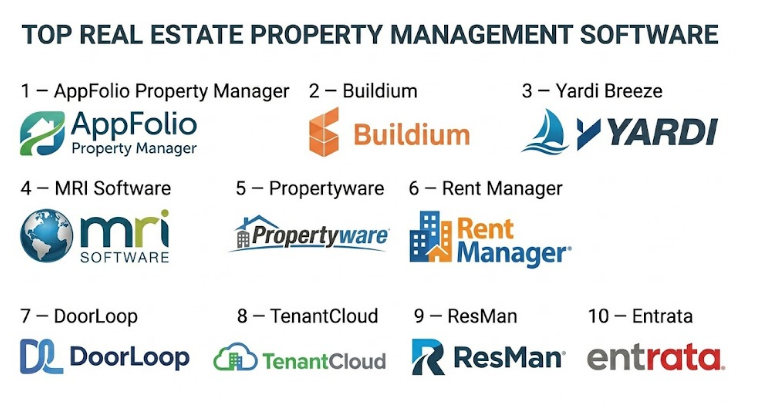
Top 10 Real Estate Property Management Software
#1 — AppFolio Property Manager
Short description :
AppFolio Property Manager is a widely used property management platform for residential, commercial, community association, student housing, and mixed portfolios. It helps property teams manage leasing, accounting, rent collection, maintenance, inspections, communication, reporting, and owner workflows. AppFolio is useful for growing property management companies that need a cloud-based system with strong operational and financial tools. It supports tenant portals, online payments, work orders, and portfolio reporting. It is best for professional property managers managing multiple properties and units.
Key Features
- Online rent collection.
- Lease and tenant management.
- Property accounting and reporting.
- Maintenance requests and work orders.
- Tenant and owner portals.
- Vacancy and listing workflows.
- Mobile access for property teams.
Pros
- Strong all-in-one property management platform.
- Useful for growing and professional property managers.
- Good balance of operations, accounting, and communication.
Cons
- May be more than small landlords need.
- Setup and training require time.
- Pricing may not fit very small portfolios.
Platforms / Deployment
Web / iOS / Android
Cloud
Security & Compliance
Supports user permissions, account controls, payment workflows, tenant data management, and administrative settings depending on plan. Specific compliance details should be validated directly with the vendor.
Integrations & Ecosystem
AppFolio connects property operations with accounting, leasing, and maintenance workflows.
- Online payments.
- Tenant screening workflows.
- Owner reporting.
- Maintenance management.
- Leasing and vacancy workflows.
- Property accounting.
Support & Community
AppFolio provides onboarding, documentation, customer support, and property management resources. It is suitable for teams that need a scalable property management platform.
#2 — Buildium
Short description :
Buildium is property management software designed for residential property managers, landlords, associations, and rental portfolio teams. It helps manage rent collection, tenant communication, lease tracking, maintenance requests, accounting, owner reports, and rental applications. Buildium is especially useful for small and mid-sized property management businesses that need a practical cloud-based platform. It supports tenant and owner portals, payment collection, and maintenance workflows. It is best for property managers that want strong core features without unnecessary enterprise complexity.
Key Features
- Rent collection and payment tracking.
- Tenant and owner portals.
- Lease management.
- Maintenance request tracking.
- Property accounting.
- Rental applications and screening workflows.
- Financial reporting.
Pros
- Good fit for small and mid-sized property managers.
- Strong core accounting and tenant management features.
- Easy enough for teams moving away from spreadsheets.
Cons
- Very large enterprise portfolios may need deeper customization.
- Advanced commercial workflows may be limited.
- Reporting and setup should be tested for portfolio needs.
Platforms / Deployment
Web / iOS / Android
Cloud
Security & Compliance
Supports user roles, account permissions, payment workflows, tenant records, and property data controls depending on plan. Specific compliance details should be validated directly with the vendor.
Integrations & Ecosystem
Buildium connects core property workflows with daily operations.
- Online rent payments.
- Tenant screening.
- Maintenance requests.
- Owner statements.
- Accounting workflows.
- Leasing workflows.
Support & Community
Buildium provides documentation, onboarding resources, support, and property management education. It is practical for growing rental management teams.
#3 — Yardi Breeze
Short description :
Yardi Breeze is a cloud-based property management platform designed for residential and commercial property teams that want easier property operations, accounting, leasing, maintenance, and reporting. It is part of the broader Yardi ecosystem and is useful for teams managing multifamily, commercial, self-storage, associations, and other property types depending on configuration. Yardi Breeze helps teams centralize leases, rent payments, tenant records, work orders, and financial reporting. It is best for property managers who want a simpler Yardi option with scalable property management features.
Key Features
- Lease and tenant management.
- Online payments.
- Property accounting.
- Maintenance work orders.
- Tenant and owner communication.
- Reporting dashboards.
- Support for different property types may vary.
Pros
- Strong property management ecosystem.
- Useful for residential and commercial teams.
- Good fit for teams wanting cloud-based property operations.
Cons
- Some advanced features may depend on product tier.
- Setup requires accurate property and accounting data.
- Smaller landlords may prefer simpler tools.
Platforms / Deployment
Web
Cloud
Security & Compliance
Supports user permissions, accounting controls, tenant records, payment workflows, and administrative features depending on configuration. Specific compliance details should be validated directly with the vendor.
Integrations & Ecosystem
Yardi Breeze connects property management with financial and operational workflows.
- Rent collection.
- Accounting and reporting.
- Maintenance management.
- Tenant communication.
- Leasing workflows.
- Owner reporting.
Support & Community
Yardi provides documentation, support resources, onboarding, and property management guidance. It is suitable for property teams that want a recognized real estate software ecosystem.
#4 — MRI Software
Short description :
MRI Software is a real estate and property management platform used by residential, commercial, retail, corporate real estate, investment, and enterprise property teams. It helps organizations manage leases, accounting, operations, reporting, property performance, and portfolio workflows. MRI is especially relevant for larger real estate organizations that need flexible and configurable property technology. It supports complex property operations and can connect with broader real estate investment and financial workflows. It is best for enterprise real estate teams managing complex portfolios.
Key Features
- Lease administration.
- Property accounting.
- Portfolio management.
- Commercial property workflows.
- Residential property workflows may vary.
- Reporting and analytics.
- Configurable enterprise workflows.
Pros
- Strong for larger and complex real estate portfolios.
- Useful for commercial and enterprise property management.
- Flexible ecosystem for different real estate needs.
Cons
- May be too complex for small landlords.
- Implementation can require planning.
- Best value depends on portfolio complexity.
Platforms / Deployment
Web / Deployment options may vary
Cloud / Enterprise options vary
Security & Compliance
Supports enterprise permissions, user roles, financial controls, lease data controls, audit records, and administrative governance depending on configuration.
Integrations & Ecosystem
MRI connects property management with enterprise real estate workflows.
- Accounting systems.
- Lease management.
- Portfolio reporting.
- Investment workflows.
- Facilities and operations tools.
- Business intelligence systems.
Support & Community
MRI provides enterprise support, implementation resources, documentation, and real estate industry guidance. It is best for organizations with complex real estate operations.
#5 — Propertyware
Short description :
Propertyware is property management software designed mainly for single-family property managers and rental portfolio operators. It helps manage leases, tenants, rent collection, maintenance, inspections, accounting, owner reporting, and portals. Propertyware is useful for property managers who manage scattered-site rental homes and need clear owner, tenant, and maintenance workflows. It focuses on single-family rental management rather than broad commercial operations. It is best for teams managing single-family residential rental portfolios.
Key Features
- Lease and tenant management.
- Online rent payments.
- Maintenance requests.
- Property accounting.
- Owner and tenant portals.
- Inspection workflows.
- Reporting and portfolio visibility.
Pros
- Strong fit for single-family rental management.
- Useful owner and tenant communication workflows.
- Good for scattered-site residential portfolios.
Cons
- Not ideal for large commercial real estate operations.
- Setup requires clean property and owner records.
- Advanced customization should be validated.
Platforms / Deployment
Web / Mobile options may vary
Cloud
Security & Compliance
Supports user access controls, owner and tenant portals, payment workflows, and property data management depending on plan. Specific security details should be validated directly with the vendor.
Integrations & Ecosystem
Propertyware connects residential property workflows with owner and tenant operations.
- Rent collection.
- Owner reporting.
- Maintenance management.
- Tenant communication.
- Inspections.
- Accounting workflows.
Support & Community
Propertyware provides support resources, onboarding guidance, and property management documentation. It is suitable for single-family property managers.
#6 — Rent Manager
Short description :
Rent Manager is property management software that supports residential, commercial, manufactured housing, self-storage, and other property types depending on setup. It helps teams manage accounting, leasing, payments, maintenance, reporting, tenant communication, and owner workflows. Rent Manager is useful for property management companies that need flexibility across different property portfolios. It offers strong accounting and operational tools for teams that need more than a basic landlord app. It is best for property managers who need flexible property accounting and portfolio operations.
Key Features
- Property accounting.
- Lease and tenant management.
- Online payments.
- Work order management.
- Tenant and owner communication.
- Reporting and dashboards.
- Support for multiple property types.
Pros
- Flexible for different property management models.
- Strong accounting and reporting focus.
- Useful for growing property management companies.
Cons
- May require training for full feature use.
- Smaller landlords may find it more advanced than needed.
- Setup quality depends on accounting and portfolio structure.
Platforms / Deployment
Web / Windows / iOS / Android options may vary
Cloud / Desktop options may vary
Security & Compliance
Supports user permissions, financial controls, tenant records, payment workflows, and administrative settings depending on configuration. Specific compliance details should be validated directly with the vendor.
Integrations & Ecosystem
Rent Manager connects property operations with financial and tenant workflows.
- Online rent collection.
- Maintenance work orders.
- Accounting reports.
- Tenant portals.
- Owner reporting.
- Property communications.
Support & Community
Rent Manager provides documentation, training, customer support, and property management resources. It is practical for teams needing flexible portfolio management.
#7 — DoorLoop
Short description :
DoorLoop is a property management platform built for landlords and property managers managing residential, commercial, student housing, community associations, and mixed portfolios. It helps users manage rent collection, leases, tenants, accounting, maintenance, owner reports, and communications. DoorLoop is useful for small to mid-sized property teams that want a modern cloud-based interface and broad core features. It supports online payments, tenant portals, document storage, and reporting. It is best for teams that want an approachable property management platform with strong everyday workflows.
Key Features
- Rent collection.
- Lease and tenant tracking.
- Property accounting.
- Maintenance requests.
- Owner and tenant portals.
- Document storage.
- Reporting dashboards.
Pros
- Easy to use for small and mid-sized teams.
- Good all-round property management feature set.
- Useful for mixed portfolio management.
Cons
- Enterprise-level customization should be validated.
- Some advanced workflows may depend on plan.
- Large complex portfolios may need deeper controls.
Platforms / Deployment
Web / iOS / Android
Cloud
Security & Compliance
Supports user permissions, account controls, payment workflows, tenant records, and administrative features depending on plan. Specific compliance details should be validated directly with the vendor.
Integrations & Ecosystem
DoorLoop connects property workflows with daily management needs.
- Online payments.
- Maintenance requests.
- Owner reporting.
- Tenant portals.
- Accounting workflows.
- Lease document management.
Support & Community
DoorLoop provides onboarding, customer support, documentation, and property management guidance. It is practical for teams that want a modern property management system.
#8 — TenantCloud
Short description :
TenantCloud is property management software for landlords, small property managers, and rental owners. It helps users manage listings, tenant applications, rent payments, leases, maintenance requests, accounting, and communication. TenantCloud is useful for small landlords who want to move from manual tracking to a cloud-based system. It supports tenant portals, online payments, lease documents, and maintenance management. It is best for small landlords and growing rental owners who need affordable digital property management.
Key Features
- Rental listing workflows.
- Tenant applications.
- Online rent payments.
- Lease tracking.
- Maintenance requests.
- Tenant communication.
- Basic accounting and reports.
Pros
- Good for small landlords and rental owners.
- Useful for online rent and tenant communication.
- Easier than managing everything manually.
Cons
- May not fit complex enterprise portfolios.
- Advanced commercial workflows may be limited.
- Feature depth should be tested for growing portfolios.
Platforms / Deployment
Web / iOS / Android
Cloud
Security & Compliance
Supports account controls, tenant data handling, payment workflows, and document management depending on plan. Specific security details should be validated directly with the vendor.
Integrations & Ecosystem
TenantCloud connects landlord workflows with tenant management.
- Online rent payments.
- Maintenance requests.
- Lease documents.
- Tenant applications.
- Listings.
- Basic accounting workflows.
Support & Community
TenantCloud provides documentation, support resources, and landlord-focused guidance. It is practical for small rental portfolios.
#9 — ResMan
Short description :
ResMan is property management software focused on multifamily, affordable housing, and residential property operations. It helps teams manage leasing, accounting, maintenance, resident communication, compliance-related workflows, reporting, and portfolio performance. ResMan is useful for multifamily owners and operators that need stronger residential property management capabilities. It supports leasing workflows, resident services, maintenance tracking, and financial visibility. It is best for multifamily property management companies that need structured residential portfolio operations.
Key Features
- Multifamily property management.
- Leasing workflows.
- Resident communication.
- Maintenance management.
- Property accounting.
- Reporting and analytics.
- Affordable housing workflows may vary by configuration.
Pros
- Strong fit for multifamily residential management.
- Useful for leasing, resident, and maintenance workflows.
- Good portfolio visibility for residential operators.
Cons
- Not ideal for small individual landlords.
- Setup requires accurate property and unit data.
- Commercial property workflows should be validated.
Platforms / Deployment
Web / Mobile options may vary
Cloud
Security & Compliance
Supports user permissions, resident data controls, accounting workflows, reporting access, and administrative settings depending on configuration. Specific compliance details should be validated directly with the vendor.
Integrations & Ecosystem
ResMan connects multifamily operations with property workflows.
- Leasing.
- Resident communication.
- Maintenance requests.
- Accounting.
- Reporting dashboards.
- Portfolio operations.
Support & Community
ResMan provides documentation, onboarding, customer support, and multifamily property management resources.
#10 — Entrata
Short description :
Entrata is a property management platform for multifamily, student housing, and residential property operators. It supports leasing, resident management, payments, accounting, maintenance, marketing, communication, and reporting workflows. Entrata is useful for larger property management companies and multifamily operators that need an integrated system for resident lifecycle management. It helps teams manage prospects, residents, service requests, renewals, and financial operations. It is best for multifamily organizations that want connected leasing, operations, payments, and resident experience workflows.
Key Features
- Leasing and resident management.
- Online payments.
- Maintenance requests.
- Property accounting.
- Marketing and prospect workflows.
- Resident communication.
- Reporting and analytics.
Pros
- Strong for multifamily and residential operators.
- Good resident lifecycle management.
- Useful for larger property management teams.
Cons
- May be too advanced for small landlords.
- Implementation requires planning and data setup.
- Best value depends on portfolio size and operational needs.
Platforms / Deployment
Web / Mobile options may vary
Cloud
Security & Compliance
Supports user permissions, resident records, payment workflows, accounting controls, and administrative settings depending on configuration. Specific compliance details should be validated directly with the vendor.
Integrations & Ecosystem
Entrata connects property operations with resident lifecycle workflows.
- Leasing.
- Payments.
- Maintenance.
- Resident communication.
- Marketing workflows.
- Reporting dashboards.
Support & Community
Entrata provides customer support, onboarding resources, documentation, and multifamily property management guidance.
Comparison Table
| Tool Name | Best For | Platform(s) Supported | Deployment | Standout Feature | Public Rating |
|---|---|---|---|---|---|
| AppFolio Property Manager | Professional property management companies | Web / iOS / Android | Cloud | All-in-one leasing, accounting, and maintenance workflows | N/A |
| Buildium | Small and mid-sized property managers | Web / iOS / Android | Cloud | Strong core rental management and accounting | N/A |
| Yardi Breeze | Residential and commercial property teams | Web | Cloud | Cloud property management in Yardi ecosystem | N/A |
| MRI Software | Enterprise real estate portfolios | Web / Varies | Cloud / Enterprise varies | Flexible enterprise real estate management | N/A |
| Propertyware | Single-family rental portfolios | Web / Mobile varies | Cloud | Single-family property management workflows | N/A |
| Rent Manager | Flexible property accounting and operations | Web / Windows / Mobile varies | Cloud / Desktop varies | Multi-property-type management flexibility | N/A |
| DoorLoop | Modern small and mid-sized property teams | Web / iOS / Android | Cloud | Approachable all-round property management | N/A |
| TenantCloud | Small landlords and rental owners | Web / iOS / Android | Cloud | Affordable landlord and tenant workflows | N/A |
| ResMan | Multifamily residential operators | Web / Mobile varies | Cloud | Multifamily leasing, maintenance, and reporting | N/A |
| Entrata | Large multifamily and student housing teams | Web / Mobile varies | Cloud | Connected resident lifecycle management | N/A |
Evaluation & Real Estate Property Management Software
| Tool Name | Core (25%) | Ease (15%) | Integrations (15%) | Security (10%) | Performance (10%) | Support (10%) | Value (15%) | Weighted Total (0–10) |
|---|---|---|---|---|---|---|---|---|
| AppFolio Property Manager | 10 | 8 | 9 | 9 | 9 | 9 | 7 | 8.80 |
| Buildium | 9 | 9 | 8 | 8 | 8 | 8 | 8 | 8.40 |
| Yardi Breeze | 9 | 8 | 9 | 9 | 8 | 9 | 8 | 8.55 |
| MRI Software | 10 | 6 | 9 | 9 | 9 | 9 | 7 | 8.45 |
| Propertyware | 8 | 8 | 8 | 8 | 8 | 8 | 8 | 8.00 |
| Rent Manager | 9 | 7 | 8 | 8 | 8 | 8 | 8 | 8.10 |
| DoorLoop | 8 | 9 | 8 | 8 | 8 | 8 | 8 | 8.15 |
| TenantCloud | 7 | 9 | 7 | 8 | 8 | 7 | 9 | 7.90 |
| ResMan | 9 | 8 | 8 | 9 | 8 | 8 | 7 | 8.15 |
| Entrata | 9 | 7 | 9 | 9 | 8 | 8 | 7 | 8.20 |
These scores are comparative and should be used as a practical guide, not a fixed ranking. AppFolio, Yardi Breeze, Buildium, and DoorLoop are strong all-round property management platforms. MRI Software is better for enterprise real estate portfolios. Propertyware is strong for single-family rentals. ResMan and Entrata are stronger for multifamily operators. TenantCloud is practical for small landlords, while Rent Manager is useful for teams needing flexible accounting and property-type support.
Which Real Estate Property Management Software
Solo / Freelancer
Solo landlords and independent property owners usually need simple tools for rent collection, lease tracking, tenant communication, and maintenance requests. TenantCloud, DoorLoop, Buildium, or lightweight landlord tools can be practical depending on the number of units.
A solo landlord should avoid overbuying enterprise software. The main focus should be online rent collection, organized documents, clear tenant communication, and basic accounting visibility.
SMB
Small and mid-sized property managers should focus on online payments, lease records, accounting, maintenance requests, tenant portals, owner reporting, and vacancy tracking. Buildium, DoorLoop, TenantCloud, Propertyware, and Yardi Breeze are strong options.
If the team manages single-family rentals, Propertyware may fit well. If the team needs general residential management, Buildium or DoorLoop may be easier to adopt. If the team wants a recognized property ecosystem, Yardi Breeze is worth reviewing.
Mid-Market
Mid-market property management companies usually need stronger accounting, owner reporting, tenant portals, maintenance workflows, application processing, portfolio dashboards, and staff permissions. AppFolio, Yardi Breeze, Rent Manager, Buildium, and ResMan are strong candidates.
At this stage, teams should define accounting rules, owner reporting needs, maintenance workflows, lease renewal processes, and tenant communication standards before implementation.
Enterprise
Enterprise property companies should prioritize portfolio reporting, lease administration, accounting controls, role-based access, compliance workflows, integrations, document governance, and multi-property scalability. MRI Software, AppFolio, Yardi Breeze, Entrata, ResMan, and Rent Manager may be relevant depending on portfolio type.
Large organizations should involve finance, operations, leasing, maintenance, legal, IT, asset management, and regional property teams before choosing a platform.
Budget vs Premium
Budget-conscious landlords may prefer TenantCloud, DoorLoop, or simpler property management platforms depending on unit count and required features.
Premium platforms such as AppFolio, MRI Software, Entrata, ResMan, and enterprise-grade Yardi options are better when organizations need advanced accounting, portfolio reporting, commercial workflows, resident lifecycle management, and stronger operational controls.
Feature Depth vs Ease of Use
If ease of use matters most, DoorLoop, Buildium, TenantCloud, and Yardi Breeze are practical choices for smaller and growing teams.
If feature depth matters more, MRI Software, AppFolio, Entrata, ResMan, and Rent Manager provide stronger support for portfolio complexity, accounting, lease administration, resident operations, and enterprise reporting.
Integrations & Scalability
Real estate property management software should integrate with accounting systems, payment processors, tenant screening tools, listing platforms, maintenance systems, communication tools, document storage, CRM, reporting tools, and business intelligence platforms.
For small residential portfolios, Buildium, DoorLoop, and TenantCloud may be enough. For single-family rental operations, Propertyware is relevant. For multifamily, Entrata and ResMan are strong. For enterprise real estate, MRI Software and Yardi ecosystem tools are better suited.
Security & Compliance Needs
Property management software may store tenant names, contact details, lease documents, payment records, bank details, maintenance history, inspection photos, owner reports, vendor records, and financial statements.
Buyers should validate user permissions, payment security, tenant data controls, owner portal access, document storage, audit logs, encryption, role-based access, data retention, and administrative controls before rollout.
Frequently Asked Questions
1. What is Real Estate Property Management Software?
Real Estate Property Management Software helps landlords and property managers manage tenants, leases, rent payments, maintenance, accounting, documents, owner reports, vacancies, and communication from one system.
2. How is property management software different from accounting software?
Accounting software focuses mainly on financial records. Property management software includes real estate-specific workflows such as leases, tenants, rent collection, maintenance requests, owner statements, vacancies, inspections, and property-level reporting.
3. What pricing models are common for property management software?
Pricing may be based on number of units, properties, users, modules, payment features, screening services, support level, or enterprise contracts. Small landlord tools may use simple monthly pricing, while enterprise platforms may use custom pricing.
4. What are common mistakes when choosing property management software?
Common mistakes include choosing software without testing accounting workflows, ignoring tenant portal usability, not checking maintenance features, failing to clean lease data, and underestimating implementation time. Another mistake is buying enterprise software for a small portfolio that only needs simple rent tracking.
5. Which tool is best for small landlords?
TenantCloud, DoorLoop, Buildium, and similar landlord-friendly platforms can be practical for small landlords. The best choice depends on unit count, rent collection needs, lease tracking, maintenance volume, and budget.
6. Which tool is best for professional property managers?
AppFolio, Buildium, Yardi Breeze, Rent Manager, and DoorLoop are strong options for professional property managers. The right choice depends on portfolio size, accounting complexity, owner reporting needs, and property type.
7. Which tool is best for single-family rentals?
Propertyware is a strong option for single-family rental portfolios. Buildium, DoorLoop, AppFolio, and Rent Manager may also be useful depending on portfolio size and operational needs.
8. Which tool is best for multifamily properties?
Entrata, ResMan, AppFolio, Yardi Breeze, and MRI Software are strong options for multifamily property management. Buyers should evaluate leasing workflows, resident portals, maintenance, accounting, reporting, and portfolio analytics.
9. Can property management software collect rent online?
Yes, most modern property management platforms support online rent collection. Payment options vary by tool and region, so buyers should validate payment methods, fees, processing time, recurring payments, and tenant experience.
10. Can property management software track maintenance requests?
Yes, most platforms allow tenants to submit maintenance requests, attach photos, receive updates, and let managers assign tasks to vendors or internal teams. Maintenance workflow depth varies by platform.
Conclusion
Real Estate Property Management Software helps landlords and property managers organize rental operations, improve rent collection, reduce manual work, and create a better tenant and owner experience. The best platform depends on portfolio size, property type, accounting needs, and operational complexity. TenantCloud is practical for smaller landlords, while DoorLoop and Buildium are strong for small and mid-sized property managers. AppFolio and Yardi Breeze are excellent all-round options for growing property management companies.
